The Four Stages of AI Agent Evolution: A Complete Guide from Copilot to Multi-Agent Collaboration

AI is evolving from a tool to an autonomous operator — multi-Agent collaboration is the core direction.
AI has progressed through four stages: Chat Mode, Copilot Assistance, Single Agent Autonomy, and Multi-Agent Collaboration, with human involvement steadily decreasing. In 2025, Agentic AI became mainstream, with multiple specialized Agents dividing labor, making autonomous decisions, and self-correcting. The article argues that multi-Agent collaborative architecture and ReAct-based autonomous decision-making are foundational AI paradigms that won't become obsolete with specific tools — making them the most worthwhile technology investment.
Introduction: AI Is Evolving Fast — What Should We Bet On?
The pace of AI iteration is dizzying. Prompt engineering, personal knowledge bases (RAG), local model deployment, and fine-tuning — hot topics just a year or two ago — are now rarely discussed, with some already replaced by new paradigms. Prompt Engineering refers to the technique of carefully designing input prompts to guide large language models toward desired outputs. In early 2023, it was hailed as "the programming language of the AI era," spawning countless courses and job titles. RAG (Retrieval-Augmented Generation) is a technical architecture that combines external knowledge bases with large models, retrieving relevant documents before generating answers to reduce model hallucinations. However, as model context windows expanded from 4K to millions of tokens and reasoning capabilities improved dramatically, simple prompting tricks became less critical, and some RAG use cases were directly covered by long-context models. This rapid iteration is a textbook example of how "paradigm shifts" in AI happen far faster than in traditional software engineering.
Facing this rapid change, a core question emerges: What AI technologies should we learn to ensure we don't become obsolete?
The answer lies in AI's evolutionary trajectory. From chatbots to Copilot assistance to today's multi-agent autonomous collaboration, AI is undergoing a fundamental transformation from "tool" to "operator." Understanding this evolution is the key to grasping the future direction of technology.
The Four Stages of AI Evolution: From Chatbots to Autonomous Decision-Making
Stage 1: Chat Mode (2023)
In 2023, OpenAI's ChatGPT burst onto the scene, ushering in the era of large language models. At this stage, AI was essentially a "supercharged search engine" — users typed questions into a chat box, and the model understood their intent and returned information. But to actually get work done, users still had to open Excel or PowerPoint themselves and manually organize the AI-provided content.
At this point, AI's share of productivity was minimal — humans were still doing the real work.
Stage 2: Copilot Mode (2024)
AI's capabilities evolved from "providing information" to "initial involvement in production." The most iconic use case was AI-assisted programming — GitHub Copilot could participate in the code-writing process, allowing developers to generate code through conversation.
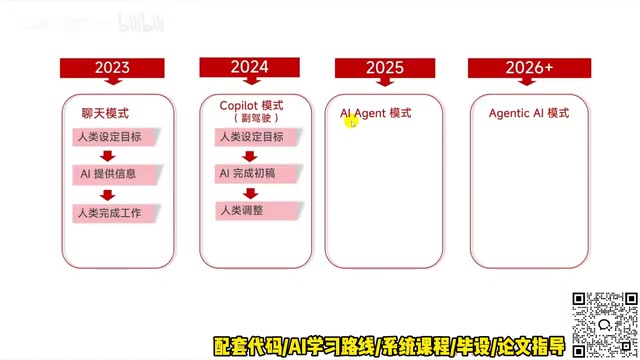
GitHub Copilot is based on OpenAI's Codex model (a code-specialized version of the GPT series) and predicts and generates subsequent code by analyzing the current code context, comments, and function signatures. Its working mechanism is essentially a "supercharged autocomplete" — providing real-time code suggestions within the IDE. However, its limitations are clear: it lacks a holistic understanding of the entire project architecture, cannot autonomously create file structures, cannot run code to verify correctness, and cannot understand the full context of business requirements. This means developers still need to handle system design, code review, integration testing, and other high-level tasks. Copilot is more like a junior programmer who types incredibly fast but lacks the big picture.
AI handled roughly one-third of the workload, with the remaining two-thirds still completed by humans. This is the "copilot mode" — AI serves as an assistant, while humans remain the primary operators.
Stage 3: Agent Mode (Early 2025)
Two landmark events in early 2025 completely upended the previous two modes:
First was the emergence of Manus. This AI Agent could autonomously complete complex tasks assigned by users from start to finish, with no human intervention required. For example, when asked to present a company's Q3 business information, Manus would automatically scrape web data, filter Q3 information, write it into a local Excel file for data analysis, and ultimately present it in chart form — the entire process completed autonomously.
Manus was considered a landmark event because it differs fundamentally from traditional RPA (Robotic Process Automation). RPA relies on pre-written fixed scripts and can only handle structured, predictable processes. Manus, powered by large language model reasoning capabilities, can understand natural language instructions, dynamically plan execution paths, and autonomously adjust strategies when encountering unexpected situations. It integrates browser control, file system operations, code execution, and other capabilities, forming the prototype of a "general-purpose digital worker." This marks a qualitative leap in automation — from "executing by rules" to "completing by objectives."
Second was the evolution of AI coding tools like Cursor. Unlike traditional IDEs, users simply describe the desired functionality or project in a chat box, and the AI handles all code writing, file generation, and project architecture setup.
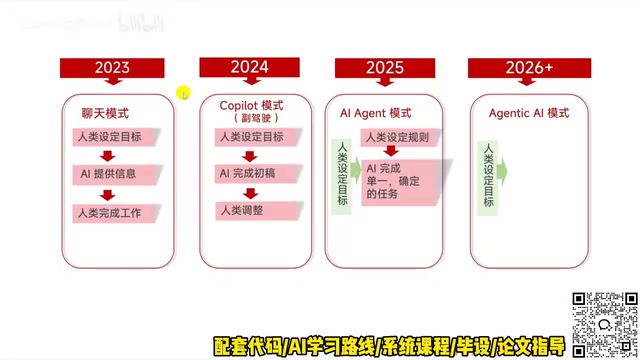
In Agent mode, AI handles two-thirds of the production process, with humans responsible for only one-third — primarily setting goals, providing resources, and defining rules. As a "proxy," the Agent can invoke tools and leverage large models for logical reasoning. This essentially established the core trend of AI development: Agents replacing humans as the primary operators in the production process.
Stage 4: Agentic AI Mode (2025 to Present)
By mid-2025, Agent mode further evolved into multi-Agent division of labor and collaboration. When facing complex tasks, Agentic AI systems can:
- Task Decomposition: Break complex tasks into multiple subtasks
- Specialized Division of Labor: Assign each subtask to an Agent with the corresponding expertise
- Reflection and Adjustment: Agents possess reflective capabilities during execution — they execute a step, check whether the expected goal is met, adjust their strategy if the result is inaccurate, and repeat until the outcome matches the preset objective
This is the current cutting-edge Agentic AI mode — multiple Agents working collaboratively, each possessing domain expertise, capable of autonomous decision-making thought processes, and able to independently solve complex tasks.
Core Architecture Design for Multi-Agent Collaboration
Two Mainstream Design Philosophies
There are currently two main architectural design philosophies for building multi-Agent collaborative systems:
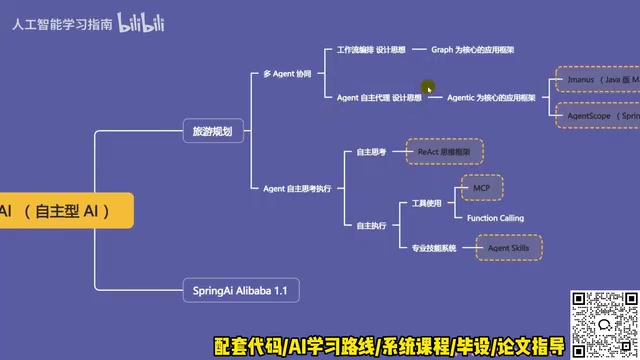
First: Graph Engine-Driven Workflow Orchestration. This approach uses a graph structure as its core, pre-defining the invocation relationships and flow logic between Agents. It's well-suited for business scenarios with relatively fixed processes. Specifically, this architecture borrows the concept of Directed Acyclic Graphs (DAGs), modeling the execution flow of multi-Agent systems as graph structures — each node represents an Agent or processing step, and edges represent data flow and control logic. A typical implementation is LangGraph, which allows developers to define state machine-style Agent interaction patterns, including conditional branching, parallel execution, and loop structures. The advantage of this approach is strong predictability, ease of debugging and monitoring, making it suitable for enterprise applications with high reliability requirements, such as customer service ticket processing and approval workflow automation. The trade-off is limited flexibility — fixed graph structures may not adapt to unforeseen task types.
Second: Autonomous Agent Proxy Design. This is the more advanced approach — Agents don't rely on pre-defined fixed processes but instead make autonomous decisions about their next actions based on task requirements. This approach is more flexible and closer to true "intelligence."
Key Technical Frameworks and Toolchains
Within the Spring AI ecosystem, implementing multi-Agent collaboration primarily involves the following technical components:
- Spring AI Alibaba: Provides foundational AI capability integration, serving as the base of the entire tech stack
- ReAct Framework: Gives Agents the ability to reason and act autonomously, forming a "think-act-observe" loop
- MCP (Model Context Protocol): A standardized tool invocation protocol that enables Agents to call various external tools and APIs. MCP was proposed by Anthropic in late 2024 to address the fragmentation problem of AI Agent integration with external tools. Before MCP, every AI application needed custom integration code for each external service, resulting in massive duplication and compatibility issues. MCP defines a standardized communication protocol, similar to how USB interfaces unify hardware devices — any tool that follows the MCP protocol can be directly invoked by any MCP-supporting Agent, including database queries, API calls, file operations, web browsing, and more. The adoption of MCP is creating an open tool ecosystem that dramatically reduces the integration cost of building Agent systems.
- Agent Scope: A professional skills system that enables Agents not only to use tools but also to complete work following a comprehensive professional workflow
The ReAct Thinking Framework: The Core Engine of Agent Autonomous Thought
The soul of a multi-Agent system lies in each Agent's ability to think autonomously. The ReAct (Reasoning + Acting) thinking framework is currently the most mainstream implementation, with core logic consisting of four steps:
- Reasoning: The Agent analyzes the current task state and thinks about what to do next
- Acting: Invokes tools or executes specific operations
- Observation: Checks whether the execution results meet expectations
- Iterative Loop: If results are unsatisfactory, returns to the reasoning stage to adjust strategy
The ReAct framework was originally proposed by Princeton University and the Google Brain team in their 2022 paper ReAct: Synergizing Reasoning and Acting in Language Models. The research found that having language models alternate between reasoning (generating chains of thought) and acting (interacting with external environments) significantly improved task completion quality. In engineering implementations, ReAct is typically realized through specific prompt templates: the model is asked to first output "Thought" (the thinking process), then "Action" (the tool call to execute), after which the system feeds the tool's return result back to the model as "Observation," forming a closed loop. Related variants include Plan-and-Execute, LATS (Language Agent Tree Search), and other frameworks, each with advantages in different scenarios.
This "think-execute-reflect-adjust" loop mechanism gives Agents problem-solving capabilities similar to humans, enabling them to handle uncertainty and complex scenarios. Unlike simple instruction execution, the ReAct framework gives Agents a genuine "chain of thought," where every decision is traceable and well-founded.
Market Trends and Future Outlook
Market data shows that the AI Agent market is growing year over year from 2024 to 2029, with 75% of enterprises currently deploying or implementing AI Agents, integrating them into core production processes.
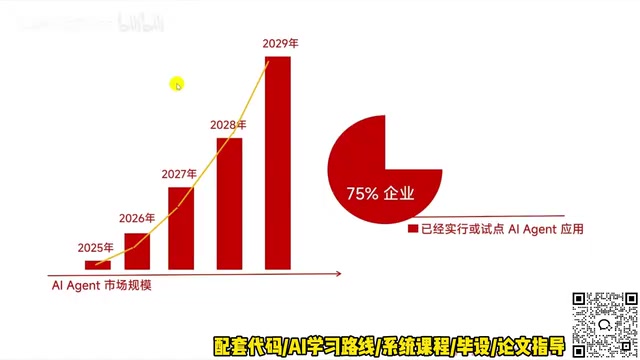
Despite the optimistic data, enterprises still face numerous challenges in actually deploying AI Agents. First is the "hallucination" problem — Agents may take actions based on faulty reasoning during autonomous decision-making, potentially causing serious consequences in high-risk domains like finance and healthcare. Second is the observability problem — the decision chains in multi-Agent systems are complex, making it difficult to trace root causes when errors occur. Additionally, there's the cost issue: each Agent reasoning loop requires calling large model APIs, and complex tasks may generate dozens or even hundreds of model calls, consuming enormous amounts of tokens. The industry is currently balancing autonomy and safety through human-in-the-loop approval nodes, guardrails, and tiered authorization mechanisms.
A noteworthy trend is that with AI Agents, a single person can have an entire company's worth of "digital employees." This isn't a distant vision — it's happening right now.
From a technological evolution perspective, two core directions will remain unchanged in the coming years:
- Multi-Agent collaborative architecture: Complex tasks inevitably require multiple specialized Agents working together — a single Agent cannot handle the complexity of real-world business scenarios
- Autonomous decision-making thinking frameworks for Agents themselves: An Agent's reasoning, planning, and reflection capabilities are the foundation of the entire system and the key differentiator between "true intelligence" and "fake intelligence"
Conclusion: Bet on AI Core Capabilities That Won't Become Obsolete
We are at a critical juncture where AI is transforming from an "assistive tool" to an "autonomous operator." Rather than chasing every fleeting tech trend, it's better to deeply understand and master the technologies at the core of AI's evolutionary trajectory — multi-Agent collaborative architecture and Agent autonomous decision-making capabilities.
These two capabilities won't become obsolete with the turnover of specific frameworks, because they represent the underlying paradigm of AI applications, not the usage methods of any particular tool. Whether you're a developer, product manager, or technical decision-maker, understanding and mastering this trend will be the most valuable technology investment of the next few years.
Key Takeaways
- AI development has progressed through four stages: Chat Mode → Copilot Assistance → Single Agent Autonomy → Multi-Agent Collaboration, with human involvement in production gradually decreasing
- In 2025, the Agentic AI mode became mainstream — multiple specialized Agents can divide labor, make autonomous decisions, reflect and adjust, and independently complete complex tasks
- Two core design philosophies for multi-Agent collaboration: Graph engine-driven workflow orchestration and autonomous Agent proxy mode
- The ReAct thinking framework (reasoning-acting-observation loop) is the core implementation of Agent autonomous thinking capabilities
- Multi-Agent collaborative architecture and Agent autonomous decision-making frameworks are underlying paradigms in AI development that won't change — they are worth mastering deeply
Related articles
 Deep Dives
Deep Dive into How OpenClaw (Open-Source Crayfish) AI Agent Works
Deep analysis of OpenClaw AI Agent internals: System Prompt, tool calling, SubAgents, Skill system, memory, and Context Engineering explained.
 Deep Dives
Demystifying Transformer: A Word-Continuation Function, Deconstructed
Understand Transformer through the lens of word continuation. Breaking down language generation into Embedding, Transformer Block, and Probability output modules for intuitive understanding.
 Deep Dives
Five Core Differences Between Claude Code and Regular AI Chat
A detailed comparison of Claude Code vs regular AI chat across five dimensions: interaction, context understanding, execution, memory, and tool integration.