Core Analysis of Agent Skill: Progressive Disclosure & Middleware Practical Guide
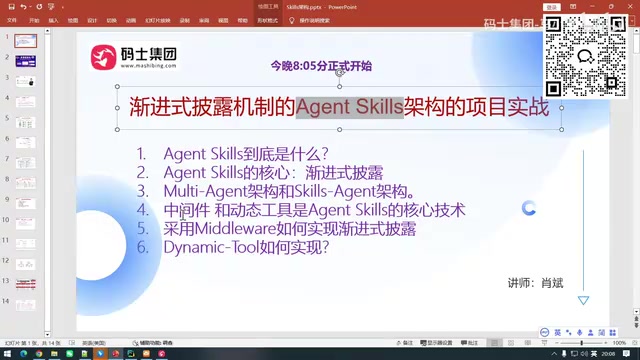
Agent Skill uses progressive disclosure, middleware, and dynamic tools to manage AI Agent capabilities efficiently.
This article explores Agent Skill as an architectural pattern for AI Agent development, centered on Progressive Disclosure—gradually revealing relevant tools based on conversation context rather than exposing all at once. It details how middleware intercepts requests to filter skills dynamically, explains dynamic tool registries, compares Agent Skill with Multi-Agent architectures, and provides practical implementation advice including state machine design and degradation strategies.
What is Agent Skill?
Agent Skill is an important concept in AI Agent development that defines the capability boundaries and behavioral patterns of an intelligent agent in specific scenarios. Unlike simple tool calling, Agent Skill emphasizes structured, composable capability units that allow agents to dynamically invoke and combine different skill modules based on task requirements.
The concept of Agent Skill is rooted in the software engineering principle of "Separation of Concerns." In traditional AI Agent development, developers typically pass all available tools to a Large Language Model (LLM) at once via Function Calling. This approach works when the number of tools is small, but as Agent capabilities expand, the bloated tool list occupies a significant portion of the Context Window with tool descriptions, and the difficulty for the model to make correct choices among numerous options increases dramatically. Agent Skill is an architectural pattern proposed to solve this "tool explosion" problem — it organizes tools into logically cohesive skill units based on business scenarios and usage phases, with each Skill internally encapsulating a set of related tools, trigger conditions, and execution logic.
In the current AI Agent development paradigm, Agent Skill has evolved from early hard-coded tool lists to an adaptive skill framework. Understanding this concept is the foundation for building high-quality intelligent agents.
The Core of Agent Skill: Progressive Disclosure
What is Progressive Disclosure?
The core design philosophy of Agent Skill is Progressive Disclosure. This concept is borrowed from the field of user interface design, and its central idea is: don't expose all capabilities to the model at once, but gradually reveal relevant skills and tools based on the current conversation context and task phase.
Progressive Disclosure was first proposed by IBM researchers John M. Carroll and Mary Beth Rosson in 1984 to address usability issues in complex software interfaces. The core insight is that users only need to interact with a subset of features relevant to their current task at any given moment — too many options actually cause Cognitive Overload. This principle is widely applied in modern UI design; for example, Photoshop's tool panel displays different editing options based on the currently selected layer type. Transferring this concept to the AI Agent domain essentially treats the large language model as a "user" — it faces the same cognitive load problem. When dozens of tool descriptions are stuffed into the System Prompt, the model's Attention Mechanism needs to distribute weights across a larger information space, directly affecting tool selection accuracy.
Why is Progressive Disclosure needed? Here are the key reasons:
- Reduced Token consumption: Avoids passing large amounts of irrelevant tool descriptions with each call. Taking GPT-4 as an example, each tool description typically consumes 200-500 Tokens. If an Agent is equipped with 50 tools, tool descriptions alone could consume 10,000-25,000 Tokens, accounting for 8%-20% of the 128K context window. This not only increases API call costs (billed per Token) but also compresses the space available for actual conversation content and reasoning.
- Lower model decision complexity: Fewer available tools mean higher probability of the model selecting the correct tool. Research shows (such as UC Berkeley's Gorilla project and the ToolBench benchmark) that when available tools exceed 15-20, mainstream LLMs show a noticeable decline in tool selection accuracy, even exhibiting "Tool Hallucination" — where the model fabricates non-existent tools or incorrectly calls irrelevant ones.
- Improved response quality: Keeps the model focused on the most relevant capabilities for the current phase
- Dynamic scenario adaptation: Different conversation phases require different skill combinations
Implementation Logic of Progressive Disclosure
Implementing Progressive Disclosure relies on precise judgment of conversation state. The system needs to dynamically determine which skills to expose to the model based on dimensions such as user intent, current task progress, and existing contextual information. It's like an experienced assistant who automatically switches work modes at different stages — focusing on understanding and decomposition when receiving requirements, then switching to specific operational tools during the execution phase.
Differences Between Agent Skill and Multi-Agent Architecture
Agent Skill and Multi-Agent architecture are two different design approaches that are easily confused but have fundamentally distinct differences:
| Dimension | Agent Skill | Multi-Agent |
|---|---|---|
| Core Unit | Skill module | Independent agent |
| Collaboration Method | Skill switching within a single entity | Message passing between multiple entities |
| Complexity | Relatively low | Higher |
| Applicable Scenarios | Capability enhancement of a single agent | Complex multi-role collaboration |
| State Management | Shared context | Each maintains its own state |
Representative frameworks for Multi-Agent architecture include Microsoft's AutoGen, CrewAI, and LangGraph. In Multi-Agent systems, each Agent has its own independent System Prompt, tool set, and memory space, and Agents collaborate through message-passing protocols (such as publish-subscribe patterns or direct communication). For example, in a data analysis scenario, there might be four independent roles: "Data Collection Agent," "Cleaning Agent," "Analysis Agent," and "Report Generation Agent," each maintaining their own state and executing sequentially according to a predefined workflow. The advantage of this architecture lies in clear role responsibilities and ease of parallel processing, but the cost is the latency introduced by inter-Agent communication, the complexity of state synchronization, and higher total Token consumption (each Agent requires its own independent context).
Agent Skill is better suited for implementing modular and dynamic capability composition within a single agent, avoiding the overhead of cross-Agent communication. Multi-Agent architecture is appropriate for scenarios requiring multiple independent roles to collaboratively complete complex tasks. The two are not mutually exclusive — in real projects, they can often be combined: using Skills to manage capabilities within a single Agent, and using Multi-Agent frameworks to coordinate division of labor between multiple Agents.
Core Technologies: Middleware and Dynamic Tools
Middleware Mechanism
One of the key technologies for implementing Progressive Disclosure is Middleware. In agent development, middleware plays the role of request interception and processing, sitting between user input and model inference, responsible for dynamically adjusting the skill list passed to the model.
The concept of middleware originates from the web development domain, with the most classic implementations being the middleware patterns in Node.js frameworks like Express.js and Koa.js, as well as similar mechanisms in Python web frameworks like Django and FastAPI. In these frameworks, middleware is a chain of processing functions between Request and Response, where each middleware can inspect, modify, enhance, or intercept requests. Introducing this pattern into AI Agent architecture, the middleware layer sits between user input (or messages from upstream Agents) and the LLM inference call, forming a pluggable processing Pipeline. This design follows the "Onion Model" — requests pass through middleware layers from outer to inner to reach the core LLM call, and responses return from inner to outer layers, with each layer capable of transforming data. This allows cross-cutting concerns such as skill filtering, permission verification, logging, and rate limiting to be implemented and composed independently.
The middleware workflow is roughly as follows:
- Intercept request: Capture user input and current conversation context
- State analysis: Determine the current phase of the conversation and user intent
- Skill filtering: Based on analysis results, filter a subset of skills needed for the current phase from the complete skill pool
- Context injection: Inject the filtered skill descriptions and relevant context into the model's prompt
- Result processing: Post-process model output and update state for the next round
This layered processing architecture design decouples skill management logic from business logic, facilitating subsequent maintenance and extension.
Dynamic Tools
Dynamic Tools are another core implementation mechanism for Progressive Disclosure. Unlike static tool lists, dynamic tools can be generated, modified, or hidden at runtime based on conditions.
At the technical implementation level, dynamic tools rely on a runtime Tool Registry and a condition evaluation engine. The Tool Registry maintains metadata for all available tools — including tool name, description, parameter Schema (typically in JSON Schema format), preconditions, and priority. When middleware triggers skill filtering, the condition evaluation engine traverses the registry, evaluates each tool's precondition expressions based on the current conversation state (such as user identity, conversation turn count, identified intent labels, results of previous tool calls, etc.), and ultimately outputs a filtered tool subset. In OpenAI's Function Calling and Anthropic's Tool Use API, tool definitions are passed via the tools parameter with each API request, which naturally supports dynamic tool implementation — developers simply need to dynamically construct the tool list before each request.
Common application scenarios include:
- Hiding tools that require permissions when the user hasn't completed authentication
- Automatically loading visualization-related tools when detecting that the user is performing data analysis
- Dynamically adjusting tool parameter descriptions and usage examples based on conversation history
- Changing corresponding parameters from
requiredtooptionaland filling in default values after the user has already provided certain information, thereby guiding the model to complete calls more efficiently
Dynamic tools, when used in conjunction with middleware, enable more granular skill management strategies.
Practical Recommendations for Agent Skill
For developers looking to apply Agent Skill in their projects, the following recommendations are worth considering:
- Start small: Define 3-5 core skills first, validate the effectiveness of Progressive Disclosure, then gradually expand the skill pool
- Design a clear state machine: Clearly define different phases of the conversation and their corresponding skill sets to avoid chaotic state transitions. A Finite State Machine (FSM) is the core data structure for managing Agent Skill switching. In practice, developers typically use finite state machines or their extended form — Hierarchical State Machines (HSM) — to model conversation flows. Each state represents a phase of the conversation (such as "requirement gathering," "solution confirmation," "task execution," "result feedback"), transitions between states are driven by Triggers, and each state is associated with a set of available Skills. For example, the LangGraph framework uses a Graph structure to define Agent state transition logic, where developers can precisely control tool availability at different phases by defining Nodes and Edges. The key challenge in state machine design is handling exception paths — users may suddenly switch topics or make unexpected requests at any phase, so "Global Transitions" need to be designed as fallback mechanisms to ensure the Agent doesn't enter a deadlock state.
- Monitor and optimize: Log each skill selection, analyze the model's tool calling accuracy, and continuously optimize filtering strategies
- Consider degradation strategies: When middleware makes incorrect judgments, ensure fallback general skills are available to prevent conversation interruption
- Combine with prompt engineering: The quality of skill descriptions directly affects model calling effectiveness — invest effort in polishing the description text for each tool
Summary
Agent Skill, through the design philosophy of Progressive Disclosure combined with the two core technologies of middleware and dynamic tools, provides an efficient solution for AI Agent capability management. Compared to the crude approach of stuffing all tools into the model at once, this refined skill management approach can significantly improve agent response quality and operational efficiency.
In actual development, mastering Agent Skill design patterns and properly applying Progressive Disclosure, middleware interception, and dynamic tool loading will help developers build more intelligent and efficient AI Agent systems.
Related articles
Learn to Code with AI from Scratch: A Complete Learning Path from Beginner to Deployment
A complete learning path for coding with AI from scratch — from concepts and environment setup to using Cursor, Claude, and other AI tools to build and deploy your first project.
Codex Hands-On from Scratch: Building a Full-Stack World Cup App Without Writing Code
Learn how to build a full-stack World Cup app with OpenAI Codex without writing code, covering multi-session concurrency, MCP voice synthesis, Skill encapsulation, and scheduled task automation.
AI Generates 7 Cocos Dissolve Shaders at Once — Zero Errors, Ready to Use
Generate 7 Cocos grayscale dissolve Shader versions at once with AI templates — zero compilation errors, ready to use. Covers dissolve principles and AI-assisted Shader workflows.