Coze Beginner's Guide: A Complete Tutorial for Building AI Agents with Zero Code

Coze is ByteDance's no-code AI platform that lets anyone build intelligent agents.
Coze is a no-code AI development platform by ByteDance that enables users to build AI agents and applications through drag-and-drop operations without any programming knowledge. It supports multiple mainstream Chinese LLMs including Doubao, Kimi, and Qwen, and offers core features like workflow orchestration, a plugin system, RAG-based knowledge bases, and long-term memory, covering scenarios from simple conversations to complex business logic across daily life assistants, document analysis, and enterprise customer service.
What is Coze?
Coze is an AI application development platform launched by ByteDance, with the core goal of lowering the barrier for ordinary people to develop AI applications. Traditional AI application development typically requires mastering multiple technology stacks including Python programming, machine learning frameworks (such as TensorFlow, PyTorch), API integration, and cloud service deployment — an extremely high barrier to entry. Coze completely breaks down this wall — users can develop their own AI applications or agents through intuitive drag-and-drop operations, without writing a single line of code.
For those who want to leverage AI to boost work efficiency but lack a programming background, Coze offers a very friendly entry path. It's not just a tool — it represents the trend of democratizing AI application development. This trend is similar to the development trajectory of automation platforms like Zapier and Make (formerly Integromat), but Coze focuses more specifically on building and orchestrating AI agents, serving as a concentrated embodiment of the new wave of no-code development in the AI domain.
Core Features of Coze
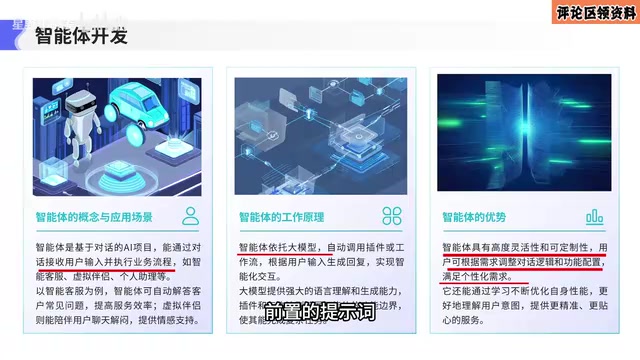
Agent Development: Build Your Own AI Assistant
AI Agents are one of the hottest concepts in the AI field today. Unlike traditional single-turn Q&A AI, agents possess a closed-loop capability of "perceive — plan — act": they can receive user input, invoke external tools (such as search engines, databases, APIs), and dynamically adjust their next steps based on intermediate results. This architecture was theoretically grounded by OpenAI's ReAct paper (2022) and subsequently implemented widely by frameworks like LangChain and AutoGPT. Coze's agents are essentially a productized encapsulation of this technology, similar to everyday products like Doubao and ChatGPT, but you can build an agent that is entirely your own, with support for connecting to multiple mainstream Chinese LLMs:
- Doubao Model (ByteDance)
- Kimi (Moonshot AI)
- Qwen Model (Alibaba)
- ERNIE Bot (Baidu)
After connecting a model, users can pre-configure prompts to have the agent respond according to specific logic and style. It's worth noting that Prompt Engineering has evolved into an independent technical discipline, encompassing techniques such as Role Prompting, Few-shot Learning, Chain-of-Thought, and more. High-quality prompt design is often the key factor determining an agent's actual performance — sometimes even more important than the choice of model itself. This means you can create highly customized AI assistants tailored to specific business scenarios.
AI Application Development: Beyond Conversations
Coze's capabilities go far beyond building chatbots. It also supports developing complete AI applications, such as:
- Survey and form-filling mini-programs
- Real-time news browsing web pages
- Data analysis tools
The entire development process is completely based on visual operations, making it very friendly for users without a technical background.
Deep Dive into Coze's Distinctive Features
Workflow Orchestration: Processing Complex Logic Like an Assembly Line
Workflows are one of Coze's most differentiating core features. Its interface resembles a factory assembly line, where each card node handles a specific task.
Coze's workflow orchestration philosophy is derived from enterprise-level RPA (Robotic Process Automation) and iPaaS (Integration Platform as a Service) technologies. Traditional RPA tools (such as UiPath, Automation Anywhere) primarily simulate manual interface operations, while iPaaS platforms (such as MuleSoft, Boomi) focus on data flow between systems. Coze's workflows deeply integrate both of these with AI large models — each node can not only execute deterministic logical operations but also invoke LLMs for understanding and generating unstructured content. This hybrid orchestration model of "deterministic logic + AI reasoning" is what fundamentally distinguishes new-generation AI workflow platforms from traditional automation tools.
Here's a typical Coze workflow example:
- Start Node → Receives user input
- Search Plugin → Retrieves relevant information from the internet
- LLM Processing → Understands and processes search results
- Canvas Generation → Generates images based on processed results
- Return to User → Presents the final result to the user
This visual logic orchestration approach makes complex business processes clear at a glance. Even without any programming experience, you can build powerful automated workflows by dragging nodes and connecting lines.
Plugin System: Extending Infinite Possibilities for Your Agent
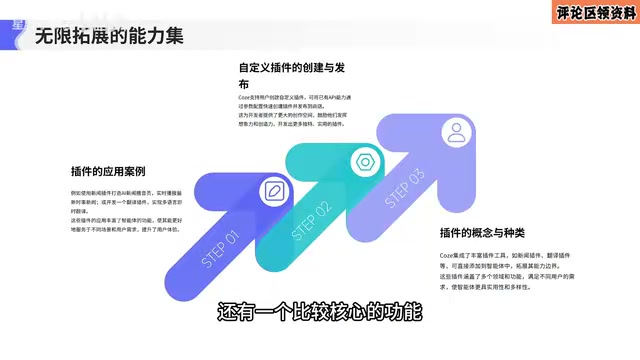
When you need to process images, execute complex business logic, or optimize workflows, the plugin feature comes into play. A highlight of Coze's plugin ecosystem: developers can publish their plugins to the app marketplace for other users' agents to call upon.
For example, you can develop a news aggregation plugin, an information query plugin, and more — usable by your own agent and shareable with other developers in the community. This open ecosystem design greatly expands the platform's functional boundaries.
Knowledge Base Configuration: Giving AI Domain-Specific Expertise
The knowledge base feature is Coze's key capability for vertical domain applications, built on RAG (Retrieval-Augmented Generation) technology. RAG was proposed by Meta AI in 2020, with the core idea being: external documents are split into text chunks, converted into high-dimensional vectors through embedding models, and stored in a vector database. When a user asks a question, the system first retrieves the most semantically relevant text chunks, then injects them as context into the LLM's prompt, guiding the model to answer based on real source material. This mechanism effectively addresses the LLM "hallucination" problem, making the agent's responses verifiable and traceable.

Education Scenario: Teachers upload teaching materials to the knowledge base, and students can directly ask the agent questions to receive precise answers based on course content.
Enterprise Scenario: Import FAQs and product documentation into the knowledge base to build enterprise-level customer service bots. When customers inquire, the agent retrieves relevant information from the knowledge base and provides professional answers, significantly reducing the pressure on human customer service teams.
Persistent Memory: An Agent That Understands You Better Over Time
Coze agents support long-term memory functionality. To understand this feature, you first need to know an underlying limitation: large language models are inherently stateless — each conversation is independent, and the model doesn't automatically remember previous interactions. This stems from the model's limited context window, which cannot infinitely stack conversation history.
Coze's long-term memory feature solves this problem through an external storage mechanism: the system summarizes and compresses historical conversations, stores them in a database, and dynamically retrieves relevant memories to inject into the context at the start of each new conversation. This is quite similar to how human memory works — we don't remember every conversation verbatim but rather distill key information into long-term memory. Once enabled, the agent remembers historical conversation content with users, summarizing and correlating information in subsequent interactions to provide more precise, personalized responses. This feature is particularly important for complex scenarios requiring multi-turn interactions.
Practical Application Scenarios for Coze
Daily Life: Building Smart Life Assistants
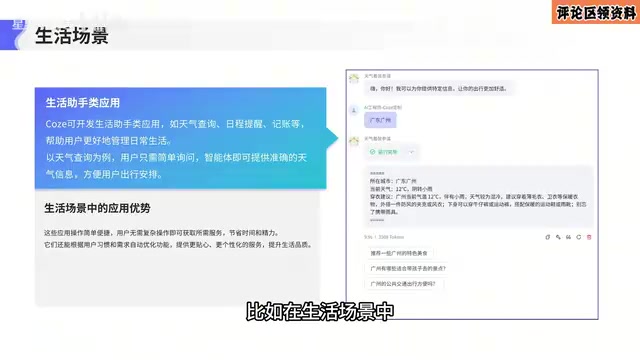
In everyday life, Coze can help us develop various practical tools. Take a weather query agent as an example — users simply input their city, and the agent automatically returns current weather information along with outfit suggestions — such as "you can wear jeans or sweatpants on the bottom, paired with warm sneakers." If you're planning a trip, it will proactively offer extended questions and suggestions.
Work Scenarios: Multiplying Efficiency with AI Agents
In the workplace, Coze's value becomes even more prominent. When your boss sends you a lengthy document, you can use an agent to quickly complete document analysis and content summarization. For example, upload a PDF file, and the agent will automatically extract key information and generate a structured summary, helping you grasp the core content of the document in seconds.
This capability is especially useful in the following scenarios:
- Meeting minutes organization: Quickly distill meeting highlights
- Competitive analysis: Batch process and compare competitor materials
- Report writing: Automatically generate analytical reports based on data
Summary: Getting Started with Coze
As a no-code AI development platform, Coze truly enables ordinary people to build professional-grade AI applications. Its workflow, plugin, knowledge base, and long-term memory features form a complete capability loop, covering everything from simple conversations to complex business logic. Behind the scenes, it integrates cutting-edge technologies including AI Agents, Prompt Engineering, RAG retrieval augmentation, and vector databases — all elegantly encapsulated beneath an intuitive visual interface.
For beginners, here's a recommended learning path:
- Start by building a simple conversational agent to familiarize yourself with prompt configuration
- Try using workflows to understand node-based logic orchestration
- Introduce knowledge bases and plugins to gradually build more complex applications
In an era where AI tools are becoming increasingly prevalent, mastering no-code development platforms like Coze is undoubtedly an important skill for enhancing personal competitiveness.
Related articles
 Tutorials
Cursor + Codex Dual-IDE Collaboration: A Practical Methodology for Open-Source Project Customization
A complete methodology for open-source project customization based on real-world experience, detailing the Cursor+Codex dual-IDE workflow, seven-stage process, MVP validation, and AI source code reading techniques.
 Tutorials
Cursor Multi-Agent in Practice: Building a Full-Stack Next.js Blog in 50 Minutes
Build a full-stack blog in 50 minutes using Cursor IDE's multi-Agent mode with Next.js, Clerk auth, and Supabase. Learn the 4-phase AI Agent workflow and key integration pitfalls.
 Tutorials
Building an AI Software Factory from Scratch: A Cursor Engineer's Hands-On Experience with Multi-Agent Collaboration
Cursor engineer Eric shares practical insights on building an AI software factory: automation levels, guardrail design, parallel Agent management, and scaling to 1000+ Agents for 24/7 development.