Coze Programming Skill Invocation Tutorial: Generate Interactive Learning Webpages in Three Steps
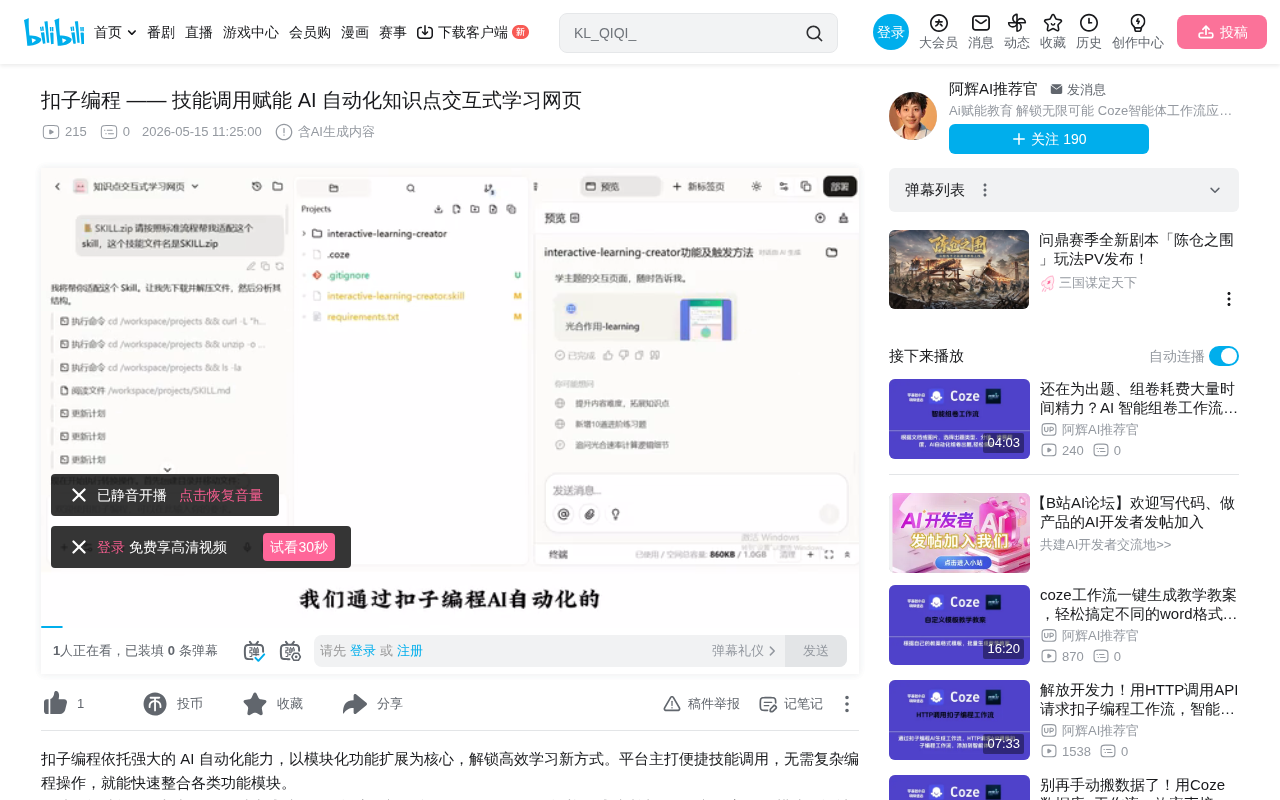
Coze programming auto-generates interactive learning webpages in minutes through AI skill invocation.
ByteDance's Coze programming platform enables users to create reusable AI skill modules through natural language or skill package uploads, then invoke them via the Engine to automatically generate complete learning webpages with knowledge explanations, visual demonstrations, and interactive exercises in just minutes. Using the Pythagorean theorem and Newton's First Law as examples, the article demonstrates the richness and interactivity of AI-generated content, dramatically reducing the barrier and time cost of traditional courseware production.
Introduction
AI educational applications are becoming increasingly widespread, but one practical problem continues to plague educators: high-quality interactive learning content has too high a production barrier and takes too long to create. According to HolonIQ data, the global Education Technology (EdTech) market is expected to exceed $400 billion in 2025. However, the core bottleneck that has long constrained the adoption of digital teaching resources isn't hardware infrastructure—it's the excessive cost of producing quality interactive content. A subject courseware package with dynamic demonstrations and interactive exercises traditionally requires teaching designers, front-end developers, and graphic designers to collaborate for days.
Coze, ByteDance's programming platform, offers a new approach—by creating and invoking Skill packages, AI can automatically generate interactive learning webpages for knowledge points, compressing what used to take hours of courseware production into just minutes.
This article provides a complete breakdown of the Coze programming skill invocation workflow, with two real cases—the Pythagorean theorem and Newton's First Law—demonstrating the final results.



What Exactly Is the "Skill" Feature in Coze Programming
Basic Concept of Skills
In the Coze programming platform, a Skill is a reusable functional module. Simply put, it's a "smart template"—you define output rules in advance, and then by passing in different knowledge point topics, it automatically generates structured, interactive learning pages.
From a technical perspective, this concept originates from modular design thinking in software engineering and the AI Agent architecture that has emerged in recent years. In Agent frameworks, an intelligent agent typically consists of three core components: perception, reasoning, and action. "Skills" correspond to standardized capability units at the action layer. Similar to functions or APIs in programming, skills encapsulate complex generation logic into a black box—external systems only need to pass in parameters to receive standardized output. Similar implementations exist in mainstream AI development frameworks like LangChain and AutoGPT, typically called Tools or Plugins. Coze programming further lowers the barrier to entry for this concept, allowing non-technical users to define and invoke skills through natural language.
Once a skill is created, it gets registered in Coze's Engine. Subsequent invocations only require specifying the knowledge point to batch-produce content. The Engine in Coze programming is essentially a task orchestration and execution layer, responsible for matching user invocation requests with registered skills and coordinating large language models to complete content generation. This architecture aligns with the commonly seen Orchestration Layer design in the industry—similar patterns can be found in Microsoft's Semantic Kernel and OpenAI's Function Calling mechanism. After the Engine receives knowledge point parameters, it injects them into the skill's preset Prompt template, then hands them to the underlying large language model (such as ByteDance's Doubao model) for inference generation. The generated results are formatted and output as HTML pages that can run directly in a browser. This is the key capability that distinguishes Coze programming from ordinary AI chat tools.
Comparison of Two Skill Creation Methods
Coze programming supports two skill creation approaches:
- Natural language description: Directly tell the AI in plain text what kind of skill you need, and the platform automatically understands and generates the corresponding functionality. Teachers without programming backgrounds can get started fastest with this method. This approach falls under the category of Natural Language Programming—a concept that isn't new. Researchers attempted to control computers with natural language as early as the 1970s, but practical results were extremely limited due to the NLP technology level at the time. The real breakthrough occurred after 2022, when large language models represented by GPT-4, Claude, and others demonstrated powerful code generation capabilities, making it possible for users to describe requirements in everyday language and have AI automatically convert them into executable programs. Coze programming leverages this capability to transform natural language input into structured skill configurations.
- Upload skill packages: Upload pre-prepared skill configuration files to the platform, suitable for scenarios requiring precise control over output format. Developers with specific technical requirements are better suited to this approach.
Practical Cases: AI Automatically Generates Interactive Learning Pages
Case One: Pythagorean Theorem Interactive Learning Webpage
By invoking a previously created skill, AI automatically generated a complete interactive learning webpage for the "Pythagorean theorem" knowledge point. The page includes the following core modules:
- Geometric proof: Demonstrates the classic proof process of the Pythagorean theorem in a graphical format
- Converse theorem explanation: Introduces the converse of the Pythagorean theorem and its application in determining right triangles
- Common Pythagorean triples: Lists commonly used Pythagorean triple combinations such as 3-4-5, 5-12-13
- Practical application examples: Connects the abstract theorem with real-life scenarios like measuring building heights and calculating distances
- Interactive exercises: The bottom of the page features problems with instant feedback—learners see whether their answers are correct along with explanations immediately after responding
The entire page is not a static pile of text. Learners can drag shapes and adjust parameters on the page to intuitively experience how the side-length relationships in the Pythagorean theorem change—truly achieving "learning by doing." From a technical implementation perspective, these interactive features are based on the HTML5, CSS3, and JavaScript front-end technology stack. Specifically, interactions like dragging shapes and adjusting parameters rely on JavaScript's DOM manipulation and event listening mechanisms, while dynamic visual demonstrations use the Canvas API or SVG rendering. The reason large language models can generate this type of code is that their training data includes massive amounts of front-end development examples, giving them the ability to directly convert teaching requirements into runnable front-end code.
Case Two: Newton's First Law Interactive Learning Webpage
The second case focuses on physics. The learning page AI generated for "Newton's First Law" is equally rich in layers:
- Law statement: Precisely articulates the core content and applicable conditions of Newton's First Law
- Historical background: Traces the discovery history from Aristotle to Galileo to Newton
- Inertia concept analysis: Provides in-depth explanation of the physical meaning of inertia and its relationship with mass
- Relationship between force and motion: Analyzes how force changes an object's state of motion
- Real-life examples: Uses everyday phenomena like the body lurching forward during sudden braking or pulling a tablecloth to aid understanding
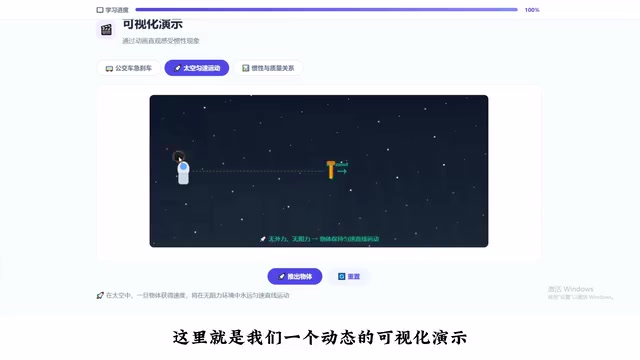
- Dynamic visual demonstration: The page embeds animation modules that visually show how objects move under different force conditions. Some complex physics simulation animations also use lightweight front-end animation libraries, presenting mechanical effects through frame-by-frame rendering or physics engine simulation
- Interactive exercises: Equipped with consolidation practice problems that support repeated attempts
It's worth noting that since each generation involves AI creating anew, pages produced from two invocations of the same knowledge point will differ in layout and expression, but the core knowledge structure and interactive functionality remain consistent. This phenomenon is directly related to the sampling mechanism of large language models—when generating text, the model samples from candidate words based on probability distributions, with the Temperature parameter controlling the degree of randomness: higher temperature means more diverse output; lower temperature means more deterministic output. Coze programming's skills constrain the output's structural framework through Prompt templates (such as requiring knowledge explanation, visual demonstration, and interactive exercise modules), ensuring consistency in core knowledge structure. Meanwhile, the model's random sampling in specific wording, layout details, and code implementation brings natural differentiation. This characteristic of "determined structure, flexible expression" happens to align with the need for diverse materials in educational scenarios, actually providing more varied material choices for teaching.
Complete Technical Workflow Breakdown of Skill Invocation
Three Steps from Creation to Output
The entire workflow of Coze programming skill invocation can be summarized in three steps:
- Create a skill: On the Coze programming platform, define an "interactive learning page generation" skill through natural language description or uploading a skill package. The core of this step is writing or configuring a Prompt template that clearly specifies the module structure, interaction types, and content depth requirements the output page must include
- Engine invocation: Invoke the skill in the Coze Engine, passing in the specific knowledge point topic as a parameter. The Engine, as the orchestration layer, is responsible for injecting parameters into the Prompt template and sending the complete instructions to the underlying large language model for inference
- Content output: AI automatically generates a complete HTML learning webpage containing knowledge explanation, visual demonstrations, and interactive exercises. The generated HTML file can be opened and run directly in a browser without additional server deployment
The entire process requires no coding—teachers and educators can complete the operation independently.
Core Differences Between Coze Skill Invocation and Traditional Courseware Production
Comparing Coze programming's skill invocation approach with traditional courseware production methods, the advantages are very intuitive:
| Comparison Dimension | Traditional Method | Coze Skill Invocation |
|---|---|---|
| Production time | Hours to days | Minutes |
| Technical barrier | Requires HTML/CSS/JS knowledge | Operable with natural language |
| Interactive features | Requires additional development | AI-generated automatically |
| Reusability | Each courseware made individually | Create once, invoke repeatedly |
| Content richness | Depends on creator's investment | Automatically includes multiple teaching elements |
For teachers without programming backgrounds, Coze programming reduces the technical barrier to nearly zero. However, it should be objectively noted that the quality of AI-generated front-end code still has a certain gap compared to code handwritten by senior engineers. In scenarios involving complex physics simulations or high-precision data visualization, manual fine-tuning and optimization may be needed.
Applicable Scenarios and Future Development Directions
Coze programming skill invocation has considerable application potential in the education sector, which also aligns closely with the global trend of K12 education digital transformation. China's Ministry of Education explicitly proposed promoting deep integration of information technology with education and teaching in its "Education Informatization 2.0 Action Plan," and the scaled production of quality interactive content is precisely the key to achieving this goal. Specific application scenarios include:
- K12 subject teaching: Rapidly generate interactive learning materials for mathematics, physics, chemistry, biology, and other subjects, covering the complete teaching chain from concept explanation to experiment simulation
- Corporate internal training: Automatically generate standardized learning modules for scenarios like new employee onboarding and skills assessment
- Self-directed learning assistance: Learners input knowledge points they want to study and receive personalized interactive learning pages
- Teaching resource library construction: Batch-generate interactive pages covering entire knowledge systems to quickly build complete learning resource libraries
As large language model capabilities continue to improve, AI-generated interactive pages will further optimize in visual effects, interaction depth, and personalized adaptation. Particularly with the rapid development of multimodal models (AI models that can simultaneously process multiple information forms such as text, images, and audio), future generated learning pages are expected to incorporate richer media elements and more precise learning analytics adaptation capabilities. Coze programming's skill mechanism provides a practical and feasible implementation path for AI-empowered education.
Summary
Coze programming deeply combines AI automation capabilities with educational content production through the three-step workflow of "create skill—Engine invocation—automatic generation." Whether it's the geometric proof of the Pythagorean theorem or the dynamic demonstration of Newton's First Law, AI can output structurally complete, interaction-rich learning webpages within minutes.
If you're an education professional looking to improve teaching efficiency and reduce content production costs, Coze programming's skill invocation feature is worth serious consideration. If you're a developer, this skill creation and invocation mechanism also provides an efficient technical solution for building educational AI applications.
Key Takeaways
- Coze programming supports creating reusable AI skills through natural language or uploading skill packages, with repeated invocation in the Engine to generate content
- AI can automatically generate complete learning webpages containing knowledge explanation, visual demonstrations, and interactive exercises, covering multi-subject knowledge points like the Pythagorean theorem and Newton's First Law
- Generated pages feature dynamic visualization and interactive exercise functionality, supporting learners' immediate interaction and consolidation practice
- The entire process requires no programming background—educators can complete the full pipeline from skill creation to content output using natural language
- Each generated page has variations, but the core knowledge structure remains consistent, providing diverse materials for teaching
Related articles
 Tutorials
Cursor + Codex Dual-IDE Collaboration: A Practical Methodology for Open-Source Project Customization
A complete methodology for open-source project customization based on real-world experience, detailing the Cursor+Codex dual-IDE workflow, seven-stage process, MVP validation, and AI source code reading techniques.
 Tutorials
Cursor Multi-Agent in Practice: Building a Full-Stack Next.js Blog in 50 Minutes
Build a full-stack blog in 50 minutes using Cursor IDE's multi-Agent mode with Next.js, Clerk auth, and Supabase. Learn the 4-phase AI Agent workflow and key integration pitfalls.
 Tutorials
Building an AI Software Factory from Scratch: A Cursor Engineer's Hands-On Experience with Multi-Agent Collaboration
Cursor engineer Eric shares practical insights on building an AI software factory: automation levels, guardrail design, parallel Agent management, and scaling to 1000+ Agents for 24/7 development.