Coze Tutorial: A Complete Guide to Building Multi-Agent Systems from Scratch
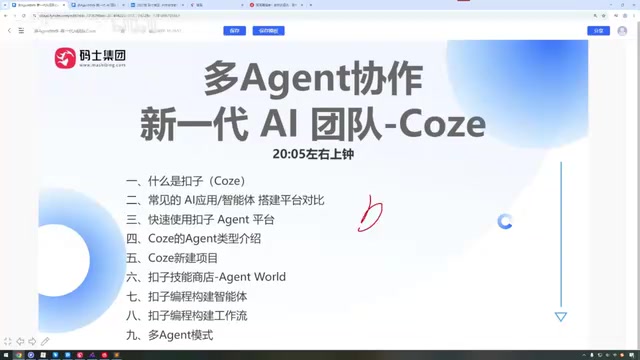
A comprehensive no-code guide to building multi-Agent systems on ByteDance's Coze platform.
This guide walks you through ByteDance's Coze platform for building AI agents without any coding. It covers the platform's core features, compares Coze with Dify, and provides a complete learning path from basic agent creation to advanced multi-Agent collaboration, including skill store usage and workflow construction.
Why Coze Deserves Your Attention
In today's flourishing landscape of AI Agent tools, ByteDance's Coze has become one of the most talked-about agent-building platforms in China. Its biggest selling point is this: whether or not you have programming skills, you can quickly build a fully functional AI agent.
An AI Agent refers to an artificial intelligence system capable of perceiving its environment, making autonomous decisions, and executing actions. Unlike traditional chatbots, agents have "tool-calling" capabilities — they can not only generate text responses but also proactively invoke external APIs, search engines, databases, and other tools to complete tasks. This concept exploded in 2023 with projects like AutoGPT, and the industry now widely considers Agents to be the key form factor for large model applications. The core architecture of an agent typically consists of three parts: a perception module (receiving user input), a planning module (breaking down tasks and formulating execution strategies), and an action module (calling tools and returning results).
This article is based on the comprehensive tutorial content from Bilibili creator "码士集团" (Code Group), systematically covering Coze's core features, a comparative analysis with Dify, and a complete hands-on path from beginner basics to multi-Agent collaboration.
What Is Coze? A One-Minute Platform Overview
Coze is an AI agent-building platform launched by ByteDance, positioned as an agent development tool for everyone. Its core philosophy is "foolproof operation" — you don't need to write a single line of code, as the platform handles all the underlying technical details for you.
As a key strategic product in ByteDance's AI era, Coze has a clear ecosystem behind it. ByteDance developed its own Doubao large model (formerly known as Skylark), and built a complete AI product matrix around it: the Doubao App for consumer users, Volcano Engine's large model services for developers, and the Coze platform for agent building. Coze offers both a domestic version (coze.cn) and an international version (coze.com) — the international version supports integration with models like OpenAI GPT-4, while the domestic version primarily runs on the Doubao model. This "platform + model + ecosystem" strategy closely mirrors Microsoft's approach (Azure + OpenAI + Copilot), aiming to establish an ecosystem moat at the AI application layer.
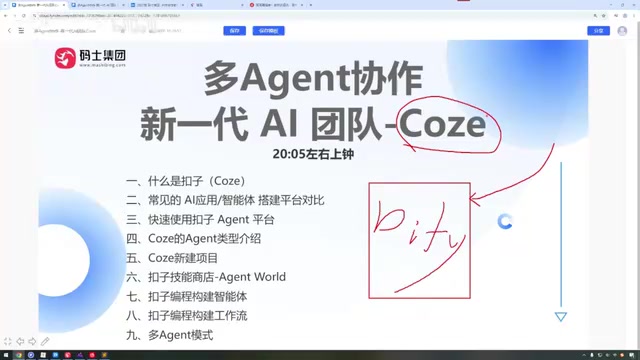
Specifically, Coze provides the following core capabilities:
- No-code agent building: Configure an agent's persona, skills, and workflows through a visual interface
- Multi-Agent collaboration: Support coordinated work between multiple agents to handle complex tasks
- Rich skill store: A large library of pre-built skills and plugins, ready to use out of the box
- Project management: Create various projects and use AI to assist with specific work tasks
The "no-code" development mentioned here is a major trend in the software industry in recent years. Its core idea is to replace traditional programming with graphical interfaces, enabling non-technical users to build applications. In the AI domain, this trend manifests as "visual orchestration" — users define agent behavior logic by dragging nodes and connecting flow lines, while all underlying technical details like model calls, API integration, and data processing are encapsulated by the platform. This approach dramatically lowers the barrier to AI application development, allowing product managers, operations staff, and even users with no technical background to participate in building AI applications.
In short, if you want to create an AI assistant that can call tools and has specific capabilities, Coze is probably one of the lowest-barrier options available in China today.
Coze vs Dify: How to Choose Between the Two Major Agent Platforms
When it comes to agent platforms, many people compare Coze with Dify. These two are indeed frequently discussed together, but their positioning differs significantly.
Target Users and Technical Barrier Comparison
| Dimension | Coze | Dify |
|---|---|---|
| Primary Users | General users + developers | Developers + enterprise teams |
| Technical Barrier | Extremely low, no code required | Relatively low, but requires some technical understanding |
| Deployment | Primarily official online platform | Supports private deployment, more common for internal enterprise use |
| Collaboration Model | Online team collaboration tool | Oriented toward internal enterprise development |
How Do Their Core Positions Differ?
Dify is more widely used in programming communities and enterprise application scenarios. It's more like a large model application development framework for developers, supporting private deployment and suited for enterprises with technical teams.
Specifically, Dify is an open-source large model application development framework developed by a Chinese team that has gained extremely high attention on GitHub (over 50K stars). Its core advantage lies in supporting private deployment — enterprises can deploy the entire platform on their own servers, ensuring data never leaves the internal network. This is critical for industries with stringent data security requirements, such as finance, healthcare, and government. Dify supports integration with multiple large models (such as GPT-4, Claude, Qwen, etc.), provides core capabilities like RAG (Retrieval-Augmented Generation), Agent, and Workflow, and integrates with existing enterprise systems via APIs. Compared to Coze's SaaS model, Dify is more of an "infrastructure-level" development tool.
Coze, on the other hand, focuses more on the team collaboration experience on its official online platform. Its main pitch is enabling users to quickly build agents with concrete tool capabilities, even without any technical knowledge or prior experience with large model applications. This "out-of-the-box" experience is Coze's most prominent competitive advantage.
Detailed Breakdown of Coze's Core Feature Modules
Based on the complete tutorial content framework, the learning path for the Coze platform can be divided into the following key modules:
Getting Started: Basic Platform Operations
Coze's onboarding experience is very beginner-friendly. After registering and logging in, you can directly create an agent on the platform and configure its basic attributes (name, persona, capability scope, etc.). The entire process is similar to filling out a form.
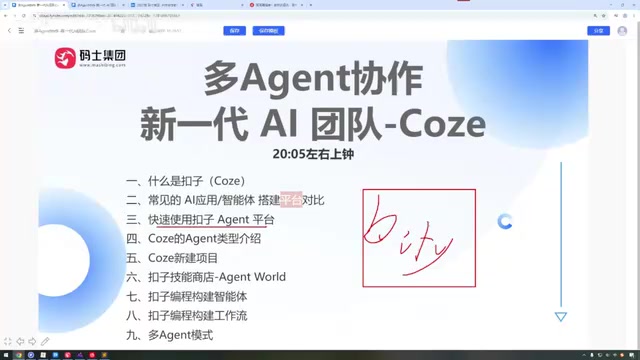
The platform offers multiple Agent types to choose from. While some advanced types currently require VIP access, the platform also provides limited-time free trial options, which are more than enough for beginners to explore and learn.
Skill Store and Agent World Community
Coze's Skill Store is a major highlight of the platform. It aggregates a large number of pre-built skill plugins that users can directly "equip" to their agents without developing anything from scratch.
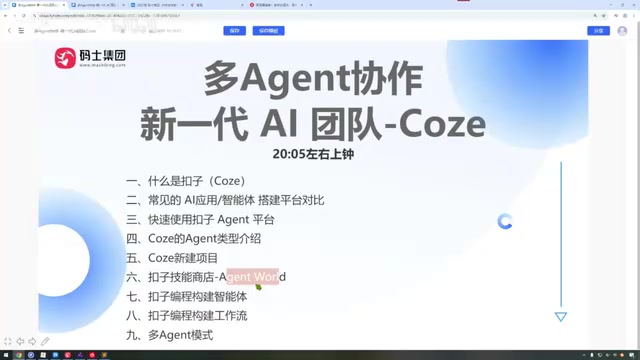
Additionally, Coze has a community module called Agent World, where users can browse and use agents created by others. However, as mentioned in the tutorial, this module has been under maintenance recently and may be temporarily inaccessible.
Project Building and Workflow Construction
Coze allows users to create various projects and leverage AI to assist with specific work tasks. A more advanced use case is building workflows — workflows are essentially another form of agent, just presented differently.
The core idea behind workflows is: break down a complex task into multiple steps, with each step handled by different nodes (such as LLM calls, conditional logic, tool invocations, etc.), ultimately chaining them into an automated processing pipeline.
From a technical perspective, the underlying structure of AI workflows is a DAG (Directed Acyclic Graph) — each node represents an independent processing unit (such as LLM calls, conditional branches, code execution, HTTP requests, etc.), connected by data flows. When a user triggers a workflow, the system executes each node sequentially along the predefined path, with the output of one node automatically becoming the input for the next. The advantage of this design is that it decomposes complex AI tasks into controllable, debuggable small steps, each of which can be independently optimized. The overall reliability and interpretability of the process far exceeds that of a single large model call. This is why workflows are widely adopted in enterprise-level AI applications.
Multi-Agent Collaboration: Unlocking Advanced Capabilities
Multi-agent collaboration is Coze's most technically sophisticated feature. Its core concept is: having multiple agents with different capabilities work together to accomplish complex tasks that a single agent cannot handle alone.
Multi-Agent Collaboration is one of the most cutting-edge research directions in AI today. Its theoretical foundation comes from distributed artificial intelligence and Multi-Agent Systems (MAS), with the core idea being "specialized division of labor and cooperative collaboration." In terms of technical implementation, multi-Agent systems typically need to solve three key problems: first, task allocation mechanisms (how to reasonably distribute complex tasks among different Agents); second, communication protocols (how Agents pass information and intermediate results to each other); and third, conflict resolution (how to coordinate when outputs from multiple Agents contradict each other). Stanford University's "AI Town" experiment, Microsoft's AutoGen framework, and Andrew Ng's Agentic Workflow concept are all important milestones in this direction. Coze encapsulates these complex underlying mechanisms into visual configurations, enabling ordinary users to experience the powerful capabilities of multi-Agent collaboration.
Here's a practical example: you could create a "Research Agent" responsible for information gathering, an "Analysis Agent" for data processing, and a "Writing Agent" for content output — the three collaborating to produce a complete industry analysis report. This pattern has strong practical value in real business scenarios.
Who Should Use Coze?
Based on the platform's characteristics, the following groups should pay special attention:
- AI enthusiasts without a technical background: The zero-code barrier makes it the best entry point for experiencing AI Agents
- Content creators and social media professionals: Build automated content production pipelines
- Product managers and operations staff: Quickly validate AI product ideas without waiting for development schedules
- Programmers and developers: Build on Coze's foundation for deeper customization and explore multi-Agent architectures
Conclusion: Is Coze Worth Learning?
As ByteDance's key play in the AI agent space, Coze's greatest value lies in dramatically lowering the barrier to building AI applications. From simple single agents to complex multi-Agent collaboration systems, from the plug-and-play skill store to flexible workflow orchestration, Coze provides a clear growth path for users at every level.
Compared to developer-oriented platforms like Dify, Coze places greater emphasis on the inclusive philosophy of "making AI accessible to everyone." If you're looking for a low-barrier, feature-rich agent-building tool, Coze is well worth exploring in depth.
Related articles
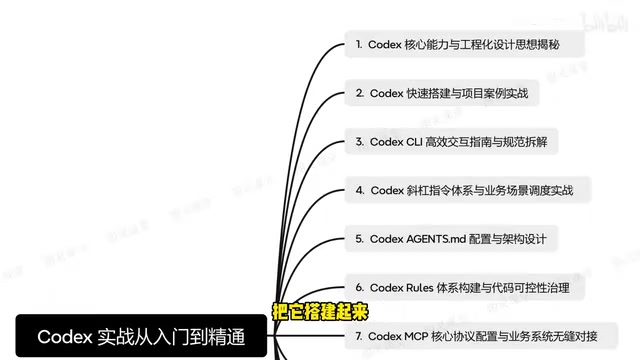
The Complete Guide to OpenAI Codex CLI: From Installation and Configuration to Enterprise-Level Practice
In-depth guide to OpenAI Codex CLI: covering installation, agents.md design, multi-agent collaboration, MCP protocol integration, and a RAG customer service project.
Decoding Google's AI Control Roadmap: A Defense Framework for When AI Goes Off the Rails
Google releases its AI Control Roadmap, a new safety paradigm that assumes alignment may fail and builds defenses at the system architecture level.
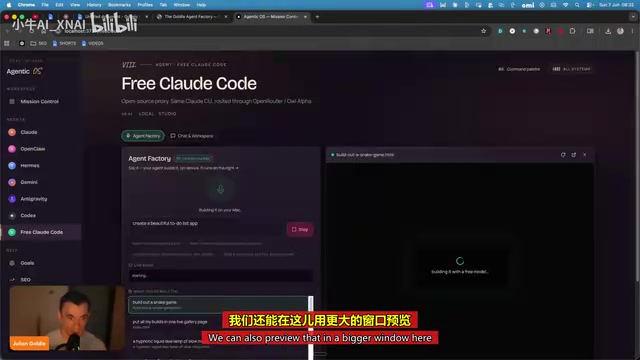
Agent Factory: Voice-Driven AI Coding — A Hands-On Guide to Building Apps for Free
Agent Factory wraps Claude Code into a voice-driven AI coding tool with dozens of free models, letting you build apps, games, and websites through conversation.