CreateNow Controlled Development in Practice: Getting AI to Write Code Requirement by Requirement
CreateNow enables controlled AI development by having AI implement requirements step by step like a senior engineer.
This article explores CreateNow's controlled AI development approach, where an AI agent acts as a senior software engineer to implement project requirements one by one. It covers the full workflow from architecture setup to acceptance testing, discusses how LLM selection (with Claude leading) impacts code quality, and highlights features like breakpoint-resume development and requirements traceability.
From Requirements to Code: AI Is More Than a Code-Spitting Machine
Many people still think of AI programming as "throw in a sentence, get a pile of code." But real software development goes far beyond that — requirements breakdown, architecture design, modular development, acceptance testing — every step demands professional process control. CreateNow is trying to change this paradigm by making AI work like a true senior software engineer, methodically advancing through requirements following professional development workflows.
This article is based on a CreateNow hands-on tutorial from a Bilibili content creator, walking you through how this "controlled AI development" approach actually works.

What Is Controlled Development
Moving Beyond One-Shot Code Generation
Traditional AI programming tools tend to be a "one-and-done" deal: you describe your requirements, and the AI generates all the code at once. This approach is passable for small projects, but falls apart with complex ones — messy code structure, severe module coupling, and requirements gaps that are impossible to trace back.
It's worth understanding why "module coupling" is the Achilles' heel of one-shot AI code generation. Module coupling is a classic software engineering problem referring to the degree of interdependence between different code modules. High coupling means modifying one module can trigger cascading failures in others, causing maintenance costs to grow exponentially in large projects. When traditional AI generates code all at once, it lacks a holistic architectural perspective and tends to produce tightly coupled code — functions calling each other directly, global variable abuse, vague interface definitions, and so on. Professional software engineering typically follows SOLID principles (Single Responsibility, Open-Closed, Liskov Substitution, Interface Segregation, Dependency Inversion) to reduce coupling, and this is precisely what controlled development aims to safeguard through process-driven methods.
CreateNow takes a fundamentally different approach. In the previous tutorial episode, the AI agent — acting as a "top-tier product manager" — completed the requirements breakdown, decomposing a family photo album project into clearly defined modules with acceptance criteria. In the development phase, the agent switches to a "senior software engineer" role, strictly implementing each requirement item by item.
Professionalizing the Development Workflow
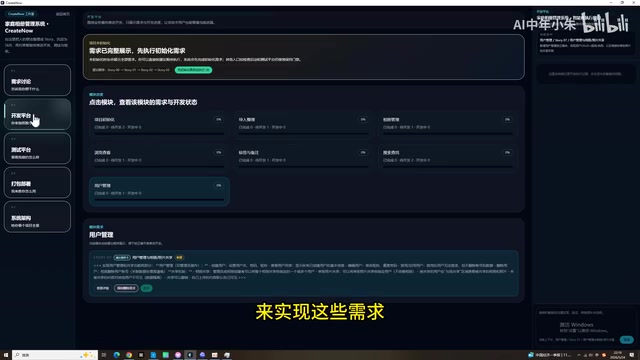
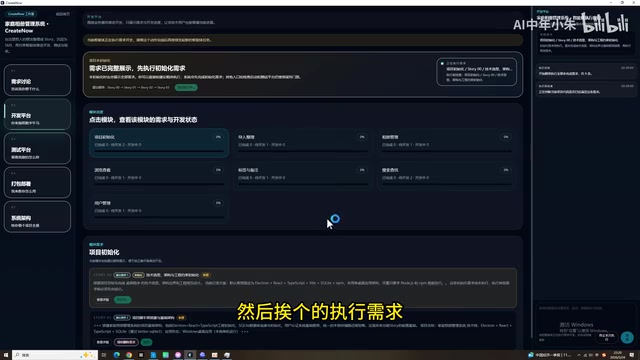
Upon entering CreateNow's development platform, the interface displays each module's requirements. After clicking the "Initialize then Execute" button, the agent follows this workflow:
- Build the project's main architecture: Establish the overall skeleton first, rather than jumping straight into feature code
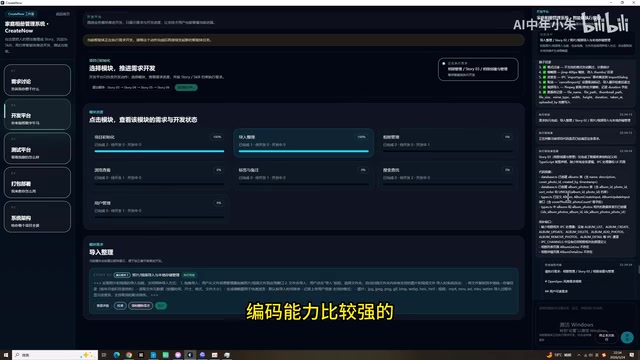
- Execute requirements one by one: Develop modules sequentially, focusing on only one requirement at a time
- Analyze existing code: Before each execution, the agent reviews the current project implementation to ensure new code is consistent and coordinated with existing code
- Check acceptance criteria item by item: After completing each requirement, verify against acceptance criteria one by one
Notably, CreateNow comes with built-in SQL for current mainstream project development and professional prompt templates. The instructions sent to the agent aren't simple natural language descriptions but carefully designed professional prompts, which significantly improve the AI's accuracy in understanding requirements.
Prompt Engineering plays a crucial role in AI programming. Simple natural language descriptions like "write a login feature" often lead models to generate generic, context-free code. Professional prompt templates, on the other hand, include structured information such as tech stack constraints, code style guidelines, error handling requirements, and interface contracts with existing code. Research shows that structured prompts can improve AI code generation accuracy by 30%-50%. CreateNow's built-in professional prompt templates essentially codify senior engineers' experience, giving the AI more complete contextual information during code generation and producing code that better adheres to engineering standards.
Hands-On Experience: The Complete Family Photo Album Development Process
Visualizing the Development Process
In practice, the right panel displays the complete interaction log between CreateNow and the agent in real time. Developers can clearly see the execution status of each step — which requirement is currently being developed, what the agent analyzed, and what code was generated.
As the tutorial author put it: "You can sit back with your coffee and watch your digital workhorse doing the heavy lifting — it feels amazing." While said in jest, it genuinely reflects the core advantage of this development model: developers transform from coders into supervisors, shifting their focus from "how to write code" to "does the code meet the requirements."
How Model Selection Affects Development Quality
The tutorial specifically mentions that the speed and quality of requirement execution are closely tied to the chosen LLM. Based on the author's hands-on testing, different models show notable performance differences in AI code generation tasks:
- Top pick: Claude: Strongest coding capabilities, highest quality generated code
- Runners-up: Kimi and GLM: Best performers among domestic Chinese models
- DeepSeek: Mid-tier performance
- Locally deployed models: Capabilities may be relatively weaker
The performance differences among LLMs in coding tasks stem from differences in training data, model architecture, and alignment strategies. Claude (developed by Anthropic) excels at coding tasks partly due to its special optimization for code comprehension and logical reasoning during training, as well as its long context window (supporting 200K tokens) that enables it to understand the full picture of large codebases. Coding tasks place multi-dimensional demands on models: syntactic correctness, logical consistency, API call accuracy, code style uniformity, and most critically — maintaining coherence across long contexts. Domestic models like Kimi and GLM have made significant progress in code generation in recent years, but still lag behind top-tier models in complex logical reasoning and multi-file coordination.
This ranking is highly valuable for developers choosing AI programming tools. Coding tasks demand exceptional logical reasoning, code comprehension, and context management capabilities from models — choosing the right model is half the battle.
Fault Tolerance and Breakpoint-Resume Development
During testing, the author also encountered situations where agent errors caused requirement execution to halt. But CreateNow's design accounts for this — simply click "Auto Execute" again, and the agent continues development from the current progress point rather than starting over.
This breakpoint-resume development capability is extremely practical in real projects. After all, AI model output isn't 100% stable, and mid-process errors are inevitable. Being able to recover from breakpoints without losing completed work dramatically reduces time costs during development.
From a technical implementation perspective, the core challenge of breakpoint-resume development lies in state management and context recovery. In traditional software development, CI/CD (Continuous Integration/Continuous Deployment) pipelines achieve similar functionality through version control and build caching. Breakpoint-resume development in AI scenarios requires recording: the list of completed requirements, the state of generated code files, the project's dependency graph, and the agent's decision-making context. When resuming from an interruption, the system needs to reconstruct a complete project state snapshot and inject it as context for the AI model, enabling it to "understand" the project's current progress and continue seamlessly. This is far more complex than simple code version rollback, as it also requires restoring the AI's "thought state."
The Value and Limitations of Controlled Development
Why "Control" Matters
From this tutorial, it's clear that CreateNow is trying to solve a core pain point in AI programming: controllability. As project complexity increases, developers don't need a black-box code generator — they need a development assistant that follows professional workflows, advances step by step, and supports full traceability and rollback.
The advantages of this controlled AI development model include:
- Clear mapping between requirements and code: Every piece of code can be traced back to a specific requirement
- More precise problem localization: If a module has issues, simply re-execute that requirement
- Transparent and controllable development process: Complete logging for easy review and debugging
Requirements Traceability is a core practice in software engineering, referring to establishing bidirectional mapping between requirements documents and code implementations. In traditional development, this is typically achieved through a Requirements Traceability Matrix (RTM), recording which design documents, code modules, and test cases correspond to each requirement. Projects lacking traceability often descend into chaos during requirement changes — unable to determine which code a change will affect, or why a particular piece of code exists. By binding requirements breakdown with code generation, CreateNow naturally establishes this traceability relationship. This is especially important in AI-generated code scenarios, where developers need to understand and trust the origin and purpose of every line of code the AI produces.
Current Limitations
Of course, this model has clear limitations. First, it's highly dependent on the underlying LLM's coding capabilities — model selection directly determines development quality. Second, for enterprise-level projects requiring deep architectural design and complex business logic, whether AI-generated code can meet production-grade quality standards remains an open question.
The tutorial author also mentioned that the next episode will cover the testing platform, which itself proves the point — AI-written code still requires rigorous testing, and automated development doesn't mean you can skip quality assurance.
Conclusion
CreateNow demonstrates an AI development paradigm worth watching: integrating requirements management, architecture design, modular development, and acceptance testing into a controllable workflow. For small-to-medium projects and individual developers, this "sit back with coffee and watch AI work" experience is genuinely exciting. But to truly replace professional development workflows, continued evolution in code quality, architectural soundness, and test coverage is still needed.
Key Takeaways
Related articles

AI Aggregator Platforms Tested: A Complete Guide to Using GPT 5.5 and Other Top Models for Free
A hands-on guide to using GPT 5.5, Gemini 3.1 Pro, and Grok 4.2 for free via AI aggregator platforms, covering cross-model context memory, account pool mechanisms, and key security risks.
Vibe Coding in Practice: A Junior Student Uses Cursor to Build a Multi-Agent System with 51 AI Officials Based on the Three Departments and Six Ministries Framework
A junior student uses Cursor and Vibe Coding to build a multi-agent system with 51 AI officials modeled on China's Three Departments and Six Ministries, featuring task distribution, approval workflows, and Token cost visualization.
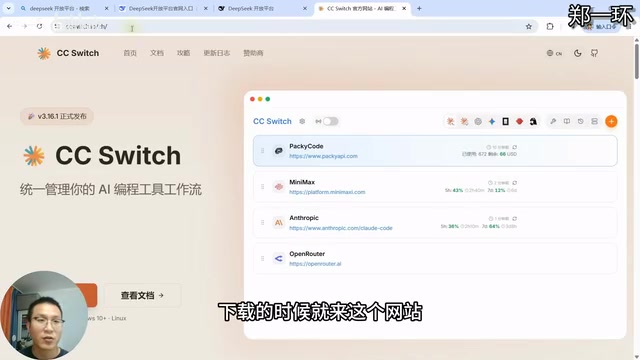
How to Connect Codex to DeepSeek Models: Free Switching via CC Switch
Learn how to connect OpenAI Codex to DeepSeek models via CC Switch, enabling free switching between DeepSeek and GPT with complete setup and routing guide.