Cursor 2.0 in Practice: Vibe Coding Methodology & Guide to 10x Coding Efficiency
Cursor 2.0 in Practice: Vibe Coding Me…
A systematic Vibe Coding methodology: Rules, Commands, Context three-layer architecture for 10x AI coding efficiency
This article presents a transferable Vibe Coding methodology centered on a three-layer architecture: Rules (global coding standards), Commands (reusable instructions), and Context (precise context). Through two real-world scenarios — building an e-commerce site from scratch and enterprise-grade bug fixing — it demonstrates efficient workflows combining Plan mode, Agent mode, voice input, and screenshot-driven development. The article emphasizes that the human role should shift from coder to orchestrator, while cautioning against skill atrophy through code review practices and AI detox days.
Introduction: AI Coding Is Not Just a Tool — It's a Methodology
When we talk about AI-assisted coding, most tutorials focus on introducing the tool's features. But what truly delivers a 10x efficiency boost isn't a particular button or keyboard shortcut — it's a systematic Vibe Coding methodology that can be transferred to Cursor, Claude Code, Copilot, or any other AI programming tool.
Background on the Vibe Coding Concept: This term was coined by OpenAI co-founder Andrej Karpathy in early 2025, describing a programming paradigm where developers rely entirely on AI-generated code and primarily express their intent through natural language. It's not just a tool-level change — it represents a fundamental shift in the cognitive model of software development: from "how to write code" to "how to describe the problem." This paradigm quickly sparked widespread discussion in the engineering community and gave rise to a set of best practices centered around "intent-driven development."
This article demonstrates how senior engineers apply AI coding in large, complex projects through two real-world scenarios — building a gardening e-commerce website from scratch, and fixing bugs and implementing new features in an enterprise-grade production application. The core philosophy is: The human's role is that of an Orchestrator, not a coder.
Scenario One: Building a Full-Stack Website from Scratch
Replace Tedious Typing with Voice Input
Cursor 2.0 supports multiple view modes, including the default Agentic view and an Editor view closer to a traditional IDE. The recommended approach is to use Editor view paired with the free tool WhisperFlow, issuing instructions to Cursor directly via voice:
"Build me a website for my gardening business. I sell gardening equipment, flowers, pots, etc. Keep the theme green. Use Next.js for frontend, FastAPI for backend, SQLite for database."
Technical Advantages of Voice Input: WhisperFlow is built on OpenAI's Whisper speech recognition model — an open-source automatic speech recognition (ASR) system trained on 680,000 hours of multilingual data, with excellent performance on technical terminology and code keywords. The advantage of voice input in programming scenarios isn't just speed (average speaking rate of ~130 words/minute, far exceeding typing speed) — it's that voice is naturally suited for descriptive, intent-based expression rather than precise syntactic structures. This aligns perfectly with the core AI coding principle of "describing intent rather than implementation details."
After voice input, Cursor enters Plan mode and automatically architects the project: four SQLite database tables (products, categories, orders, order items), tech stack selection, design theme, database schema, and more.
Seamless Switching from Plan Mode to Agent Mode
The to-do list generated in Plan mode supports manual editing — you can add, remove, or selectively execute specific tasks. After confirming the plan, click "Build" and the system automatically switches to Agent mode to start writing code.
Technical Principles Behind the Two Modes: Plan mode essentially has the LLM perform Chain-of-Thought reasoning first, decomposing complex tasks into an ordered list of subtasks before entering the execution phase. This "plan first, execute second" pattern draws from the ReAct (Reasoning + Acting) framework, effectively reducing AI "hallucinations" and directional drift on complex tasks. Agent mode is an autonomous loop system with tool-calling capabilities: the LLM can read/write files, execute terminal commands, run tests, and self-correct based on output results, forming a perception-decision-action feedback loop. The coordination between these two modes essentially separates "strategic planning" from "tactical execution" — a digital mapping of the architect-developer division of labor in large software engineering projects.
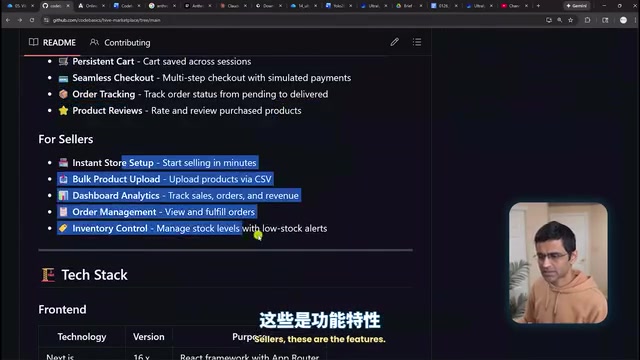
Throughout the process, Cursor operates like a development team with a Jira board: implementing features one by one, automatically checking off completed items, and auto-retrying on errors. A full-stack website that might take a traditional developer one to two weeks was scaffolded in minutes — complete with shopping cart, checkout flow, product browsing, and other full features.
Incremental Iteration: Add New Features with a Single Sentence
After the website is built, say you want to add a "Contact Us" button to the menu bar. The workflow demonstrates an important best practice:
- Open a new chat — avoid historical context interference; every bug fix or new feature should be done in a new session
- Select page elements — directly select the target area on the page as context
- Describe the requirement in natural language — "Add a contact us button, when clicked show contact us page with required information"
Cursor not only implemented the button but also automatically designed a complete page with a contact form, phone information, map, and more. Since both frontend and backend run in hot-reload mode, changes take effect immediately.
Scenario Two: Real-World Operations on Enterprise-Grade Production Applications
Screenshot-Driven Bug Fixing
In an Amazon-like e-commerce platform, a bug was discovered where the cart badge displayed the wrong item count (2 items added but showing 1). The fix is extremely intuitive:
- Use a screenshot tool to capture the problem area
- Attach the screenshot and describe: "The badge shows wrong number of items in my cart, fix it"
- Cursor analyzes the screenshot and code, automatically locates and fixes the bug
After the fix, you can use the LLM as a Judge strategy — have another LLM review the code changes by clicking "Review agent changes."
Technical Background on LLM as a Judge: This method is an AI quality assurance practice that emerged in 2024, with its effectiveness validated by research from Stanford University and other institutions. The core idea is leveraging large models' language understanding capabilities to evaluate another model's output quality, similar to the "four-eyes principle" in code review. In coding scenarios, the judge LLM checks whether code changes introduce security vulnerabilities, comply with architectural standards, or contain logical errors. Research shows that GPT-4-level models acting as judges achieve over 80% agreement with human experts, and in catching obvious errors, they can even outperform fatigued human reviewers.
Implementing a Wishlist Feature with a Single Sentence
A complete Wishlist feature was implemented with just one instruction: select the page element and type "Next to this button add 'Add to Wishlist', there will be only one default wishlist for a given user." Cursor modified 10 files and implemented the complete feature chain — heart icon, add/remove from wishlist, add to cart from wishlist — zero iterations, first-try success.
Three-Layer Architecture: Rules, Commands & Context
This is the most critical methodology section of the entire article. Abstracting AI coding best practices into a three-layer architecture, mastering this system is the key to achieving high-output Vibe Coding.
Rules — Traffic Laws
Rules are global coding standards, similar to "stop at red lights, observe speed limits." They are automatically loaded with every interaction, defining the AI's behavioral guidelines:
- "Always use TypeScript interface"
- "Prefer functional programming over OOP"
- "Always use async, never use sync calls"
- API endpoint structure, database query standards, etc.
In Cursor, add project-level Rules (shared by all developers) or user-level Rules (personal preferences) through Cursor Settings.
Commands — GPS Navigation Instructions
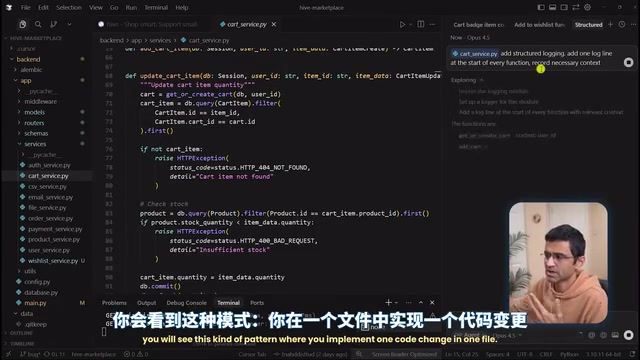
Commands are reusable, precise operational instructions. A typical example: first manually add structured logging to cart_service, then encode that logging standard into a Command named "add-structured-logging" (essentially a Markdown file).
Afterward, to add logging to any service file, simply type /add-structured-logging @order_service — no need to write long prompts or reference historical commits. This Command is stored in the .cursor/commands directory and can be committed to Git for team sharing.
Context — Map Data
Context is the decisive factor in AI output quality. Ways to provide context include:
- @files/folders: Limit the AI's scope of attention
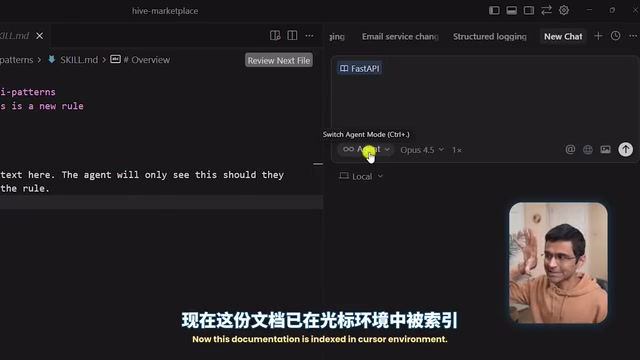
- @docs: Reference official documentation like FastAPI (already indexed in Cursor)
- Screenshots: Visually describe problems
- Terminal output: Reference error logs
- Git commits: Reference historical changes
- MCP servers: Such as Context7, ensuring the latest version of API documentation is used
Technical Background on MCP Protocol and Context7: MCP (Model Context Protocol) is an open protocol released by Anthropic in late 2024, designed to standardize connections between AI models and external data sources/tools. Analogous to how USB-C unified device connection standards, MCP provides a unified context injection interface for AI applications. Context7 is a documentation service built on MCP, specifically solving the "knowledge expiration" problem caused by LLM training data cutoff dates — for example, a model might use deprecated API syntax. Through MCP, Cursor can pull the latest official documentation in real-time, ensuring generated code conforms to current framework specifications rather than historical versions from training data.
Key Insight: More context doesn't equal better answers — relevance always beats quantity.
The Human Role: From Coder to Orchestrator
Linux creator Linus Torvalds admitted after using AI coding tools that "this is much better than what I write by hand." The Anthropic team used Claude Code to write Claude Code itself within two sprints. A Staff Engineer at a well-known US fintech company revealed that over the past month, 95% of PRs were written entirely by Claude Code.
Historical Evolution of the Orchestrator Role: The role shift from coder to orchestrator is not unprecedented in software engineering history. In the 1960s, assembly language programmers worried that high-level languages would make them obsolete; in the 1990s, the rise of object-oriented programming made procedural programmers anxious; in the cloud computing era, operations engineers transformed into DevOps engineers. Each elevation in abstraction level freed engineers from low-level implementation details, redirecting them toward higher-value system design and business logic. The current AI coding wave is merely the latest chapter in this historical progression — the difference being that this time, the leap in abstraction is larger and faster.
But this doesn't mean humans become irrelevant. An LLM is like a "genius engineer who joined the company five seconds ago" — fluent in every programming language but knowing nothing about business logic, legacy code, or architectural constraints. The orchestrator's core competency lies in: understanding business constraints, identifying architectural trade-offs, establishing quality standards, and most critically — knowing when not to trust AI output. The cost of silence is: if you don't provide sufficient context, it will default to producing "internet-average" code — syntactically correct but architecturally invalid.
Final Thoughts: Finding Balance
Over-reliance on AI can indeed cause developers' fundamental skills to atrophy. A worthwhile practice is establishing AI Detox Days, similar to digital detox days: for example, every Friday, don't use AI — write all code by hand to keep your programming fundamentals sharp.
But regardless, not using AI coding means a 100% efficiency loss. The key is: Rigorously review every line of AI output, build a comprehensive automated testing system, and continuously improve your capabilities as an orchestrator.
Key Takeaways
- Cursor 2.0's Plan mode and Agent mode work together to compress full-stack website development from a week to minutes, supporting efficient interaction methods like voice input and screenshot-driven bug fixing
- The three-layer AI coding methodology: Rules (global coding standards), Commands (reusable precise instructions), Context (relevant context) — transferable to any AI coding tool
- The Commands feature allows encoding repetitive operations (like adding structured logging) into Markdown files; once shared with the team, a single slash command executes them, dramatically reducing repetitive work
- The human role transforms from coder to Orchestrator, with core value in providing business context, architectural constraints, and code review — not hand-writing code
- Over-reliance on AI carries skill atrophy risks; it's recommended to build comprehensive automated testing systems and regularly conduct 'AI Detox Days' to maintain coding fundamentals
Related articles
 Tutorials
Cursor + Codex Dual-IDE Collaboration: A Practical Methodology for Open-Source Project Customization
A complete methodology for open-source project customization based on real-world experience, detailing the Cursor+Codex dual-IDE workflow, seven-stage process, MVP validation, and AI source code reading techniques.
 Tutorials
Cursor Multi-Agent in Practice: Building a Full-Stack Next.js Blog in 50 Minutes
Build a full-stack blog in 50 minutes using Cursor IDE's multi-Agent mode with Next.js, Clerk auth, and Supabase. Learn the 4-phase AI Agent workflow and key integration pitfalls.
 Tutorials
Building an AI Software Factory from Scratch: A Cursor Engineer's Hands-On Experience with Multi-Agent Collaboration
Cursor engineer Eric shares practical insights on building an AI software factory: automation levels, guardrail design, parallel Agent management, and scaling to 1000+ Agents for 24/7 development.