Cursor AI Fully Auto-Generates a Xiaomi Store Clone: Deep Dive into a Full-Stack Practical Course

A full-stack course using Cursor AI + Figma AI to auto-generate a complete Xiaomi Store clone
This course uses Cursor AI for front-end and back-end code generation and Figma AI for UI design as its core approach. The tech stack covers Spring Boot, Vue3, Element Plus, and UniApp, building a Xiaomi Store clone supporting both Web and WeChat Mini Program platforms. It integrates enterprise-grade APIs including Alibaba Cloud logistics, OSS, and WeChat login/payment, targeting beginners.
Course Overview
A full-stack practical course centered on AI-driven development recently launched on Bilibili, featuring Cursor AI for automatic front-end and back-end code generation, combined with Figma AI for design work, building a Xiaomi Store clone project from scratch. The tech stack covers Spring Boot, Vue3, Element Plus, and UniApp, delivering a complete e-commerce project that supports both Web and WeChat Mini Program platforms.
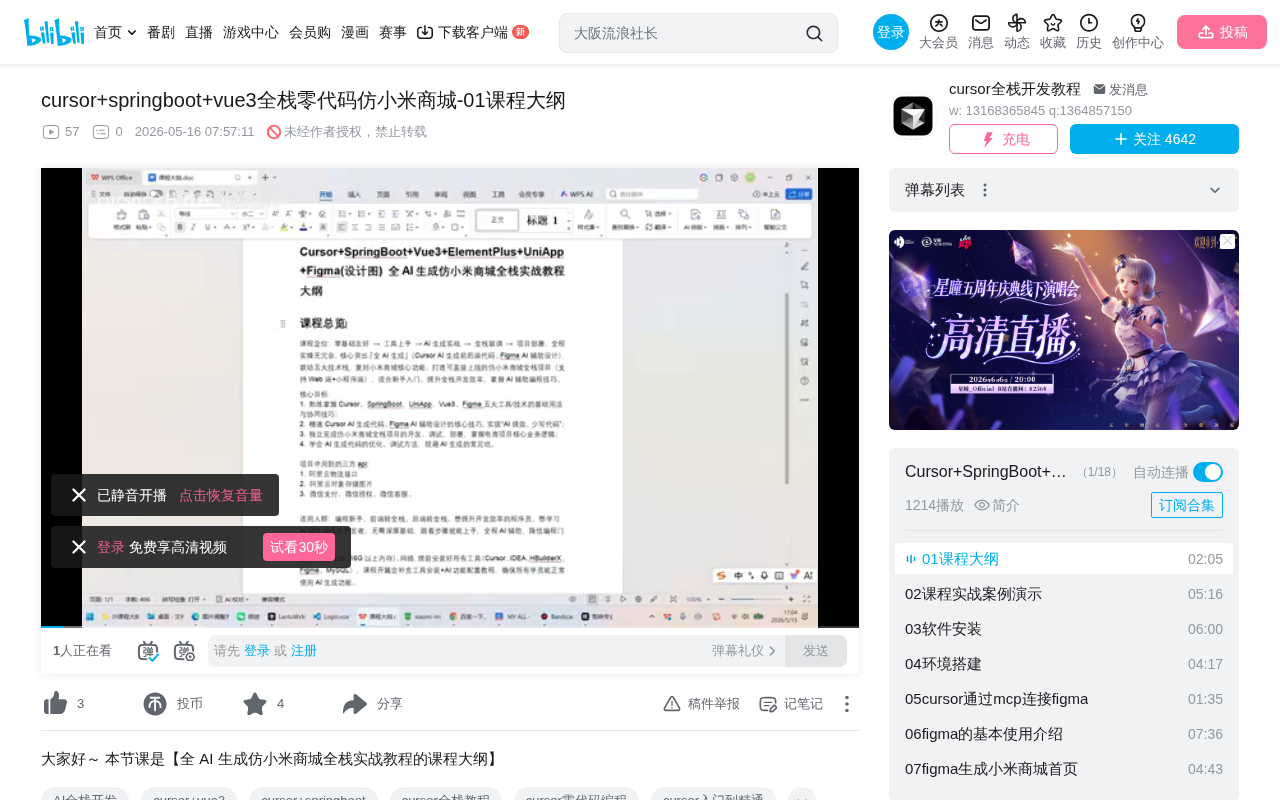
Tech Stack & AI Toolchain
The course's core selling point is the "fully AI-generated development" approach, with a clearly defined toolchain:
- Cursor AI: Automatically generates all front-end and back-end business code, handling the primary coding workload
- Figma AI: Generates the complete set of store UI designs, replacing the traditional manual design process
- Back-end framework: Spring Boot for business logic and API development
- Front-end framework: Vue3 + Element Plus (Web) and UniApp (WeChat Mini Program)
Cursor AI's Technical Positioning
Cursor is an AI code editor developed by Anysphere, deeply integrating large language model capabilities on top of VS Code's architecture. It supports generating complete code segments, performing code refactoring, and fixing bugs through natural language descriptions. Unlike code completion tools such as GitHub Copilot, Cursor emphasizes "conversational programming" — developers can chat directly with AI within the editor, describe feature requirements, and have AI generate entire files or even multi-file codebases. Since 2024, Cursor has rapidly become the benchmark product in AI-assisted programming, with its Composer feature enabling cross-file batch code generation and modification, making it particularly suited for rapid full-stack project scaffolding.
Figma AI's Design Empowerment
Figma is the world's most popular collaborative design tool. Starting in 2024, it has progressively rolled out multiple AI features, including automatic layout suggestions, design draft generation, and automatic icon and illustration creation. Figma AI can generate UI components and page layouts based on text descriptions, significantly reducing repetitive design work. For developers, Figma AI's value lies in enabling quick production of interface designs that meet modern aesthetic standards — even without a professional design background — which can then be converted into front-end code using tools like Cursor, forming a complete AI workflow from design to development.
Collaborative Development Model
The overall collaboration approach is: first use Figma AI to output design drafts, then use Cursor AI to automatically generate code based on the designs and requirements, while developers primarily handle debugging, optimization, and business logic oversight. This model dramatically shortens the cycle from design to development.
Back-End Technology Choice: Spring Boot
Spring Boot is the most popular rapid development framework in the Java ecosystem, maintained by the Pivotal team. Through its "convention over configuration" philosophy, it simplifies the tedious XML configuration of traditional Spring into annotation-driven development, with an embedded Tomcat server allowing projects to run directly as JAR packages. In e-commerce projects, Spring Boot typically handles RESTful API development, database interaction (via MyBatis or JPA), authentication (Spring Security), cache management (Redis integration), and other core back-end responsibilities. Its mature ecosystem and extensive Starter components make it particularly well-suited for AI code generation — because training data contains massive amounts of Spring Boot project code, AI has a high level of mastery over its APIs and best practices.
Front-End Technology Choice: Vue3 + Element Plus
Vue3 is the latest major version of the Vue.js framework, introducing the Composition API, better TypeScript support, and performance optimizations. Compared to Vue2's Options API, the Composition API allows code organization by logical concerns, making it more suitable for code reuse in large projects. Element Plus is an open-source Vue3 component library from the Ele.me team, providing dozens of enterprise-grade UI components including tables, forms, modals, and navigation — ready to use out of the box. This combination is currently the mainstream technology choice for Chinese internet enterprise admin systems and e-commerce front-ends, with rich community resources and relatively high accuracy in AI-generated code patterns.
Cross-Platform Solution: UniApp
UniApp is a cross-platform development framework from DCloud that uses Vue syntax to write a single codebase, which can be compiled simultaneously into mini programs for WeChat/Alipay/Baidu and other platforms, H5 web pages, and native iOS/Android apps. Its core advantage is "develop once, publish everywhere," dramatically reducing the development cost of multi-platform adaptation. In e-commerce scenarios, UniApp is particularly suited for projects that need both a WeChat Mini Program and a mobile H5 version, allowing developers to maintain a single codebase covering all major traffic entry points.
Hands-On Project Content
Core Business Features
The project fully replicates Xiaomi Store's core functionality and integrates multiple enterprise-grade third-party APIs:
- Alibaba Cloud Logistics API: Order logistics information tracking
- Alibaba Cloud OSS Object Storage: Product image upload and management
- WeChat OAuth Login: Quick user login functionality
- WeChat Mini Program Payment: Complete payment flow integration
Alibaba Cloud OSS in E-Commerce
OSS (Object Storage Service) is a massive, secure, and cost-effective cloud storage service provided by Alibaba Cloud, suitable for storing unstructured data such as images, videos, and documents. In e-commerce projects, static resources like product images, user avatars, and marketing materials are typically stored on OSS and distributed to users nationwide via CDN acceleration. Compared to storing images on local application servers, the OSS approach offers unlimited scalability, high availability (99.995% SLA), automatic backup, and other advantages — making it standard practice for enterprise-grade projects. Developers can implement file upload, download, and permission control through simple SDK calls.
Four Core Competencies Developed
- Master engineering-level collaborative development techniques with Cursor AI and Figma AI
- Become proficient in practical methods and prompt engineering for AI-powered coding and design
- Independently complete the development, debugging, and deployment of a full e-commerce site
- Develop the ability to optimize, debug, and troubleshoot AI-generated code
Target Audience & Learning Prerequisites
The course is positioned as beginner-friendly, suitable for the following types of learners:
- Programming beginners who want to quickly get started with full-stack development through AI tools
- Front-end developers looking to expand into back-end capabilities with AI assistance for a full-stack transition
- Back-end developers who need to expand their front-end and mini program development skills
- Developers with some foundation who want to systematically learn AI-assisted programming
Hardware requirements are minimal — just a computer with 16GB RAM and a normal internet connection.
Personal Perspective
This type of fully AI-generated practical course represents a clear trend in current programming education: using AI coding tools like Cursor to lower the coding barrier, shifting the developer's role from "writing code line by line" to "directing AI to write code and performing quality control."
Quality Risks of AI-Generated Code
However, it's important to note that while AI-generated code is extremely efficient, there are several known quality risks: First, the "hallucination" problem — AI may call non-existent APIs or use outdated syntax. Second, security vulnerabilities — protections against SQL injection, XSS attacks, and other threats may be overlooked. Third, performance concerns — AI tends to generate functionally correct but unoptimized code that may fail under high-concurrency scenarios. Fourth, architectural consistency — code generated across multiple conversations may be inconsistent in naming conventions and design patterns. Therefore, a developer's ability to perform "code review" and "architectural oversight" hasn't weakened in the AI era — it has become even more critical.
The ability to debug and optimize AI-generated code still requires solid foundational programming knowledge. Beginners following along with the project are advised to simultaneously build their understanding of underlying principles — such as database design, HTTP protocols, and component-based development thinking — to truly develop independent development and troubleshooting capabilities.
Key Takeaways
- The course uses Cursor AI + Figma AI to generate all code and designs throughout, building a complete Xiaomi Store clone
- The tech stack covers Spring Boot, Vue3, Element Plus, and UniApp, supporting both Web and Mini Program platforms
- Integrates enterprise-grade third-party APIs including Alibaba Cloud logistics, OSS storage, and WeChat login/payment
- Beginner-friendly with low hardware requirements, emphasizing AI's role in reducing development learning costs
Related articles
 Tutorials
Cursor + Codex Dual-IDE Collaboration: A Practical Methodology for Open-Source Project Customization
A complete methodology for open-source project customization based on real-world experience, detailing the Cursor+Codex dual-IDE workflow, seven-stage process, MVP validation, and AI source code reading techniques.
 Tutorials
Cursor Multi-Agent in Practice: Building a Full-Stack Next.js Blog in 50 Minutes
Build a full-stack blog in 50 minutes using Cursor IDE's multi-Agent mode with Next.js, Clerk auth, and Supabase. Learn the 4-phase AI Agent workflow and key integration pitfalls.
 Tutorials
Building an AI Software Factory from Scratch: A Cursor Engineer's Hands-On Experience with Multi-Agent Collaboration
Cursor engineer Eric shares practical insights on building an AI software factory: automation levels, guardrail design, parallel Agent management, and scaling to 1000+ Agents for 24/7 development.