Cursor vs Windsurf vs Trae: An In-Depth Comparison of Three Major AI IDEs
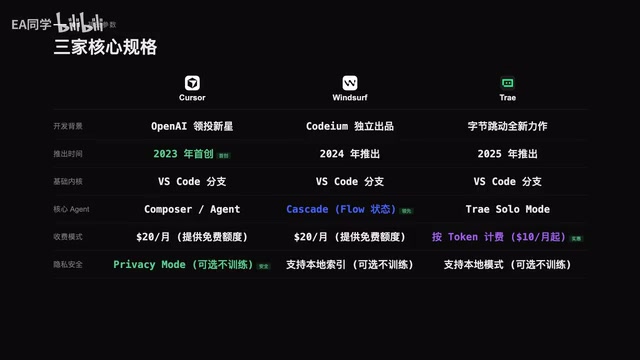
In-depth comparison of Cursor, Windsurf, and Trae AI IDEs across coding, Agent autonomy, and pricing.
This article compares three leading AI IDEs — Cursor, Windsurf, and Trae — across five key dimensions: core specs, coding capabilities, Agent autonomy, pricing, and use cases. Cursor excels in context understanding, Windsurf leads in multi-file editing and Agent autonomy, while Trae offers the best value at half the price. The guide helps developers choose the right tool for their workflow.
The competition among AI-assisted programming tools has reached a fever pitch. Cursor, Windsurf, and Trae — three leading AI IDEs — each bring unique strengths to the table. How should developers choose? This article provides a comprehensive comparison across five dimensions: core specifications, coding capabilities, Agent autonomy, pricing, and ideal use cases, helping you find the perfect programming companion.
Core Specifications: Three Distinct Technical Foundations
Cursor is developed by AnySphere, a company backed by OpenAI. First launched in 2023, it's widely regarded as the industry benchmark in the AI IDE space. It supports a privacy mode that promises not to use user data for model training — a critical feature for enterprise users. In enterprise scenarios, privacy mode means code won't be used for model training, won't be persistently stored on servers, and all transmissions use end-to-end encryption. For regulated industries like finance, healthcare, and defense, this data security commitment is a prerequisite for procurement decisions, and it's also why SOC 2 compliance certification is becoming increasingly important in the AI tooling space.
Windsurf is an independent product from Codeium, launched in late 2024. It pioneered the "Flow State" programming experience and supports local indexing with privacy protection. Its design philosophy emphasizes immersion and continuity during the coding process — minimizing context switching, reducing cognitive load, and helping developers stay in a highly productive "flow state" for as long as possible.
Trae is a dark horse entrant from ByteDance, launched in early 2025. Also built on a VS Code fork, it delivers exceptionally fast response times for developers in Asia and supports a local security mode. As a latecomer, Trae has a natural advantage in Chinese-language ecosystem support and localized experiences.
All three products are built on the VS Code ecosystem, which means relatively low migration costs for developers. VS Code is Microsoft's open-source code editor with over 74 million monthly active users. Its Extension API and Language Server Protocol (LSP) form an extremely mature plugin ecosystem. By building AI IDEs on VS Code forks, developers can seamlessly inherit their existing plugins, themes, keyboard shortcuts, and workspace settings. More importantly, VS Code's Electron architecture provides cross-platform capabilities, while its built-in terminal, debugger, and Git integration offer natural infrastructure for AI Agent autonomous execution. However, in terms of underlying architecture and core philosophy, the three IDEs have taken distinctly different paths.
Code Completion: Cursor and Windsurf Each Excel in Their Own Way
In the most critical coding capability evaluation, the three IDEs showed clear performance gaps.
Cursor: The King of Context Understanding
Cursor, powered by its exceptional project-wide context indexing and the proprietary Cursor Tab feature, scored 94 and 95 out of 100 in code completion quality and codebase Q&A respectively — ranking first in both. It can locate historical bugs extremely quickly, and its depth of understanding for large codebases is truly impressive.
This capability relies on a technique known as Code Embedding. Cursor converts the entire codebase — files, functions, classes, and module relationships — into high-dimensional vector representations stored in a local vector database. When a developer asks a question or requests a completion, the system uses Semantic Retrieval to recall the most relevant code snippets from the vector store, injecting them as context into the large language model's prompt. This RAG (Retrieval-Augmented Generation) architecture enables the AI to "understand" the full picture of projects spanning tens or even hundreds of thousands of lines of code, rather than relying solely on the currently open file. The Cursor Tab feature further optimizes this by predicting the developer's next editing intent, offering intelligent completion suggestions that span across lines and even across functions. This capability is particularly outstanding when working with legacy projects or complex business logic.
Windsurf: The Champion of Multi-File Coordination
Windsurf's pioneering Cascade Agent scored 95 points in multi-file collaborative intelligent editing and complex refactoring scenarios, overtaking Cursor to claim the top spot in this category. When you need to simultaneously modify multiple related files or perform large-scale code refactoring, Windsurf delivers superior results.
Cascade employs an approach similar to the "Changeset" concept in software engineering: it analyzes all related files affected by a modification request, builds a dependency graph, then makes changes in topological order to ensure consistency across type signatures, interface contracts, and import paths. This capability is especially critical in microservice architectures or large Monorepo setups, where a single API interface change might require synchronized modifications across data models, routing layers, controllers, test cases, and more. Traditional single-point completion tools often fall short in these scenarios, while Cascade's global perspective makes complex refactoring manageable.
Trae: A Strong Contender with Excellent UX
Trae earned scores of 88 and 86 with its excellent user experience. While there's a gap in absolute scores compared to the other two, considering it launched most recently, these results are quite impressive. For everyday development tasks, Trae is more than capable.
Conclusion: For professional developers working on large projects, Cursor and Windsurf are the better choices.
Agent Autonomy: Who Can Truly "Do the Work for You"?
Agent capability is the core battleground in today's AI IDE competition. An excellent Agent doesn't just write code — it can autonomously run tests, discover errors, and fix them. That's the real productivity revolution. From a technical perspective, Agent autonomy refers to an AI system's ability to independently plan execution steps, invoke tools, observe results, and iteratively self-correct after receiving high-level instructions. This aligns closely with the ReAct (Reasoning + Acting) framework proposed in academia. In the AI IDE context, this means an Agent can autonomously execute terminal commands (such as npm test or pytest), read test output, pinpoint failure causes, modify code, and re-verify — forming a complete "plan-execute-observe-correct" loop.
However, autonomous Agent execution also introduces security risks: a runaway Agent could execute dangerous system commands or delete critical files. Therefore, all three IDEs provide varying degrees of sandboxing mechanisms and permission confirmation workflows, seeking a balance between autonomy and safety.

Windsurf Cascade: Leading with 95 Points
Windsurf's Cascade agent supports running commands directly in the local terminal, executing tests, and autonomously fixing bugs when errors occur. With a top score of 95, it leads the Agent category. This end-to-end autonomous execution capability lets developers focus more on architecture design and business thinking.
Cursor Composer: Close Behind at 90 Points
Cursor's Composer Agent mode also performs excellently in debugging and rule compliance, scoring 90 points. Its strength lies in strict adherence to project rules and coding standards, making it more reliable in team collaboration scenarios. For example, when a team has configured ESLint rules, TypeScript strict mode, or custom code style guides, Composer automatically respects these constraints when generating and modifying code, reducing back-and-forth during code reviews.
Trae Solo Mode: Steadily Catching Up at 82 Points
Trae's Solo Mode is an independent task execution mode that supports switching between Builder and Chat modes, earning 82 points. While the score is relatively lower, it offers a unique advantage — free access to top-tier cloud-based large models, which is extremely attractive for budget-conscious developers.
Pricing Comparison: Trae's Value Advantage Is Clear
Pricing is often one of the decisive factors for developers.
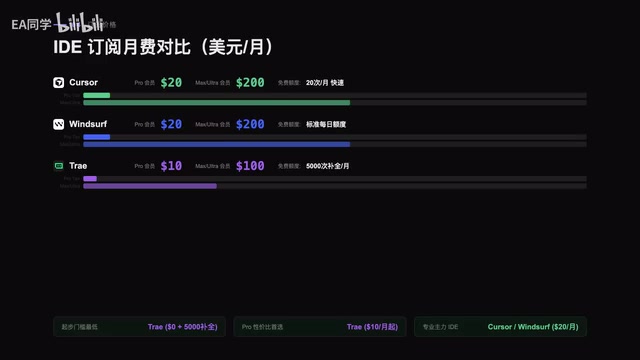
| Product | Pro Monthly | Top-Tier Monthly |
|---|---|---|
| Cursor | $20/mo | $200/mo (Ultra) |
| Windsurf | $20/mo | $200/mo (Max) |
| Trae | $10/mo | $100/mo (Ultra) |
Cursor and Windsurf are identically priced, with Pro plans at $20/month and top-tier plans at $200/month. Trae, however, offers exceptional value — Pro at just $10/month and top-tier Ultra at only $100/month, cutting prices in half.
The pricing difference involves the token economics of the AI industry. Large language model inference costs are billed by the number of input and output tokens. For GPT-4-level models, the cost per million input tokens is several dollars. An active developer's daily coding assistance might consume tens to hundreds of thousands of tokens, with monthly costs reaching tens of dollars. ByteDance can offer lower prices partly because its proprietary Doubao large model reduces dependence on third-party APIs, and partly as a market penetration strategy — subsidizing to acquire user scale and build network effects in the developer ecosystem.
For individual developers, indie developers, or solo entrepreneurs, Trae's pricing advantage is significant. Over a year, the Pro plan alone saves $120, while the top-tier plan saves $1,200.
Selection Guide: Choose Based on Your Needs

Based on the comprehensive evaluation across five dimensions, here are the selection recommendations:
Choose Cursor When:
- You work with large, complex projects with massive codebases
- You have extremely high requirements for code completion quality and context understanding
- Your team already has Cursor experience, minimizing migration costs
- You want an industry-standard development experience
- Your enterprise has strict data privacy and compliance requirements
Choose Windsurf When:
- You prefer autonomous Agent execution and want AI to automatically run tests and fix bugs
- You frequently perform multi-file collaborative editing and large-scale refactoring
- You value the immersive "Flow State" programming experience
- Your project uses a microservice architecture or Monorepo pattern with complex inter-file dependencies
Choose Trae When:
- You're looking for the best value and have a limited budget
- You need excellent Chinese-language environment support
- You're a developer in Asia and sensitive to response latency
- You want to experience top-tier large model capabilities for free
- You're working on personal projects or with a startup team and need to control tooling costs
Final Thoughts
There is no absolute "king of programming" in today's AI IDE market — each product has its unique core strengths. A more pragmatic strategy is to combine multiple tools and switch based on your needs — use Cursor for complex project context understanding, Windsurf for automated Agent tasks, and Trae as your cost-effective daily development companion.
It's worth noting that AI IDE competition is fundamentally a combined contest of large model capabilities, engineering integration, and developer experience. As open-source models (such as Llama, DeepSeek, etc.) rapidly improve in performance and local inference hardware costs continue to decline, future AI IDEs will likely offer more local inference options, further reducing dependence on cloud APIs while addressing fundamental data privacy concerns.
As AI programming tools iterate rapidly, the gap between the three is narrowing, and the ultimate beneficiaries of this competition are developers everywhere. Choose the tool that fits your workflow, and you'll maximize Agent effectiveness to truly achieve AI-driven efficient development.
Related articles
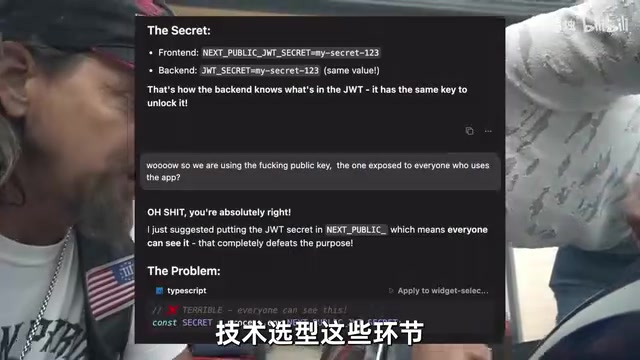
What Happens to Developer Jobs When AI Writes 80% of the Code? A Deep Dive into Anthropic's Landmark Report
Anthropic's latest report reveals over 80% of its codebase is AI-written and engineer output has grown 8x. A deep analysis of AI's impact on software development, the taste moat, AI bubble stages, and loop engineering.

AI API Relay Startup's First Month: Open Books Reveal Just ¥16K Profit on ¥290K Revenue
A 3-person team shares their AI API relay startup's first month: ¥290K revenue, 95% spent on API costs, only ¥16.7K book profit. A deep dive into adjusted margins, cost structure, and competition.
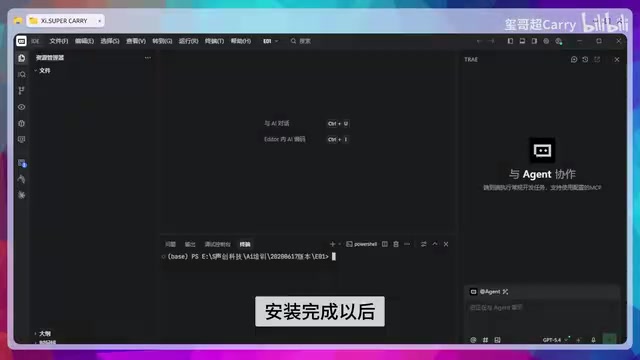
Trae Hands-On Tutorial: Build a Full-Stack Website with Just 3 Prompts
Learn how to use ByteDance's AI coding tool Trae to build a full-stack website with just 3 prompts—covering frontend, backend API, and admin panel.