Deconstructing the Serenity Methodology: An Investment Research Framework from Market Leaders to Physical Bottlenecks
Serenity's method: drill from market leaders down the supply chain to find irreplaceable physical chokepoints.
This article deconstructs the investment research methodology of anonymous analyst Serenity (4,500% annualized returns). The core approach starts from market leaders and drills upstream along supply chains to locate physical chokepoints — nodes that are irreplaceable, supply-rigid, oligopolistic, and undiscovered. The six-step pipeline spans from anchoring super cycles to multi-dimensional verification, and can be systematized using Claude Code for repeatable execution across sectors.
An Anonymous Trader's 4,500% Track Record
A 4,500% annualized return — a number explosive enough for any investment circle. The creator of this track record, Serenity, is an anonymous overseas analyst who positions himself as someone who "tracks bottlenecks no one notices." What's even more noteworthy is that Serenity didn't gain recognition from a single precise bet, but from a repeatable, verifiable, and systematically executable drill-down methodology.
This article is based on a deep breakdown by a Bilibili content creator, fully reconstructing Serenity's investment research framework and exploring how to implement it as an actionable pipeline using Claude Code.
Disclaimer: This article is purely a methodology discussion and does not constitute investment advice. Markets carry risk; invest with caution.
Core Philosophy: Treat Market Leaders as Entry Points, Dig Down to Physical Chokepoints
Start from Leaders, Drill Down Along the Demand Chain
Most investors chase market leaders — buying whatever's hot. Serenity does the exact opposite: the leader is just the entry point, not the destination.
His core action is to start from the market leader and drill layer by layer into the upstream supply chain: Where does demand come from? Where does it propagate? From components to chips, from chips to materials, from materials to substrates, from substrates to equipment — drilling all the way down until hitting an unavoidable chokepoint.
This approach can be summarized in one sentence: "Collect tolls at the narrow pass" — no matter how large the water flow, it must pass through here.
Focus Only on Physical Constraints, Not Business Narratives
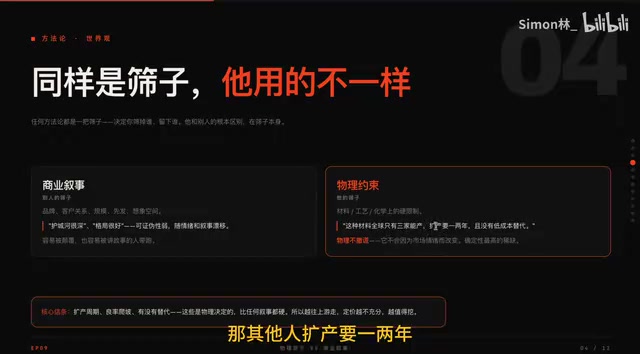
This is the most hardcore principle in Serenity's methodology. Many investment targets love to paint pictures with business narratives — telling stories, casting visions, describing ecosystems. But Serenity only cares about one thing: physical constraints.
Physical constraints refer to hard limitations at the material, process, and chemistry levels. For example, a certain material can only be mass-produced by three companies globally, other companies need one to two years to expand capacity, and there's no low-cost alternative.
In investment analysis, business narrative refers to growth expectations constructed through stories, visions, and ecosystem layouts, such as "the metaverse will change everything" or "Web3 will reshape the internet." The problem with such narratives is the lack of hard constraint verification — they're easily amplified by market sentiment. Physical constraints are entirely different — they're based on objective laws of material science, chemical processes, and physics. For example, the growth rate of silicon carbide (SiC) crystals is limited by thermodynamics, and no amount of capital can break through this in the short term; EUV lithography machine manufacturing involves the coordination of hundreds of thousands of precision components, with only ASML capable of production globally. These constraints don't bend to human will, giving them higher analytical certainty.
His core belief is: Expansion timelines, yield ramp-ups, whether substitutes exist — these facts determined by physical laws are harder than any narrative.
Four Hard Conditions for a Chokepoint: Can't Bypass, Can't Scale, Oligopoly, Undiscovered
What kind of node qualifies as a true "chokepoint"? Serenity provides four conditions that must be simultaneously met:
- Irreplaceable: Downstream has no alternative technology route to bypass it
- Supply rigidity: Capacity cannot be rapidly expanded in the short term
- Oligopoly: Only a handful of players globally can do it
- Not yet discovered: Not yet fully explored and priced in by institutions
Regarding the oligopoly condition, supplier concentration is typically measured using CR3 (combined market share of the top three companies) or the HHI index (Herfindahl-Hirschman Index). In semiconductor upstream materials, oligopoly is extremely common: the photoresist market has a CR3 exceeding 80% (JSR, Tokyo Ohka Kogyo, Shin-Etsu Chemical); ASML holds 100% of the EUV lithography market; the high-purity electronic specialty gas market is controlled by a few companies like Linde, Air Liquide, and Taiyo Nippon Sanso. Oligopoly formation often stems from extremely high technical barriers, lengthy customer certification cycles (typically 1-3 years), and massive upfront R&D investment, making it difficult for new entrants to quickly break the pattern even with capital.
These four conditions form an extremely strict filter. In plain language: can't bypass it, can't scale it, it's an oligopoly, and nobody's watching it. Only when all four conditions hold simultaneously does a true investment opportunity emerge.
Six-Step Drill-Down Pipeline: From Super Cycles to Physical Chokepoints
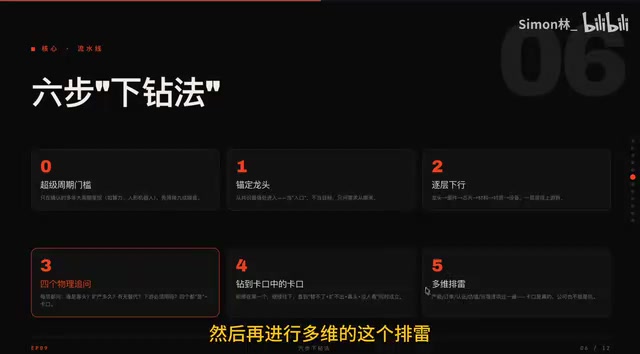
Serenity standardized the entire methodology into six steps, forming a repeatable investment research pipeline:
Step 1: Anchor the Super Cycle
First, determine which super cycle we're currently in. For example, the current AI computing power cycle, and the upcoming humanoid robotics cycle. The super cycle is the starting point of the entire analysis — it determines the total volume and direction of demand.
A Super Cycle is an economics concept describing structural growth trends lasting years or even decades. Historical examples include: the 2000s commodity super cycle driven by China's urbanization, the 2010s mobile internet cycle, and the current AI computing power cycle. Super cycles are characterized by demand growth that is certain and sustained — not short-term hype but long-term trends driven by fundamental technological change or demographic shifts. The key to identifying a super cycle is judging whether demand is irreversible — once started, it's hard to reverse.
Step 2: Anchor the Market Leader
Within the super cycle, identify the clearest market leader. For example, in the AI computing power cycle, NVIDIA is the most obvious leader. The leader is the source of demand — all supply chain analysis begins here.
Step 3: Decompose the Supply Chain Layer by Layer
Starting from the leader, decompose layer by layer upstream: Leader → Components → Chips → Substrates → Materials → Equipment. At each layer, clarify: Who supplies? What are the supply relationships? Are there alternatives?
Step 4: Physical Interrogation (Four Core Questions)
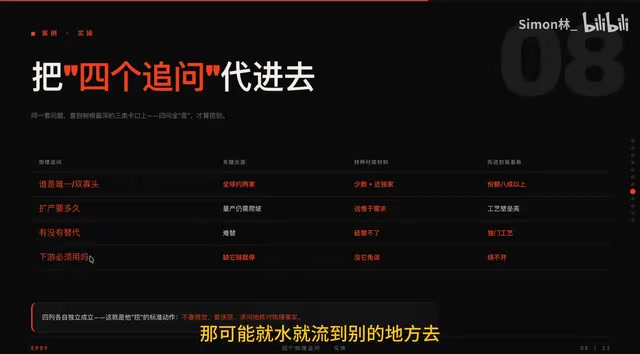
At each layer, rigorously execute four questions:
- Who's the oligopoly? What's the supplier concentration at this node?
- How long to expand capacity? If expansion is fast, it doesn't constitute a real bottleneck
- Are there substitutes? If substitutable, demand will divert when prices rise
- Must downstream use it? If downstream can avoid it, the water flow will find another path
Step 5: Drill to the Chokepoint
Through layer-by-layer interrogation, ultimately locate the true physical chokepoint. Using AI computing as an example: computing power growth → data transmission demand surges → optical interconnect becomes the bottleneck → optical module demand explodes → key light sources can only be mass-produced by two companies globally → specialty substrate materials, advanced packaging, dedicated synthesis equipment — these are the true chokepoints.
It's worth understanding in depth why optical interconnect has become the core bottleneck for AI computing power. As large language model parameters scale from hundreds of billions to trillions, GPU cluster sizes expand dramatically, and inter-chip data transfer rates become the core constraint on computing power scaling. Traditional copper cable interconnects suffer severe signal attenuation and rapidly increasing power consumption beyond 3 meters, while optical interconnects use light signals for data transmission, offering advantages of high bandwidth, low latency, and low power consumption. Optical modules are the core component of optical interconnects, and their laser light sources (such as VCSEL, EML, silicon photonics chips) have extremely high technical barriers. Taking indium phosphide (InP) substrates as an example, only a handful of companies globally can mass-produce telecom-grade InP substrates, with expansion cycles of 18-24 months — a textbook "physical chokepoint" case in Serenity's methodology.
Step 6: Multi-Dimensional Ranking and Verification
After identifying chokepoint candidates, verify from multiple dimensions including capacity, orders, certifications, valuation, and corporate governance, ultimately filtering out targets truly worthy of deep research.
Methodology Boundaries and Limitations
While Serenity's methodology is powerful, it has clear boundaries:
First, chokepoint realization doesn't equal long-term upside. Sometimes a node is so "hard" that it actually limits its own growth potential. Once a chokepoint is fully priced in, excess returns disappear.
Second, tailwinds amplify hit rates. We're currently in the tailwind phase of the AI super cycle, with the entire supply chain trending upward. In this environment, the methodology's hit rate gets systematically amplified, but this doesn't mean the methodology itself is that accurate.
Third, not every focus area is a physical chokepoint. Some nodes Serenity focuses on may not truly constitute physical-level bottlenecks — users need to conduct further verification and judgment on their own.
Building an Investment Research Pipeline with Claude Code
No matter how good a methodology is, it's meaningless if it can't be executed. Here are the specific steps for converting Serenity's methodology into an actionable process using Claude Code:
Step 1: Select a Sector and Batch-Pull Research Reports
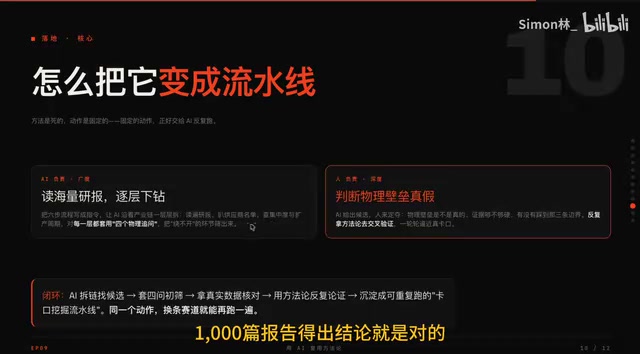
After selecting a sector, have Claude Code batch-pull research reports through data repositories like sdata. Report volume is key — 200 reports is the minimum; for major sectors, pull 1,000 or more. A single report may have inaccurate viewpoints, but when sample size rises to hundreds or thousands, you can form a holistic understanding of the industry. Be careful to control pull rates to avoid triggering limits.
The logical foundation for large-scale report analysis comes from the "signal extraction" concept in information theory. Individual reports may suffer from analyst personal bias, conflicts of interest (the natural bullish tendency of sell-side research), and information lag. But when sample sizes reach hundreds, cross-validation and frequency statistics can effectively filter noise and extract consensus. For example, if 150 out of 200 reports mention a certain supplier as a critical node, with diverse data sources, that judgment's credibility far exceeds any single source. This is essentially a quantitative application of "wisdom of crowds," with Claude Code serving as an efficient information aggregation and structuring tool in this process.
Step 2: Decompose Layer by Layer, Drill Down Progressively
Have Claude Code systematically decompose the reports, starting from the top of the supply chain and analyzing layer by layer downward. When drilling to a noteworthy node, pull another ~200 specialized reports for that specific sub-segment for deeper analysis.
Step 3: Apply the Four Questions for Screening
At each layer, have AI execute the four core questions: Can't bypass? Can't scale? Oligopoly? Is anyone watching? Cross-check physical facts layer by layer, ultimately outputting a chokepoint list.
Step 4: Human-AI Collaborative Verification
This step is crucial. Conclusions derived from AI-based report analysis cannot be directly treated as final answers. Users need to actively challenge AI conclusions, question the reasoning basis, and let the AI correct its views through adversarial dialogue. Only what survives repeated argumentation and data verification constitutes a truly reliable physical chokepoint.
AI limitations in report analysis manifest in three main areas: first, the "hallucination" problem — large language models may generate conclusions that seem reasonable but are actually wrong; second, timeliness issues — training data has cutoff dates and cannot reflect the latest capacity expansions or technological breakthroughs; third, depth judgment issues — AI cannot understand the true difficulty of a process breakthrough the way an industry expert can. Therefore, the "human" role in human-AI collaboration is indispensable — cross-validating AI outputs using industry experience, primary research data, and patent searches. Best practice is to treat AI as an "efficient preliminary screening assistant" rather than a "decision maker."
The entire closed loop can be summarized as: AI decomposes the chain to find candidates → Apply four questions to screen → Verify with data → Repeatedly argue the methodology → Crystallize true chokepoints. Switch to a different sector, and the same process can be fully reused.
Summary
The essence of Serenity's methodology is using physical constraints instead of business narratives as the filter for investment decisions. It doesn't chase hot topics or listen to stories — instead, it drills layer by layer along the supply chain until finding that chokepoint "where all water must pass through no matter how large the flow." The value of this methodology lies not only in its logical coherence but in its systematizability and repeatability — which is precisely what AI tools excel at.
Of course, every methodology has its applicable boundaries. When using it, respect the framework's discipline while maintaining independent thinking ability. After all, the person ultimately responsible for investment decisions is always yourself.
Related articles

AI Aggregator Platforms Tested: A Complete Guide to Using GPT 5.5 and Other Top Models for Free
A hands-on guide to using GPT 5.5, Gemini 3.1 Pro, and Grok 4.2 for free via AI aggregator platforms, covering cross-model context memory, account pool mechanisms, and key security risks.
Vibe Coding in Practice: A Junior Student Uses Cursor to Build a Multi-Agent System with 51 AI Officials Based on the Three Departments and Six Ministries Framework
A junior student uses Cursor and Vibe Coding to build a multi-agent system with 51 AI officials modeled on China's Three Departments and Six Ministries, featuring task distribution, approval workflows, and Token cost visualization.
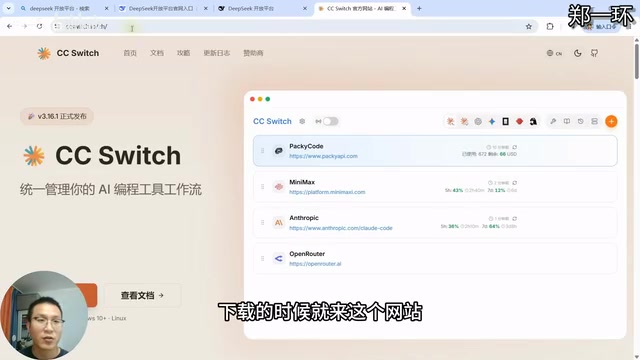
How to Connect Codex to DeepSeek Models: Free Switching via CC Switch
Learn how to connect OpenAI Codex to DeepSeek models via CC Switch, enabling free switching between DeepSeek and GPT with complete setup and routing guide.