Deep Dive into Alibaba's AgentScope 2.0: Six Core Upgrades and Agent Design Patterns
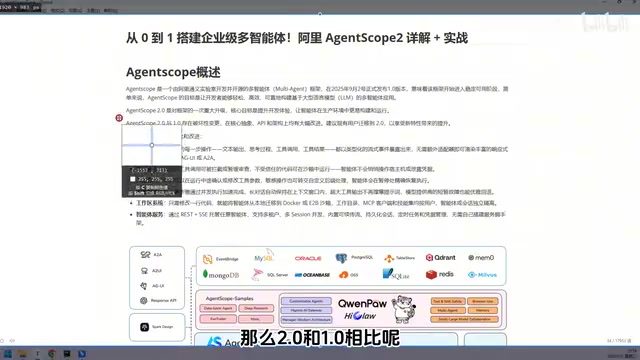
Alibaba's AgentScope 2.0 upgrades multi-agent development with six production-grade improvements and classic agent patterns.
Alibaba's Tongyi Lab released AgentScope 2.0, a major multi-agent framework upgrade featuring six core improvements: event system, execution safety, human-in-the-loop, higher execution efficiency, workspace system, and agent-as-a-service. The article also explains the ReAct and Plan-and-Execute agent design patterns that power the framework's architecture.
Alibaba's Tongyi Lab recently released AgentScope 2.0, a multi-agent framework that represents a major leap from "toy-grade" to "production-grade" compared to version 1.0. This article provides an in-depth analysis of AgentScope 2.0's design philosophy and practical value, covering its framework architecture, core improvements, and agent design patterns.
What Is AgentScope 2.0?
AgentScope is an open-source multi-agent development framework developed by Alibaba's Tongyi Lab, designed specifically for multi-agent collaboration in complex scenarios. While the previously released version 1.0 pioneered the concept of multi-agent orchestration, it still had notable shortcomings in terms of practical usability.
AgentScope 2.0 introduces major upgrades to the framework with a clear objective: improve the developer experience and make it easier to build and run agents in production environments. One important detail: 2.0 is a Breaking Change relative to 1.0 — code written for 1.0 won't run directly in a 2.0 environment, as the API layer has been completely redesigned. So if you're just getting started with this framework, it's best to jump straight into 2.0.
Six Core Improvements Explained
AgentScope 2.0 delivers significant improvements across six key areas, each targeting real pain points of multi-agent systems in production environments.
1. Event System
Every operation in the framework — text output, reasoning processes, tool calls, tool results — is exposed as a typed event. Developers can precisely monitor and respond to every step of an agent's execution, providing a solid foundation for debugging, logging, and flow control.
2. Execution Safety
This is one of the most critical improvements in AgentScope 2.0. Large language models are fundamentally probabilistic and cannot guarantee 100% output correctness. If a model hallucinates a dangerous instruction — such as generating a command to delete system files — and the agent executes it without judgment, the entire system could crash instantly.
Version 2.0 introduces execution safety mechanisms that can automatically intercept dangerous instructions, ensuring the system remains robust even when facing anomalous outputs.
3. Human-in-the-Loop
During agent execution, users can confirm or modify tool parameters at critical checkpoints, and sensitive operations can be routed to custom backend handlers. The system automatically pauses at points requiring human review, waiting for confirmation before continuing execution.
This is especially crucial in high-risk scenarios like payments and transfers — you would never want an AI to automatically complete a large financial transaction without human confirmation.
4. Higher Execution Efficiency
Multi-tool call steps can be accelerated through concurrent execution. Additionally, long conversations are automatically kept within the context window, large tool outputs no longer blow up prompts, and transient failures from model providers are handled with graceful fallbacks. These seemingly minor optimizations are actually critical factors determining system stability in production environments.
5. Workspace System
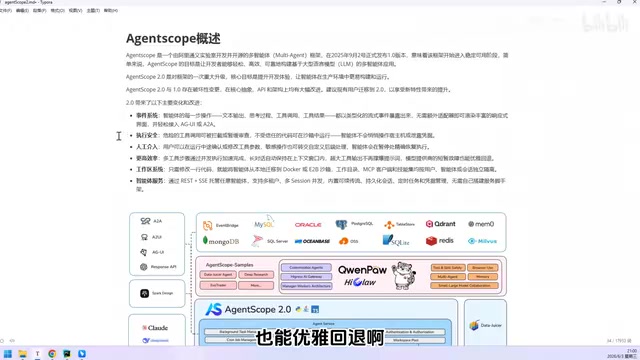
This is one of the most practically valuable improvements in AgentScope 2.0. Developers can seamlessly migrate agents from local environments to cloud deployments without modifying a single line of code. This directly solves a long-standing developer headache: agents that run perfectly locally but crash when deployed to the cloud. The workspace system makes environment switching transparent and painless.
6. Agent-as-a-Service
Any agent can be hosted with a single click via REST API, supporting enterprise-grade features such as multi-tenancy, concurrent multi-session handling, checkpoint resumption, streaming responses, scheduled tasks, and rate management. Developers no longer need to build their own service scaffolding — AgentScope 2.0 comes with a complete built-in service layer.
Architecture Overview: An Ecosystem, Not an Island
AgentScope 2.0's architecture reflects an "ecosystem" approach rather than a closed, monolithic framework.
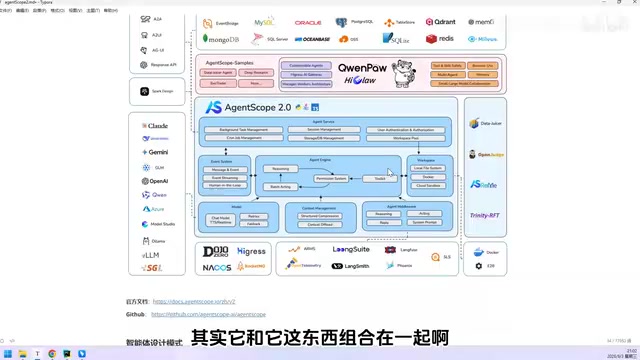
The framework core sits at the center of the architecture, connecting outward across multiple dimensions:
- Model Layer: Supports mainstream LLMs including GLM, DeepSeek, Gemini, Zhipu, OpenAI, Qwen, and more
- Application Layer: Provides a unified development interface for upper-layer applications
- Tool Layer: Integrates various supporting tools
- Environment Layer: Supports multiple runtime environments
- Middleware Layer: Provides underlying infrastructure support
It's worth noting that not all components are developed by Alibaba's Tongyi Lab — AgentScope 2.0 itself is the framework core, which combines with surrounding models, tools, middleware, and other components to form a complete multi-agent development ecosystem.
Agent Design Patterns: ReAct and Plan-and-Execute
Understanding agent design patterns is a prerequisite for using AgentScope effectively. The framework primarily employs two classic AI Agent design paradigms.
ReAct Pattern: Alternating Between Thinking and Acting
ReAct stands for Reason and Act, and it's currently the most mainstream paradigm for building agents. Its core idea mimics how humans solve problems: think first, then act, observe the results, and adjust the next round of thinking and action based on those results.
Using "finding the latest AI news" as an example, the ReAct workflow looks like this:
- Reason: The LLM analyzes the task and determines "I need to search for recent AI news first"
- Act: The agent invokes a search tool to perform the search
- Observe: Check whether the search results meet expectations
- Reflect: Discover that some results are irrelevant and refine the search terms for another query
- Iterate: Repeat the above process until the results are satisfactory
- Output: Organize and deliver the final AI news summary
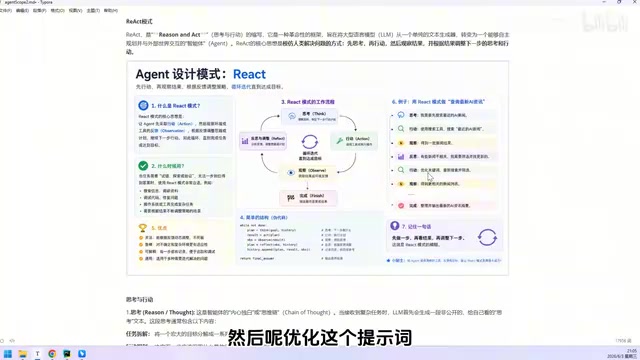
In short, the essence of ReAct is: take one step, check the results, then adjust the next step. This closely mirrors how humans handle complex problems — much like how in a judicial system, a judge's ruling still needs to be reviewed by the prosecution, with a verification step at every stage.
Plan-and-Execute Pattern: Plan First, Execute Later
The Plan-and-Execute (PE) pattern divides task processing into two distinct phases:
- Planning Phase: After receiving the user's instruction, a powerful LLM comprehensively analyzes the task and creates a detailed multi-step action plan. This plan is static — it's fully formulated before execution begins
- Execution Phase: The plan is executed step by step in strict order, potentially invoking various tools such as search engines, code interpreters, and APIs along the way. The planning process is only restarted when a major obstacle is encountered
The core difference between the two agent design patterns is this: ReAct alternates between thinking and execution, with the possibility of adjusting direction at every step; PE involves one-time planning followed by sequential execution. Currently, AgentScope 2.0 primarily adopts the ReAct pattern, which is also the mainstream choice in the industry.
Summary and Outlook
The release of AgentScope 2.0 marks a critical step for Alibaba in the multi-agent framework space — moving from experimentation to production readiness. The six core improvements — event system, execution safety, human-in-the-loop, execution efficiency, workspace system, and agent-as-a-service capabilities — each precisely address real-world production requirements.
For developers considering building multi-agent applications, AgentScope 2.0 offers a choice worth serious evaluation: it provides not only a well-designed framework but also clear design pattern guidance (ReAct / Plan-and-Execute), along with out-of-the-box service capabilities that significantly lower the barrier from development to deployment.
Of course, the true value of any multi-agent framework must ultimately be validated in real projects. Interested developers are encouraged to start with the official documentation and example projects to experience firsthand the development improvements that AgentScope 2.0 brings.
Related articles

T3 Stack Creator Theo's Story: The Lazy Programmer Philosophy Behind a Full-Stack Type-Safe Tool
T3 Stack creator Theo reveals how Create T3 App was born from a lazy programmer's quest for full-stack type safety, solving the frontend-backend type disconnect.
GML 5.2 Multimodal Upgrade Hands-On: Full Validation with DeepSeek V4
Hands-on testing of GML 5.2 and DeepSeek V4 multimodal upgrades on OneBlockBase, covering vision-text workflows, safety mechanisms, and deployment tips.
DeepSeek + Cline Setup Guide: A $1.50 Alternative to $20/Month AI Coding Subscriptions
Step-by-step guide to configuring DeepSeek API with VS Code plugin Cline, including API Key setup, Plan/Act dual-model strategy, and project management files for a $1.50 AI coding alternative.