Deep Dive into ByteDance's Codex Chinese Manual: A Complete Guide Across Ten Chapters

ByteDance releases a ten-chapter Codex Chinese manual covering everything from setup to multi-Agent collaboration.
ByteDance has released a systematic Codex Chinese user manual spanning ten chapters that covers environment setup, command configuration, sandbox environments, MCP workflows, Skills encapsulation, multi-Agent collaboration, and background tasks. The manual fills a gap in Chinese-language Codex learning resources and serves developers at all levels from beginners to advanced practitioners.
Overview: Why This Manual Deserves Your Attention
ByteDance has released a comprehensive Codex Chinese user manual covering everything from zero-knowledge basics to advanced multi-Agent collaboration, spanning ten major chapters. For developers who have long struggled with English-only documentation or been misled by scattered tutorials, this systematic Chinese guide fills an important gap.
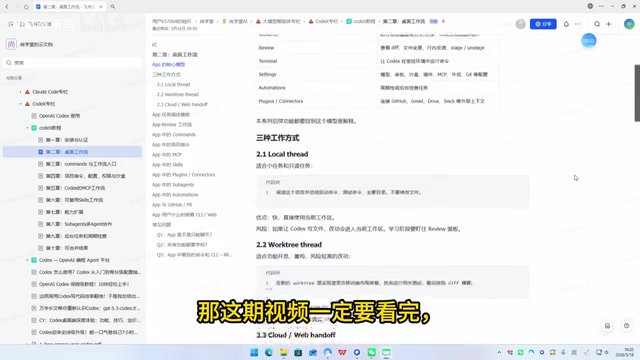
Codex is an AI programming assistant developed by OpenAI, built on large language model technology. It can understand natural language instructions and generate, modify, and debug code. Initially widely recognized as the underlying engine of GitHub Copilot, it later evolved into a standalone programming Agent tool capable of autonomously executing complex programming tasks in sandbox environments. Unlike traditional code completion tools, Codex can understand project context, execute multi-step operations, and interact with external systems—representing a paradigm shift in AI programming tools from "assisted completion" to "autonomous execution."
Codex's official documentation has long been primarily in English, and Chinese developers frequently encounter issues with configuration, permissions, and multi-Agent collaboration. The release of this Chinese manual significantly flattens the learning curve. It's worth noting that ByteDance has been continuously investing in AI development tools in recent years, launching products like Doubao MarsCode and Coze in addition to this Codex Chinese manual. ByteDance's choice to publish a Codex Chinese manual rather than solely promoting its own products reflects an open strategy in developer ecosystem building—attracting developer community attention through high-quality technical documentation and tutorials while cultivating a user base for its own AI infrastructure products.
Beginner Section: Core Content of Chapters One Through Four
Environment Setup and Basic Configuration
The first four chapters focus on the complete onboarding process from scratch, covering these key areas:
- Installation & Authentication: Detailed environment setup steps including dependency installation, account authentication, etc.
- Desktop Workflow: How to efficiently use Codex in a local desktop environment
- Commands Configuration: Core command usage and parameter descriptions
- Project Permissions & Sandbox Environment: Securely isolated runtime environment configuration
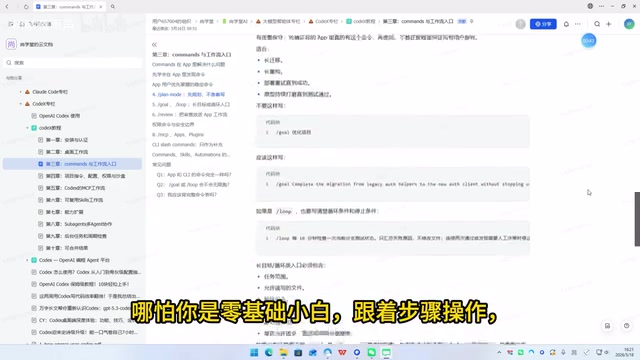
For complete beginners, following the manual's steps allows you to complete environment setup and run your first task within about five minutes—a several-fold efficiency improvement over translating English documentation word by word.
The Importance of Sandbox Environments
The sandbox environment is the foundation for Codex's secure operation. A sandbox is a security isolation mechanism that prevents potentially destructive operations by restricting a program's system access permissions. In AI programming scenarios, sandbox environments are particularly critical because AI-generated code may contain unexpected system calls, file deletions, network requests, and other operations. Common sandbox implementation technologies include containerization (such as Docker), virtual machines, and OS-level permission isolation (such as Linux namespaces and cgroups).
Codex's sandbox environment is typically based on lightweight container technology, creating an independent isolated space for each code execution that is destroyed upon completion, ensuring the host system's files, network, processes, and other resources remain unaffected. The manual explains in detail how to configure this isolated execution environment to ensure AI-generated code doesn't impact the host system. This is especially important for enterprise applications—security isolation is an essential prerequisite when using AI programming tools in production environments.
Intermediate Section: MCP Workflows and Skills Encapsulation
MCP Workflow Setup (Chapter Five)
Chapter Five provides an in-depth explanation of how to build Codex's MCP (Model Context Protocol) workflows. MCP is an open standard protocol proposed by Anthropic in late 2024, designed to solve the connection problem between AI models and external data sources and tools. Before MCP, every AI application needed to write specialized integration code for different data sources and tools, resulting in massive duplication of effort.
MCP defines a unified communication standard that allows AI models to access databases, file systems, API services, and other external resources in a standardized way. It adopts a client-server architecture where AI applications act as clients initiating requests, and MCP servers handle interactions with specific external systems. This design is similar to how the USB protocol unifies hardware devices, greatly simplifying the extension development of AI tools. Through proper MCP configuration, Codex can gain extended capabilities such as database access, API calls, and file system operations—upgrading it from a pure code generation tool to a full-stack development assistant capable of interacting with real systems.
Reusable Skills Encapsulation (Chapter Six)
Chapter Six contains extremely practical content—how to encapsulate repetitive operations into reusable Skills (skill plugins).
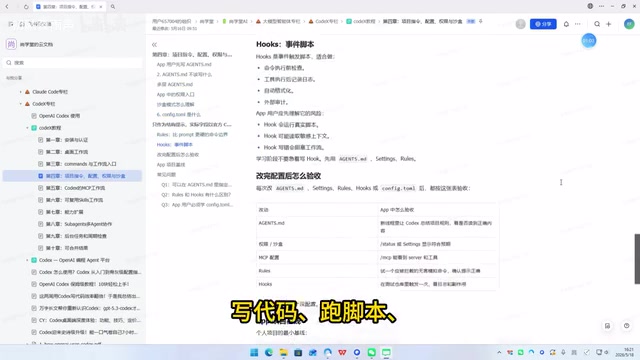
Specifically, the value of Skills encapsulation lies in:
- Reducing Repetitive Work: One-click invocation of commonly used code generation and data processing workflows
- Team Sharing: Encapsulated Skills can be distributed and used across teams
- Quality Consistency: Standardized operational processes reduce human errors
For example, you can encapsulate a workflow like "read CSV file → data cleaning → generate visualization charts" into a single Skill, requiring only one command to complete the entire process afterward. The design philosophy of Skills is similar to function encapsulation and modularization in software engineering, but it operates on AI behavior patterns rather than traditional code logic. This enables non-technical personnel to accomplish complex automation tasks by combining existing Skills.
Advanced Section: Multi-Agent Collaboration and Background Tasks
Subagents Multi-Agent Collaboration Mechanism (Chapter Eight)
Chapters Seven through Ten target advanced developers. The most noteworthy among them is the Subagents multi-Agent collaboration mechanism.
Multi-Agent collaboration is an important development direction in current AI system architecture, with its core concept derived from distributed computing and microservices architecture thinking. In single-Agent mode, one AI model needs to handle all tasks independently, easily running into problems like context window overflow and task complexity exceeding capability boundaries. Multi-Agent architecture decomposes complex tasks into multiple subtasks handled by specialized Agents separately, then integrates results through coordination mechanisms. The advantages of this pattern include: individual Agents can focus on specific domains to improve quality, multiple Agents can execute in parallel to improve speed, and the overall system has stronger fault tolerance. Similar industry practices include Microsoft's AutoGen framework and CrewAI, among other multi-Agent orchestration tools.
The manual provides detailed explanations of the specific implementation of multi-Agent collaboration in Codex:
- Capability Extension: How to add new tools and capabilities to Codex
- Task Distribution: How to properly decompose tasks and assign them to different Subagents
- Result Merging: How outputs from multiple Agents are integrated into final results
For example, a complete web application development task can be decomposed as follows: a frontend UI Agent handles page component development, a backend API Agent handles interface design and implementation, a testing Agent handles automated test case writing, and finally a main Agent coordinates and merges all outputs. This division of labor model greatly improves development efficiency for complex projects.
Background Tasks and Periodic Checks (Chapters Nine and Ten)
The manual also covers background task configuration and periodic checking mechanisms. This means you can set up Codex to continuously run specific tasks in the background, such as:
- Periodically checking code repository quality issues
- Automated test case generation and execution
- Periodic documentation updates and synchronization
These features are especially valuable for team collaboration scenarios, upgrading AI programming tools from "passive response" to "proactive service." This pattern essentially transforms the AI programming assistant from an on-demand tool into a continuously online "virtual developer" on the team. It can perform code reviews, dependency update checks, security vulnerability scans, and other routine maintenance tasks unattended, freeing human developers to focus on more creative work.
Practical Value Assessment of the Manual
Strengths
The greatest value of this manual lies in its systematic approach and localization. Most Codex tutorials on the market are scattered and primarily in English, while this manual provides a complete learning path with progressive layers from basics to advanced topics. The fully Chinese presentation also eliminates language barriers and lowers the entry threshold.
Target Audience
- Zero-knowledge developers: The first four chapters are sufficient for quick onboarding
- Experienced AI programming users: The middle chapters on MCP and Skills encapsulation can significantly improve efficiency
- Team technical leads: The last four chapters on multi-Agent collaboration and background tasks are suitable for team-level applications
Points to Note
Although the manual is comprehensive, practical use still requires attention to: Codex's capability boundaries, API call costs, and applicability in specific scenarios. The manual provides operational guidance, but specific best practices still need to be explored through project experience. Additionally, AI programming tools iterate extremely fast, and some configurations and interfaces in the manual may change with version updates—it's recommended to reference the official Changelog alongside the manual.
Conclusion
ByteDance's Codex Chinese manual is indeed one of the most systematic and complete Chinese learning resources currently available. Its ten chapters cover the entire chain from environment setup to multi-Agent collaboration, offering corresponding solutions for both individual developers and team use cases. For developers exploring AI programming tools, this manual is worth bookmarking and consulting repeatedly.
Key Takeaways
- ByteDance released a complete Codex Chinese manual with ten chapters covering the full journey from beginner to advanced
- The first four chapters address foundational issues including environment setup, command configuration, permissions, and sandbox environments
- Chapters Five and Six explain MCP workflow setup and reusable Skills encapsulation, significantly improving development efficiency
- Advanced chapters cover Subagents multi-Agent collaboration, background tasks, and periodic checks for team-level functionality
- The systematic Chinese-language guide fills a gap in domestic Codex learning resources
Related articles
 Tutorials
Cursor + Codex Dual-IDE Collaboration: A Practical Methodology for Open-Source Project Customization
A complete methodology for open-source project customization based on real-world experience, detailing the Cursor+Codex dual-IDE workflow, seven-stage process, MVP validation, and AI source code reading techniques.
 Tutorials
Cursor Multi-Agent in Practice: Building a Full-Stack Next.js Blog in 50 Minutes
Build a full-stack blog in 50 minutes using Cursor IDE's multi-Agent mode with Next.js, Clerk auth, and Supabase. Learn the 4-phase AI Agent workflow and key integration pitfalls.
 Tutorials
Building an AI Software Factory from Scratch: A Cursor Engineer's Hands-On Experience with Multi-Agent Collaboration
Cursor engineer Eric shares practical insights on building an AI software factory: automation levels, guardrail design, parallel Agent management, and scaling to 1000+ Agents for 24/7 development.