Deep Dive into Cursor Refill Plugins: Pay-Per-Use Billing and Account Pool Scheduling Mechanisms
Technical breakdown of Cursor refill plugins: account pool scheduling, pay-per-use billing, and compliance risks.
This article dissects the architecture of Cursor refill plugins that use clean account pool scheduling instead of code tampering, offering pay-per-use billing at 35% of official prices. While technically more robust than cracking tools, users should weigh compliance risks with Cursor's ToS, data security concerns from intermediate layers, and long-term sustainability before adopting such solutions.
Introduction: Two Major Pain Points for Cursor Users
For developers who use Cursor daily for AI-assisted programming, cost has always been an unavoidable topic. Cursor is a deeply customized AI-native IDE built on VS Code that deeply integrates large language models like Claude and GPT, providing developers with code generation, intelligent completion, multi-file refactoring, and other capabilities. It has become the benchmark product in the AI programming tools space.
On one hand, the market is flooded with cheap trial accounts and shared accounts that get banned frequently, offering terrible stability. On the other hand, the official monthly subscription (Pro version at $20/month) represents obvious waste for programmers with irregular usage patterns—you might code intensively for 8 hours one day, then not touch it for several days, yet the monthly fee keeps charging regardless.
Recently, a technically-minded content creator on Bilibili provided a detailed breakdown of the underlying architecture, billing logic, and account mechanisms of their team's Cursor "refill" plugin, attempting to address user concerns with complete transparency. This article provides an in-depth analysis of their solution to help developers assess the actual value and potential risks of such tools.
Why Cheap Trial Accounts and Cracking Tools Inevitably Get Banned
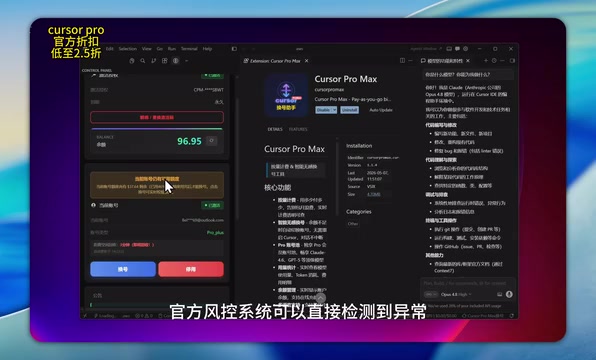
The creator first pointed out a key technical fact: most Cursor alternative tools or cracking tools on the market fundamentally operate by tampering with Cursor's frontend code or proxying requests through API intermediaries to shell models. The essence of this approach is modifying client-side data, and Cursor's official enforcement system can directly detect such abnormal behavior.
From a technical perspective, this assessment is reasonable. As a commercial IDE product, Cursor inevitably implements integrity verification mechanisms in its client. Specifically, this verification involves multiple technical layers: the client validates hash values of core files during startup and runtime to ensure they haven't been tampered with; each communication with the server includes request signatures generated from device fingerprints, timestamps, and keys, allowing the server to determine whether requests come from legitimate clients; additionally, telemetry systems commonly adopted by modern SaaS products continuously collect client behavior data, including plugin lists, runtime environments, request frequency patterns, etc., for anomaly detection. These multi-layered protection mechanisms make any frontend tampering extremely easy to identify.
The so-called API proxy shelling refers to third-party tools intercepting API requests that Cursor sends to official servers, redirecting them to self-hosted intermediate servers, which then call other large language models (such as through OpenAI API, Anthropic API, etc.) to generate responses, and finally returning results disguised as Cursor's official model output back to the client. This man-in-the-middle (MITM) approach has multiple problems: response formats and model behavior characteristics are difficult to perfectly simulate and can be detected by server-side response consistency checks; request latency patterns become abnormal; and security mechanisms like TLS Certificate Pinning directly block unauthorized proxying.
Therefore, getting banned for using cracking tools is not a matter of probability, but a matter of time.
This also explains why many users report: purchased trial accounts stop working within days, and shared accounts are even more precarious.
Core Mechanism: Clean Account Scheduling Rather Than Code Tampering
The plugin claims to adopt a completely different technical approach—no modification of any Cursor frontend code, no intervention in client-side data modification—only performing "clean account scheduling."
How Account Pool Scheduling Works
In simple terms, the plugin establishes an intermediate scheduling channel that connects the user's local Cursor client to an "account pool" composed of legitimate official accounts.
From a technical architecture perspective, this account pool scheduling resembles a combination of reverse proxy and load balancing. Its core typically includes several key components: an account management system that maintains the status, quota balance, and health of all legitimate accounts; a scheduling engine that distributes user requests to appropriate accounts based on load balancing algorithms (such as weighted round-robin, least connections, etc.); and a session management layer that ensures requests from the same user within a time period are routed to the same account to avoid context loss. The user's Cursor client itself undergoes no modifications—only the authentication credentials are replaced with those of pool accounts. Therefore, from Cursor's server perspective, every request comes from a legitimate paying user.
Since the entire process involves no code tampering or model shelling, it can theoretically achieve the following:
- Perfect compatibility with all official Cursor models, including Opus 4, Fable 5, and other latest models
- No interference with normal client updates—official new version pushes can be upgraded directly
- Reduced risk of detection and banning, since from Cursor's server perspective, normal official accounts are being used normally
A few more words about model compatibility. Claude Opus 4 is Anthropic's flagship reasoning model released in 2025, delivering exceptional performance in complex code generation, multi-file refactoring, and architecture design tasks, with significant improvements in context window and instruction-following capabilities compared to its predecessors. Cursor provides users with a unified access point through deep commercial partnerships with these model providers, eliminating the need to manage multiple API keys separately. This is why the account pool solution emphasizes "perfect compatibility with all official models"—because it essentially uses the full permissions of official accounts rather than cobbling together alternatives through third-party APIs.
Account Quality: Fully Purchased Pro and Enterprise Accounts
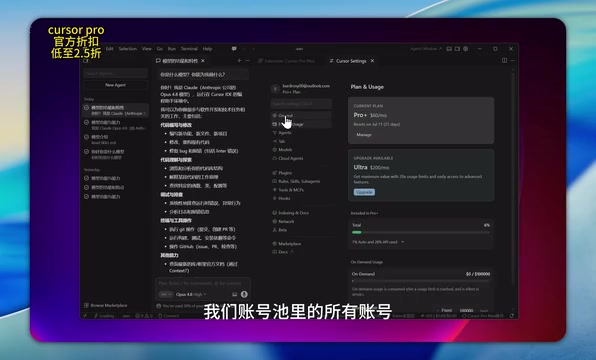
The solution emphasizes that all accounts in its pool are fully purchased official Cursor exclusive Pro accounts and enterprise accounts, completely eliminating trial accounts, shared accounts, and other gray-market accounts. This is the core guarantee for their claimed long-term stable operation.
From a business logic perspective, this means the team needs to continuously invest substantial funds to maintain the account pool. Account quality directly determines service stability—legitimate paid accounts have a much higher trust level in the official system than trial accounts, and the probability of mass banning is indeed lower.
Billing Model Explained: Pay-Per-Use vs. Monthly Subscription
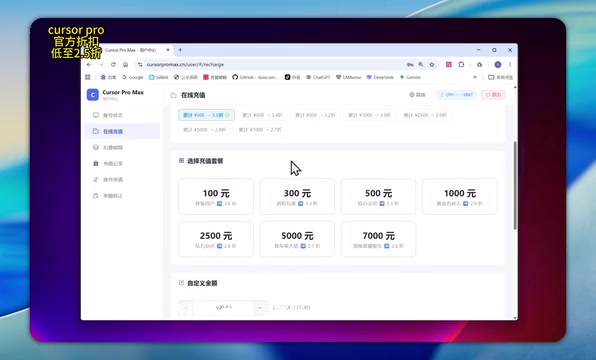
This is one of the most attractive design aspects of the solution. Unlike the official fixed monthly fee, this plugin adopts a pure pay-per-use billing model:
- Rate standard: Charged at 35% of Cursor's official price (i.e., 3.5x discount)
- Billing granularity: Precise to every code generation, every conversation, every token consumed
- Zero usage, zero charges: If you're not coding and not consuming tokens, no fees are incurred
- Balance never expires: Deposited funds never expire or get cleared
It's worth explaining the concept of tokens here. Tokens are the basic units that large language models use to process text—in English, each word corresponds to approximately 1-1.5 tokens, while in Chinese, each character is roughly 1.5-2 tokens. Cursor Pro accounts include a certain monthly quota of Fast Requests, with throttling or additional charges after exceeding the limit. Precise per-token billing means the system needs to track input and output token counts for each request in real-time, which technically requires interfacing with Cursor's Usage API or precise metering through the proxy layer.
Intelligent Idle Quota Circulation
The solution also mentions a key mechanism: all idle quota from unused accounts automatically circulates and releases in real-time within the account pool. This means when an account's monthly quota isn't fully used, the remaining allowance can be allocated to other users, maximizing resource utilization.
This "resource pooling" approach is very mature in cloud computing (similar to overcommitment mechanisms) and is the core business logic enabling the team to offer services at a 65% discount. Overcommitment originates from a classic business model in the cloud computing industry—cloud providers discovered that not all users utilize their full resources simultaneously, so physical resources can be allocated to users at ratios exceeding actual capacity. Similarly, Cursor Pro accounts' monthly quotas are rarely fully consumed by individual users. Through pooled scheduling, idle quotas can serve other users, improving overall utilization from the typical 30-40% to over 70-80%. Reducing unit costs through bulk purchasing, then improving resource utilization through intelligent scheduling, and profiting from the margin—this is the core business logic of the solution.
Transparency and Trust Mechanisms
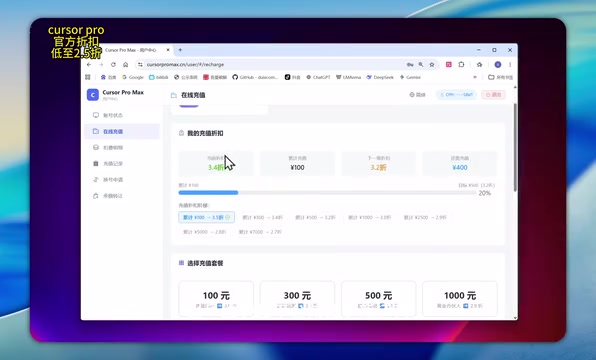
Regarding billing transparency, the solution promises:
- User dashboard consumption details are fully synchronized with Cursor's official original bills
- Each charge is precise to three decimal places
- Users can self-audit at any time, with all data publicly accessible
This "no black-box billing" approach, if actually implemented, is very effective for building user trust. After all, the most criticized aspect of many similar products is opaque billing and phantom charges.
A Rational Perspective: Potential Risks and Considerations
Although the solution appears reasonable in terms of technical architecture and business model, users should maintain rational judgment:
Compliance Risks
Account sharing or scheduling may inherently violate Cursor's Terms of Service (ToS). Almost all SaaS products' terms of service explicitly prohibit account sharing, transfer, or proxy usage. Cursor's ToS typically includes clauses such as: each account is limited to use by the registered user only, account credentials must not be provided to third parties, and services must not be used in bulk through automated means. Violating these terms may result in account suspension or permanent banning, with users having no right to request refunds. From a legal perspective, even if no code is technically tampered with, the essence of account pool scheduling is still allowing non-account holders to use that account's service entitlements, which sits in a clearly gray area regarding compliance. It's worth noting that enterprise accounts typically have more flexible multi-user authorization mechanisms, but their usage scope is usually limited to within that enterprise organization.
Once Cursor adjusts its detection strategies (such as anomaly detection based on IP, device fingerprints, or usage patterns), service stability may be affected. Device Fingerprinting is a technology that uniquely identifies a device by collecting multi-dimensional data including hardware information, operating system version, network environment, and more. In Cursor's context, device fingerprints may include combinations of machine ID, MAC address hash, CPU/GPU model, screen resolution, timezone settings, and other information. When the same account initiates requests from multiple different device fingerprints within a short period, it triggers anomaly detection alerts. More advanced detection also analyzes usage patterns—for example, an account continuously sending requests non-stop within 24 hours, or frequently switching between code languages and project types—these may all be flagged by machine learning models as characteristics of shared accounts.
Data Security Considerations
Using a third-party scheduling channel means your code requests pass through an intermediate layer. Although the solution claims to be "clean and untampered," users still need to assess whether their code involves sensitive information and whether they trust the intermediate layer not to log or leak data. In actual network communications, even if the intermediate layer doesn't actively record data, code content still briefly passes through third-party server memory during transmission, theoretically creating the possibility of interception. For code involving sensitive industries such as finance, healthcare, or government, this risk is particularly worth considering.
Long-term Sustainability
This business model relies on "bulk purchase price differentials." If Cursor adjusts enterprise account pricing strategies or strengthens shared account detection, the service's cost structure may change. Based on industry precedents, similar "resource pooling resale" models have appeared in ecosystems of other SaaS products (such as Netflix, Spotify, etc.), but as platforms strengthen controls, the survival space for such services tends to gradually narrow.
Summary and Recommendations
From a technical architecture perspective, the "clean account scheduling" approach adopted by this Cursor refill plugin is indeed more robust than cracking tools and trial accounts on the market. The pay-per-use model with non-expiring balances also better fits programmers' actual usage habits. The creator's suggestion for users to start with a small 100 RMB deposit for testing is also quite pragmatic.
For developers with such needs, recommendations include:
- Start with a small amount to verify stability and billing transparency before deciding on long-term use
- Do not use third-party scheduling tools for projects involving core business secrets
- Stay informed about official policy changes and assess risks promptly
- If your usage frequency is high and consistent, subscribing directly to the official Pro version may still be the safest choice
Ultimately, which solution to choose depends on your trade-off between cost, stability, and security.
Related articles
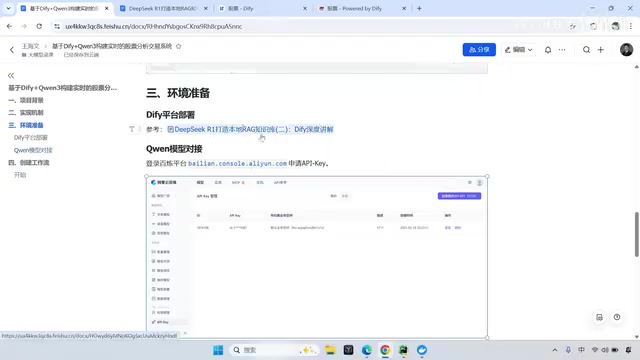
Building an AI Stock Analysis System with Qwen3 + Dify: A Hands-On Tutorial
A hands-on guide to building a real-time AI stock analysis system using Dify workflows and Qwen3. Covers deployment, technical indicators (RSI/MACD/Bollinger Bands), and trading strategy generation.

Ubisoft Co-Founder Claude Guillemot Dies in Plane Crash at Age 69
Ubisoft co-founder Claude Guillemot has died in a plane crash at age 69. He co-founded Ubisoft with his four brothers, creating iconic IPs like Assassin's Creed and Far Cry.

How to Write Prompts: Four Elements, Three Techniques, and Three Pitfalls Explained
Master prompt writing with the four-element framework (Role, Task, Requirements, Format), three techniques (few-shot, chain-of-thought, anti-hallucination), and avoid three common pitfalls for better AI results.