Deep Dive into LangChain's Social Media Agent Open-Source Project: Architecture, Features, and Practical Value
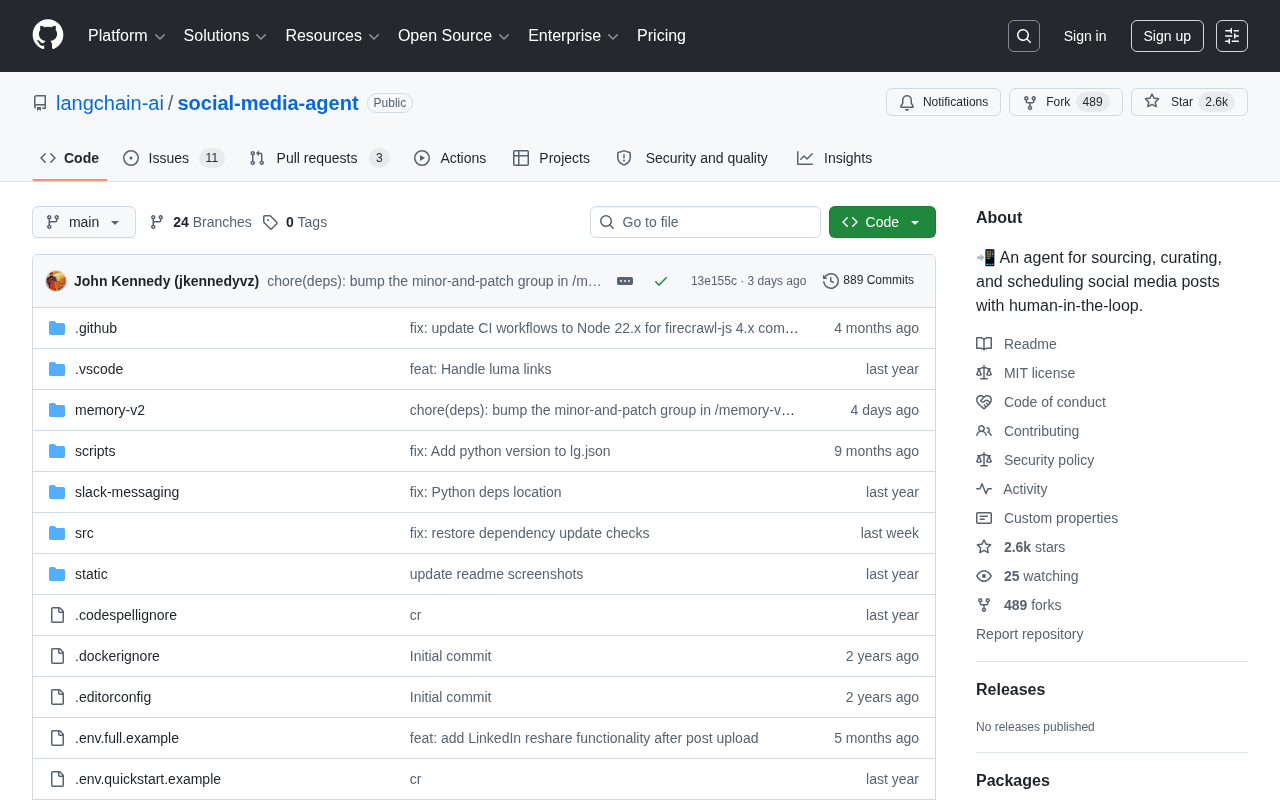
A deep dive into LangChain's open-source social media Agent covering architecture, HITL design, and practical value.
LangChain's social-media-agent is an open-source TypeScript project that automates social media content sourcing, AI-powered curation, and scheduled publishing. Built on LangGraph's directed-graph workflow orchestration, it features a Human-in-the-Loop mechanism for human review at critical steps. With 2,600+ GitHub stars, it exemplifies the rise of vertical AI Agents and offers a compelling open-source alternative to SaaS tools like Buffer and Hootsuite.
Project Overview
The LangChain team has open-sourced a project called social-media-agent on GitHub, focused on automated social media content sourcing, curation, and scheduled publishing. Built with TypeScript, the project has already earned 2,600+ stars and nearly 500 forks, reflecting strong community demand for AI-driven social media automation.
LangChain is one of the most influential large language model (LLM) application development frameworks today. Founded by Harrison Chase in 2022, its core mission is to simplify the process of building LLM-powered applications. The LangChain ecosystem currently encompasses Python and JavaScript/TypeScript SDKs, LangSmith (an observability platform), LangGraph (an agent orchestration framework), LangServe (a deployment tool), and other components, with a combined total of over 200,000 stars on GitHub. social-media-agent is a hands-on, vertical-scenario project within this ecosystem, representing LangChain's strategic expansion from a general-purpose framework toward industry-specific solutions.
Project URL: langchain-ai/social-media-agent
Core Features and Design Philosophy
Three Core Capabilities
This Agent covers the complete social media operations workflow:
- Content Sourcing: Automatically crawls and filters valuable content from multiple sources. This typically involves RSS feed parsing, web scraping, API data retrieval, and other techniques. The Agent needs the ability to make preliminary judgments about content relevance and quality, filtering out material that matches the target topic from a massive pool of information.
- Content Curating: Uses AI to process, rewrite, and optimize source material, generating posts tailored for different platforms. Different social platforms have vastly different content format requirements — Twitter/X has character limits, LinkedIn favors professional long-form content, Instagram emphasizes visual storytelling — and the AI needs to understand these platform characteristics and automatically adapt its output format.
- Scheduled Publishing: Supports content scheduling and automated publishing to target social platforms. This involves integrating with each platform's OAuth authentication system, intelligently selecting publishing time windows (based on audience activity analysis), and engineering capabilities like failure retry and status tracking.
Human-in-the-Loop Design
The most noteworthy design decision in this project is the introduction of a Human-in-the-Loop (HITL) mechanism. The AI doesn't publish content fully autonomously — instead, it preserves the ability for human review and intervention at critical junctures.
HITL is a core paradigm in AI system design, and its technical implementation typically includes several patterns: approval gating (the Agent pauses before executing critical actions and waits for human confirmation), feedback correction (humans edit AI outputs and feed them back to the system for learning), and exception escalation (the AI automatically hands off to humans when confidence falls below a threshold). In LangGraph's implementation, HITL is typically achieved by inserting "interrupt" nodes into the state graph — the workflow pauses at these nodes and persists the current state, waiting for an external signal (human approval result) before continuing execution. This mechanism is already widely adopted in high-stakes domains such as medical AI-assisted diagnosis, financial risk management, and autonomous driving.
This design is highly pragmatic in real-world applications — social media content is directly public-facing, and any inappropriate expression could trigger brand risk, making full automation far from the optimal solution. Since 2023, multiple cases of companies facing PR crises due to uncontrolled AI-generated content (such as AI chatbots making inappropriate remarks or auto-generated ad copy containing factual errors) have further validated the necessity of HITL mechanisms. Retaining a human gatekeeping step both unlocks operational efficiency and maintains the content safety baseline.
Technical Architecture Analysis
Technology Stack Choices
The project is built on TypeScript, which is relatively unusual within the LangChain ecosystem (where most projects are Python-based). The TypeScript choice is driven by the following considerations:
- Social media API interactions are naturally suited to asynchronous programming models. Node.js's event-driven, non-blocking I/O architecture excels at handling large volumes of concurrent API requests, and TypeScript's async/await syntax makes asynchronous code far more readable and maintainable than callback patterns.
- Frontend integration is more convenient, making it easier to build visual management interfaces. TypeScript enables language unification across frontend and backend — the review interface used by operations staff and the Agent backend can share type definitions and data models, significantly reducing the complexity of full-stack development.
- The Node.js ecosystem is highly mature in web services and scheduled task management. Libraries like node-cron and Bull for task scheduling, along with web frameworks like Express/Fastify, provide out-of-the-box infrastructure for building scheduled publishing and management APIs.
It's worth noting that TypeScript is rapidly gaining ground in AI Agent development. As frameworks like LangChain.js, Vercel AI SDK, and Microsoft AutoGen's TypeScript version mature, more and more teams are choosing TypeScript for building AI applications — especially in scenarios requiring deep integration with web frontends. This also reflects the industry trend of AI applications evolving from "data scientist experiments" to "full-stack engineer products."
LangGraph-Powered Workflow Orchestration
As an official LangChain project, it deeply integrates the LangGraph framework for orchestrating complex Agent workflows. LangGraph's state machine model is perfectly suited for scenarios requiring multi-step decision-making, conditional branching, and human approval, enabling clear definition of every state transition from content sourcing to final publishing.
LangGraph is an Agent orchestration framework released by the LangChain team in 2024. Its core design philosophy models Agent execution flows as directed graphs, where nodes represent specific execution steps (such as calling an LLM, executing a tool, or human review), and edges represent state transition logic (including conditional branches). Unlike the simple chain-based calls in early LangChain, LangGraph supports cyclic execution (Agents can iterate repeatedly until conditions are met), state persistence (workflows can pause and resume at any node — the technical foundation for HITL), and parallel execution (multiple independent steps can run simultaneously).
In social-media-agent, a typical workflow might look like: content sourcing nodes pull material from multiple data sources in parallel → a relevance evaluation node filters out low-quality content → an LLM generation node rewrites material into social media posts → a human review interrupt node waits for operations staff confirmation → a conditional branch determines whether to publish immediately or add to the scheduling queue → the final publish action is executed. This graph structure makes expressing complex business logic both intuitive and maintainable.
Use Cases and Target Audience
Who Should Use This Project
- Content Creators: Reduce repetitive content distribution work and focus energy on original content creation
- Social Media Operations Teams: Boost content output efficiency and consistently maintain publishing frequency
- AI Agent Developers: Use it as a high-quality reference project for learning hands-on LangChain and LangGraph development
- Enterprise Marketing Departments: Build automated content pipelines to systematically reduce operational costs
Real Pain Points It Solves
In social media operations, a significant amount of time is consumed by repetitive tasks like content sourcing, rewriting for different platforms, and scheduling management. According to HubSpot's industry research, social media operations professionals spend an average of 6-10 hours per week on content curation and scheduling, with over 60% of that work being formulaic, repetitive labor — screening material from industry news, rewriting the same content into versions adapted for different platforms, manually setting publish times, and so on. While time-consuming, these tasks don't demand high creativity, placing them squarely within AI's sweet spot.
This Agent delegates mechanical work to AI while ensuring content quality and brand consistency through the Human-in-the-Loop mechanism — a textbook example of "AI augmenting human capabilities" rather than "AI replacing humans." This "Copilot model" — where AI handles draft generation and process automation while humans own creative direction and final decisions — is becoming the dominant paradigm for AI applications in production.
Comparison with Mainstream SaaS Tools
Compared to existing social media management tools (such as Buffer, Hootsuite, etc.), this open-source solution offers differentiated advantages:
| Dimension | Open-Source Agent Solution | SaaS Management Tools |
|---|---|---|
| Customization Flexibility | Fully customizable, adaptable to specific business processes | Fixed features, limited extensibility |
| Data Security | Self-controlled data, local deployment | Data stored on third-party platforms |
| System Integration | Deep integration with enterprise knowledge bases and internal systems | Limited integration capabilities |
| Cost | Free and open-source, only LLM API call costs | Monthly/annual subscription fees |
Buffer and Hootsuite are the two benchmark SaaS products in the social media management space, each with millions of users, offering content scheduling, analytics, team collaboration, and other features. However, these tools are fundamentally process management tools rather than content generation tools — they help you manage the publishing workflow for content you already have, but they won't help you create content from scratch. The core differentiator of social-media-agent is that it deeply integrates AI content generation capabilities with publishing management, covering the complete pipeline from "finding content worth sharing" to "generating platform-adapted posts" to "publishing on schedule."
Additionally, from a data compliance perspective, open-source self-hosted solutions are particularly important for enterprises subject to regulations like GDPR (EU General Data Protection Regulation) and China's Data Security Law. Hosting social media operations data (including audience profiles, engagement data, content strategies, etc.) on third-party SaaS platforms may expose organizations to risks such as cross-border data transfer issues and vendor lock-in. Self-hosted solutions keep data entirely within the enterprise's own infrastructure, fundamentally mitigating these compliance risks.
Community Response and Ecosystem Value
The 2,600+ stars and 488 forks indicate strong developer community recognition for this type of practical AI Agent project. Within LangChain's open-source ecosystem, social-media-agent fills an important gap — a social media automation solution that has moved beyond proof-of-concept toward production readiness.
From a broader perspective, this project also reflects an important trend in the AI Agent space: the rise of vertical-scenario Agents. Between 2023 and 2024, AI Agents have progressively shifted from the generic "universal assistant" concept toward deep specialization in niche domains — vertical solutions like coding Agents (e.g., Devin, Cursor), data analysis Agents, and customer service Agents have been emerging continuously. A social media operations Agent is a quintessential example of this wave. Compared to the grand narrative of general-purpose Agents trying to "do everything," vertical Agents focus on solving specific problems in particular domains and can often reach production-quality standards much faster.
Conclusion
LangChain's social-media-agent project demonstrates an excellent example of AI Agent deployment in a vertical scenario. Rather than chasing the gimmick of full automation, it pragmatically combines AI generation capabilities with human judgment, striking a balance between operational efficiency and content safety. For teams looking to explore AI applications in content operations, this is a worthy starting point for in-depth study and secondary development.
Related articles
Mistral Le Chat Image Generation Review: Can It Replace Fable?
Mistral AI launches image generation in Le Chat, dubbed Le Chaton Fat. We analyze its capabilities, compare it with Fable, and explore the trend of AI chat platforms integrating image generation.

Testing DeepSeek's Safety Mechanisms: Multiple Jailbreak Attempts Successfully Blocked
An overseas security blogger systematically tested DeepSeek's jailbreak resistance using direct requests, rephrased prompts, and varied strategies. Results show robust intent recognition, consistent blocking, and context-aware safety mechanisms.
A Middle Schooler with Zero Coding Skills Built a Story-Driven Game with AI: Creativity Unshackled from Technical Barriers
A middle schooler with no coding experience used AI to build an interactive story game with branching choices and surreal alien adventures. We explore what this means for creative democratization.