DeepSeek + EPLAN Real-World Test: A Complete Guide to AI-Powered Automatic Electrical Schematic Generation
DeepSeek LLM automates EPLAN electrical schematic generation from component selection to PLC addressing.
An engineer tested integrating DeepSeek with EPLAN to automate electrical design workflows. Using modular macro templates, the AI handles component selection, automatic numbering, wire labeling, terminal strip assignment, and PLC addressing through natural language commands. Tests covered motor direct-start, forward-reverse, servo motor, and auxiliary circuits, demonstrating significant efficiency gains for standardized, repetitive engineering projects.
When AI Meets Electrical Design: What Can DeepSeek + EPLAN Do?
Electrical design has always been a domain where engineers spend enormous amounts of time on repetitive tasks — from component numbering and wire labeling to terminal assignment, every step demands meticulous yet tedious manual work. If AI could take over these tasks that follow clear rules but involve massive workloads, the efficiency gains would be substantial.
Recently, an engineer shared a highly practical experiment: integrating the DeepSeek large language model into EPLAN electrical design software to achieve full-process automation — from project generation and component selection to automatic numbering and PLC addressing. This isn't a simple proof of concept; it's a complete workflow capable of generating small but fully functional projects, covering multiple typical circuit types found in real-world engineering.
EPLAN is an electrical engineering design software developed by Germany's EPLAN Software & Service. It holds a dominant position in the global industrial automation sector. Unlike traditional CAD drawing tools, EPLAN is a database-centric engineering design platform where all component, connection, and terminal information is stored as structured data, supporting automatic generation of reports, BOM lists, and wiring diagrams. This data-driven architecture makes it naturally suited for deep integration with AI technology. DeepSeek, developed by DeepSeek (深度求索), is a large language model renowned for its strong reasoning and code generation capabilities. Its open-source ecosystem and local deployment options are particularly important for industrial scenarios involving proprietary design data, effectively mitigating the risk of sensitive engineering data leakage.
DeepSeek + EPLAN Project Architecture: A Modular Macro-Based Design Approach
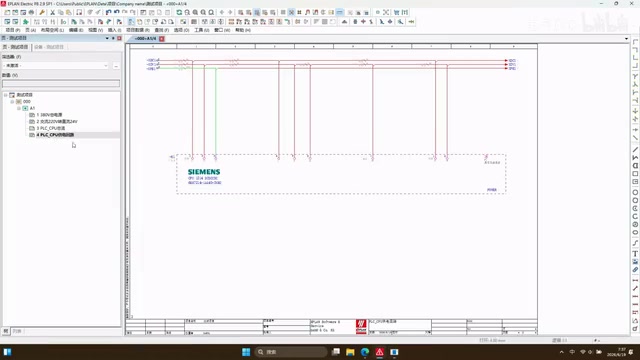
The core idea behind the entire solution is encapsulating commonly used circuits as "macros" (templates), then invoking and combining them as needed through an AI dialog interface. EPLAN's Macro functionality allows engineers to save frequently used circuit modules as reusable templates containing complete component symbols, connection relationships, and attribute data. The project comes with several default pages of base drawings, including a main power supply, DC power supply, Siemens 1214C CPU, and 16DI/DO modules.
The key design philosophy lies in modularity and interchangeability. For example, for the switch-mode power supply section, the developer created two sets of macros — one for a Siemens dual-output circuit and another for a domestic Meanwell single-output circuit. Switching between them is as simple as an AI conversation: the system automatically replaces the Siemens dual-output with two Meanwell single-output units, seamlessly transitioning the power supply scheme. In this process, DeepSeek handles natural language understanding and rule-based reasoning — the engineer describes requirements through conversation, and the model translates them into invocation commands and parameter configurations for EPLAN macro templates.
PLC modules also support dynamic addition and removal. The test demonstrated adding two 16DI/DO modules and then removing one, with the AI correctly handling page additions and deletions while maintaining project structural integrity. Taking the Siemens S7-1200 series 1214C CPU as an example, it comes with 14 digital inputs (DI) and 10 digital outputs (DO). When IO points are insufficient, expansion modules are needed. Each IO point has a unique hardware address (e.g., I0.0, Q0.0), and addressing must account for the physical slot order and channel offset of each module. Manual addressing is not only time-consuming but also prone to address conflicts or omissions when modules are added or removed. This flexibility means engineers can quickly build a foundational framework based on actual project scale without worrying about the complexity of underlying address management.
Core Feature Validation: Depth and Precision of Automation
Automatic Load Selection and Main Circuit Generation
After inserting motor control macros into the base project, the AI automatically completes component selection based on load power — choosing appropriate contactors, cable specifications, and protective devices. The generated results follow a practical rule: higher-power loads are arranged first, which aligns with common conventions in real-world engineering.
After validating the main circuit, the control circuit logic is equally noteworthy. The case study employs a classic motor control scheme:
- Contactor coils are controlled by normally open contacts of small relays, with motor protector normally closed contacts in series to prevent overload
- Relay coils are controlled by PLC output points
- Motor protector normally open contacts are connected to PLC DI inputs for software-based overload protection
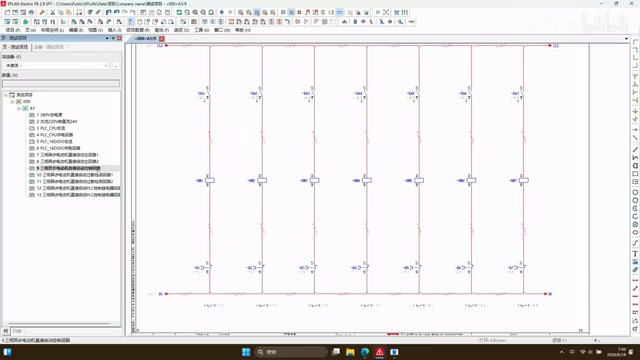
This relay-isolated control scheme is a classic design pattern in industrial settings. PLC output points typically provide only a small drive current (e.g., 0.5A), which is insufficient to directly drive high-power contactor coils (which usually require several amperes of pickup current), hence the need for intermediate relays for power amplification. Meanwhile, wiring the motor protector's (thermal relay or electronic protector) normally closed contacts in series within the control circuit provides hardware-level overload protection, while its normally open contacts connected to the PLC enable software-level monitoring and alarming. This dual-protection strategy combining hardware and software is a fundamental requirement of industrial safety design, ensuring that hardware protection remains reliable even if the PLC program malfunctions.
A noteworthy detail: this approach of drawing main circuits and control circuits on separate pages isn't universally preferred among engineers — some prefer combining related circuits on the same page to avoid fragmented control logic and excessive page-flipping. The case study adopted this layout specifically to test the AI's accuracy in contactor-relay pairing calculations, main circuit and control circuit page count matching, and drawing position calculations.
Automatic Component Numbering and Cross-References in EPLAN
All components are automatically numbered according to preset rules. The reference designations displayed at the bottom of the drawings clearly show the automatic matching relationships between AC contactor coils and contacts, including correct association of motor protector normally closed contacts.
Cross-referencing is a core mechanism in electrical design for ensuring drawing consistency. A single contactor may have three pairs of main contacts in the main circuit for switching the motor on and off, while simultaneously having auxiliary normally open/normally closed contacts in the control circuit for interlocking or status feedback. These contacts distributed across different pages must be correctly associated with the same coil, with their locations annotated on the drawings (e.g., "see Page 5, Column 3"). In large projects, a single control cabinet may contain dozens of contactors and hundreds of contacts. Manually maintaining cross-references is extremely error-prone, and any association error can lead to serious problems during on-site commissioning — ranging from functional anomalies to equipment damage or safety incidents. Automating this function is critically important for improving design quality, especially as the number of circuits increases and the cost of maintaining cross-references rises dramatically.
Automatic Wire Numbering
The wire number format is defined as "page name of the wire's associated potential + underscore + sequential number." This numbering scheme is used for demonstration purposes only in the test — in real applications, rules can be fully customized according to company standards, allowing the AI to automatically generate wire numbers following enterprise specifications.
Intelligent Terminal Strip Assignment
This is one of the most "intelligent" aspects of the entire solution. Terminal strips are the physical interfaces for wiring inside and outside the control cabinet, and their proper classification directly impacts on-site installation efficiency and long-term maintenance convenience. Terminal strips are not only automatically numbered but also automatically categorized based on functional definitions:
- XGE: Terminal strip for external motor wiring — all motor wiring terminals belong here
- XPE0: In-cabinet grounding terminal strip for motors — all motor cabinet-side grounds are unified here
- XGR: Sensor wiring terminal strip
- DC2/0V2: 24V supply terminals from the switch-mode power supply, dedicated to external 24V devices
- DCE/0V1: In-cabinet 24V device power supply for PLC, instruments, etc.
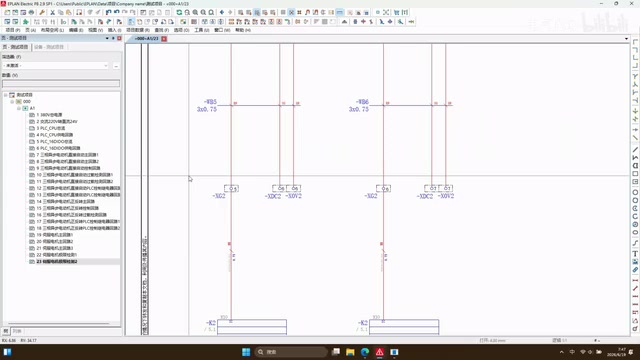
This function-based classification approach stems from recommendations in international standards such as IEC 61439: separating power terminals from signal terminals reduces electromagnetic interference, separating in-cabinet and external power supplies facilitates fault isolation, and independent grounding terminals ensure reliable protective earthing. In real-world engineering, terminal assignment errors are one of the most common causes of on-site rework, and automated assignment can reduce such issues at the source. This function-based automatic classification significantly reduces human errors in terminal assignment while notably improving drawing readability and maintainability.
PLC Automatic Addressing in Detail
The PLC overview page automatically records all IO interface information, corresponding one-to-one with the distributed PLC wiring points in subsequent drawings. When a module's channel count exceeds its limit, the system automatically jumps to the next module and restarts addressing without manual intervention. This means that as project scale grows and IO point counts increase, engineers only need to focus on functional requirements — the complex calculations of address allocation are entirely handled by the AI.
Extended Testing with Multiple Electrical Circuit Types
To verify the solution's versatility, the developer further tested several typical circuit types:
Motor Forward-Reverse Circuit
After inserting three forward-reverse circuits, the AI automatically creates corresponding main and control circuits following matching rules. The logic is consistent with the direct-start scheme but adds forward-reverse interlocking control. Forward-reverse interlocking is a fundamental safety requirement in motor control — it must be ensured that the forward and reverse contactors never engage simultaneously, as this would cause a phase-to-phase short circuit. Interlocking is typically achieved through both electrical interlocking (wiring the opposing contactor's normally closed auxiliary contact in series within one's own control circuit) and mechanical interlocking (physical linkage mechanisms).
Servo Motor Circuit
Three servo motor circuits were generated (equally applicable to VFDs or soft starters), with the system automatically selecting components based on load. Servo motors typically require two proximity switches for limit protection, which were connected directly to PLC input points in the test. The key difference between servo drive systems and conventional motor control is that servo drives integrate current protection and speed control functions internally, simplifying the main circuit design. However, the signal circuit is more complex, requiring handling of encoder feedback, enable signals, alarm outputs, and various other interfaces. PLC output points directly provide soft-controlled emergency stop, though hardware buttons can also be used and made into optional macros.
Auxiliary Circuits
Common auxiliary circuits such as cabinet-internal outlets, fans, and lighting also support on-demand insertion and removal. Network switch power terminals are supplied by the in-cabinet 24V power terminal strip, and power terminals for devices like vision modules are also automatically calculated and assigned.
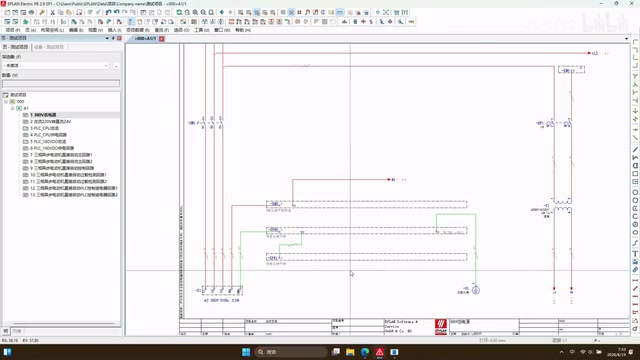
The testing also revealed a minor issue with the EPLAN software itself: PE potential connections defined in the layer should display in yellow-green (PE stands for Protective Earth, which per IEC 60446 standard uses yellow-green dual-color identification), but occasionally the color doesn't appear when opening a page and requires switching pages to restore. This is a display bug at the EPLAN software level and is unrelated to the AI functionality.
Technical Value and Limitations Analysis
The core value of this solution lies in codifying engineering experience into rules, then using AI to automatically execute those rules. It doesn't make the AI "understand" electrical principles; rather, it turns the AI into an efficient rule execution engine — automatically performing combination, calculation, and numbering tasks based on preset macro templates and naming conventions. This methodology is essentially a combination of knowledge engineering and large language models: domain experts encode design experience into structured rules and templates, while the large model handles understanding natural language instructions and mapping them to the rule execution layer.
From a practical standpoint, this DeepSeek + EPLAN solution is particularly well-suited for the following scenarios:
- Highly standardized projects: such as complete cabinet design
- Batch projects with high repetitiveness: electrical design for multiple identical machines
- Teams with well-defined design standards: internal enterprise standardization processes
Of course, the solution's effectiveness is highly dependent on the quality of the macro templates and the completeness of rule definitions prepared upfront. The richer the templates and the more refined the rules, the closer the AI-generated results will be to actual requirements. For non-standard designs, complex process interlocking logic, or scenarios requiring creative solutions, AI still cannot replace the professional judgment of experienced engineers.
It's worth noting that EPLAN is also advancing its own AI product — Copilot, integrated into EPLAN Platform 2025, which leverages large language models to assist engineers with equipment selection recommendations, design standard checks, and automatic document generation. Meanwhile, Siemens' TIA Portal is also integrating AI-assisted programming features, and Schneider Electric has launched intelligent upgrades to EcoStruxure Machine Expert. The entire industrial automation design field is undergoing a paradigm shift from CAD-assisted drafting to AI-assisted engineering. The explorations of individual developers and the advancement of official products are jointly driving the intelligent transformation of this traditional engineering field, with individual developers' open-source solutions often leading commercial products in flexibility and customization.
Conclusion
This real-world test demonstrates DeepSeek's practical capabilities in the electrical design domain: not replacing engineers' professional judgment, but automating tasks that follow clear rules and involve high repetitiveness. From component selection to terminal assignment, from wire numbering to PLC addressing, every step has been validated. For electrical design engineers, integrating DeepSeek with EPLAN represents a promising direction worth exploring in depth for boosting productivity.
Related articles

Japan's Ride-Hailing Platform Go Completes ¥88.6 Billion IPO, Betting on Robotaxis to Tackle Driver Shortage
Japan's ride-hailing app Go completed the country's largest IPO this year, raising ¥88.6 billion. Facing a severe driver shortage, Go is investing in Robotaxis and industry M&A to reshape Japan's mobility future.
Claude Code + Firecrawl MCP Tutorial: One-Click Install with No Registration or API Key
Complete guide to connecting Firecrawl MCP to Claude Code with no registration or API Key. Get 1,000 free monthly searches to boost your coding productivity.
A Beginner's Guide to Vibe Coding: The New Way to Build Software with AI — No Coding Required
What is Vibe Coding? Learn the core philosophy, three key traits, and boundaries of this AI-powered approach. Get a complete beginner's learning path with tools like Cursor and Bolt.new.