A Beginner's Guide to Vibe Coding: The New Way to Build Software with AI — No Coding Required
Vibe Coding lets anyone build software by describing ideas to AI in natural language — no coding required.
Vibe Coding is an AI-powered programming approach coined by Andrej Karpathy that lets you build software using natural language instead of writing code. This guide covers its three core traits — no architecture decisions, no programming languages needed, and full focus on creation — along with recommended tools like Cursor, Bolt.new, and V0, a clear beginner learning path, and an honest look at what Vibe Coding can and can't do.
What Is Vibe Coding? A Completely New Programming Philosophy
Vibe Coding is one of the most talked-about concepts in the AI programming space right now. In simple terms, it's a way of programming that lets you immerse yourself in the creative vision rather than technical details — you describe what you want in natural language, have a conversation with AI, and it writes the code for you.
The concept was originally coined by Andrej Karpathy (former Tesla AI Director and OpenAI co-founder). In February 2025, Karpathy first used the term "Vibe Coding" on social media to describe a completely new experience he had while programming with AI. Karpathy holds a PhD in Computer Science from Stanford University, where he studied under deep learning pioneer Professor Fei-Fei Li, and has deep academic expertise in computer vision and natural language processing. It was precisely this top-tier AI researcher who, after personally experiencing LLM-assisted programming, keenly identified a paradigm shift: the focus of programming is moving from "writing code" to "expressing intent." After the concept was introduced, it quickly sparked heated discussion across the global developer community, transforming from a single tweet into a full-blown movement within just a few months.
His core argument is this: programming shouldn't be a privilege reserved for the few — it should be a creative skill anyone can master, just like writing or painting. The word "Vibe" in Vibe Coding captures this perfectly — all you need to do is stay immersed in your ideas, and let AI handle the rest.
The Three Core Characteristics of Vibe Coding
No Need to Worry About Software Architecture
In traditional software development, architecture design is the part that intimidates beginners the most: Should you separate the frontend and backend or go monolithic? Which framework should you use? How do you choose a database? In the world of Vibe Coding, you don't need to worry about any of this. AI automatically selects the appropriate tech stack and architecture based on your description of what you need.
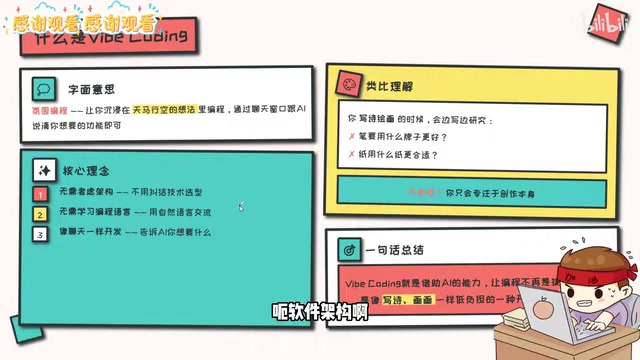
To understand just how much simplification this represents, consider the decision chain a traditional developer faces: First, you need to decide between a monolithic architecture or microservices. Then you choose a frontend framework — React, Vue, or Angular. For the backend, you weigh options like Node.js, Python Django, or Java Spring Boot. At the database layer, you choose between relational databases (like MySQL or PostgreSQL) and non-relational databases (like MongoDB). Finally, you need to consider deployment — cloud servers, containerization, or Serverless. Every choice affects subsequent development efficiency and system performance. Just completing these technical decisions alone could take an inexperienced team several weeks. In Vibe Coding mode, AI analyzes your project scope, feature complexity, and use case, then delivers a reasonable technical plan and starts coding — all within seconds.
No Need to Learn a Programming Language
This is the most disruptive aspect of Vibe Coding. You don't need to learn Python, JavaScript, Java, or any other language. Your "programming language" is natural language — English, Chinese, whatever you speak. If you can talk and type, you have the basic skills for Vibe Coding. Just describe the features you want as clearly as if you were having a conversation, and AI will understand and generate the corresponding code.
The technology behind this is the rapid advancement of Large Language Models (LLMs). Models like GPT-4 and Claude have been trained on massive open-source code repositories from across the internet (including billions of lines of code on GitHub), so they're not only fluent in natural language but also proficient in dozens of programming languages. When you say in plain English, "Build me a web app that tracks my daily expenses," the model internally translates natural language into programming logic — understanding that "track expenses" means you need data input forms and database storage, "daily" means you need a date field and date-based filtering, and "web app" means you need an HTML/CSS/JavaScript frontend plus a backend API. In this process, Prompt Engineering plays a critical role: the clearer and more structured your descriptions are, the higher the quality of AI-generated code. This is why Vibe Coding doesn't require you to learn a programming language, but it does require you to learn "how to talk to AI."
Focus on the Creation Itself
Here's a vivid analogy: imagine you're painting or writing poetry. Would you stop to research what brand your paintbrush is? Would you obsess over the paper's material specifications? Of course not. You'd just focus on the creation itself — composition, color, mood. Vibe Coding pursues exactly this state: turning software development into a low-friction creative process rather than a technical skill requiring years of training.
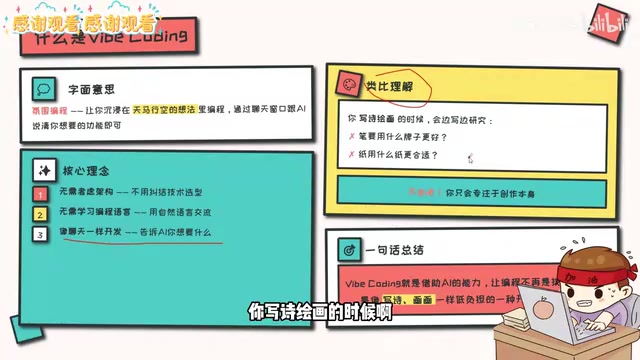
This philosophy aligns perfectly with the broader trend of the "Creator Economy." Over the past decade, we've watched content creation tools become increasingly democratized — short-video platforms turned everyone into a director, Canva enabled anyone to produce professional-grade designs, and Notion let anyone build knowledge management systems. Vibe Coding is essentially an extension of this democratization path into software development: when creation tools become simple enough, creativity itself becomes the scarcest resource. People with unique ideas and deep understanding of user needs can rapidly turn their creativity into products through Vibe Coding — even without any technical background.
How Do Complete Beginners Get Started with Vibe Coding?
Learning Path Overview
For beginners starting from zero, learning Vibe Coding can be broken into three stages:
- Awareness Stage: Understand what Vibe Coding is, what it can do, and why it's worth learning
- Onboarding Stage: Master basic Prompt techniques and learn how to clearly express your requirements to AI
- Practice Stage: Choose the right tools and complete a real project hands-on
It's worth emphasizing that the Prompt skills in the second stage go far beyond simply "chatting with AI." Effective Prompts typically follow structured principles: set a clear role (tell the AI it's a full-stack developer), provide context (describe the target users and use cases), break down requirements step by step (first build the login page, then the data display page), and specify constraints (use the React framework, optimize for mobile). The process of mastering these techniques is essentially training a new kind of "product thinking" — how to transform vague ideas into clear, actionable requirement descriptions.
Recommended Vibe Coding Tools
The most popular tools for Vibe Coding currently include:
-
Cursor: The most popular AI-powered coding IDE right now, with powerful built-in code generation and conversational capabilities. Cursor is a deep modification of VS Code (Microsoft's open-source code editor), integrating multiple top-tier LLMs including GPT-4 and Claude. Its core advantage is "context awareness" — the AI doesn't just generate code based on your conversation; it understands your entire project's file structure, existing code logic, and dependencies, producing new features that seamlessly match your existing code style. For users who want to develop moderately complex projects, Cursor currently offers the most complete experience.
-
Bolt.new / Lovable: Online AI full-stack development platforms that require no local environment setup. The biggest advantage of these tools is "zero configuration" — you don't need to install any development environment on your computer; just open a browser and start coding. Bolt.new is built by the StackBlitz team and uses WebContainer technology to run a complete Node.js environment in the browser. Lovable focuses more on non-technical users with a friendlier visual interface. Both support one-click deployment, allowing finished projects to go live immediately.
-
Claude / ChatGPT: General-purpose LLMs, ideal for the requirements analysis and solution design stages
-
V0 by Vercel: Focused on frontend UI generation — type a description and get a beautifully designed interface. V0 is built by Vercel, the frontend deployment platform, and uses a specially fine-tuned AI model with exceptional understanding of React components and Tailwind CSS (a popular CSS utility framework). Simply describe "I want a dashboard page with a search bar and card list," and V0 generates production-ready, design-forward frontend code.
Each of these tools has its own strengths. Beginners are recommended to start with Bolt.new or Cursor, as they have the lowest barrier to entry and the most intuitive user experience.
The Boundaries of Vibe Coding: What It Can and Can't Do
Scenarios Well-Suited for Vibe Coding
- Personal tool development: Expense trackers, to-do lists, personal blogs, etc.
- Rapid MVP validation: Entrepreneurs quickly building product prototypes to validate business ideas. MVP (Minimum Viable Product) is a core concept in lean startup methodology, systematically described by Eric Ries in The Lean Startup. The core idea is: rather than spending months developing a fully-featured product, build a version with only the core functionality in the shortest time possible, release it to the market for real user feedback, then iterate rapidly based on that feedback. Traditional MVP development, even with a minimal tech stack, typically requires several weeks and tens of thousands of dollars in development costs. Vibe Coding compresses this timeline to hours or even minutes — an entrepreneur can build an interactive product prototype in a single afternoon and start collecting user feedback the same day. For resource-constrained solo founders and small teams, this is a true game-changer.
- Mobile web pages: H5 pages, mini-program frontends, marketing landing pages
- Data visualization: Simple charts, data dashboards
- Automation scripts: Batch file processing, data cleaning, and other repetitive tasks
Current Limitations of Vibe Coding
It's important to have a clear-eyed understanding that Vibe Coding is not a silver bullet:
-
Complex system architecture: Large-scale systems involving high concurrency and distributed computing still require professional engineers. High concurrency refers to scenarios where a system must handle massive numbers of simultaneous user requests (like an e-commerce platform during Singles' Day sales or a ticket-booking system during holiday travel rush). These systems require fine-tuned load balancing, caching strategies, and database optimization — levels of system design that AI cannot yet reliably handle. Distributed architecture involves complex challenges like coordinating communication between multiple servers and ensuring data consistency, requiring deep engineering experience to make correct architectural decisions.
-
High-security scenarios: Core systems in finance, healthcare, and similar fields may have security vulnerabilities in AI-generated code. A 2023 Stanford University study found that developers using AI-assisted programming actually produced code with a higher proportion of security vulnerabilities than a control group that didn't use AI — and the AI-assisted developers were more confident in their code's security. This "false sense of security" is particularly dangerous. Common AI code security issues include SQL injection vulnerabilities (where attackers can manipulate databases through malicious input), insecure authentication logic, and plaintext storage of sensitive data. In scenarios involving user funds, health data, or other sensitive information, AI-generated code must undergo professional security audits before deployment.
-
Highly customized requirements: When requirements are very unique and complex, pure natural language descriptions may not be precise enough
-
Debugging and maintenance: When bugs appear in AI-generated code, someone with zero coding knowledge may struggle to locate the problem. This is why an increasing number of voices in the industry suggest that even in the Vibe Coding era, learning some basic programming concepts (such as variables, functions, conditional statements, and loops) is still valuable. You don't need to master any programming language, but understanding the basic logic of how code runs helps you spot problems faster when AI makes mistakes, describe bugs more accurately to AI, and get better fixes as a result.
The Essence of Vibe Coding: Lowering the Barrier to Creation
The essence of Vibe Coding is not "replacing programmers" — it's lowering the barrier to creation. It empowers people who have ideas but no programming background to turn the concepts in their heads into working software products.
In other words, Vibe Coding leverages AI to transform programming from a purely technical skill into a low-friction creative process. For beginners starting from zero, the most important thing isn't agonizing over tool selection or technical details — it's getting your hands dirty and building your first project. Even if it's just a simple mobile webpage, that feeling of "I actually built this" is the greatest motivation for continued learning.
From a broader perspective, the rise of Vibe Coding marks a new phase in human-AI collaboration. In this phase, the core value humans bring is no longer "knowing how to write code" but "knowing what to build" — having insight into problems, empathy for user needs, and the thinking ability to transform vague ideas into clear plans. The technical implementation is increasingly handed off to AI, while humans return to more fundamental capabilities: creativity and judgment. This isn't the end of technology — it's the liberation of creativity.
The era of democratized programming has arrived, and Vibe Coding is the gateway to this revolution.
Key Takeaways
Related articles
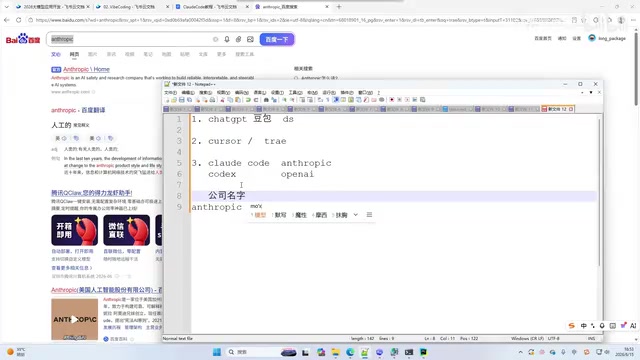
Claude Code Installation & Setup Guide: Low-Cost Vibe Coding with Chinese AI Models
Step-by-step guide to installing Claude Code and configuring it with Chinese models like DeepSeek for low-cost vibe coding, including Node.js setup and CCSwitcher usage.
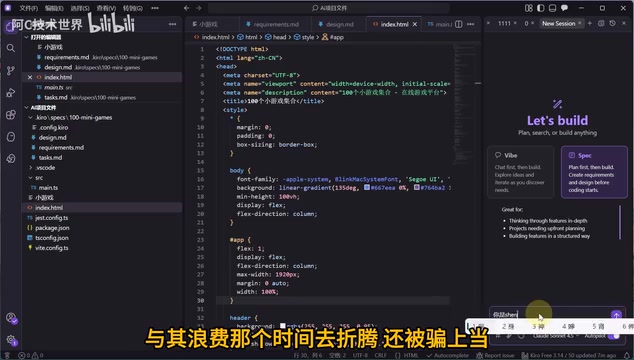
Keyroll: An In-Depth Look at a Stability-Focused Claude Refill Tool
In-depth review of Keyroll, a stability-focused Claude refill tool. Analyzing its core strengths, security implications, and compliance considerations for developers facing usage limits.
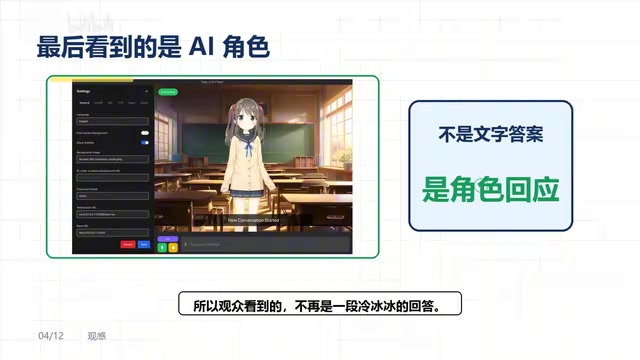
OpenLLMVTuber: A Deep Dive into the Open-Source AI Virtual Character Framework
Deep dive into OpenLLMVTuber, a 10K-star open-source AI virtual character framework integrating ASR, LLM, TTS, and Live2D with voice interruption, visual perception, and modular architecture.