Claude Code Installation & Setup Guide: Low-Cost Vibe Coding with Chinese AI Models
Install Claude Code and pair it with DeepSeek for affordable AI-powered vibe coding.
This tutorial walks through the complete process of setting up Claude Code for vibe coding on a budget. It covers installing prerequisites like Node.js and Git, configuring Chinese AI models such as DeepSeek via the CCSwitcher GUI tool, and demonstrates generating a web page using natural language prompts — all without writing a single line of code manually.
What Is Vibe Coding
Vibe Coding is a highly popular development approach in the AI programming space. The core idea is simple: describe your goals and requirements in natural language, and let AI handle the code writing, command execution, and result verification — developers no longer need to write code line by line.
The term was first coined by Andrej Karpathy, former OpenAI co-founder and former Tesla AI Director, in February 2025. He described an entirely new programming experience where developers simply "surrender to the vibes, embrace exponential growth, and forget that code even exists." The concept quickly sparked industry-wide discussion because it represents a fundamental shift in the software development paradigm — from "humans write code, machines execute" to "humans describe intent, AI implements code." The underlying driving force behind this shift is the leap in code generation capabilities of Large Language Models (LLMs), especially the expansion of context windows that enable AI to understand and operate on entire project-level codebases, rather than just generating isolated code snippets.
This concept has evolved through several stages. Initially, we simply asked AI for code snippets in chat interfaces like GPT, Doubao, or DeepSeek, then manually copied them into our projects. Later, Cursor showed the industry the potential for engineering-level development — AI could modify multiple files in a project at once. The emergence of Claude Code then pushed vibe coding to new heights, with its ability to understand entire project contexts and autonomously complete complex development tasks.
The Relationship Between Claude Code and Models
Before diving into the installation, let's clarify a few core concepts:
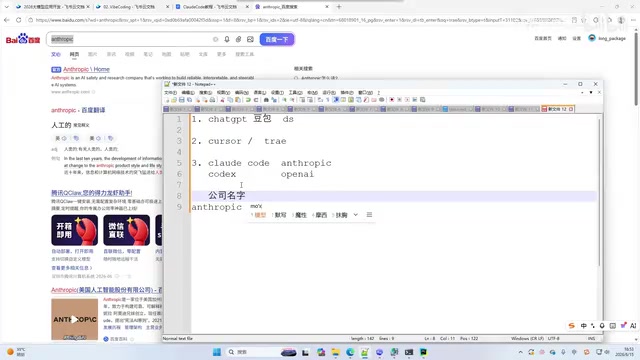
- Anthropic: A US-based AI company whose model series is collectively called Claude (including versions like Claude 3.5 Sonnet, Claude 4, etc.)
- Claude Code: A coding agent tool released by Anthropic that requires a configured model to function
- OpenAI: Another AI company whose model series is GPT (e.g., GPT-4, GPT-5.5), with a corresponding coding tool called Codex
It's important to understand the distinction between "tool" and "model": Claude Code is a command-line agent that runs locally, responsible for reading project files, understanding developer intent, planning task steps, and executing file operations. The model, on the other hand, is the "brain" that provides thinking capabilities — understanding natural language, generating code, and making decisions. Their relationship is similar to that of a browser and a search engine — the browser is the tool, while the search engine provides the content.
The key takeaway here is: Installing Claude Code alone isn't enough — you must configure a usable model for it. Using Claude's official models directly requires access to overseas services, which carries the risk of account suspension. To lower the barrier and cost, we can substitute with Chinese models like DeepSeek.
DeepSeek is a large language model series developed by China's DeepSeek company. Among them, DeepSeek-V3 and DeepSeek-R1 have demonstrated capabilities approaching or even rivaling GPT-4 levels across multiple benchmarks, particularly excelling in code generation and mathematical reasoning. DeepSeek employs a Mixture of Experts (MoE) architecture that activates only a subset of parameters during inference, maintaining high performance while dramatically reducing inference costs. Its API pricing is extremely competitive among models of the same tier both domestically and internationally, with cache-hit prices as low as one-tenth of the regular rate. Additionally, as a domestic model, DeepSeek's servers are deployed within China, offering low access latency without the need for VPN tools — a significant practical advantage for Chinese developers.
The Codex + GPT-5.5 plan costs approximately 140 RMB per month, and purchasing channels within China are limited. Therefore, this tutorial focuses on the Claude Code + Chinese models approach as the best value-for-money solution.
Setting Up Prerequisites
Installing Node.js
Claude Code depends on the Node.js runtime environment — this is a mandatory prerequisite.
Node.js is a JavaScript runtime environment built on Chrome's V8 engine that allows JavaScript code to run on servers or local computers outside of a browser. Claude Code itself is a command-line tool written in JavaScript/TypeScript, distributed and installed via npm (Node Package Manager). npm is the world's largest open-source software registry, hosting over 2 million packages. When we run the npm install command to install Claude Code, npm automatically downloads the package and all its dependencies from the remote repository and installs them locally.
Installation steps:
- Download the Node.js installer and double-click to run it
- You can use the default installation path on the D: drive or choose another location; click "Next" for all other options
- After installation, open CMD and type
npmandnodeto verify
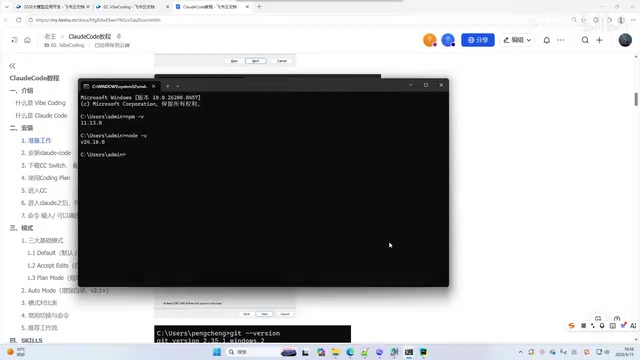
If both commands output version information correctly, Node.js has been installed successfully.
Installing Git
Git is a version control tool that Claude Code also requires to run.
Git is a distributed version control system created by Linus Torvalds (the creator of Linux) in 2005, originally designed to manage Linux kernel development. It tracks every modification to files and supports code merging and conflict resolution during collaborative development. Claude Code relies on Git because when AI modifies project files, Git records every change, allowing developers to revert to previous versions at any time. If AI-generated code has issues, developers can use git diff to see specific changes or git revert to undo unsatisfactory modifications. This safety net mechanism is especially important for AI-assisted development.
Most developers likely already have Git installed, and the installation process is straightforward, so we won't go into detail here.
Installing Claude Code
Open CMD and run the installation command to complete the Claude Code installation. After installation, run claude code --version to verify — if the command doesn't throw an error, the installation was successful.
Configuring Chinese Models with CCSwitcher
Why CCSwitcher Is Recommended
In real-world development, you may configure multiple models on your machine and switch between them frequently. Manually editing configuration files is not only tedious but error-prone. CCSwitcher provides a graphical interface that makes model management intuitive — under the hood it still modifies configuration files, but the user experience is vastly improved.
Specifically, Claude Code's model configuration is stored in local JSON-format config files, including parameters like API endpoint addresses, keys, and model names. When manually editing these files, a single extra comma or misplaced quotation mark can break the entire configuration. CCSwitcher wraps these low-level operations into a visual form interface where users simply fill in key information and click a button, and the tool automatically generates correctly formatted configuration files.
It's recommended to use the latest version of CCSwitcher (version 3.1.6.3 at the time this tutorial was recorded).
Adding the DeepSeek Model
After opening CCSwitcher, click the plus button to add a new model. The software has built-in information for mainstream model providers:
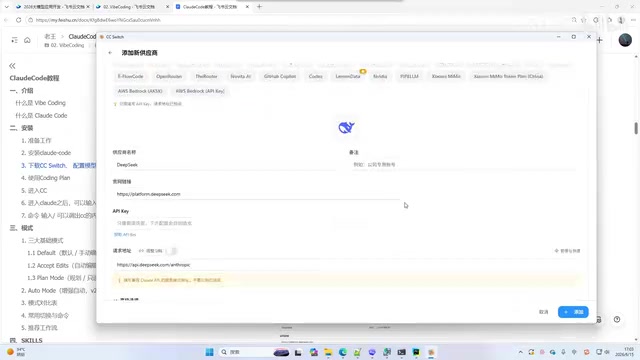
After selecting DeepSeek, fields like provider name, website link, and request URL are automatically populated. In addition to DeepSeek, it also supports providers like OpenAI, Alibaba Cloud Bailian, MiniMax, Zhipu, Volcengine, and more.
Steps to obtain an API Key:
An API Key (Application Programming Interface Key) is an authentication credential, similar to a "pass" for accessing LLM services. When Claude Code sends a request to DeepSeek, the API Key verifies the caller's identity and links to a billing account. The entire calling process follows the HTTP protocol: Claude Code packages the user's natural language instructions and project context into a request, sends it via an HTTPS encrypted channel to the model provider's server endpoint, and the server processes it and returns the generated code or text. This architecture means the actual inference computation happens in the cloud — the local device only needs a network connection, not a high-performance GPU.
- Click the provider link to navigate to the corresponding website
- Create a new API Key on the API management page
- Copy the key and paste it into CCSwitcher, then click "Add"
After adding, you can click the test button to verify the connection. However, test results are for reference only — passing the test doesn't guarantee everything will work, and a failed test doesn't mean it's completely unusable. DeepSeek is generally quite stable, but some niche providers may have compatibility issues.
Hands-On Demo: Generating a Web Page with Claude Code
Initializing the Project
After configuration, launch Claude Code from CMD. On first launch, you'll see an initialization screen (this only appears once):
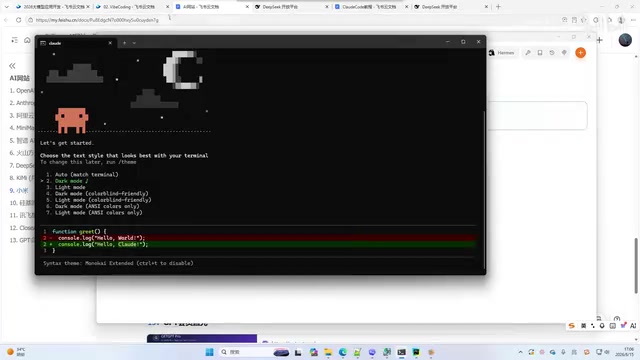
Important tip: Create your project folder manually before launching. For example, create a test2 folder, then launch Claude Code from within that folder. When the system asks "Do you trust this directory?", select Yes. This security confirmation exists because Claude Code has permissions to read/write files and execute commands — confirming trust means you're authorizing the AI to perform file operations within that directory. It's recommended to always launch from a dedicated project folder and avoid running it in system root directories or directories containing sensitive files.
Describing Requirements in Natural Language
Once inside Claude Code, simply type your request:
"Hello, please create a simple web page for me"
The AI will first ask for more details, such as the type and functionality of the web page. After confirmation, you'll see tokens being consumed as the AI begins automatically generating code.
During this process, Claude Code acts as an agent that autonomously plans execution steps: first analyzing the requirements, then deciding which files need to be created (e.g., HTML, CSS, JavaScript), generating file contents one by one, and finally potentially self-checking the code for completeness. This ability to autonomously plan and execute is the core characteristic that distinguishes an "agent" from a simple "chatbot."
Token Billing Mechanism
During use, pay attention to token consumption, as it directly determines costs:
A token is the basic unit by which large language models process text, but it doesn't equate to a single Chinese character or English word. For Chinese text, one character is typically split into 1-3 tokens; in English, a common word corresponds to roughly 1-2 tokens. The model uses a tokenizer to split input text into a token sequence before processing.
- Input tokens (upstream): Tokens consumed by your questions and project code uploads
- Output tokens (downstream): Tokens consumed by AI-generated responses, code, and reports — these typically cost more. Output tokens are more expensive because the generation process requires the model to perform inference predictions token by token, with computational demands far exceeding simple input encoding
- Cache hits: LLMs reduce redundant computation through caching mechanisms, and cache-hit tokens are priced very low. When multiple requests share the same context prefix, the model can reuse previous computation results, avoiding redundant processing — this is especially effective in continuous conversation and iterative development scenarios
The billing unit is typically M (million), e.g., "1M = 5 RMB" means 1 million tokens costs 5 RMB. DeepSeek's cache-hit pricing is particularly cheap, which is a major reason for recommending it.
After code generation is complete, the AI will ask whether to confirm execution — select Yes. Open the generated web page file to see the result — no hand-written code required throughout the entire process.
Installation & Setup Summary
As a popular vibe coding tool, Claude Code's core advantage lies in its ability to understand entire project contexts and perform engineering-level development. For users in China, pairing it with Chinese models like DeepSeek offers the best value for money.
Complete installation process recap:
- Install Node.js and Git as prerequisite runtime environments
- Install Claude Code via command line and verify the version
- Use CCSwitcher to configure Chinese model API Keys
- Create a project folder, launch Claude Code, and start developing
Tools are just the means — model capabilities are equally important. During the learning phase, it's recommended to start with low-cost options like DeepSeek to get familiar with the workflow, then choose more suitable models based on actual needs and budget. As Chinese LLMs continue to iterate rapidly, the number of cost-effective options will only grow, and the barrier to vibe coding will continue to decrease.
Related articles
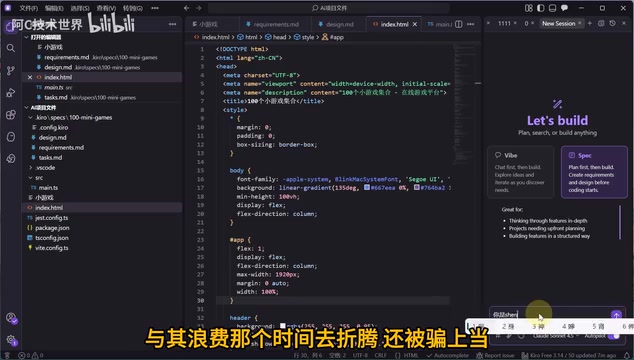
Keyroll: An In-Depth Look at a Stability-Focused Claude Refill Tool
In-depth review of Keyroll, a stability-focused Claude refill tool. Analyzing its core strengths, security implications, and compliance considerations for developers facing usage limits.

OpenLLMVTuber: A Deep Dive into the Open-Source AI Virtual Character Framework
Deep dive into OpenLLMVTuber, a 10K-star open-source AI virtual character framework integrating ASR, LLM, TTS, and Live2D with voice interruption, visual perception, and modular architecture.
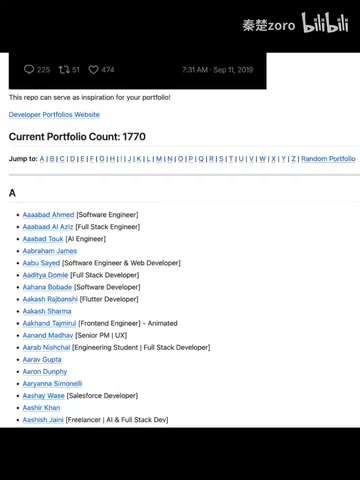
1700+ Top Developer Personal Website Collection: A Treasure Trove of Frontend Design Inspiration
A GitHub repo with 24,000+ stars featuring 1,700+ personal websites from top developers and designers worldwide. Styles range from minimalist to cyberpunk to 3D effects — perfect for design inspiration.