DeepSeek Multi-Agent Matrix + UE5.8 Official MCP: A Collaborative Development Workflow in Practice

A complete workflow combining DeepSeek multi-Agent matrix with UE5.8 MCP for collaborative Unreal Engine development.
A Bilibili creator shared a workflow for collaborative UE5 development using DeepSeek's multi-Agent matrix and UE5.8's official MCP. The project completely abandons Blueprint logic, delegating 100,000+ lines of C++ code to multiple AI agents through layered knowledge systems, cache hit rate optimization, precise context control, and concurrent multi-Agent code review—demonstrating an efficient AI-assisted game development practice.
Overview
With the rapid evolution of AI programming tools, the game development landscape is undergoing a profound transformation. A Chinese Bilibili content creator named Xiao Gang shared a complete workflow for collaborative Unreal Engine project development using a DeepSeek multi-Agent matrix and UE5.8's official MCP (Model Context Protocol). This system delegates the management of over 100,000 lines of C++ code, Blueprint-to-C++ translation, and code review to a team of AI agents working in concert—showcasing the cutting edge of AI-assisted game development.
Project Architecture: The Pure UE C++ Approach
Full Blueprint-to-C++ Translation
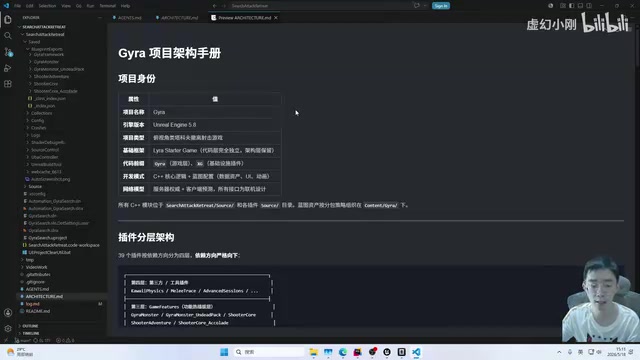
Xiao Gang's project is built on the Lyra/Gyra framework, targeting a top-down shooter game. Lyra is Epic Games' official UE5 sample project featuring modular architecture design that demonstrates GAS (Gameplay Ability System), the Enhanced Input System, modular game features, and other modern UE5 development paradigms—serving as the definitive best-practice reference for UE5 project architecture. Gyra is a community framework that extends Lyra with additional utility modules.
The project's most distinctive technical decision is completely abandoning Blueprint logic. Through human-AI collaboration, all Blueprint business logic has been converted to C++ code, resulting in over 100,000 lines of C++ and thousands of Blueprint assets used solely for data configuration.
The core rationale behind this choice: C++ code is far more AI-friendly. AI can directly read, generate, and review text-based code, whereas Blueprints—UE's visual scripting system that implements logic through node connections—while lowering the programming barrier, store data in a binary asset format that creates inherent obstacles for version control, code reuse, and AI interaction. AI simply cannot parse the node topology structures within .uasset files. To solve the Blueprint-to-C++ translation problem, the team developed an "offline JSON" approach—using a custom editor tool to export Blueprint node graphs into structured JSON format. Once AI reads the JSON, it can understand the Blueprint's execution flow and generate corresponding C++ code.
Layered Knowledge Management System
The project established a strict layered documentation hierarchy:
- agents.mind: The top-level rules file, defining universal rules and role-specific rules
- Architecture Manual: The project architecture handbook, covering the engine layer, foundation layer, and game layer design
- Skills Library: Contains skill documents for code design, architecture review, bug localization, MCP invocation, log analysis, and more
- Blueprint Index: Records the location and node count of all Blueprints for quick AI lookup
The design philosophy behind this system: slice AI's working scope into sufficiently fine granularity—the finer the granularity, the stronger AI's execution capability. This aligns with the Single Responsibility Principle in software engineering—when each document describes only one clearly defined knowledge domain, AI's reasoning accuracy within that domain improves significantly, avoiding the attention dilution caused by monolithic prompts.
DeepSeek Multi-Agent Matrix Design
Role Division and Cache Optimization
In this workflow, there's only one developer in the physical world, while the AI world has DeepSeek V4 Pro/Flash filling multiple roles:
- Tech Lead: Responsible for technical architecture, code review, and development planning
- Operations: Handles video copywriting, content ideation, and material creation
- Game Designer: Manages gameplay design and scheduling
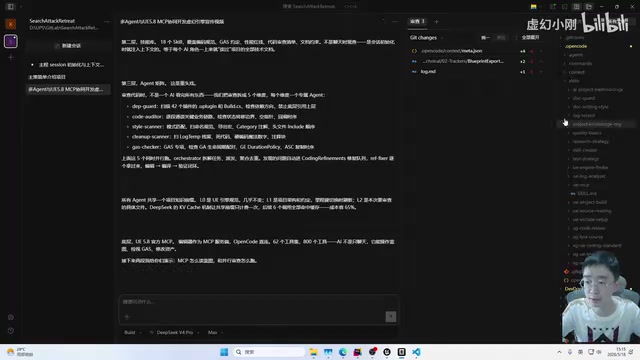
A critical cost optimization strategy is cache hit rate management. DeepSeek's API features a disk-based context caching mechanism—when multiple API requests share the same prefix content, the server persists the KV Cache (Key-Value Cache, a data structure in Transformer models that stores pre-computed attention information) for that prefix to disk. Subsequent requests that hit the cache skip recomputing attention weights for the prefix portion, dramatically reducing computational costs. DeepSeek officially prices cache-hit tokens at approximately 1/10 the standard rate, making carefully designed shared prefixes the core lever for cost control. By having all Agents share a common project knowledge request prefix, Xiao Gang maintains cache hit rates above 90%-95%, significantly reducing API call costs.
Precise Context Control
Xiao Gang emphasized a core principle: every AI conversation is a fresh session, requiring precise context—too much is noise, too little is bias. Within the 1-million-token context window, he uses approximately 5% of the space (~50,000 tokens) to give AI a project overview, including progress, coding standards, and current focus areas. This 5% "project overview" section is the shared cache prefix across all Agents, with the remaining 95% reserved for task-specific code snippets and instructions.
Regarding model selection, practice has shown that DeepSeek Flash performs poorly when handling complex UE C++ code. For example, implementing MVVM architecture (Model-View-ViewModel, an official UI data-binding framework introduced in UE5.3+ that decouples game data from the UI presentation layer), or irregular inventory network replication interactions—systems involving custom serialization, FFastArraySerializer (UE's specialized high-efficiency array network replication framework), conditional replication, and other advanced networking techniques that require simultaneously handling client prediction, server authoritative validation, and bandwidth optimization. These scenarios require switching to the Pro version for a smooth code generation experience. The Flash model's capability gap in multi-step reasoning and complex constraint satisfaction becomes particularly evident in such tasks.
UE5.8 Official MCP in Practice
MCP Toolset Overview
MCP (Model Context Protocol) was originally proposed by Anthropic in late 2024 as an open standard protocol designed to provide AI models with a unified interface for interacting with external tools and data sources. It uses a client-server architecture where AI acts as the client, calling tool functions exposed by the server through standardized JSON-RPC protocol—similar to providing AI with a "USB interface standard" that allows different AI models to interact with various software through the same protocol.
UE5.8 introduced official MCP support. Once enabled in the plugin settings, the editor acts as an MCP server exposing extensive toolsets for AI invocation, covering Blueprint reading and editing, animation state machine queries, Niagara particle system parameter adjustments, and more. Configuration involves obtaining the MCP server address (typically a local WebSocket port) from the editor's Model Content Protocol settings, then connecting as an MCP client from your AI coding tool (such as Cursor). This means AI can directly query and manipulate in-engine asset data without developers manually exporting intermediate formats.
Offline JSON vs. MCP Comparison
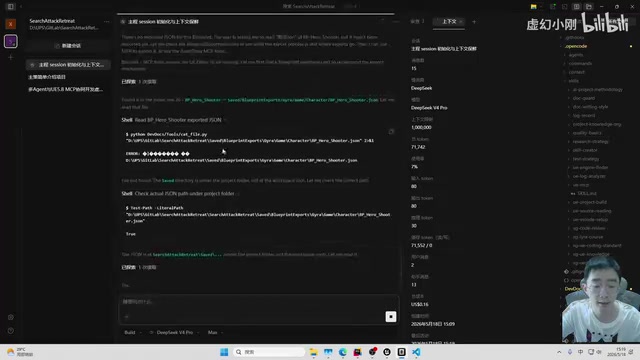
Xiao Gang demonstrated a comparison between two Blueprint reading approaches:
- Offline JSON: One-click export via custom tooling, low token consumption (JSON is structurally compressed), suitable for large Blueprints, and export results can be version-controlled and reused
- MCP Real-time Reading: Directly reads Blueprint data from the editor via API, requires no additional tools, but has higher token consumption (MCP returns raw data containing extensive metadata), and requires the editor to be running for each read
Testing revealed that MCP encounters truncation issues when reading large Blueprints (beyond a certain node count threshold), returning incomplete data. The official MCP is still in its early stages, with toolset stability and completeness needing improvement—likely subject to significant refactoring in future versions. Therefore, Xiao Gang recommends treating it primarily as a learning experience, using both approaches in tandem for production—MCP for real-time queries on small Blueprints, offline JSON as a fallback for large ones.
An important recommendation: don't let AI blindly call MCP tools. Instead, prepare a dedicated Skill document telling AI which MCP tools are available, what each tool's parameters mean, and when to invoke them. Otherwise, AI will repeatedly probe the available tool list, wasting significant tokens on the tool discovery phase.
Multi-Agent Code Review Workflow
Automated Review System
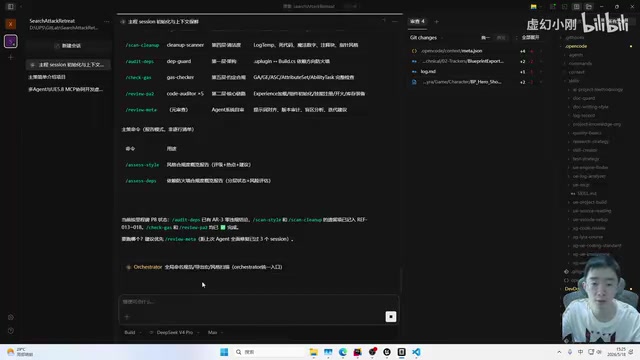
The project established multiple specialized review agents that can execute concurrently:
- Architecture Firewall Review: Checks whether inter-plugin dependency relationships are correct, preventing higher-level modules from depending on lower-level modules, maintaining the dependency directionality of UE's modular architecture
- Global Coding Style Review: Checks naming conventions (UE's U/A/F/E prefix conventions), header file inclusion order, spelling errors, etc.
- GAS-Specific Review: Specialized checks for the Gameplay Ability System. GAS is UE's built-in highly abstracted ability framework comprising core components including GameplayAbility (ability definitions), GameplayEffect (effect application), AttributeSet (attribute sets), and GameplayTag (tag system). These components collaborate through complex authorization, activation, and effect application chains involving network Prediction, effect Stacking, cooldown management, and other mechanisms—making code highly susceptible to timing errors, Tag configuration omissions, and improper Effect lifecycle management
- Core Business Logic Review: Validates business logic correctness, ensuring game rule implementations match design specifications
Typical Application Scenarios
Xiao Gang highlighted several high-value AI review scenarios:
- Header File (#include) Management: Code translated from Blueprints often has missing required header file inclusions. UE C++ projects follow the IWYU (Include What You Use) principle, requiring each .cpp file to explicitly include headers for all types it uses. Blueprint-translated code often relies on implicit inclusion chains, making manual verification extremely painful. AI can globally scan and auto-complete by analyzing symbol usage
- GameplayTag Migration: The project once needed to migrate hundreds of Tags from a game module to a foundation module (for cross-module reuse), involving Tag definition file modifications, updating all reference points, and syncing configuration tables. AI completed the organization and migration in one pass
- Naming Convention Unification: Filename spelling errors, extra characters, inconsistent capitalization—AI handles these in batch far more efficiently than humans
The common characteristic of these tasks: rules are clear but quantities are massive—precisely AI's sweet spot. These are deterministic rules applied at scale, requiring no creative judgment but demanding extremely high coverage and consistency.
Summary and Reflections
Xiao Gang's practice demonstrates a mature methodology for AI-assisted game development: through carefully designed knowledge systems and Agent role division, DeepSeek's capabilities are maximally unleashed into the UE5 development pipeline. Several core lessons are worth noting:
- Developers themselves must have a clear understanding of fundamentals—AI is an amplifier, not a replacement. You need to be able to judge the correctness of AI-generated code; otherwise, errors accumulate at AI speed
- Context management is the key to AI effectiveness—precision matters more than abundance. This aligns with Transformer attention mechanism characteristics: irrelevant information dilutes the model's attention weights on critical information
- Cache hit rate directly determines cost controllability; shared prefix design is an architecture-level decision
- MCP is currently best suited for experimentation and learning, with production environments needing offline solutions as fallback. However, as the protocol matures, MCP is poised to become the standard channel for AI-game engine interaction
- Multi-Agent concurrent review can cover details that humans easily overlook, delivering particularly significant value in large-scale code migration and standardization scenarios
The essence of this workflow is encoding "human expert knowledge" into structured documents, then applying it across the entire codebase through AI's scalable execution capability. As the MCP protocol matures and large model reasoning capabilities continue to improve, AI's role in game development will gradually evolve from "assistive tool" to "collaborative partner."
Related articles
 Tutorials
Cursor + Codex Dual-IDE Collaboration: A Practical Methodology for Open-Source Project Customization
A complete methodology for open-source project customization based on real-world experience, detailing the Cursor+Codex dual-IDE workflow, seven-stage process, MVP validation, and AI source code reading techniques.
 Tutorials
Cursor Multi-Agent in Practice: Building a Full-Stack Next.js Blog in 50 Minutes
Build a full-stack blog in 50 minutes using Cursor IDE's multi-Agent mode with Next.js, Clerk auth, and Supabase. Learn the 4-phase AI Agent workflow and key integration pitfalls.
 Tutorials
Building an AI Software Factory from Scratch: A Cursor Engineer's Hands-On Experience with Multi-Agent Collaboration
Cursor engineer Eric shares practical insights on building an AI software factory: automation levels, guardrail design, parallel Agent management, and scaling to 1000+ Agents for 24/7 development.