DeepSeek Open-Sources a Terminal Coding Agent: A Claude Code Alternative with 38K GitHub Stars
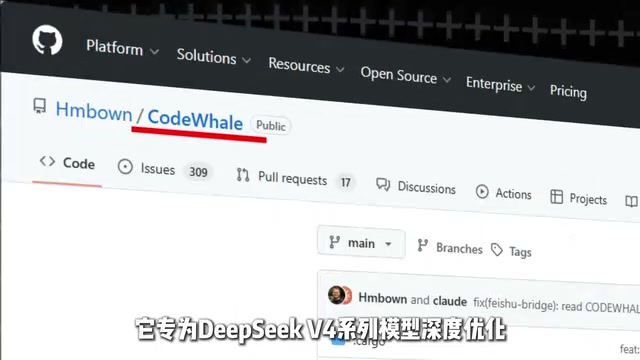
DeepSeek open-sources a terminal coding Agent with 38K+ GitHub Stars as a Claude Code alternative.
DeepSeek has open-sourced a terminal-native coding Agent optimized for its V4 models, quickly earning 38K+ GitHub Stars. Featuring zero-dependency installation, million-token context windows, 20 parallel sub-agents, built-in MCP support, and sandboxed execution, it offers a compelling open-source alternative to Claude Code for developers who prefer command-line workflows.
DeepSeek recently open-sourced a terminal-native coding Agent, deeply optimized for the DeepSeek V4 series of models. Shortly after launch, it has already garnered over 38K Stars on GitHub. Many developers see this tool as an open-source alternative to Claude Code — it brings the AI coding assistant back to the terminal, letting developers stay in full control within the command-line environment they know best.
Why the DeepSeek Terminal Agent Deserves Your Attention
In the AI coding assistant space, Claude Code has long held a leading position thanks to its terminal-native experience. DeepSeek's new terminal Agent takes direct aim at this niche and brings significant differentiating advantages.
Terminal-native means the AI coding assistant runs directly in the command-line interface (CLI), as opposed to being embedded as an IDE plugin (like GitHub Copilot in VS Code) or running as a browser-based web application. The terminal, as the most fundamental developer interface, offers natural advantages like scriptability, composability, and remote access — the Agent can directly invoke system commands, manage the file system, and operate Git repositories without going through an IDE's abstraction layer. This makes it more efficient for DevOps, server administration, large-scale code refactoring, and similar scenarios.
The project has already reached 38.4K Stars on GitHub, with extremely strong growth momentum. This number reflects the developer community's intense demand for an open-source, free, deeply optimized terminal coding Agent. Compared to Claude Code's closed-source commercial model, DeepSeek's open-source strategy is clearly more appealing.
Deep Dive into Core Features
Zero-Dependency Installation, Ready to Use in the Terminal
One of the Agent's biggest highlights is that it requires no Node.js or Python environment. Traditional AI coding tools often require configuring a bunch of runtime dependencies, but DeepSeek's terminal Agent delivers a truly native experience — just open a terminal window and start working.
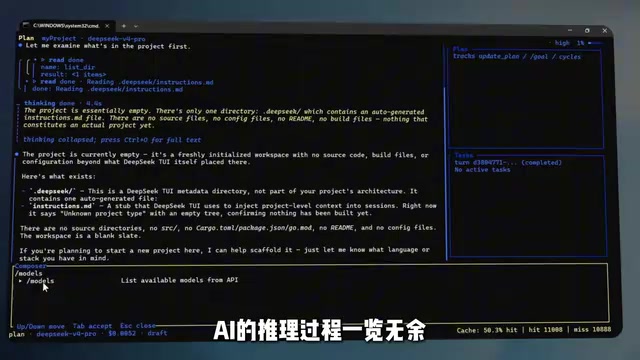
Whether you're on macOS, Linux, or a remote server, all you need is a terminal window for a seamless experience. For engineers who frequently switch between different development environments, this dramatically lowers the barrier to entry.
Million-Token Context Window
Powered by the DeepSeek V4 series of models, the Agent natively supports a million-token-level context window.
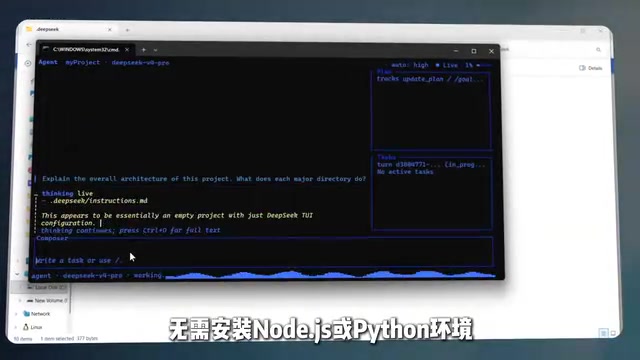
The context window is the maximum text length a large language model can process in a single inference pass, directly determining how much information the AI can "see." Early models like GPT-3.5 supported only 4K tokens (roughly 3,000 English words), meaning the model could handle very little code. As the technology evolved, Claude 3.5 expanded the window to 200K tokens, and DeepSeek V4 pushed further into the million-token range. Achieving ultra-long context relies on several key technologies: Sparse Attention reduces the O(n²) computational complexity of self-attention; RoPE (Rotary Position Embedding) extrapolation enables the model to handle sequence lengths unseen during training; and KV Cache compression techniques reduce GPU memory usage.
A million tokens is roughly equivalent to a 750-page technical book, or the complete codebase of a medium-to-large software project. This means the Agent can "see" an entire large project's codebase at once, understand inter-file dependencies, and avoid losing critical information due to context truncation. This is especially crucial when handling complex code refactoring tasks or cross-file modifications.
DeepSeek V4 is the latest generation of large language models from DeepSeek, which had already established a strong technical reputation in the open-source model space with its V2 and V3 series. Its MoE (Mixture of Experts) architecture maintains extremely high parameter counts while keeping inference costs under control. The V4 series has been specifically trained on programming-related tasks such as code completion, multi-turn dialogue, and tool calling, making it an ideal foundation model for powering a terminal coding Agent.
Chain-of-Thought Visualization: Transparent and Controllable AI Reasoning
The tool features streaming thought output, making the AI's reasoning process fully visible. Developers can watch in real time as the Agent analyzes problems, breaks down tasks, and makes decisions.
Chain-of-Thought (CoT) is a technical paradigm for improving large language model reasoning, formally introduced by Google in 2022 research. The core idea is to have the model generate intermediate reasoning steps before providing a final answer, similar to how humans "show their work." In programming scenarios, CoT manifests as the Agent first analyzing requirements, identifying relevant files, and planning a modification strategy before executing specific operations. Streaming output means these reasoning steps are displayed incrementally in real time, rather than waiting for everything to complete before showing results all at once.
This transparency not only builds trust in AI output but also makes it easy to intervene and correct course when reasoning goes astray. Developers can spot directional errors mid-execution and correct them promptly, avoiding the uncontrollable risks of AI "black box" operations.
Multi-Task Parallel Processing
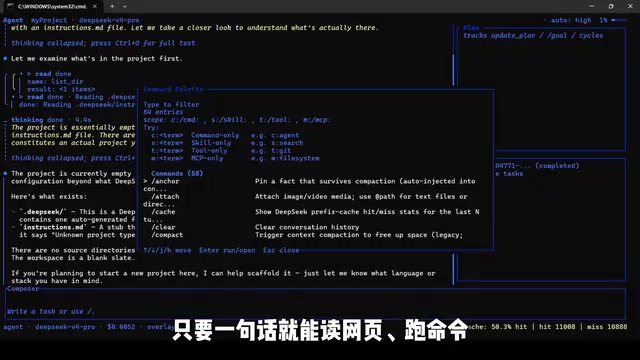
With a single natural language instruction, this terminal Agent can perform a variety of operations:
- Read web pages: Fetch and parse web content
- Run commands: Execute system commands directly in the terminal
- Write code: Generate, modify, and refactor code files
- Manage Docker: Handle containerized deployment environments
- Search the web: Search online for the latest information
Even more noteworthy, it can dispatch up to 20 sub-agents working in parallel. Sub-agent parallelism is a multi-agent collaboration architecture — when the main Agent receives a complex task, it decomposes it into multiple independent or semi-independent subtasks and assigns them to different sub-agents for parallel execution. For example, for a task like "refactor the entire project's logging system," the main Agent might break it down into: scanning all logging call sites, designing a new logging interface, replacing implementations module by module, and writing test cases — all handled simultaneously by multiple sub-agents. This architecture draws from the MapReduce concept in distributed computing and can significantly reduce completion time for complex tasks. Supporting up to 20 parallel sub-agents means a theoretical speedup of nearly 20x, though actual results depend on the degree of task parallelism and dependencies between subtasks.
Enterprise-Grade Architecture Design
From an architectural perspective, the tool's design is quite ambitious:
-
MCP Client: Out-of-the-box Model Context Protocol support for easy integration with various external tools and data sources. MCP is an open standard protocol proposed by Anthropic in late 2024, designed to establish a unified communication interface between AI models and external tools and data sources. Before MCP, every AI tool needed custom integration code for different external services, leading to severe ecosystem fragmentation. MCP defines a standardized JSON-RPC communication format that allows AI Agents to invoke database queries, API requests, file operations, browser control, and other external capabilities through a unified interface. DeepSeek's terminal Agent includes built-in MCP client support, meaning developers can directly reuse the many existing MCP servers in the community (such as GitHub MCP Server, PostgreSQL MCP Server, etc.), greatly expanding the Agent's capability boundaries.
-
Sandbox Environment: Code execution takes place in an isolated sandbox to ensure system security. A sandbox is a security isolation technology that creates a restricted execution environment within the host operating system, preventing code running inside it from accessing system resources outside the sandbox. For AI coding Agents, sandboxing is critical — because the Agent automatically executes system commands and code based on AI model output, and without proper isolation, an erroneous
rm -rfcommand or malicious code injection could cause catastrophic consequences. Common sandbox implementations include container-based isolation (e.g., Docker), virtual machine isolation, and OS-level namespace isolation (e.g., Linux namespaces and cgroups). -
Persistent Task Queue: Tasks aren't lost when the terminal closes, with support for resuming from breakpoints
These features indicate that DeepSeek isn't just building a simple command-line tool — it's constructing a complete terminal AI development platform.
DeepSeek Terminal Agent vs. Claude Code
| Feature | DeepSeek Terminal Agent | Claude Code |
|---|---|---|
| Open Source | ✅ Fully open source | ❌ Closed-source commercial |
| Context Window | Million-token level | 200K Tokens |
| Parallel Sub-agents | Up to 20 | Limited support |
| Dependencies | Zero dependencies | Requires Node.js |
| Tied to Model | DeepSeek V4 series | Claude series |
To be fair, Claude Code still holds advantages in code generation quality and tooling ecosystem maturity. However, the DeepSeek Terminal Agent has carved out clear competitive differentiation through being open-source and free, offering ultra-long context, and delivering powerful parallel processing capabilities — making it especially suitable for development teams with limited budgets or a preference for open-source solutions.
Conclusion: A New Choice for Terminal AI Coding
"Bring the AI coding assistant back to the terminal and let developers stay in control" — this is the core philosophy behind DeepSeek's tool. At a time when IDE plugins and web-based AI assistants dominate the landscape, a terminal-native approach actually gives developers greater flexibility and control.
The rapid growth to 38.4K Stars proves the developer community's strong endorsement of this type of tool. As DeepSeek V4's model capabilities continue to evolve and the open-source community contributes, this terminal coding Agent is poised to become an indispensable part of the developer's toolkit. If you're accustomed to terminal workflows or looking for an open-source alternative to Claude Code, this tool is worth trying right away.
Related articles
Devin Review Security Audit Feature Explained: How AI Code Review Detects Deep Security Vulnerabilities
Devin Review adds AI security audit to auto-detect auth bypasses, logic flaws & deep vulnerabilities in every PR, with full remediation from finding to fix.
Founders Fund Invests in Shinkei: The Business Logic Behind a Humane Fish-Slaughter Robot
Founders Fund bets on Shinkei, a humane fish-slaughter robotics company. Its Poseidon robot automates Japan's Ikejime technique. Analyzing the tech moat, market opportunity, and food tech trends.
Signal President Warns: AI Chatbots Are Not Your Friends
Signal President Meredith Whittaker warns users not to treat AI chatbots as friends. This article analyzes the dangers of AI anthropomorphization, privacy risks, and how to build healthy human-AI boundaries.