Devin Review Security Audit Feature Explained: How AI Code Review Detects Deep Security Vulnerabilities
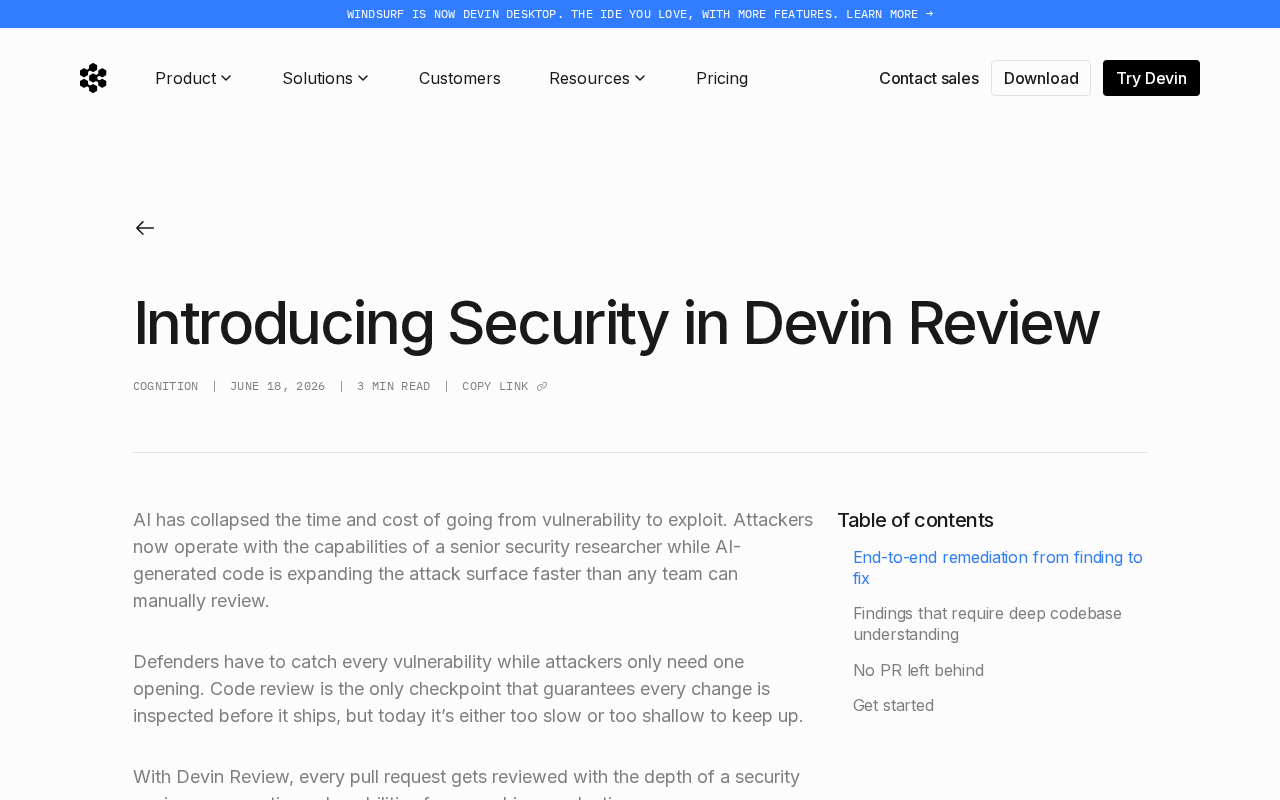
Devin Review adds AI-powered security auditing to detect deep vulnerabilities and provide fixes in every PR.
Cognition's Devin Review now includes an AI security audit feature that automatically reviews every Pull Request for deep security vulnerabilities like auth bypasses and logic flaws — issues traditional SAST tools often miss. Unlike pattern-matching scanners, Devin leverages semantic code understanding and cross-file analysis to detect complex vulnerabilities, providing complete remediation from discovery to fix. This advances shift-left security to the PR level, helping teams balance speed and security.
Overview: Every PR Now Gets an AI Security Review
Cognition recently announced that its AI development tool, Devin Review, has added a security audit feature. This means every Pull Request (PR) will automatically undergo an AI-powered security review upon submission. Unlike traditional pattern-matching scanners, Devin can catch deeper security vulnerabilities such as auth bypasses and logic flaws, providing a complete closed loop from discovery to remediation.
A Pull Request (PR) is a core mechanism in modern collaborative software development, originating from the Git distributed version control workflow. When a developer completes a feature or fix, they create a PR requesting that the code be merged into the main branch. A PR is not just an entry point for code merging — it's a critical node for team collaboration where other developers can conduct code reviews, discuss design decisions, and run automated tests. On platforms like GitHub and GitLab, PRs have become the standard practice for quality gating, typically requiring CI/CD pipeline checks and at least one reviewer's approval before merging. Embedding security reviews into the PR stage means security detection becomes the last line of defense before code enters the main branch.
Limitations of Traditional Security Scanning
The Ceiling of Pattern Matching
Most mainstream code security scanning tools (such as SAST tools) rely on pattern matching and rule engines. SAST (Static Application Security Testing) is a category of security detection technology that analyzes source code or compiled code without running the program. Its core techniques include lexical analysis, syntax tree parsing, data flow analysis, and taint analysis. Representative products include Checkmarx, Fortify, SonarQube, Semgrep, and others. These tools match known vulnerability patterns through predefined rule libraries — for example, detecting whether unfiltered user input is directly concatenated into SQL queries. SAST's strengths lie in broad coverage and fast execution, but its fundamental limitation is the lack of understanding of runtime behavior and business semantics, leading to high false-positive rates and difficulty in discovering logic-based vulnerabilities.
They excel at detecting known vulnerability patterns, such as typical SQL injection patterns and common XSS entry points. However, these tools often fall short in the following scenarios:
-
Auth Bypass: These vulnerabilities typically involve complex business logic chains where attackers may bypass permission checks through specific request sequences or parameter combinations. Pattern matching struggles to understand such cross-function, cross-module logical relationships. Auth bypass is one of the most dangerous vulnerabilities under the "Broken Access Control" category in the OWASP Top 10. Typical auth bypass scenarios include: JWT token validation flaws (such as algorithm confusion attacks), lax redirect URI validation in OAuth flows, permission inheritance errors in Role-Based Access Control (RBAC) implementations, and API endpoints missing authentication middleware. The detection difficulty lies in the fact that any individual function may appear correct in isolation — problems often emerge at the boundaries where multiple components interact. For example, a microservice might correctly verify a user's identity but fail to properly pass the authentication context when calling downstream services, leading to privilege escalation.
-
Logic Flaws: Security issues in business logic often have no fixed code patterns. For instance, a race condition in a payment system or a privilege escalation vulnerability requires understanding the code's semantics and business context to discover. Race conditions are a class of security vulnerabilities caused by the uncertain execution order of multiple operations, particularly common in concurrent programming and distributed systems. Classic examples include TOCTOU (Time-of-Check to Time-of-Use) vulnerabilities — where a time window exists between the system checking permissions and executing the operation, allowing attackers to change conditions within that window. In payment systems, race conditions can lead to double spending: a user simultaneously initiates two debit requests, and if the balance check and deduction are not atomic, the account may be overdrawn. These vulnerabilities cannot be found through simple regex matching — they require understanding the code's concurrency model and state management mechanisms.
These are precisely the vulnerability types most commonly seen in real-world security incidents and those that cause the greatest damage.
The Cost Dilemma of Manual Review
Experienced security engineers can identify these deep issues, but manual security review faces severe scalability challenges. In fast-paced development environments, dozens or even hundreds of PRs may be generated daily, making it neither practical nor economical for security teams to review each one. This forces many teams to only sample-review critical modules, leaving vast security blind spots.
Core Capabilities of Devin's Security Review
Semantic-Level Security Understanding
As an AI coding agent, Devin's security review capability is built on deep semantic understanding of code. As an AI Coding Agent, Devin's technical architecture differs from simple code completion tools. Agent architectures typically include: a Large Language Model (LLM) as the reasoning core, a long-term memory system for maintaining project context, tool-calling capabilities (such as file read/write, terminal operations, browser interaction), and planning and reflection mechanisms. In security review scenarios, the agent can proactively browse the codebase, trace function call chains, and understand dependency relationships, rather than passively scanning individual files. This proactive exploration capability allows it to simulate a security researcher's audit approach — starting from the attack surface and tracing potential exploitation paths along data flows.
Unlike simple pattern matching, Devin possesses the following key capabilities:
- Understanding Code Context: Tracing data flows and control flows to understand how variables are passed and transformed across different functions.
- Identifying Business Logic Vulnerabilities: Determining whether logical security flaws exist based on an understanding of the code's intent.
- Cross-File Correlation Analysis: Analyzing the security implications of modifications across multiple files when a PR involves changes to several files.
A Complete Closed Loop from Discovery to Fix
Another core highlight of Devin's security review is "full remediation from finding to fix" — a complete remediation closed loop. Traditional scanning tools typically only report issues, leaving developers to research fixes on their own. Devin not only identifies security issues but also provides specific remediation recommendations and even fix code, significantly shortening the cycle from vulnerability discovery to completed remediation.
This capability is especially valuable for development teams with limited security expertise. Developers don't need to be security experts to complete security fixes under Devin's guidance.
Practical Impact on Development Workflows
Putting Shift-Left Security into Practice
"Shift Left Security" is a core principle in the DevSecOps domain, advocating for integrating security detection as early as possible in the development process. DevSecOps is a security extension of the DevOps philosophy, with the core proposition that security should be a shared responsibility integrated throughout the entire Software Development Life Cycle (SDLC), rather than serving as a final gate before release. The evolution of shift-left security has gone through several stages: initially, security testing was only performed before release (penetration testing), then it moved forward into CI/CD pipelines (automated SAST/DAST), then to real-time detection at the IDE stage, and now it has deepened further into the PR review stage. Gartner research shows that the cost of fixing security vulnerabilities during the development phase is only 1/30 to 1/100 of the cost of fixing them in production. This economic logic is the fundamental driving force behind the continued push for shift-left security.
Devin Review's security audit feature advances this concept to the PR level — completing security detection and remediation before code is merged, reducing the accumulation of security debt at the source.
Development Efficiency and Security Quality No Longer at Odds
Automating security reviews into every PR means development teams no longer need to make painful trade-offs between "fast delivery" and "security compliance." AI security reviews respond far faster than manual reviews, avoiding bottlenecks in the development process, while providing detection depth that surpasses traditional SAST tools.
Outlook and Reflections
It's worth noting that AI security review does not mean human security teams can be entirely replaced. In areas such as complex security architecture design, threat modeling, and security strategy formulation, the judgment of human experts remains indispensable. Devin's security review is better positioned as a "force multiplier" for security teams — handling large volumes of repetitive security checks so that security engineers can focus their energy on higher-value security decisions.
As AI code comprehension capabilities continue to improve, AI security review is poised to cover increasingly complex security scenarios, becoming an indispensable component of software development security assurance systems.
Key Takeaways
Related articles

6 Must-Have MCPs for Claude Code: Upgrade It to a Full AI Development Workstation
6 essential MCPs for Claude Code: Playwright, File System, Sequential Thinking, Context7, GitHub, and Memos — upgrade your AI coding assistant into a complete development workstation.
DeepSeek++ Plugin: Adding Memory and Automation to the DeepSeek Web Interface
DeepSeek++ browser plugin adds long-term memory, Skill automation, and sidebar chat to the DeepSeek web interface — no API setup required. Full feature guide and installation tutorial.

Workstyle Memory Bridge: Making AI Remember How You Work
Explore how Workstyle Memory Bridge uses Slot+Scope unique keys, provenance tracking, and verifiable deletion to solve AI coding assistants' persistent memory loss of collaboration preferences.