Founders Fund Invests in Shinkei: The Business Logic Behind a Humane Fish-Slaughter Robot
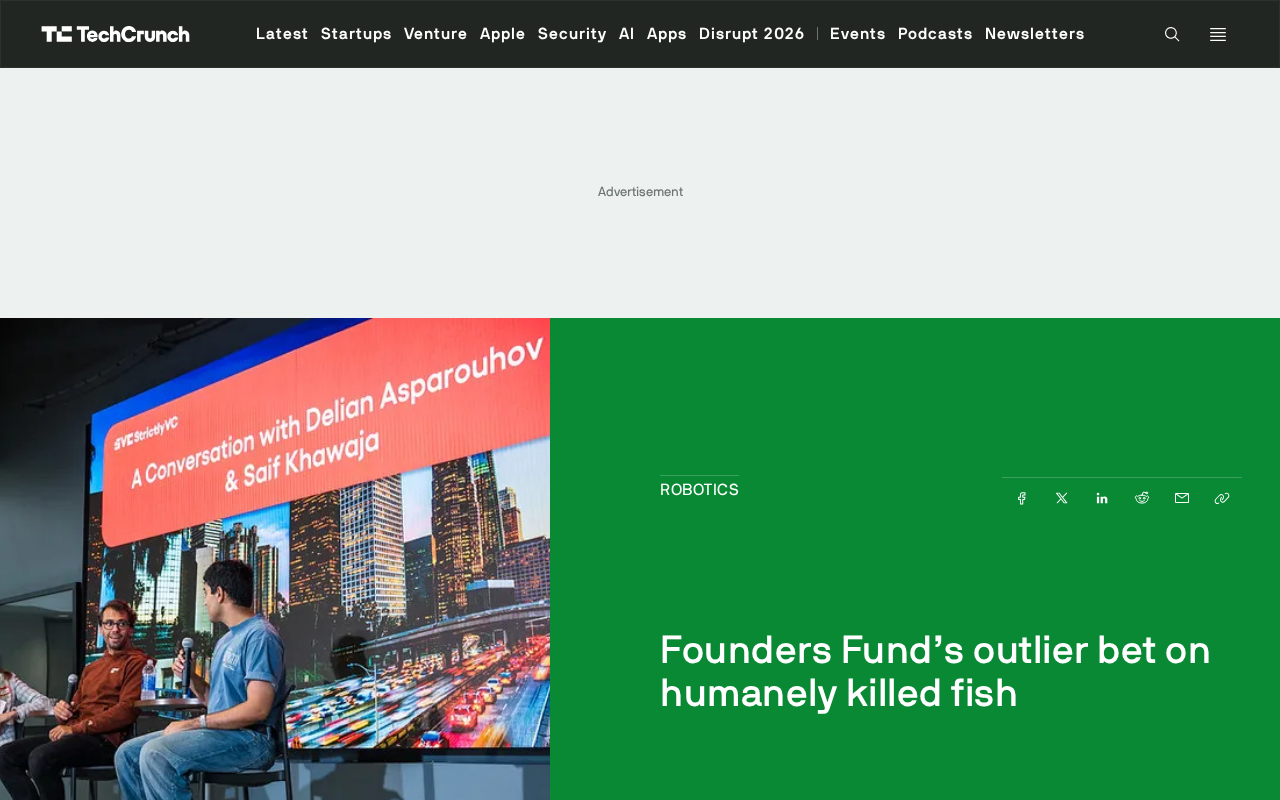
Founders Fund backs Shinkei's robot that automates Japan's Ikejime fish processing for better quality and humane slaughter.
Founders Fund has invested in Shinkei, a robotics company whose Poseidon robot automates the traditional Japanese Ikejime technique for humane fish slaughter. The investment targets a massive yet under-automated global fishing industry, leveraging computer vision and AI to improve fish quality, extend shelf life, and meet rising animal welfare regulations — signaling a pragmatic new direction in food tech.
Why Did Top VC Firm Founders Fund Bet on a Fish Processing Robot?
Silicon Valley's elite venture capital firm Founders Fund (founded by Peter Thiel) recently made a seemingly unconventional investment decision — backing a company called Shinkei. Shinkei has developed a refrigerator-sized robot called "Poseidon" designed to process fish quickly and humanely.
At first glance, this investment appears vastly different from Founders Fund's typical focus on hard tech, AI, and aerospace. But a deeper analysis reveals that this is actually a cross-disciplinary innovation at the intersection of food tech and robotics, underpinned by clear business logic.
Founded in 2005 by PayPal co-founder Peter Thiel, Founders Fund manages over $11 billion in assets. The fund is known for its "contrarian thinking," focusing on companies that tackle significant problems but are overlooked by mainstream investors. Its portfolio includes iconic names like SpaceX (commercial space), Palantir (big data analytics), and Anduril (defense tech). Thiel's core investment philosophy centers on finding "zero-to-one" innovations — creating entirely new value rather than competing for share in existing markets. Founders Fund's investment in Shinkei is a natural extension of this philosophy into traditional industries.
What Is Shinkei? How Does the Poseidon Robot Work?
Core Technology: Automated Ikejime
Shinkei's flagship product, Poseidon, is a refrigerator-sized automated robotic system designed to achieve rapid, humane fish slaughter. In conventional fishing, fish typically die through slow asphyxiation after being caught. This raises animal welfare concerns and also degrades meat quality — stress hormones cause the flesh to deteriorate in taste and shorten its shelf life.
From a scientific perspective, when fish undergo the stress of capture and asphyxiation, their bodies release massive amounts of cortisol and adrenaline. Simultaneously, glycogen in the muscles is rapidly depleted, producing large quantities of lactic acid. This causes a sharp drop in muscle pH, accelerating protein denaturation, which makes the flesh soft, pale, and metallic-tasting. Additionally, the rapid depletion of ATP (adenosine triphosphate) under stress accelerates the onset of rigor mortis, causing the flesh to stiffen quickly before rapidly entering autolysis — dramatically shortening shelf life. This phenomenon, known in food science as "stress-induced quality deterioration," is one of the major causes of billions of dollars in losses across the global fishing industry each year.
Shinkei's technology draws inspiration from the traditional Japanese technique of "Ikejime." Ikejime is a Japanese fish processing method with over 350 years of history, literally meaning "to kill alive" (or more precisely, "living締結"). The complete Ikejime process involves three steps: first, a sharp tool is inserted into the fish's brain for instant brain death (brain spike); then the main artery is severed for bleeding (blood draining); and finally, a thin steel wire is inserted into the spinal canal to destroy the nervous system (spinal cord destruction). This process prevents rapid ATP breakdown and delays the onset of rigor mortis, allowing the flesh to maintain its elasticity and umami flavor for much longer. Fish processed with Ikejime can have a shelf life 2-3 times longer than conventionally processed fish, and at high-end sushi restaurants, Ikejime fish typically commands 3-5 times the price of ordinary fish.
In the premium Japanese cuisine industry, Ikejime is widely recognized as the best method for preserving fish quality. The Poseidon robot essentially automates and scales this experience-dependent artisanal technique.
However, the technical challenges of automated fish processing far exceed those of typical industrial robotics applications. First, there's the issue of morphological diversity: even within the same species, individual fish vary significantly in size and shape, requiring the robot to identify and adjust its strategy in real time. Second, there are extreme precision requirements: Ikejime demands an exact strike into a specific point in the fish's brain (typically with only a few millimeters of tolerance), requiring computer vision systems to achieve sub-millimeter positioning in wet, reflective environments. Furthermore, the mucus and moisture on fish surfaces interfere with conventional optical sensors, necessitating specialized imaging algorithms. Solving these challenges collectively requires the coordination of multiple cutting-edge technologies — deep learning, 3D vision, force-feedback control — creating a significant technical moat.
Business Value: A Triple Upgrade in Quality, Efficiency, and Compliance
The commercial value of this technology manifests across multiple dimensions:
- Improved fish quality: Humanely processed fish yields superior meat that commands higher prices
- Extended shelf life: Reduced stress response means longer shelf life and lower supply chain waste
- Scalable processing capacity: Converting artisanal techniques into robotic automation dramatically increases throughput
- ESG and regulatory compliance: Meeting increasingly stringent animal welfare regulations and consumer expectations for humane processing
On the ESG compliance front, animal welfare regulations worldwide are expanding from land-based farming to aquaculture. The EU has already incorporated fish into its animal welfare legislative framework, requiring effective stunning before slaughter. The UK, Norway, Switzerland, and other countries have also enacted or are developing specific regulations for humane fish processing. Under the ESG (Environmental, Social, Governance) investment framework, animal welfare falls under the "Social" dimension, and an increasing number of institutional investors and retailers are factoring supply chain animal welfare performance into procurement and investment decisions. Several of the world's largest retailers (such as Tesco and Whole Foods) have begun requiring suppliers to provide proof of humane fish processing, creating clear market pull for technology providers like Shinkei.
The Three-Layered Logic Behind Founders Fund's Investment in Shinkei
Founders Fund is known for investing in projects that "seem crazy but are actually rational" — SpaceX and Palantir being early examples. The Shinkei investment continues this tradition, driven by three core layers of logic:
First, a massive overlooked market. The global fishing industry is worth hundreds of billions of dollars, yet technology penetration remains extremely low. Most fish processing still operates in a semi-manual state, leaving enormous room for automation and robotics. Specifically, the global fishing industry generates approximately $400-500 billion in value, but its automation level lags far behind livestock farming and agriculture. Currently, over 70% of fish processing operations still rely on manual labor, especially in the primary processing stage after catch. Reasons for this include limited space on fishing vessels, harsh maritime working conditions, and the variability of fish species and sizes. In recent years, labor shortages in the global fishing industry have worsened (particularly in major fishing nations like Norway, Japan, and the United States), and rising labor costs are driving rapid growth in demand for automated solutions. The primary fish processing automation market alone is estimated to have a potential scale of several billion dollars.
Second, the technical barriers are real. Fish come in diverse shapes and sizes, and achieving precise automated processing requires deep integration of computer vision, robotic control, and other technologies. This is not a simple engineering problem, and latecomers cannot easily replicate it. Poseidon must complete species identification, body measurement, optimal insertion point calculation, and precise execution within milliseconds — the algorithmic complexity and engineering difficulty involved give it a technical moat comparable to autonomous driving systems.
Third, consumer trends are irreversible. Globally, consumer awareness of animal welfare continues to rise. "Humane processing" is shifting from a niche demand to a mainstream expectation, providing Shinkei with long-term market demand support.
A New Direction in Food Tech Investment: Changing How Food Is Produced, Not What We Eat
Over the past few years, food tech investment has been concentrated primarily in alternative proteins — plant-based meat, cultivated meat, and the like. But as these sectors have cooled (Beyond Meat's stock price collapse being a prime example), investors are turning their attention to more pragmatic technological innovation opportunities within the food supply chain.
The cooling of the alternative protein sector deserves deeper context. Between 2019 and 2021, plant-based and cultivated meat experienced an investment frenzy, with Beyond Meat's market cap briefly exceeding $13 billion at its 2019 IPO. By 2024, however, Beyond Meat's stock had fallen more than 95% from its peak, and Impossible Foods had repeatedly postponed its IPO plans. Core reasons for the sector's downturn include: low repeat purchase rates after initial consumer trial, difficulty competing on price with conventional meat, persistent gaps in taste and nutrition, and a consumer trust crisis triggered by the "ultra-processed food" label. On the cultivated meat front, despite continued technological progress, production costs remain far above the commercialization threshold, and timelines for scaled production keep getting pushed back. This backdrop has prompted food tech investors to reassess their direction, pivoting toward more pragmatic, closer-to-commercialization technological innovations.
Shinkei represents a different approach: rather than changing what people eat, it uses robotics and AI to change how food is produced. This kind of "incremental innovation" is often easier to commercialize than "disruptive innovation" and is more readily accepted and adopted by traditional industries. From a business model perspective, Shinkei can generate revenue through equipment sales, leasing, or per-unit processing fees. Its value proposition is clear and quantifiable for fishing industry operators — higher fish selling prices, lower waste rates, and reduced labor dependency.
Conclusion: What an Unconventional Bet Reveals About the Next Chapter of Food Tech
Founders Fund's investment in Shinkei may appear to be an "outlier bet" on the surface, but it actually reflects a clear investment thesis: finding application scenarios for robotics and AI within traditional industries, using technology to simultaneously solve efficiency problems and ethical concerns.
This may signal the next direction for food tech investment — not creating entirely new foods, but using better technology to process existing ones. For investors watching the fishery automation and food tech space, Shinkei's trajectory is well worth following. This case also reminds us that truly transformative technology opportunities are often hidden in industries that seem traditional and unglamorous, waiting to be unlocked by the right technology at the right time.
Related articles
GLM 5.2 & Zcode Hands-On Review: A Deep Dive into the Free AI Coding Tool with 5 Million Tokens/Day
In-depth review of Zhipu's GLM 5.2 model and Zcode programming tool: interface experience, coding benchmarks, and long-horizon Agent performance compared to GPT and Opus. 5M free tokens/day with MIT license.
Devin Review Security Audit Feature Explained: How AI Code Review Detects Deep Security Vulnerabilities
Devin Review adds AI security audit to auto-detect auth bypasses, logic flaws & deep vulnerabilities in every PR, with full remediation from finding to fix.
Signal President Warns: AI Chatbots Are Not Your Friends
Signal President Meredith Whittaker warns users not to treat AI chatbots as friends. This article analyzes the dangers of AI anthropomorphization, privacy risks, and how to build healthy human-AI boundaries.