DeepSeek V3 + bolt.html: A Practical Guide to Generating Beautiful Web Pages with Zero Code
DeepSeek V3 + bolt.html: A Practical G…
DeepSeek V3 combined with bolt.html generates beautiful web pages from prompts with zero coding
DeepSeek V3-0324 brings significantly improved frontend code generation capabilities. Combined with the open-source tool bolt.html, users can generate beautifully designed, fully functional HTML web pages in seconds using structured prompts. The workflow's core competitive advantage lies in prompt engineering quality, covering use cases from calculators and infographics to animated cards. bolt.html supports private deployment for data security and dramatically lowers the frontend development barrier.
Introduction: Redefining Frontend Development Efficiency with AI
DeepSeek V3-0324 quietly rolled out an update with significantly improved frontend code generation capabilities. Combined with the open-source tool bolt.html, you can generate beautifully designed, fully functional HTML web pages in seconds simply by entering well-crafted prompts — no programming background required.
This workflow of "powerful prompts + AI code generation" is redefining the efficiency boundaries of frontend development. This article breaks down the core elements of this approach to help you get started quickly.
The Tool Combination: DeepSeek V3 and bolt.html
DeepSeek V3-0324's Frontend Capability Upgrade
DeepSeek V3 is a large language model developed by the Chinese AI company DeepSeek, built on a Mixture of Experts (MoE) architecture with approximately 671 billion parameters, of which only about 37 billion are activated per inference. This maintains high performance while dramatically reducing computational costs. This architectural design makes it far more inference-efficient than dense models of comparable scale, and serves as the technical foundation enabling DeepSeek to offer low-cost API services.
The 0324 release was a typical Silent Update — no official technical report, no launch event — but community benchmarks quickly revealed a qualitative leap in code generation: scores on mainstream code evaluation benchmarks like HumanEval and SWE-bench showed significant improvements. The model's understanding of HTML/CSS/JavaScript synergistic generation became notably deeper, particularly regarding layout semantics, style inheritance, and DOM interaction logic. The generated pages are not only well-structured but achieve visual quality approaching that of professional designers.
More importantly, DeepSeek V3's API currently offers quite generous free tiers. Through third-party platforms like Novita, new users can receive $20 in free API credits — more than enough for extensive web page generation experiments.
bolt.html: An Open-Source AI Web Page Generation Platform
bolt.html was born from the philosophy of StackBlitz's bolt.new project, focusing on the minimalist generation scenario of single-file HTML. It wraps the code generation capabilities of large language models into an easy-to-use interface — users simply enter descriptive prompts, and the platform calls the backend AI model (such as DeepSeek V3) to generate complete HTML pages with real-time preview.
Compared to competitors like Vercel's v0.dev and Microsoft's GitHub Copilot Workspace, bolt.html's differentiated positioning lies in being lightweight, open-source, and self-deployable. The AI code generation platform ecosystem is rapidly diverging — one category pursues the SaaS route for ultimate user experience, while another takes the open-source route emphasizing data sovereignty and customizability. bolt.html firmly belongs to the latter.

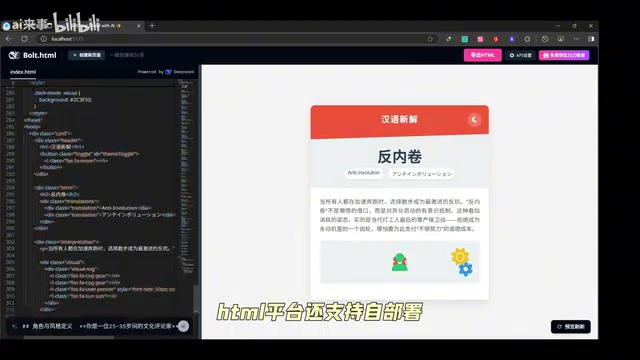
A major highlight of the platform is its support for self-deployment — if you have data privacy requirements or want to use it in an intranet environment, you can deploy the entire system on your own servers.
Practical Examples: Prompt-Driven Web Page Generation
Basic Pages: From Calculators to Hello World
The most basic use case is generating functional pages. For example, entering "design a beautiful calculator page" prompts DeepSeek V3 to generate a calculator with complete interaction logic — not only with well-arranged button layouts but also automatically adding gradients, shadows, and other visual details.
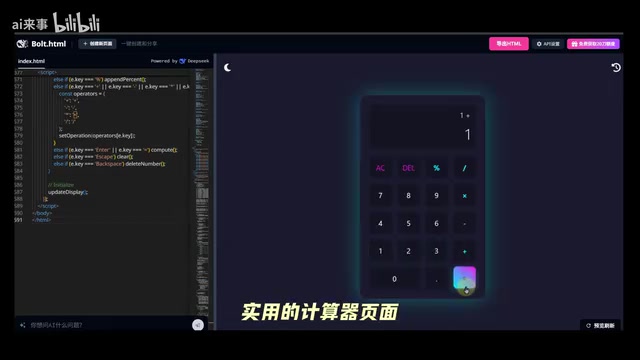
Even for a seemingly simple Hello World page, the AI will deliver refined typography, animation effects, and responsive layouts that far exceed the initial results of hand-written code. The reason behind this is that large language models absorb massive amounts of high-quality frontend code and design specification documents during training, giving them an inherent "aesthetic preference" — they tend to generate visual solutions that align with modern design trends rather than minimal implementations.
Advanced Usage: Chinese Word Reinterpretation and Content Cards
What truly impresses is creative prompts like "Chinese Word Reinterpretation" (汉语新解). It interprets input words with a unique visual style and automatically generates beautifully typeset content cards. With minor adjustments, such generated content can be directly used for social media posts.
The key behind this lies in prompt design quality. Prompt Engineering refers to the technical practice of carefully designing input text to guide large language models toward desired outputs. In code generation scenarios, effective prompts typically encompass four dimensions: functional description (what it does), visual style (what it looks like), technical constraints (what technologies to use), and quality standards (what level to achieve). Research shows that structured prompts can improve code generation quality by 30%-50% compared to vague natural language descriptions. Additionally, Few-shot Prompting — including reference examples within the prompt — is a commonly used advanced technique for improving frontend generation results. The more specific the prompt, the closer the output matches expectations.
Advanced Applications: Infographics and Animated Cards
More complex application scenarios include:
- Article summary infographics: Input an article's content to automatically generate structured visual summaries
- Weather broadcast cards: Weather display pages with smooth animation effects
- Universal HTML page generation: Adaptable to various page needs through general-purpose prompt templates
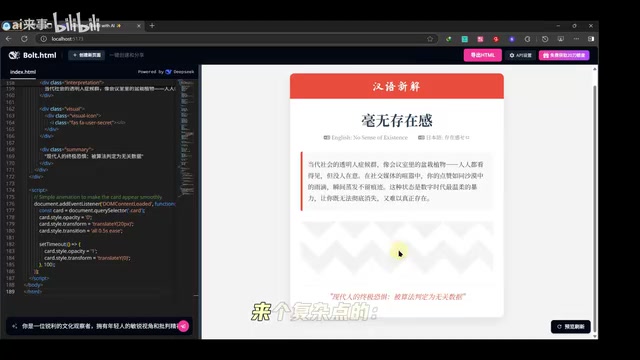
Among these examples, the animation effects are particularly impressive. AI-generated CSS animations are smooth and natural, with silky transitions, achieving a level that "looks like a professional designer spent hours carefully crafting." This is thanks to DeepSeek V3's deep mastery of animation technologies such as CSS Keyframes, Web Animations API, and cubic-bezier easing functions, enabling it to automatically select appropriate animation curves and timing parameters based on semantic descriptions.
bolt.html Self-Deployment and Extension Options
As an open-source project, bolt.html supports full private deployment. Its self-deployment solution is based on the Node.js runtime, with core dependencies including a frontend framework (typically React or Svelte) and a backend API proxy layer. Deployers can flexibly configure the backend model's API Endpoint through environment variables, theoretically compatible with all model services that follow the OpenAI API specification, including locally running solutions like Ollama and LM Studio.
For team use cases, self-deployment offers the following advantages:
- Data doesn't pass through third-party servers, ensuring privacy and security
- Interface and functionality can be customized according to needs
- Flexible backend model switching, not limited to a single AI service provider
For industries with strict data compliance requirements such as finance and healthcare, combining Nginx reverse proxy with intranet DNS resolution enables a completely offline private AI code generation environment. The deployment process is relatively straightforward — developers with basic server operations experience can complete the setup in a short time.
Prompt Engineering: The Core Competitive Advantage of This Workflow
The core competitive advantage of this workflow lies not in the tools themselves, but in prompt quality. A carefully designed prompt can transform vague requirements into precise visual outputs. This is essentially a new form of "programming" — replacing code syntax with natural language, and implementation with description.
From a technical evolution perspective, prompt engineering is undergoing a transition from "art" to "engineering": early prompt optimization relied more on intuition and trial-and-error, while today systematic prompt frameworks (such as CRISPE, CO-STAR) and automated prompt optimization tools (such as DSPy) have emerged. Mastering these methodologies means you can harness AI code generation capabilities more predictably and efficiently.
For non-technical users, this means the barrier to frontend development has been dramatically lowered; for professional developers, it means prototype design and rapid validation efficiency can improve by an order of magnitude.
Of course, AI-generated code still requires manual review and optimization for production environments — particularly in areas like Accessibility, cross-browser compatibility, and performance optimization, where AI-generated results often need professional developers' refinement. But as a rapid prototyping tool and creative validation method, this combination is already powerful enough.
Conclusion
The combination of DeepSeek V3 + bolt.html represents a practical direction in AI-assisted frontend development. It's not about replacing professional developers, but making the process from "idea to visualization" unprecedentedly fast. Mastering prompt engineering will become an essential skill for every content creator and developer.
Key Takeaways
- DeepSeek V3-0324, based on MoE architecture, offers significantly improved frontend code generation capabilities; combined with bolt.html, it enables zero-code generation of beautiful web pages
- bolt.html is an open-source HTML generation platform compatible with various model services following the OpenAI API specification, supporting private deployment to ensure data security
- Prompt engineering is the core factor determining generation quality; structured prompts (covering four dimensions: function, style, constraints, and standards) can dramatically improve output quality
- Application scenarios range from basic functional pages to complex needs like infographics and animated cards
- This workflow significantly lowers the frontend development barrier, suitable for non-technical users' rapid prototype validation, though production code still requires professional review
Related articles
 Tutorials
Cursor + Codex Dual-IDE Collaboration: A Practical Methodology for Open-Source Project Customization
A complete methodology for open-source project customization based on real-world experience, detailing the Cursor+Codex dual-IDE workflow, seven-stage process, MVP validation, and AI source code reading techniques.
 Tutorials
Cursor Multi-Agent in Practice: Building a Full-Stack Next.js Blog in 50 Minutes
Build a full-stack blog in 50 minutes using Cursor IDE's multi-Agent mode with Next.js, Clerk auth, and Supabase. Learn the 4-phase AI Agent workflow and key integration pitfalls.
 Tutorials
Building an AI Software Factory from Scratch: A Cursor Engineer's Hands-On Experience with Multi-Agent Collaboration
Cursor engineer Eric shares practical insights on building an AI software factory: automation levels, guardrail design, parallel Agent management, and scaling to 1000+ Agents for 24/7 development.