Devin's Client List Revealed: Why Goldman Sachs, the U.S. Military, and Mercedes-Benz Are Choosing Autonomous AI Programming

AI programmer Devin lands Goldman Sachs and U.S. military as clients, signaling enterprise autonomous AI programming tipping point.
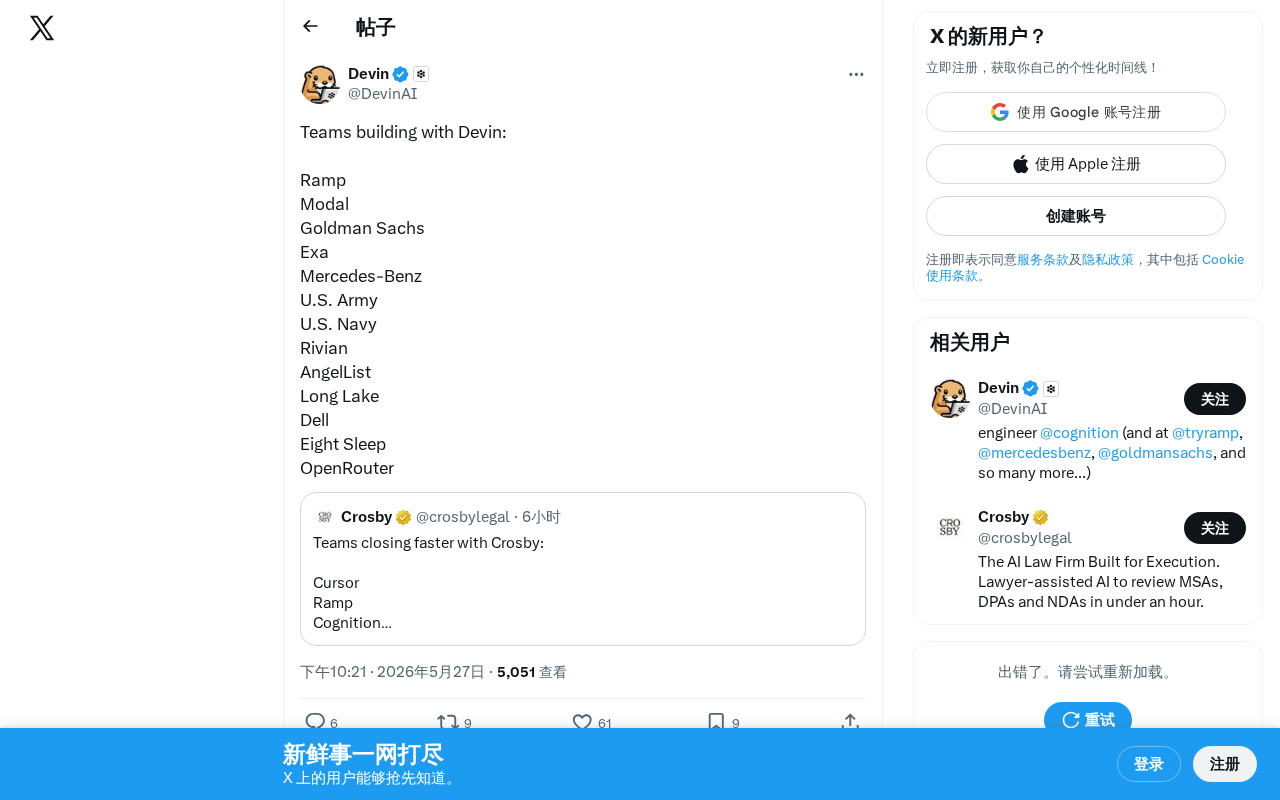
Cognition's AI software engineer Devin has unveiled a heavyweight client list spanning Goldman Sachs, the U.S. military, Mercedes-Benz, and other top institutions across six major industries. Unlike code completion tools such as Copilot, Devin positions itself as an autonomous programming agent capable of independently completing full software engineering tasks. Military adoption implies it meets the highest security compliance standards, while AI-native companies' usage creates a recursive "AI building AI" acceleration effect. This signals the commercialization tipping point for autonomous AI programming is arriving, with software development cost structures facing historic transformation.
Devin's Enterprise-Level Breakthrough in AI Programming
Cognition's AI software engineer Devin recently unveiled a remarkable client list spanning top-tier institutions across finance, military, automotive, technology, and other critical sectors. This list not only showcases Devin's commercialization progress but also reflects a profound shift in AI programming tools — from "tech experimentation" to "enterprise-level necessity."
Heavyweight Clients Across Multiple Industries
The client list carries exceptional weight, covering at least six major industries:
- Financial Technology: Goldman Sachs, Ramp, AngelList
- Defense & Military: U.S. Army, U.S. Navy
- Automotive Manufacturing: Mercedes-Benz, Rivian
- AI Infrastructure: Modal, Exa, OpenRouter
- Hardware & Consumer: Dell, Eight Sleep
- Other: Long Lake
Notably, these aren't small startups testing the waters — they represent formal adoption by industry leaders. Goldman Sachs, as a top global investment bank, has extremely stringent requirements for the security and reliability of technical tools. The U.S. military's involvement further implies that Devin has passed some level of security review and compliance assessment.
Three Signals Worth Watching
AI Programming Shifts from Assistance to Autonomy
Unlike "assistive" programming tools such as GitHub Copilot and Cursor, Devin positions itself as an "AI software engineer" — capable not only of completing code but also of independently understanding requirements, planning solutions, and writing and debugging complete code projects.
To understand the technical implications of this positioning, it helps to know the three generational tiers of current AI programming tools. The first generation, represented by GitHub Copilot, is based on Code Completion, predicting subsequent code in real-time as developers type. The second generation, represented by Cursor and Codeium, introduces Conversational Editing and codebase-level context understanding, capable of comprehending project structure across files. The third generation, represented by Devin, moves toward the Autonomous Agent paradigm, where the tool itself can accept task objectives described in natural language and autonomously complete the full software engineering loop — from environment configuration and code writing to testing and deployment. These three generations are not replacements for each other but rather address engineering tasks at different levels of granularity.
Devin was released by Cognition in March 2024. Its core technical breakthroughs lie in "persistent context memory" and "multi-step task decomposition" — Devin can break down a complex engineering requirement into dozens of subtasks, execute them sequentially, autonomously debug and backtrack when encountering errors, and independently operate terminals, browsers, and code editors within a sandboxed environment. This is fundamentally different from the single-line/single-function completion paradigm of tools like Copilot.
This client list demonstrates that enterprises have begun trusting AI to independently complete software engineering tasks of considerable complexity, rather than merely using it as an "autocomplete" tool for human programmers.
Military Adoption Accelerates Legitimization of AI Programming Tools
The simultaneous appearance of the U.S. Army and Navy on this list is a landmark event. The military's software supply chain security requirements far exceed those of the commercial sector. Their adoption implies: first, that Devin's code quality and security have reached a considerably high standard; second, that the application of AI programming tools in sensitive domains is being institutionally accepted.
U.S. military software procurement typically requires passing rigorous security certification systems, including FedRAMP (Federal Risk and Authorization Management Program), CMMC (Cybersecurity Maturity Model Certification), and DISA STIGs compliance requirements specific to the Department of Defense. AI tools entering the military supply chain must also address additional data sovereignty concerns — code and business logic cannot leave controlled environments. The presence of both military branches on the list suggests Cognition may have already provided private deployment or government-exclusive cloud solutions. This carries demonstration significance for the entire AI programming tools industry: it proves that autonomous AI agents can operate while meeting the highest security standards, thereby paving the way for other regulated industries (such as healthcare and energy) to adopt similar tools.
AI-Native Companies Become a Key Client Segment
Modal (AI infrastructure platform), Exa (AI search engine), and OpenRouter (LLM routing platform) on the list are all AI-native companies. These companies already possess top-tier engineering teams. Their choice to use Devin indicates that even the most AI-savvy technical teams recognize the efficiency gains that AI programming assistants deliver.
There's a unique techno-economic logic behind these companies choosing Devin. AI-native companies typically have small but extremely high-density engineering teams, whose bottleneck often isn't "the ability to write code" but rather "the parallelism of advancing multiple engineering tasks simultaneously." Devin, as parallelizable AI engineer instances, can handle multiple independent repository tasks concurrently — effectively expanding the team's concurrent processing capacity without increasing headcount costs. OpenRouter's choice to use Devin carries an additional layer of significance: this is an AI infrastructure company using AI tools to maintain and expand AI infrastructure itself, forming a positive feedback loop of technological self-reinforcement. This recursive phenomenon of "AI companies using AI to build AI" is accelerating the evolution speed of the entire industry.
Impact on the AI Programming Landscape
The current AI programming space is fiercely competitive. GitHub Copilot holds first-mover advantage through Microsoft and GitHub's ecosystem dominance, Cursor has risen rapidly with its excellent editor experience, while Devin has taken a differentiated path — targeting higher-level autonomous programming capabilities.
Judging from this client list, Devin's strategy is working. Rather than competing head-on with Copilot in the red ocean of "code completion," it has carved into the higher-value market of "autonomously completing engineering tasks." For large enterprises like Goldman Sachs and Mercedes-Benz, what they need isn't making existing programmers write code 10% faster — it's an AI system capable of independently handling large volumes of standardized development tasks, thereby freeing scarce senior engineers for more creative work.
Future Outlook for Autonomous AI Programming
This list also raises some thought-provoking questions: What exactly are these institutions using Devin for? Core business system development, or rapid internal tool building? What's the actual code quality and reliability like? These details remain undisclosed, but judging solely from the caliber and diversity of clients, the commercialization tipping point for autonomous AI programming may arrive sooner than expected.
For the software engineering industry, this isn't the simplistic narrative of "whether programmers will be replaced" — it's a deeper transformation, underpinned by a historic restructuring of software development cost structures. The cost structure of software development has undergone several major shifts over the past thirty years: from the mainframe era (hardware cost-dominated) to the internet era (labor cost-dominated), to the cloud computing era (infrastructure and labor costs in parallel). The scaled adoption of autonomous AI programming tools is ushering in a fourth cost structure transformation — the marginal cost of standardized software development tasks (such as CRUD API development, unit test writing, documentation generation, and legacy code refactoring) is approaching zero. This trend aligns with the pattern of every productivity tool revolution in history: automation doesn't eliminate work but pushes human labor toward higher-abstraction value creation activities.
The unit cost of software development is being dramatically compressed by AI, which will give rise to entirely new application scenarios and business models. As the barrier to building software continues to fall, what becomes truly scarce will be the ability to define "what to build" rather than the skill of "how to build it."
Key Takeaways
- Devin unveils a heavyweight client list spanning Goldman Sachs, the U.S. military, Mercedes-Benz, and other top institutions across six major industries including finance, military, automotive, and technology
- Simultaneous adoption by the U.S. Army and Navy marks institutional acceptance of AI programming tools in high-security sensitive domains, likely meeting stringent compliance requirements such as FedRAMP and CMMC
- AI-native companies including Modal, Exa, and OpenRouter are also using Devin, creating a recursive acceleration effect of "AI building AI"
- Devin takes a differentiated approach, positioning itself as an autonomous software engineer rather than a code completion tool, targeting the higher-value enterprise market
- The commercialization tipping point for autonomous AI programming may arrive sooner than expected, as unit costs of software development are being dramatically compressed, and the industry is undergoing its fourth historic cost structure transformation
Related articles
 Industry Insights
AI Product Development in Practice: Model Selection, Building Moats, and Paths to Commercialization
Practical strategies for AI product development: why not to train models from scratch, when to use APIs vs. fine-tuning, building product moats, and the full path from evaluation systems to commercialization.
 Industry Insights
No Product Fits Your Needs? Building It Yourself Is the Best Starting Point for Indie Developers
Can't find a product that fits? Building from personal pain points is the best entry for indie developers. Niche needs + AI tools = rapid product creation.
 Industry Insights
OpenAI Codex Tutorials Mass-Copied on Bilibili, Highlighting AI Content Farm Problem
At least 9 Bilibili accounts mass-published identical OpenAI Codex tutorial videos, exposing content farm operations in the AI tools space.