DIY Electronic Music Box: Building a Sound & Light Gift Box with the E101 Module
DIY Electronic Music Box: Building a S…
An E101-based electronic music box that brings synchronized sound and light to gift boxes.
This article introduces an electronic music box project built with the E101 module, a buzzer, and LEDs. It uses PWM to drive the buzzer for music playback while synchronizing LED lighting effects, targeting premium gift packaging such as watch boxes and cake boxes. With low material costs and easy assembly, the solution significantly boosts product value and can be further upgraded with custom tracks, voice recording, and RGB lighting.
When Gift Boxes Meet Embedded Technology
In the premium gift market, the "sense of ceremony" and "added value" of a product are increasingly important. Imagine a beautifully crafted watch box or birthday cake box that plays a delightful melody the moment it's opened, accompanied by rhythmically flickering lights — the surprise factor is simply incomparable to ordinary packaging.
Recently, a maker shared a simple electronic music box project based on the E101 module, achieving synchronized music playback and ambient lighting effects. The overall build difficulty is low, yet it significantly elevates the perceived quality of gift packaging. While the project itself is straightforward, the underlying considerations — embedded hardware selection, audio driving, and lighting synchronization — are worth the attention of every DIY enthusiast and product designer.
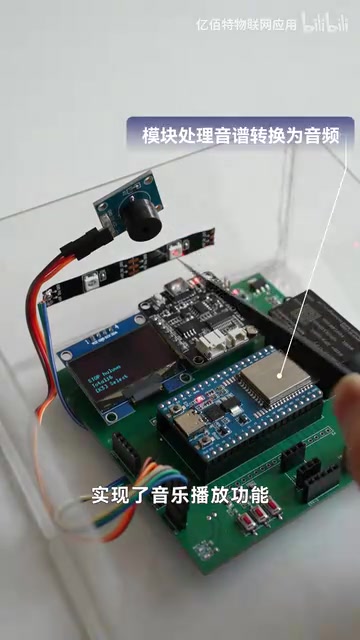
Core Hardware: E101 Module + Buzzer + LED
The Role of the E101 Module
The E101 is a common compact programmable control module. Small in size and low in power consumption, it's perfectly suited for embedding in space-constrained scenarios like gift boxes. It serves as the "brain" of the entire system — storing melody data, controlling the buzzer to produce sounds at specific frequencies, and driving LED beads to flash in sync.
Buzzer: The Sound Source
The project uses an active or passive buzzer for music playback. By applying PWM signals of varying frequencies to the buzzer, different musical notes can be simulated, allowing a complete melody to be performed.
PWM (Pulse Width Modulation) is a core technique in embedded systems for controlling analog output. By rapidly toggling a digital signal between high and low levels and adjusting the duty cycle (the proportion of time the signal stays high within each period) along with the signal frequency, a microcontroller can precisely control the vibration frequency of the buzzer's diaphragm, producing sounds of different pitches. The human ear can perceive audio in the range of approximately 20Hz to 20kHz, while common musical scale frequencies are concentrated between 261Hz (middle C) and 4186Hz (high C). It's worth noting that a passive buzzer has no built-in oscillation circuit and must rely on an external PWM signal to operate, which means it can play melodies by varying the frequency. An active buzzer, on the other hand, has a built-in oscillator and can only produce a fixed-frequency tone, making it generally unsuitable for playing music. This is why electronic music box projects tend to favor passive buzzers.
While the sound quality can't match that of a speaker, a buzzer's crisp and bright tone actually creates a unique "music box texture" in small spaces — a perfect fit for the gift box use case.
Ambient Lighting: A Visual Bonus
Beyond music playback, the project also incorporates LED ambient lighting. The lights don't simply stay on — they flash and pulse in sync with the musical beat, creating a synchronized sound-and-light effect. This design makes the moment of opening the gift box far more impactful, maximizing the atmospheric experience.
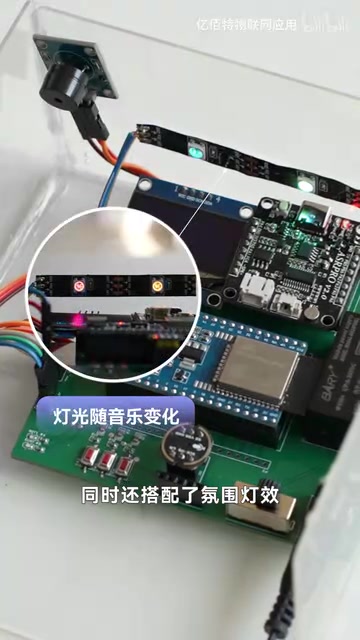
Application Scenarios & Commercial Value
Differentiation in Premium Gift Packaging
The target application for this solution is crystal clear: premium gift boxes. This includes but is not limited to:
- Watch boxes: A classic melody plays the instant the lid is lifted, with lights illuminating the watch — pure ceremony
- Premium birthday cake boxes: The birthday song plays automatically, eliminating the awkwardness of manually lighting candles and singing
- Jewelry boxes: In a proposal scenario, the dual enhancement of music and lighting makes the moment truly unforgettable

Cost & Feasibility Analysis
From a commercial perspective, the E101 module is inexpensive, and buzzers and LED beads are components costing mere cents to a few dollars each. The total bill of materials for the entire electronic music box can be kept very low, yet the added value it brings to the product is considerable. For gift box manufacturers, this is a value-added solution with an exceptionally high ROI.
Technical Implementation Approach
Basic Principles
The core principle of an electronic music box is not complicated:
- Digitizing the score: Convert the musical melody into an array of frequency and duration data, stored in the module's program memory
- PWM-driven buzzer: Use a timer to generate square wave signals at corresponding frequencies, driving the buzzer to produce sounds of different pitches
- Synchronized lighting effects: Control LED on/off states or color changes in sync with each note being played, achieving sound-light coordination
- Trigger mechanism: Typically uses a magnetic switch or micro switch to detect the lid's open/close state — open to play, close to stop
Implementation Details of Score Digitization
Converting a musical melody into data executable by a microcontroller is the most creative part of electronic music box development. Each note requires two key parameters: frequency (determining pitch) and duration (determining how long the note lasts). Developers typically build a note-to-frequency lookup table — for example, Do (C4) maps to 261Hz, Re (D4) to 293Hz, and so on. The melody is then encoded as a two-dimensional array, with each row containing a frequency value and a duration in milliseconds. This approach is essentially a simplified implementation of the MIDI (Musical Instrument Digital Interface) standard — since its inception in 1983, MIDI has been the universal standard in digital music, similarly describing music through note numbers and durations, albeit in a more complex and comprehensive format. For simple melodies, manually writing the note array is entirely feasible; for complex pieces, tools can convert MIDI files into C language arrays, significantly reducing the effort involved.
Magnetic Switches: An Elegant Contactless Trigger Solution
Lid open/close detection in gift boxes is typically achieved using magnetic switches (Hall effect sensors or reed switches), a contactless triggering approach that offers longer service life and better sealing reliability compared to mechanical micro switches. The reed switch is the most traditional type of magnetic switch, consisting of two magnetic metal reeds sealed inside a glass tube — when an external magnet approaches, the reeds attract and make contact; when the magnet moves away, they spring apart and break the circuit. Hall effect sensors, on the other hand, are semiconductor devices based on the Hall effect that can detect magnetic field changes and output digital or analog signals, offering faster response times and smaller form factors. In gift box applications, the magnet is typically installed on the inside of the lid, with the sensor mounted at the corresponding position on the box body. When the lid opens, the magnetic field disappears and triggers playback; when closed, the magnetic field is restored and triggers a stop. The entire process requires no physical contact — elegant and durable.
Build Difficulty Assessment
The overall build difficulty is low. For developers with some microcontroller experience, this is a project that can be completed in a weekend. Even beginners can successfully complete it by following a tutorial. The key challenge lies in writing the score data — accurately encoding each note's corresponding frequency and duration into the program.

From DIY Toy to Mass-Produced Product: Further Thoughts
Although this project may appear to be a simple DIY creation, it demonstrates an important product mindset: using low-cost technology to add new experiential value to traditional products.
With further iteration, the following upgrade directions could be considered:
- Swappable tracks: Allow users to customize the music via Bluetooth or USB interface
- Voice recording: Add a recording chip to support personalized voice messages
- RGB lighting effects: Use programmable RGB LEDs like the WS2812 for richer lighting effects. The WS2812 integrates an RGB LED chip and control IC into a single package, using a single-wire serial communication protocol — with just one data line, hundreds of LEDs can be daisy-chained, each individually addressable, capable of producing approximately 16.77 million color combinations. Compared to standard LEDs, the WS2812 doesn't require multiple PWM pins — a single IO pin from the microcontroller can drive an entire LED strip, while supporting complex dynamic effects like breathing lights, rainbow flows, and beat-synced flashing, dramatically enhancing visual impact.
- Low-power optimization: Use coin cell battery power combined with deep sleep mode to ensure the gift box can maintain months of standby time on store shelves. Modern microcontrollers in deep sleep mode can reduce power consumption to the microamp or even nanoamp level. Taking the common CR2032 coin cell battery (approximately 220mAh capacity) as an example, if the system's sleep current is 5μA, the theoretical standby time can exceed 5 years. This "sleep by default, wake on trigger" design pattern is one of the key technical thresholds for transforming a DIY prototype into a mass-producible commercial product.
Even a small gift box can become a carrier for smart, interactive experiences. This electronic music box project is a small but beautiful starting point for exactly that kind of thinking.
Related articles
 Tutorials
Cursor + Codex Dual-IDE Collaboration: A Practical Methodology for Open-Source Project Customization
A complete methodology for open-source project customization based on real-world experience, detailing the Cursor+Codex dual-IDE workflow, seven-stage process, MVP validation, and AI source code reading techniques.
 Tutorials
Cursor Multi-Agent in Practice: Building a Full-Stack Next.js Blog in 50 Minutes
Build a full-stack blog in 50 minutes using Cursor IDE's multi-Agent mode with Next.js, Clerk auth, and Supabase. Learn the 4-phase AI Agent workflow and key integration pitfalls.
 Tutorials
Building an AI Software Factory from Scratch: A Cursor Engineer's Hands-On Experience with Multi-Agent Collaboration
Cursor engineer Eric shares practical insights on building an AI software factory: automation levels, guardrail design, parallel Agent management, and scaling to 1000+ Agents for 24/7 development.