Earning $30K in 4 Days: A Complete Breakdown of the Reverse SaaS Launch Strategy
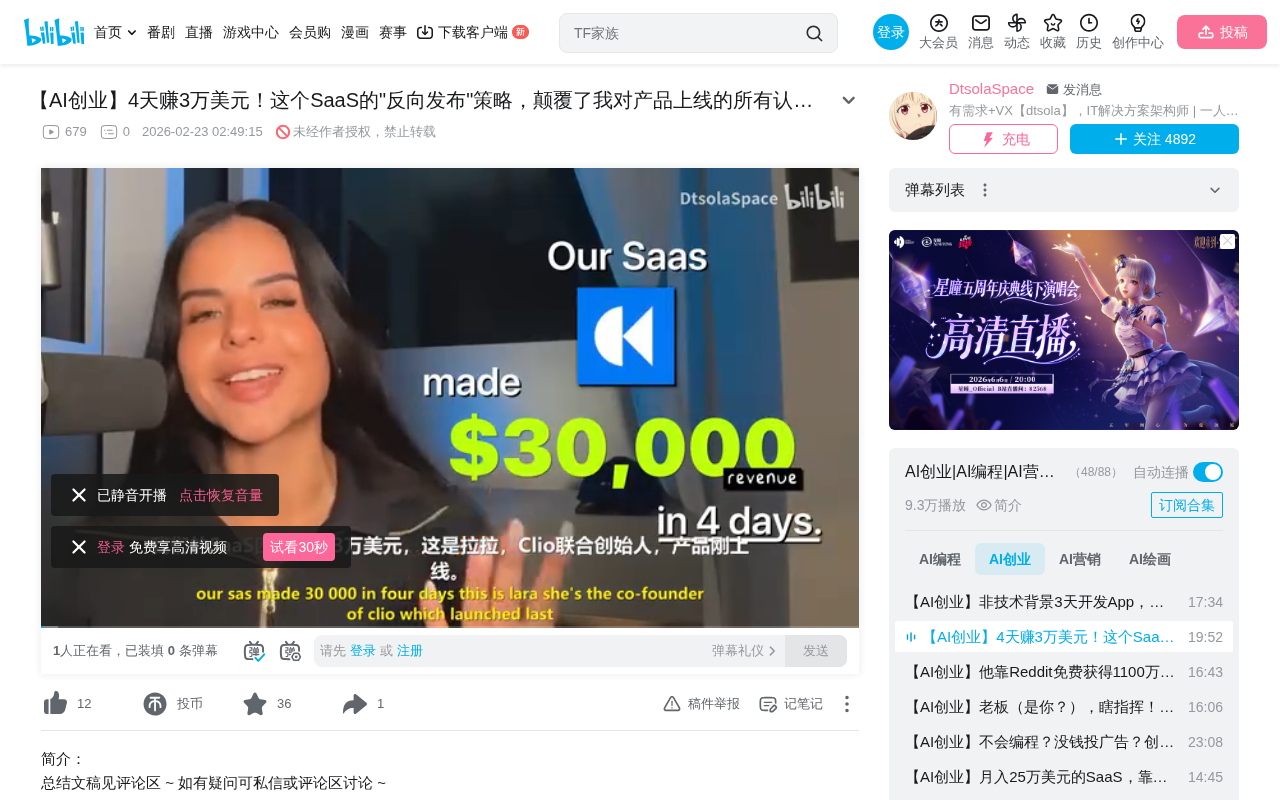
Clio used a "reverse launch" strategy — building an audience before the product — to hit $30K MRR in 4 days.
Clio co-founder Lara Acosta employed a "reverse launch" strategy, building momentum through educational LinkedIn content before launch, meticulously nurturing a waitlist to build trust, and using webinars to convert — ultimately reaching $30K MRR in just 4 days. The core philosophy: a SaaS product's competitive edge lies not in features but in distribution. Build your audience first, then build your product.
Introduction: A Counterintuitive Way to Launch a SaaS
Most founders launch their SaaS products the same way: build the product first, then promote it everywhere. But Clio co-founder Lara Acosta did the exact opposite — she accumulated a massive pool of potential users through a waitlist before the product even went live. The result? $30K in Monthly Recurring Revenue (MRR) within 4 days of launch, breaking through $60K MRR within two months, with over 932 active subscribers.
This approach, known as the "reverse launch" strategy, is built on a core principle: sell before you build, create buzz before you go live. This article provides a complete breakdown of this Launch Playbook, offering a reusable methodology for any founder looking to launch a SaaS product.
What Is Clio? An AI-Powered LinkedIn Content Tool
Clio positions itself as a "Ghostwriter in your pocket," specifically solving the pain point founders face when creating LinkedIn content. Powered by AI, it can mimic a user's thought process and writing style to generate high-quality LinkedIn posts.
Lara's background is worth noting: she's been consistently creating content on LinkedIn for three years and has built two companies based on LinkedIn content (an agency and an info-product business). She's deeply versed in marketing psychology — FOMO, scarcity, waitlists, email sequences, and webinars. These classic info-product tactics were systematically transplanted into her SaaS launch.
The Three Core Pillars of the Reverse Launch Strategy
Clio's launch playbook consists of three core components: Content, Waitlist, and Webinars. Unlike the traditional "build first, promote later" path, their logic was to first educate the market through content and accumulate demand, then filter high-intent users through a waitlist, and finally convert them through webinars.
Building Momentum on LinkedIn with "Edu-selling"
Lara's team employed a content strategy on LinkedIn called "Edu-selling" (educational selling). Their posts had no direct calls-to-action (CTAs), no hard sells — just pure user education.
For example, one post was titled "The best LinkedIn writing tip I've discovered," delivering pure value with only a natural mention of the Clio tool at the end. Co-founder Jake's posts focused on typical pain points founders face in content creation, also without any direct selling.
The brilliance of this strategy lies in the fact that it doesn't feel like a sales pitch — it feels like sharing a secret. Users feel like they're "chosen insiders" rather than "targets being sold to."
Lara also introduced a practical content framework — the 4-3-2-1 Rule:
- 4: Post content 4 times per week — no more, no less
- 3: Three content pillars — educational, storytelling, and sales-conversion
- 2: Target two audiences — ICP (Ideal Customer Profile) and IFP (Ideal Fan Profile)
- 1: One lead magnet — a free resource in exchange for the user's email
Meticulous Waitlist Nurturing
The mistake most founders make is building a waitlist and never nurturing it. The Clio team began systematic email warm-up four weeks before the official launch.
They sent over 10 warm-up emails, each one educating users rather than pitching the product. The first email's subject was "The problem with AI content and why we're different," directly addressing users' biggest concern — "How is this better than free ChatGPT or Claude?" They reframed the issue as "This isn't an AI problem, it's a differentiation problem," creating psychological buy-in.
The key insight: Real conversion happens in email, not on social media. Lara explicitly stated that everyone expects viral content to drive conversions, but email is actually where users make purchases — because you don't have to compete with algorithms.
When the product officially launched, they only needed to send one simple email: "Clio 2.0 is live — try it now." Trust had already been built through the previous 10 emails, making conversion effortless.
Using Webinars to Close the Deal
Clio's first launch included just one LinkedIn Live session with a very clear structure:
- First 20 minutes: Education around a single topic
- Middle 20 minutes: Product demo and feature showcase
- Final segment: Direct pitch with a purchase link
The value of going live lies in personal connection. When users see a real person presenting — feeling the founder's expressions, tone, and enthusiasm — trust skyrockets. This was the key catalyst that enabled Clio to hit $30K MRR in 4 days.
The Post-Launch Growth Flywheel: Doing Things That Don't Scale
After launch, the Clio team did several things that "look dumb but are incredibly effective":
White-glove VIP onboarding: Co-founders personally conducted one-on-one video calls with early users, walking them through the product step by step. Lara pointed out that most user churn isn't because the product is bad — it's because users don't know how to use it. These calls were also recorded to identify product issues and understand user mental models.
Scarcity-driven purchases: They told users "only 500 spots available" and offered a lifetime 50% discount. When a product is too easy to access, people don't feel urgency to buy; adding constraints significantly accelerated action.
Founder-level customer support: Co-founder Rob gave his personal phone number to every user. As Lara put it: "You need to do things that don't scale in order to scale faster."
Tech Stack: A Lean, AI-Native Architecture
Clio's tech stack reflects the typical way AI SaaS products are built today:
- Development: Claude + Claude Code
- Frontend: Next.js + TypeScript
- Deployment: Vercel (including Vercel Chat)
- Authentication: Clerk
- Operations: Slack (communication), Loops (email), Calendly (scheduling), Fernand (support)
- Monetization: Polar and its native landing pages
The entire stack is remarkably lean, built almost entirely on modern cloud-native tools. This demonstrates that in the AI era, the technical barrier to building a SaaS product has dropped dramatically — the real moat is distribution capability.
Two Core Pieces of Advice for SaaS Founders
At the end of the interview, Lara offered two extremely practical recommendations:
First, build a personal brand on LinkedIn. No matter how awkward it feels, LinkedIn is the most efficient platform for making money. Compared to Twitter and Instagram, LinkedIn has far fewer creators relative to consumers, meaning competition is extremely low — and the platform is packed with decision-makers. You don't need to be an expert; you just need to be "useful."
Second, build an email list. You never know when you might lose access to your social media accounts. An email list is the only distribution channel you truly own. Start building it before you need it, not when you're scrambling to promote something.
Conclusion: Distribution Is the Core Competitive Advantage in SaaS
Looking back at Clio's entire launch process, the most thought-provoking takeaway isn't any specific tactic — it's a fundamental mindset shift: The core competitive advantage in SaaS isn't product features — it's distribution capability. Build your audience first, then build your product. Create demand first, then fulfill it. This "reverse launch" logic is essentially the systematic application of mature info-product marketing methodologies to the SaaS domain.
For founders currently building a SaaS product, rather than spending six months polishing a "perfect" product and praying someone will buy it, start writing your first LinkedIn post today and collect your first email address. As Lara said: "Start building before you need it."
Related articles
 Tutorials
Cursor + Codex Dual-IDE Collaboration: A Practical Methodology for Open-Source Project Customization
A complete methodology for open-source project customization based on real-world experience, detailing the Cursor+Codex dual-IDE workflow, seven-stage process, MVP validation, and AI source code reading techniques.
 Tutorials
Cursor Multi-Agent in Practice: Building a Full-Stack Next.js Blog in 50 Minutes
Build a full-stack blog in 50 minutes using Cursor IDE's multi-Agent mode with Next.js, Clerk auth, and Supabase. Learn the 4-phase AI Agent workflow and key integration pitfalls.
 Tutorials
Building an AI Software Factory from Scratch: A Cursor Engineer's Hands-On Experience with Multi-Agent Collaboration
Cursor engineer Eric shares practical insights on building an AI software factory: automation levels, guardrail design, parallel Agent management, and scaling to 1000+ Agents for 24/7 development.