Enterprise-Grade RAG Full-Pipeline Optimization: Multi-Turn Conversations, Retrieval Tuning, and Production Engineering in Practice
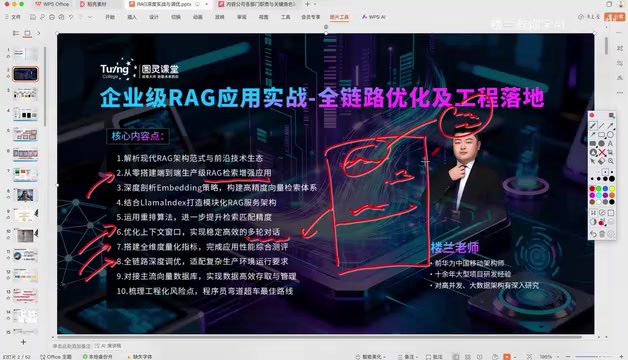
A practical guide to optimizing enterprise RAG systems from multi-turn dialogue to production deployment.
This article provides a comprehensive breakdown of the engineering challenges involved in taking RAG systems from prototype to production. It covers critical topics including multi-turn conversation query rewriting, hybrid retrieval strategies with BM25 and reranking, building systematic quality evaluation frameworks using metrics like RAGAS, and the importance of deep engineering experience in anticipating production-level issues.
Introduction: Building RAG Is Easy — Making It Production-Ready Is the Real Challenge
In the world of large model application development, RAG (Retrieval-Augmented Generation) has become one of the core architectures for enterprise AI applications. RAG was first proposed by Meta AI's research team in 2020. Its core idea is to retrieve relevant document fragments from an external knowledge base before the large language model generates a response, injecting the retrieved content as context into the prompt so the model can generate answers based on real data. This architecture effectively mitigates the "hallucination" problem of large models (where models fabricate nonexistent information) while avoiding the prohibitive cost of writing all enterprise knowledge into model parameters through fine-tuning. The typical RAG pipeline includes: document loading → text chunking → vectorization (Embedding) → storage in a vector database → query vectorization → similarity retrieval → concatenating retrieved results with the question → LLM answer generation.
However, many developers encounter an awkward reality: building a basic RAG system might only take a few hours, but making it run reliably and answer accurately in a production environment requires solving a series of deep engineering challenges.
Instructor Loulan from Turing Academy recently delivered an in-depth public lecture on full-pipeline RAG optimization and production engineering best practices. This wasn't a simple beginner tutorial — it directly addressed the most common pitfalls in enterprise RAG applications, including multi-turn conversations, retrieval accuracy, and quality evaluation.
Multi-Turn Conversations in RAG: A Challenge Most Developers Overlook
Regular Chat Multi-Turn Dialogue vs. RAG Multi-Turn Dialogue
In standard LLM chat scenarios, implementing multi-turn conversations is relatively straightforward: the system maintains a memory mechanism, sending previous chat history along with the current question to the LLM, enabling the model to understand the conversational context.
A classic example: a user first asks "What's the weather like in Beijing?" After the model responds, the user simply says "Changsha." The model can infer the user is asking about Changsha's weather — because the context has already established a "weather query" scenario.
But in a RAG scenario, things are completely different. RAG's core mechanism uses the user's question as a query to perform vector retrieval against the enterprise knowledge base. Here, vector retrieval works by using an Embedding model (such as OpenAI's text-embedding-ada-002, BGE, M3E, etc.) to convert text into high-dimensional vectors (typically arrays of 768 or 1536 floating-point numbers). The distance relationships between these vectors in mathematical space reflect the semantic similarity between texts. When a user asks a question, the system similarly converts the question into a vector, then uses algorithms like cosine similarity or Euclidean distance to find the closest document fragments in a vector database (such as Milvus, Pinecone, Chroma, etc.).
When the user asks "What's the weather like in Beijing?" the system can use this complete question to retrieve relevant content from the document library. But when the user then simply says "Changsha," the system takes just those two characters to search the knowledge base — what can it possibly retrieve?
The knowledge base has no idea whether the user is asking about Changsha's weather, economy, or travel guide. This is the core contradiction of RAG multi-turn conversations: the retrieval system needs complete, explicit query statements, but in multi-turn conversations, users' expressions are often abbreviated and context-dependent.
The Solution: Query Rewriting and Context Fusion
According to Instructor Loulan's analysis, the key to solving this problem is adding a "Query Rewriting" step before retrieval — leveraging the LLM's semantic understanding capabilities, combined with conversation history, to rewrite the user's brief input into a complete retrieval query. For example, rewriting "Changsha" into "What's the weather like in Changsha?" and then using this complete query to search the knowledge base.
This seemingly simple optimization actually involves the coordination of multiple engineering components: conversation history management, query intent recognition, and retrieval strategy adjustment. For conversation history management, you need to decide how many rounds of history to retain (too many introduce noise, too few lose context). For query intent recognition, you need to determine whether the user is continuing the previous topic or starting a new one. For retrieval strategy adjustment, the rewritten query may require different retrieval parameter configurations. Instructor Loulan pointed out that roughly 70%-80% of developers who haven't systematically studied RAG engineering aren't even aware this problem exists.
Three Core Challenges in RAG Production Deployment
Challenge 1: Deep Tuning of Retrieval Accuracy
Basic RAG systems rely on simple vector similarity matching for retrieval, but in real enterprise scenarios, this approach falls far short in accuracy. Multi-pipeline deep tuning is the key to improving retrieval quality, including:
-
Document Chunking Strategy Optimization: Different types of documents (process documents, technical manuals, FAQs) require different chunking granularities and methods. For example, FAQ-type documents are best chunked by question-answer pairs, with each pair as an independent retrieval unit, while lengthy technical manuals need to be chunked by paragraph or section while preserving Chunk Overlap to prevent critical information from being truncated. Chunks that are too large result in excessive irrelevant information in retrieval results, while chunks that are too small may lose necessary context.
-
Hybrid Retrieval Strategies: Combining vector retrieval with keyword retrieval (BM25) to leverage the strengths of both, covering both semantic matching and exact matching needs. BM25 is a classic algorithm in information retrieval, a sparse retrieval method based on term frequency statistics. It's an improved version of the TF-IDF algorithm that calculates the relevance score between a query and a document by considering three factors: term frequency, inverse document frequency, and document length normalization. BM25 outperforms vector retrieval in scenarios involving exact keyword matching, proper nouns, and product codes. In enterprise RAG systems, a Hybrid Search strategy is typically employed, executing both BM25 keyword retrieval and vector semantic retrieval simultaneously, then merging and ranking the two sets of results using algorithms like Reciprocal Rank Fusion (RRF).
-
Reranking Mechanism (Reranker): Performing secondary ranking on initial retrieval results using Cross-Encoder models to improve the relevance of final results. Rerankers use a Cross-Encoder architecture, which differs from the Bi-Encoder used in the initial retrieval stage. It concatenates the query and each candidate document together as input to the model, allowing the model to "see" the complete information of both the query and the document simultaneously, enabling more precise relevance judgments. Commonly used Reranker models include Cohere Rerank, BGE-Reranker, and others. The typical workflow is: first recall the Top-20 or Top-50 candidate documents through vector retrieval, then re-score and re-rank them with the Reranker, and finally select the Top-3 or Top-5 to feed into the LLM for answer generation.
Challenge 2: Building a Quality Evaluation System
Instructor Loulan particularly emphasized a core insight: "You can only optimize RAG if you can evaluate it. If you can't even identify the problems, optimization doesn't exist."
RAG system issues are "endless" — different documents, different phrasings, and different business scenarios can all expose new problems. Therefore, establishing a systematic RAG evaluation framework is crucial:
-
Retrieval Quality Assessment: Quantitative metrics including Recall (measuring the proportion of relevant documents that are retrieved) and Precision (measuring the proportion of relevant documents among retrieved results). Additional fine-grained metrics include MRR (Mean Reciprocal Rank, measuring the ranking position of the first relevant result) and NDCG (Normalized Discounted Cumulative Gain, measuring ranking quality).
-
Generation Quality Assessment: Semantic consistency scoring between generated answers and reference answers. The widely-used evaluation framework RAGAS proposes four core metrics: Faithfulness (whether the generated content is faithful to the retrieved context rather than fabricated by the model), Answer Relevancy (whether the answer addresses the question), Context Precision (whether the retrieved content is precisely relevant), and Context Recall (whether all information needed to answer the question has been retrieved). Additionally, there's the LLM-as-Judge evaluation method, which uses powerful models like GPT-4 to score generated answers across multiple dimensions.
-
End-to-End Assessment: User satisfaction tracking and feedback loops. This includes collecting thumbs-up/thumbs-down feedback from users in production, tracking whether users need multiple follow-up questions to get satisfactory answers, and conducting periodic sampling for manual review — forming a continuous improvement cycle of "evaluate → identify issues → optimize → re-evaluate."
Challenge 3: Technology Selection Amid the Explosion of AI Tools
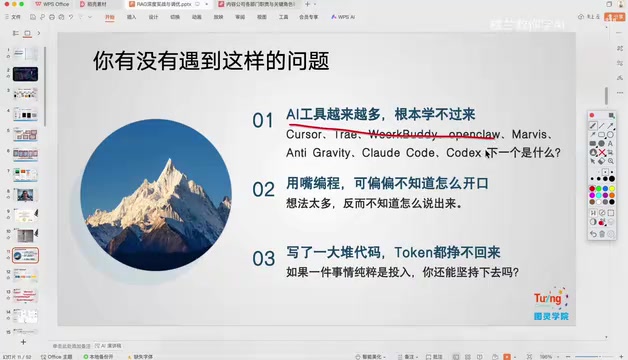
The explosive growth of AI development tools has created severe "choice anxiety" for developers. From Cursor to Claude Code, from OpenAI Codex to various domestic LLM tools — if you just chase tools, you'll never finish learning.
Instructor Loulan recommends that developers establish a core technical thread, understanding the underlying principles and architectural thinking rather than being led around by tools. Specifically in the RAG domain, LlamaIndex is one of the mainstream frameworks for enterprise RAG development. LlamaIndex (originally named GPT Index) was created by Jerry Liu in 2022, specifically designed for building data-augmented applications based on large language models. Compared to another popular framework, LangChain, LlamaIndex is more focused on data indexing and retrieval scenarios, offering more granular control over the RAG pipeline. Its core modules include: Data Connectors (supporting data loading from PDFs, databases, APIs, and other data sources), Index Structures (supporting vector indexes, list indexes, tree indexes, keyword indexes, and other index structures), Query Engine (supporting custom retrieval strategies and post-processing logic), and an Evaluation module (with built-in RAG evaluation metrics). LlamaIndex's modular design allows developers to independently replace and tune each component of the RAG pipeline, making it highly suitable for customized development in enterprise scenarios.
From "Working" to "Working Well": The Shift in RAG Engineering Mindset
Two Dimensions of Requirements Description
In the era of AI-assisted development, many people assume that "describing requirements in natural language" can solve everything. But Instructor Loulan points out that clearly describing requirements actually involves two dimensions:
- The Purpose Dimension: What system do I want to build — most people can articulate this clearly
- The Problem Dimension: What technical problems need to be solved to achieve that purpose — this is what truly tests engineering experience
If a developer lacks sufficient experience, many problems simply can't be anticipated. Just like the classic "Three Highs" challenges in traditional Java development (high concurrency, high availability, high performance), system decoupling issues, and CPU saturation problems — inexperienced developers may not even recognize a problem when they see one. The same applies to RAG: information truncation caused by document chunking, embedding model misunderstanding of domain-specific terminology, timeliness management of retrieval results, handling of multilingual mixed documents, indexing performance bottlenecks for large-scale knowledge bases... These problems don't surface when building a demo but emerge one by one in production environments.
The Value of Engineering Experience Lies in Anticipating Problems
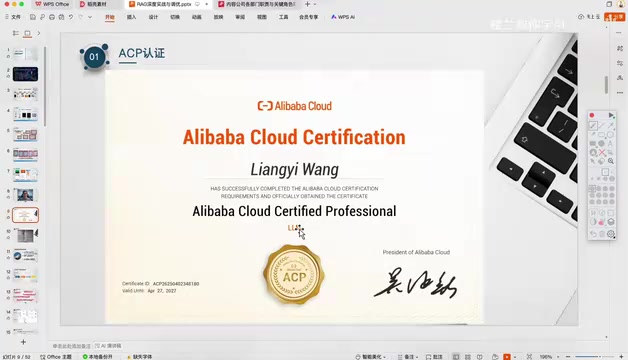
This is precisely why RAG production deployment needs to be led by people with extensive project experience. Instructor Loulan mentioned that he has been doing Java development since 2008, with 11 years of large-scale project development experience, and was among the first batch of experts to pass the Alibaba Cloud LLM ACP certification (currently the highest level). This kind of cross-domain engineering experience accumulation is exactly the key capability needed to push RAG from demo to production-grade product. The architectural design thinking, performance tuning methodologies, and system observability practices accumulated in traditional software engineering all find direct parallels and applications in the RAG engineering process.
Conclusion: Core Insights for RAG Engineering
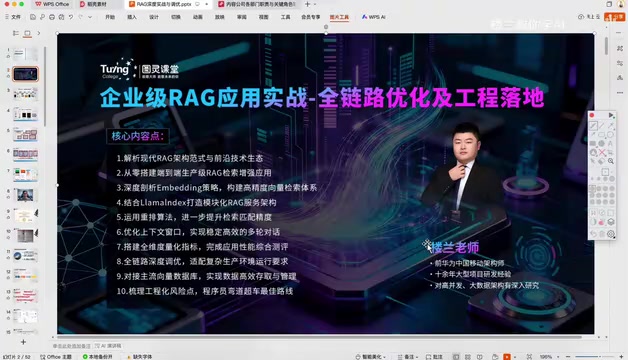
Developing enterprise-grade RAG applications is fundamentally a systems engineering problem, not a simple API calling exercise. From query rewriting in multi-turn conversations, to multi-pipeline deep tuning of retrieval accuracy, to building quality evaluation systems — every component requires deep understanding of underlying principles combined with customized optimization for specific business scenarios.
For developers looking to go deep in the LLM application development space, rather than chasing an endless stream of new tools, it's better to settle down and master RAG's core architectural thinking and engineering methodologies. Tools will keep iterating, but problem-solving mindsets and engineering experience are the true competitive moat.
Related articles
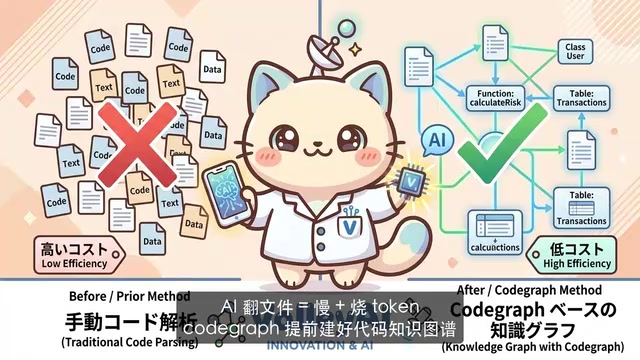
CodeGraph: The 50K-Star Open-Source Tool That Cuts AI Coding Token Usage in Half
CodeGraph is a 50K-star open-source tool that builds a code knowledge graph so AI coding assistants can locate code instantly—cutting Token usage by 47%, boosting speed by 22%, all running 100% locally.
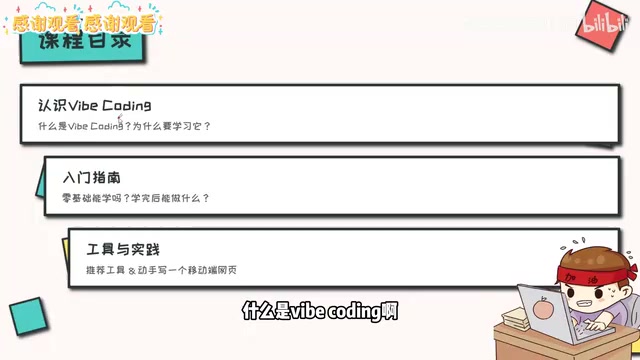
VibeCoding Beginner's Guide: A Complete Guide to Building Software with Natural Language from Scratch
VibeCoding lets anyone build software through natural language conversations with AI. Learn the core concepts, learning path, and practical methods to get started.
Using UU Accelerator to Speed Up Cursor: A Compliant Solution for Stable AI Coding in China
Learn how to use NetEase UU Accelerator to speed up Cursor AI coding tool in China, with step-by-step setup including node selection and launch configuration.