FastAPI Beginner Tutorial: Frontend-Backend Separation and RESTful API Core Concepts
FastAPI Beginner Tutorial: Frontend-Ba…
FastAPI fundamentals: frontend-backend separation architecture and RESTful API design principles
This article covers the foundational concepts needed before learning FastAPI. It compares monolithic and frontend-backend separated web development models, noting that separation is now mainstream (90%+ enterprise adoption) with JSON-formatted backend responses serving multiple platforms. It explains how FastAPI, built on the ASGI async framework Starlette, is naturally suited for API development. The article focuses on RESTful API specifications—using HTTP verbs for operations and URL nouns for resources—and provides learning path recommendations including SQLAlchemy 2.0 and Pydantic v2.
Introduction
FastAPI is one of the fastest-running Python web frameworks available today, designed from the ground up for the frontend-backend separation development model. Before diving into writing code, understanding web development patterns, API interface specifications, and other foundational concepts is crucial. This article starts with the frontend-backend separation architecture and progressively covers the key design principles of RESTful APIs, helping beginners build a clear technical knowledge framework.
Two Web Development Models: Frontend-Backend Separation vs. Monolithic
Monolithic (Non-Separated): Traditional but Gradually Becoming Obsolete
The core characteristic of the monolithic model is: everything the client browser sees—the interface, effects, and data—is all generated and returned by a single server.
The specific flow is: Browser sends request → Application server queries database → Processes business logic → Renders data into HTML templates → Returns the complete HTML page to the browser.
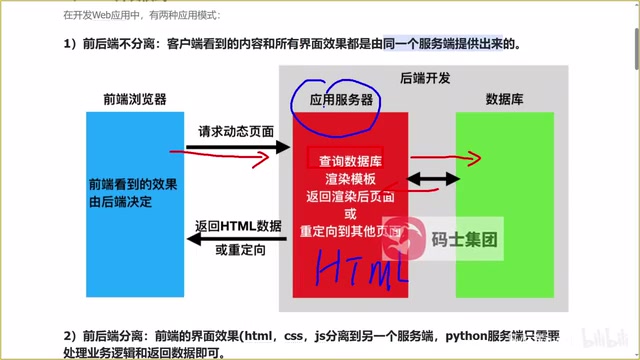
The biggest problem with this model is high development coupling. Backend developers have to write business logic, handle data, and also worry about interface rendering. Frontend design mockups must be completed first before backend development can begin, severely slowing down overall development efficiency. In real enterprise projects, this model has been gradually phased out.
Frontend-Backend Separation: The Current Mainstream Development Paradigm
The frontend-backend separation model splits the entire application into two independent servers:
- Frontend server (static file server): Stores HTML, CSS, JavaScript, images, and other static resources, dedicated to interface display and interaction
- Backend server (Python application server): Dedicated to processing business logic, providing unified API interfaces externally, returning data in JSON format
The benefits of this architecture are obvious:
- Parallel development: Frontend and backend teams can work simultaneously—once requirements are confirmed, each team can proceed independently
- Clear responsibilities: Backend only handles data and logic; frontend only handles interface and interaction
- Multi-platform reuse: The same set of backend APIs can simultaneously serve web browsers, mobile apps, WeChat mini-programs, and other clients
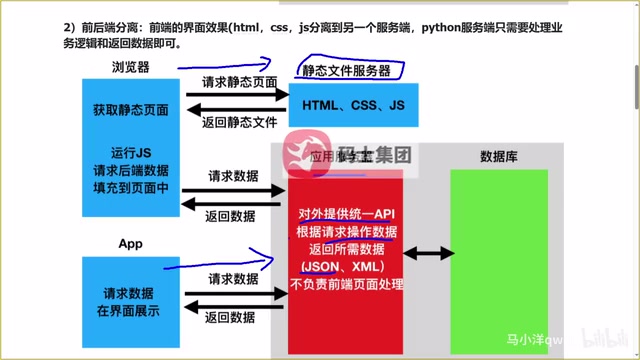
In enterprise-level projects today, over 90% adopt the frontend-backend separation development model. JSON is the dominant data format for backend responses (accounting for over 95%), while the once-popular XML format has essentially exited the stage.
Why did JSON replace XML? JSON (JavaScript Object Notation) became the absolute mainstream for API data exchange for deep technical and engineering reasons. XML has redundant tags, high parsing costs, and poor readability—a simple user data record might require dozens of lines in XML, while JSON needs only a few. JSON is naturally compatible with JavaScript object syntax, and browsers can directly parse it with
JSON.parse()without additional libraries. Furthermore, the data types JSON supports (strings, numbers, booleans, arrays, objects, null) cover the vast majority of business scenarios. Python'sjsonstandard library and FastAPI's built-in Pydantic models can seamlessly convert between Python objects and JSON strings, which is one of the key reasons why FastAPI's development experience is so smooth.
FastAPI's Positioning and Core Features
FastAPI is built on top of the Starlette framework, and Starlette was specifically designed for API interface development from its inception. Therefore, FastAPI is naturally suited for frontend-backend separation project architectures.
Starlette and ASGI Async Framework Background: The Starlette framework underlying FastAPI is built on the ASGI (Asynchronous Server Gateway Interface) specification, which is key to understanding FastAPI's high performance. ASGI is the asynchronous successor to WSGI (Web Server Gateway Interface)—traditional WSGI frameworks (like Django and Flask) use a synchronous blocking model where each request must wait for the previous one to complete before proceeding, creating obvious performance bottlenecks in high-concurrency scenarios. ASGI allows the server to handle multiple requests simultaneously, making it particularly suitable for I/O-intensive operations (such as database queries and external API calls). It's precisely this underlying capability that allows FastAPI to match Node.js and Go frameworks in official benchmarks, far exceeding traditional Python synchronous frameworks.
Of course, FastAPI isn't limited to backend APIs only. It also supports integrating the Jinja2 template engine for monolithic page rendering, but this isn't its core strength. A look at FastAPI's official documentation reveals that its main features and design philosophy revolve around backend API development.
A simple summary of FastAPI's positioning: It is one of the fastest-running Python web backend frameworks, focused on backend API development, with supplementary frontend rendering capabilities.
What is an API Interface
API (Application Programming Interface) is essentially an entry point that an application provides externally for operating on data. This entry point can be a function, a class, or a URL address. Clients only need to send requests to this entry point to retrieve or manipulate data.
Currently, there are two mainstream API interface specifications:
| Specification | Features | Use Cases |
|---|---|---|
| REST | Simple, convenient, highly secure | Mainstream choice, highest adoption |
| RPC | Remote Procedure Call protocol | Used in specific scenarios, lower adoption |
Python can implement both specifications, but REST remains the absolute mainstream due to its simplicity and universality.
RESTful API Design Specification Explained
REST stands for Representational State Transfer—the literal translation is admittedly obscure. But essentially, it's just the name of a set of interface design specifications, similar to how ISO9001 is the name of a quality management system. Don't get hung up on the literal meaning.
Historical Origins of the REST Architectural Style: REST is not a standard created by any company or organization. It was an architectural style proposed by Roy Fielding in his 2000 doctoral dissertation Architectural Styles and the Design of Network-based Software Architectures. Fielding himself was one of the principal designers of the HTTP/1.1 protocol, and REST is essentially a systematic summary and distillation of the HTTP protocol's design philosophy. REST's six constraints include: client-server separation, statelessness, cacheability, uniform interface, layered system, and code on demand (optional). Among these, "statelessness" is particularly important—the server does not save client session state, and each request must carry complete context information (such as a Token). This is the fundamental reason why modern JWT authentication mechanisms are so prevalent.
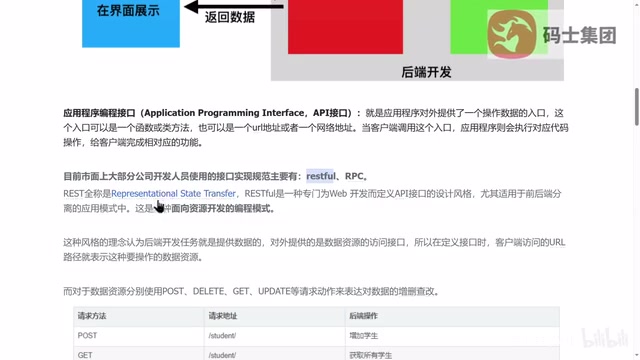
REST's Core Philosophy: Resource-Oriented Development
- The backend's job is to provide data; data is the resource
- Each API interface corresponds to a type of resource
- URL paths describe the location of resources
- Different HTTP request methods perform different operations on resources
RESTful API Design Example
Using "student" as a resource example, the RESTful API design looks like this:
| Operation | HTTP Method | URL Path | Description |
|---|---|---|---|
| Add student | POST | /student | Create new resource |
| Get all students | GET | /student | Get resource list |
| Get single student | GET | /student/1 | Get specific resource |
| Update student | PUT | /student/1 | Update specific resource |
| Delete student | DELETE | /student/1 | Delete specific resource |
As you can see, for the same /student path, different HTTP methods express completely different operational semantics. This is the essence of RESTful design—use HTTP verbs to describe operations, and URL nouns to describe resources.
Semantic Specifications and Idempotency of HTTP Methods: The choice of HTTP methods in RESTful APIs is not arbitrary—each method has clear semantic conventions and idempotency requirements. Idempotency means that performing the same operation on the same resource multiple times produces the same result as performing it once. GET, PUT, and DELETE are all idempotent operations—fetching the same resource multiple times yields the same result, updating the same resource to the same value multiple times yields the same result, and deleting the same resource multiple times (already non-existent) also yields the same result. POST, however, is non-idempotent—submitting the same form multiple times may create multiple duplicate records. Additionally, the PATCH method (partial update) is widely used in real projects, complementing PUT (full replacement). Understanding these semantic conventions helps design APIs that are more standards-compliant and easier for frontend-backend collaboration.
FastAPI Learning Path Recommendations
For developers preparing to learn FastAPI, here are some practical suggestions:
- Understand concepts before writing code: Frontend-backend separation, RESTful APIs—these concepts are the foundation for all subsequent hands-on work, so make sure you understand them first
- Django experience helps: If you've previously learned the Django framework, these concepts will be easier to grasp; but don't worry if you haven't—FastAPI's learning curve is relatively gentle on its own
- Master the JSON data format: As a backend developer, generating and parsing JSON is an essential fundamental skill
- Learn alongside SQLAlchemy 2.0: FastAPI is typically used with SQLAlchemy for database operations, which is also a key focus area for further study
The Core Value of the Pydantic Data Validation Library: Pydantic, mentioned in the FastAPI learning path for data validation, deserves special attention. Pydantic is a data validation library based on Python type annotations, and FastAPI deeply integrates Pydantic v2. Its core value lies in this: developers only need to declare data models using Python's type annotations (e.g.,
name: str,age: int), and Pydantic will automatically perform type checking, data conversion, and error reporting at runtime—no need to manually write tedious validation logic. FastAPI takes this further by deeply binding Pydantic models with API routes—request bodies are automatically deserialized into Python objects, response data is automatically serialized to JSON, and OpenAPI (Swagger) documentation is automatically generated. This "types as documentation, types as validation" design philosophy dramatically reduces error rates and maintenance costs in backend API development.
The Technical Evolution of SQLAlchemy 2.0: The FastAPI learning path specifically emphasizes SQLAlchemy 2.0, which represents a major architectural upgrade from version 1.x. SQLAlchemy is the most mature ORM (Object-Relational Mapping) framework in the Python ecosystem. The core change in version 2.0 is its full embrace of async programming—through
asynciosupport for asynchronous database operations, combined with FastAPI's async routes, it enables truly end-to-end async processing, preventing database I/O from blocking the event loop. Version 2.0 also introduces a more conciseselect()query syntax, deprecating the oldQueryobject style. In FastAPI projects,asyncpg(PostgreSQL) oraiomysql(MySQL) are typically used as async database drivers, combined with SQLAlchemy 2.0'sAsyncSessionto implement a high-performance database access layer. This is the mainstream technology stack combination for current Python backend development.
With these foundational concepts mastered, you'll have a solid foundation for diving deeper into FastAPI's routing, request handling, data validation (Pydantic), dependency injection, and other core features.
Key Takeaways
- Web development is divided into monolithic and frontend-backend separated models; currently over 90% of enterprise projects adopt the separated model
- FastAPI is built on the Starlette framework (ASGI async specification), designed from the ground up for frontend-backend separation and API interface development, making it one of the fastest Python web backend frameworks available
- RESTful API is the current mainstream interface development specification, proposed by Roy Fielding in 2000. Its core philosophy is resource-oriented development, performing idempotent or non-idempotent operations on resources through HTTP methods (GET/POST/PUT/DELETE)
- Under the frontend-backend separation architecture, the backend server returns JSON-formatted data that can simultaneously serve web, mobile apps, mini-programs, and other clients
- FastAPI is typically used alongside SQLAlchemy 2.0 (fully async ORM) and Pydantic v2 (type-driven data validation); together these three form the mainstream Python backend development technology stack
Related articles
 Tutorials
Cursor + Codex Dual-IDE Collaboration: A Practical Methodology for Open-Source Project Customization
A complete methodology for open-source project customization based on real-world experience, detailing the Cursor+Codex dual-IDE workflow, seven-stage process, MVP validation, and AI source code reading techniques.
 Tutorials
Cursor Multi-Agent in Practice: Building a Full-Stack Next.js Blog in 50 Minutes
Build a full-stack blog in 50 minutes using Cursor IDE's multi-Agent mode with Next.js, Clerk auth, and Supabase. Learn the 4-phase AI Agent workflow and key integration pitfalls.
 Tutorials
Building an AI Software Factory from Scratch: A Cursor Engineer's Hands-On Experience with Multi-Agent Collaboration
Cursor engineer Eric shares practical insights on building an AI software factory: automation levels, guardrail design, parallel Agent management, and scaling to 1000+ Agents for 24/7 development.