Fatherhood as the Most Unexpectedly Rewarding Life Experience: Reflections from Tech Leaders
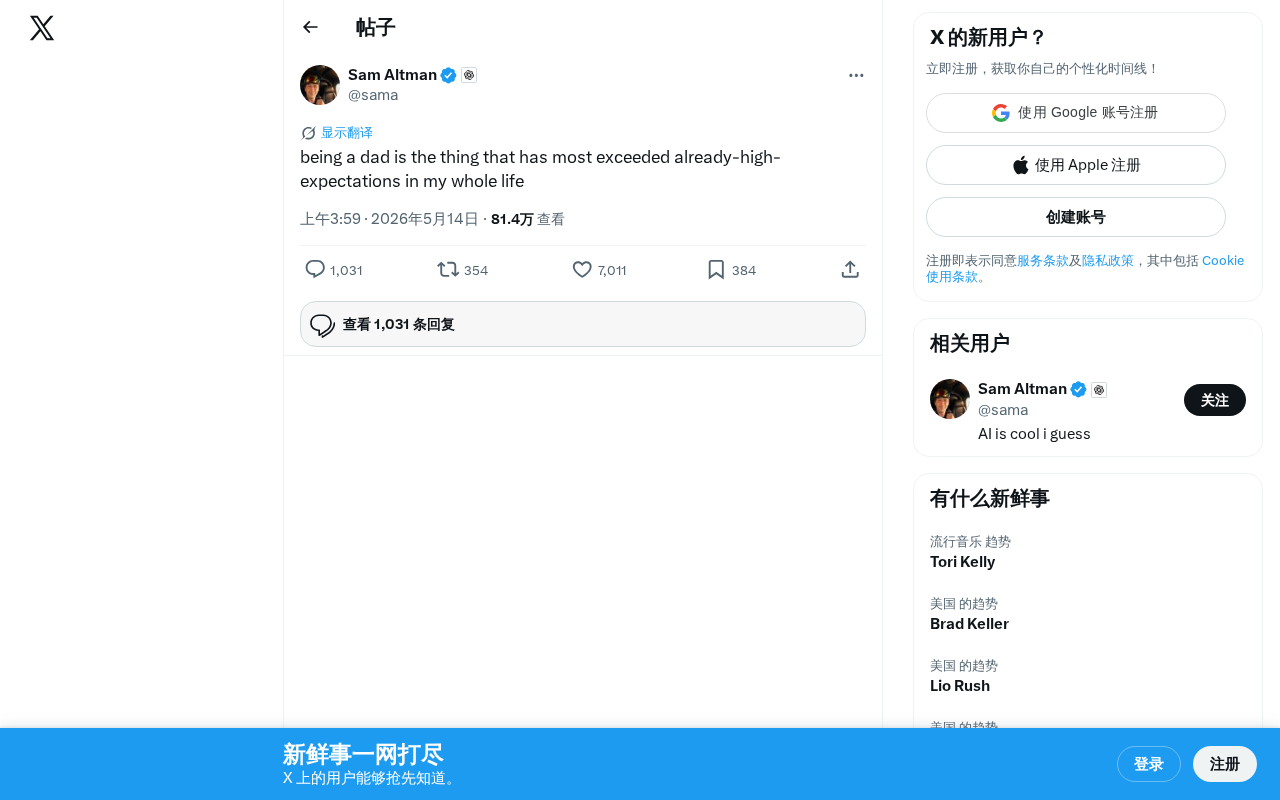
Tech leaders find fatherhood to be the most unexpectedly rewarding experience, signaling a cultural shift in Silicon Valley.
A simple tweet about fatherhood exceeding expectations sparked deep resonance across the tech community. In an industry obsessed with quantifiable metrics and optimization, this reflection highlights a cultural shift from work-is-everything to valuing family life—accelerated by remote work, AI automation, and a rethinking of human purpose in the age of LLMs.
A Tweet That Struck a Chord
Recently, a brief tweet sparked widespread discussion across the tech community:
"Being a dad is the thing that has most exceeded already-high-expectations in my whole life."
This seemingly non-technical personal reflection resonated deeply among tech professionals. In an industry dominated by efficiency, growth, and disruptive innovation, such candid life expressions feel especially precious.
The Tech Industry's "Expectation Management" vs. the Real Experience of Fatherhood
Tech professionals are no strangers to the concept of "exceeding expectations." Whether it's product launches, funding rounds, or user growth, practitioners deal with expectations every day. In fact, "Expectation Management" has become a deeply ingrained operational philosophy in the tech industry. From product roadmap planning to quarterly earnings releases, professionals are trained to quantify everything using OKR (Objectives and Key Results) and KPI (Key Performance Indicators). Apple's pre-launch "leak-expectation-exceed" trilogy and venture capital firms' precise calculations of startup valuation multiples are classic manifestations of this culture. In this environment, "exceeding expectations" typically means some quantifiable metric surpassing a preset threshold—say, user growth exceeding projections by 20%, or product performance improving by an order of magnitude.
However, this tweet reveals a fascinating contrast: In our careers, we're accustomed to measuring "exceeding expectations" with data; yet in life's most important role transitions, that feeling of surpassing expectations is utterly unquantifiable.
One notable detail: the author specifically emphasized "already-high-expectations." This means he didn't stumble into fatherhood unprepared—rather, even after setting high expectations, the actual experience still profoundly moved him. This "known unknown" is precisely what makes tech innovation so exciting—you know something will be good, but it turns out to be good beyond your imagination.
The Family Narrative in Silicon Valley Culture Is Changing
For a long time, Silicon Valley culture celebrated an "all-in" work attitude: endless overtime, always-on availability, treating the company as one's entire life. This culture traces back to the garage startup era of the 1970s—from HP's garage to Apple's origin story, "burning yourself out to achieve greatness" became a mythologized narrative. In the 21st century, this culture was pushed to extremes by Facebook's early motto "Move Fast and Break Things." Elon Musk openly demanding employees work 80-100 hours per week, former Yahoo CEO Marissa Mayer continuing to work during maternity leave—these were once seen as industry benchmarks. However, this culture also brought serious side effects: burnout rates in the tech industry are far higher than in other sectors, and mental health issues have become increasingly prominent.
But in recent years, more and more tech leaders have begun openly sharing the deep fulfillment that family life brings, representing a cultural shift worth paying attention to.
From "Work Is Life" to "Life Is More Than Work"
This shift didn't happen by accident. The 2020 COVID pandemic forced global tech companies to pivot to remote work almost overnight. This transformation, often called "the great remote work experiment," allowed millions of tech professionals to spend extended time in the same space as their families for the first time. The widespread adoption of collaboration tools like Slack and Zoom completely blurred the boundaries between work and life, but many professionals also rediscovered the value of family life in the process—witnessing their child's first steps for the first time, or having time to eat lunch with family on a workday. In the subsequent "Great Resignation," pursuing work-life balance became one of the top reasons for leaving jobs, directly driving the tech industry's increased focus on flexible work arrangements and family-friendly policies.
At the same time, the efficiency revolution brought by AI and the industry's cyclical waves of layoffs have prompted many tech professionals to reassess their life priorities. When algorithms can optimize everything, those human experiences that cannot be optimized—like raising the next generation—become even more precious.
Implications for the Tech Industry: Technology Should Serve Life
This tweet also indirectly reminds us: The best technology should serve people's lives, not replace life itself.
With the rapid development of Large Language Models (LLMs) like the GPT series and Claude, AI is automating knowledge work at an unprecedented pace. Code generation, document writing, data analysis—tasks that once required significant human effort can now be completed in seconds. This efficiency revolution raises a profound philosophical question: when machines can handle most of our "productive" work, where does the value of human existence actually lie? Philosopher Hannah Arendt once divided human activity into three levels: "Labor," "Work," and "Action"—with "Action," the unpredictable interactions between people, being the most essentially human activity. Raising children falls squarely within this "Action" category: it's full of uncertainty, cannot be optimized by algorithms, yet delivers the deepest sense of meaning.
When we discuss how AI is changing the world, perhaps we should also consider: the ultimate goal of technology is to give people more time and energy to experience those "exceeding expectations" moments in life.
Conclusion
In an age of information overload, the fact that a tweet of fewer than 20 words can spark such widespread discussion shows it touched something universally true. Technology continues to advance, but humanity's deepest satisfaction often comes from the most ancient, most fundamental experiences. Being a father is clearly one of them.
Key Takeaways
Related articles

Getting Started with Claude Code: 5 Key Differences from Traditional AI Chatbots
Explore 5 key differences between Claude Code and traditional AI chatbots like ChatGPT, covering interaction, context, execution, memory, and tool integration.
Your Pension Forced to Buy AI Bubble Stocks: The Truth Behind Nasdaq's Rule Changes
Nasdaq's fast-track rule changes may force your 401K and pension funds to buy SpaceX, OpenAI, and Anthropic stock. Analysis of the $4T valuation bubble and what investors can do.

GPT 5.6 Internal Testing Codename Revealed, Google Pays SpaceX $920M Monthly for Computing Power
OpenAI begins GPT 5.6 Kindle Alpha internal testing with stronger base reasoning. Google partners with SpaceX at $920M/month for computing power. Gemma 4 QAT enables edge deployment, Claude Cowork doubles credits.