Fengxing Story AI Novel Expansion Suite: Installation, Configuration & Seven-Stage Creative Writing Tutorial

Fengxing Story AI suite breaks novel writing into seven automated stages from synopsis to full text.
Fengxing Story is a zero-dependency AI novel expansion tool that leverages LLM APIs to break the creative workflow into seven stages: world-building, character sheets, detailed outline, expansion with logic verification, dialogue optimization, style transfer, and AI audit/formatting. It employs a multi-Agent collaborative architecture with dual verification through Golden Seed logic completion and creative reports, enabling controlled, pipeline-based generation from story synopsis to complete long-form text.
Overview
As large models like DeepSeek V4 continue to improve in capability, AI-assisted writing tools are evolving from simple text generation toward systematic creative workflow management. Recently, an AI expansion suite called "Fengxing Story" (风行故事) was officially released for download. It breaks down novel writing into seven standardized stages, leveraging LLM APIs to automate the expansion from story synopsis to full-length text. This article provides a detailed guide on installation, configuration, and hands-on usage of this tool.
An LLM API (Application Programming Interface) refers to a service that exposes the inference capabilities of large language models through programmatic interfaces. Developers don't need to deploy model weight files that can easily reach hundreds of gigabytes locally — they simply make network requests to call models running on remote servers. This architecture makes lightweight client tools like Fengxing Story possible — the tool itself performs no AI inference computation, but instead acts as a creative workflow orchestrator, dispatching tasks to cloud-based LLMs for completion.

Installation & Basic Configuration
Zero-Dependency One-Click Deployment
Fengxing Story has an extremely low installation barrier with no additional dependencies required. The developer provides both Windows and Mac versions — users simply download and extract the one-click package to any directory, then click the Start file to automatically open the workspace in a browser.
One important note: you must not close the black command-line window while the software is running — it serves as the backend service process for the entire program. This architecture is essentially a local web application: the command-line window runs a lightweight HTTP server, and the browser interface communicates with it through local network requests. This explains why closing the command-line window causes the entire program to stop working.
Model API Configuration
Fengxing Story doesn't include a built-in LLM — it relies on external LLM APIs to function. After clicking the settings button in the lower-right corner, you need to configure models for four core roles:
- System Default: General task processing
- Commander (执行官): Core creative workflow
- Auditor (扫地僧): Logic verification and review
- Publisher (发布师): Style transfer and formatting
This multi-role division is essentially an engineering implementation of a multi-Agent (multi-intelligent-agent) collaborative architecture. In AI system design, decomposing complex tasks among multiple AI roles with different System Prompts and specializations yields better results than having a single model handle everything. This design borrows from the "separation of concerns" principle in software engineering — the Commander handles core content generation, the Auditor focuses on logical consistency review (similar to a Reviewer role in code review), and the Publisher handles stylized output. Each role can be configured with a different model — for example, using a more creative model for the writing stage and a model with stronger logical reasoning for the verification stage — achieving an optimal balance between cost and quality.
The gear icon below each model configuration can be used to test whether the connection is successful. After configuration, you must click the checkmark to save. Fengxing Story supports all mainstream LLMs currently available, but if you're using the DeepSeek V4 model, there's one important detail: you don't need to set the temperature parameter.
The "temperature parameter" (Temperature) is a key hyperparameter that controls the randomness of model output: higher temperatures (e.g., 0.9-1.2) produce more creative but less predictable content; lower temperatures (e.g., 0.1-0.3) produce more deterministic and conservative output. The reason DeepSeek V4 doesn't require manual temperature setting is that its API endpoint has built-in adaptive sampling strategies for different task scenarios, automatically adjusting the degree of generation randomness based on context.
Creative Workflow in Practice
Step 1: Generate Story Synopsis
Click the "Inspiration" button in the upper-left corner to select the story's genre, time-space setting, emotional tone, and specify which model to use for generation. The custom input field supports special requirements, such as excluding unwanted elements or specifying plot points that must be included.

Inspiration generation offers three modes:
- Brainstorm Mode: AI generates automatically based on settings
- New Mode: Creates a blank inspiration card for manual input
- Random Mode: Random combination generation
After selecting a satisfying story, click "Adopt" to proceed to the next stage.
Step 2: Golden Seed Logic Completion
In the book list, select the story you want to write and click "Expand" to enter the expansion page. You'll see the "Golden Seed" in an unchecked state.
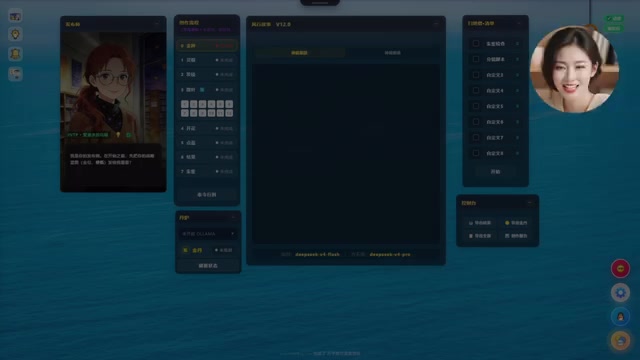
Open the Golden Seed and click "Logic Completion" — the AI will perform a logical consistency check on the story synopsis. This step is crucial — the developers strongly recommend that users carefully review the Golden Seed content themselves, because only a solid foundation can produce an excellent story. This reflects an important philosophy: AI is an assistive tool, and human judgment remains the ultimate guarantee of creative quality.
The "Golden Seed" concept can be understood as the story's core DNA — it contains the basic logical chain of the plot, causal relationships, and key turning points. The logic completion process essentially has the AI play the role of a "logic auditor," checking whether the synopsis contains causal breaks, timeline contradictions, unreasonable character motivations, and other issues, while automatically filling in missing logical links. The quality of this step directly determines the upper limit of all subsequent stages.
Step 3: Seven-Stage Automated Creation
After adjusting the story synopsis, click the button below the creative workflow to start automatic generation. The entire creation process is broken down into seven standardized stages:
- World-building - Establishing the story's foundational settings
- Character Sheet Generation - Creating character profiles
- Detailed Outline, Storyboard & Foreshadowing - Refining plot structure
- Story Expansion & Logic Verification - Removing habitual phrases and adjective overload
- Character Dialogue & Mirror Verification - Optimizing dialogue quality
- Style Transfer - Adjusting to a specified author's style
- Zhuque (AI Audit & Formatting) - Final proofreading
Breaking the creative process into a standardized pipeline draws from the "Pipeline" concept in software engineering. In traditional publishing, a book typically goes through planning, outlining, first draft, editing, proofreading, and typesetting stages, each handled by different professionals. Fengxing Story's seven-stage design digitizes and automates this professional workflow. This approach has significant advantages over the brute-force method of "generating tens of thousands of words in one shot": each stage's output serves as input constraints for the next, progressively narrowing the creative space, thereby greatly reducing common issues in long-text generation such as logical breaks, character personality inconsistencies, and plot contradictions.
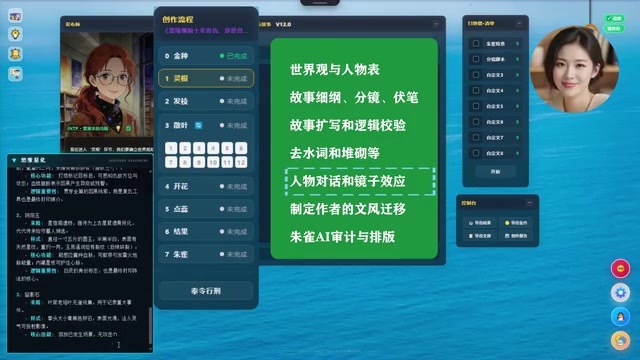
The "Logic Verification" in Stage 4 and "Mirror Verification" in Stage 5 deserve special attention. "Logic Verification" checks whether the expanded content deviates from the plot framework established in the Golden Seed, while also clearing common "AI-flavored" expressions — such as overuse of simile words like "as if" and "like," or piling on flowery but hollow adjectives. "Mirror Verification" specifically targets character dialogue, ensuring each character's speech patterns match their personality settings, educational background, and social status, avoiding the common problem of "all characters sounding like the same person."
Due to the number of stages, the entire process takes some time. However, with a stable network connection, Fengxing Story completes everything fully automatically without manual intervention. Even if generation is interrupted midway, there's no need to worry — the software records progress and resumes from the interruption point next time.
The Clever Design of Style Transfer
The style transfer in Stage 6 is a highlight feature. Clicking the "Publisher's" name allows you to select different author style templates, and the system calls the corresponding style parameters to rewrite the text.
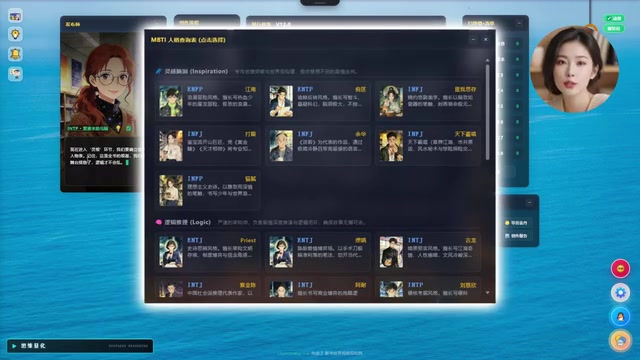
Style Transfer is a classic research direction in natural language processing. Its core approach is to convert the expression style to a target style while preserving the semantic content of the text. In the era of large models, style transfer is typically achieved through carefully designed prompt engineering: providing the model with descriptions of the target author's writing characteristics (such as sentence structure preferences, rhetorical devices, narrative pacing, word choice tendencies, etc.), then having the model rewrite the original text accordingly. Compared to earlier methods that required large amounts of parallel corpora to train specialized models, prompt-based style transfer is more flexible, can quickly adapt to any author's style, and doesn't require additional model fine-tuning costs.
If users aren't sure which author's style best suits their current story, they can have the system automatically recommend one. This design reduces the user's decision burden while preserving the flexibility of autonomous choice.
Post-Production Review & Export
Once the "Zhuque" stage is complete, the generated content can be exported. But the work isn't over — Fengxing Story provides a clever secondary verification workflow:
- Click "Creative Report" in the console — the AI generates a quality audit report
- Click the copy button in the lower-right corner to get the report content
- Open any AI web interface (such as the DeepSeek website)
- Upload the exported 07-Zhuque file and paste the quality report
- Wait for the AI to perform manuscript repair
- Paste the repaired full text back into the Zhuque content
This "in-tool generation + external AI verification" dual-guarantee mechanism effectively improves the quality of the final manuscript. The technical logic behind it leverages an important characteristic of large models: models typically perform better when reviewing and modifying existing text than when generating from scratch. This is similar to how "writing" and "editing" are two different cognitive modes in human writing. By exporting the generated results to an independent AI session for review, it also avoids attention degradation caused by an overly long Context Window — in the original creative session, the model may have accumulated tens of thousands of tokens of context, while reviewing in a new session allows it to examine the text with "fresh eyes," with attention resources fully concentrated on text quality itself.
After completing this step, users can begin manual manuscript review and editing.
Summary & Reflections
Fengxing Story represents a new direction for AI writing tools: rather than simply having AI generate long texts in one shot, it engineers and systematizes the creative process. The seven-stage design corresponds to different phases in professional writing, with targeted optimization strategies for each stage.
The advantage of this approach is that human intervention is possible at every step, avoiding the uncontrollability of "all-at-once" generation. Meanwhile, the multi-model collaborative architecture allows users to select the most appropriate model for each stage's needs, achieving a balance between cost and quality. For example, structured tasks like world-building and character sheet generation can use more cost-effective models, while core expansion and style transfer stages can call upon more powerful but costlier models.
From an industry trend perspective, the emergence of such tools signals that AI writing is transitioning from the "toy stage" to the "tool stage." Early AI writing experiences typically involved typing a prompt into a chat box and waiting for results, with users having almost no control over the generation process. Pipeline-based tools like Fengxing Story provide professional-software-level control granularity, enabling users to perform quality checks and direction adjustments at every critical node.
For web novel authors and content creators, the value of such tools lies not in replacing creativity, but in accelerating the journey from inspiration to first draft, allowing human creators to devote more energy to the aspects that truly require creativity — such as conceiving core ideas, crafting emotional resonance, and imbuing text with the warmth and depth that only human life experience can provide.
Key Takeaways
- Fengxing Story is a zero-dependency AI novel expansion suite supporting Windows and Mac with one-click deployment
- The tool breaks the creative workflow into seven standardized stages: world-building, character sheets, detailed outline, expansion, dialogue, style transfer, and audit/formatting
- Supports all mainstream LLM APIs; no temperature parameter setting needed when using DeepSeek V4
- Employs a multi-Agent collaborative architecture where different roles (Commander, Auditor, Publisher) each handle their specialties
- Provides dual verification through Golden Seed logic completion and creative reports to ensure content quality
- Uses an engineering approach to manage AI creative workflows, with human intervention supported at every stage
- Style transfer functionality is implemented through prompt engineering, flexibly adapting to multiple author styles
Related articles
 Tutorials
Cursor + Codex Dual-IDE Collaboration: A Practical Methodology for Open-Source Project Customization
A complete methodology for open-source project customization based on real-world experience, detailing the Cursor+Codex dual-IDE workflow, seven-stage process, MVP validation, and AI source code reading techniques.
 Tutorials
Cursor Multi-Agent in Practice: Building a Full-Stack Next.js Blog in 50 Minutes
Build a full-stack blog in 50 minutes using Cursor IDE's multi-Agent mode with Next.js, Clerk auth, and Supabase. Learn the 4-phase AI Agent workflow and key integration pitfalls.
 Tutorials
Building an AI Software Factory from Scratch: A Cursor Engineer's Hands-On Experience with Multi-Agent Collaboration
Cursor engineer Eric shares practical insights on building an AI software factory: automation levels, guardrail design, parallel Agent management, and scaling to 1000+ Agents for 24/7 development.