Firebase Functions Now Supports Dart: A New Era for Full-Stack Flutter Development

Firebase Functions adds Dart support, enabling unified full-stack Flutter development
This article covers Firebase Functions' experimental support for Dart, addressing the core pain point of duplicated business logic across frontend and backend. Through Dart's AOT compilation and Cloud Run's OS-only runtime, developers can use a single language for both Flutter apps and cloud functions, achieving a Single Source of Truth for shared data models and business logic, with benefits like millisecond-level cold starts, zero Docker dependency, and full-stack local debugging via the emulator suite.
The Pain Points of Frontend-Backend Unification
When building applications at scale, developers constantly face a core dilemma: should business logic live on the client or the server? The client needs instant, responsive UI experiences, while the server requires secure and reliable logic protection. This tension leads to a widespread phenomenon — the same business logic being implemented twice in completely different languages.
As Google Developer Relations Engineer Rhody pointed out in his talk: "Client-side checks are great for user experience, but are fundamentally insecure. Server-side rules can lock everything down, but aren't as flexible as client-side validation logic." This fragmentation forces developers to tear apart their carefully designed, type-safe Dart models and translate them into TypeScript or Python, reducing Flutter apps to "pretty dumb terminals" waiting for responses from a black-box backend.
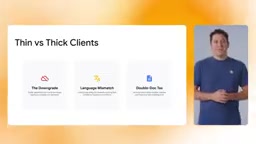
More critically, as AI coding agents become increasingly prevalent, duplicated logic across languages means more room for errors and oversights. Single Source of Truth is a core design principle in software engineering, meaning every piece of data or logic in a system is defined and maintained in exactly one place. In traditional full-stack development, the frontend (e.g., TypeScript/JavaScript) and backend (e.g., Python/Java/Go) use different languages, forcing data validation rules, model definitions, and business constraints to be implemented separately on both sides. This not only increases maintenance costs but also introduces "drift risk" in team collaboration — when one side modifies a rule without syncing the other, system behavior becomes inconsistent. Statistics show that approximately 15-30% of bugs in medium-to-large projects stem from frontend-backend logic being out of sync. AI coding agents (such as GitHub Copilot, Cursor, etc.) are also more prone to generating inconsistent code suggestions when dealing with cross-language projects due to context switching. The value of a Single Source of Truth has never been more apparent.
Dart: More Than Just Flutter's Language
A Full-Spectrum Player from Client to Cloud
As Flutter's core language, Dart's capabilities extend far beyond rendering pixels. Dart powers the entire Flutter toolchain — static analysis, code formatting, and even the JavaScript and WebAssembly compilers themselves are written in Dart. Dart's lexer and parser are also implemented in Dart, compiled to native code and embedded in the C++ runtime.
In the cloud, Dart is equally battle-tested. The official Flutter package management site (serving millions of monthly active developers) is written entirely in Dart; DartPad's backend interactive compilation service is also a pure Dart implementation.
The Natural Advantages of Dart Cloud Functions
While the Dart SDK is feature-rich, its AOT (Ahead-of-Time) compilation capability means it can produce extremely small native binaries. AOT compilation refers to fully compiling source code into target platform machine code before the program runs, as opposed to JIT (Just-in-Time) compilation, which dynamically compiles hot code paths at runtime. Dart supports both modes: JIT for Hot Reload during development, and AOT for generating native binaries in production deployments. The advantage of AOT compilation lies in eliminating runtime compilation overhead — there's no need to load compiler infrastructure at startup, and the resulting binaries are smaller (typically in the 10-20MB range). By comparison, Node.js requires the V8 engine, Java requires the JVM, and Python requires an interpreter runtime, all of which significantly increase container image size and cold start time. In serverless scenarios, cold start latency directly impacts user experience and billing costs. Dart AOT's millisecond-level startup gives it a significant competitive advantage in this context:
- Deployment speed: Deploys in seconds
- Cold start: Millisecond-level startup with no JIT warm-up needed
- Elastic scaling: Rapid scale-up with support for scaling down to zero — no paying for idle resources

Firebase Functions with Dart: A Full-Stack Symmetric Experience
How It Works Under the Hood
Google Cloud Run now supports OS-only runtimes, meaning developers can compile and deploy server binaries directly from their development machines or CI/CD pipelines. Google provides a base Ubuntu environment and packages your binaries and assets on top of it.
This OS-only runtime is a lower-level abstraction: Google provides only a minimal Ubuntu OS environment, and developers are responsible for supplying the executable binary. The revolutionary aspect of this model is that it hands language choice entirely back to developers — any language that can compile to a Linux ELF binary can be deployed directly. For Dart, this means leveraging its cross-compilation capability to compile linux-amd64 binaries directly on macOS or Windows development machines, bypassing the traditional Docker build process. While Docker solves environment consistency issues, its image build-push-pull workflow introduces significant time overhead during rapid iteration phases of development.
Key advantages include:
- No need to install Docker on your development machine
- No waiting for Google Cloud Build
- Dart supports cross-compilation to AMD64 Linux binaries
Hands-On: A Full-Stack Counter App
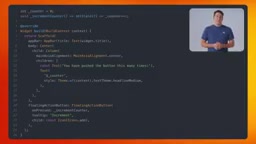
The talk demonstrated the full-stack Dart implementation path through the classic Flutter counter app:
Step 1: Create a Shared Dart Package
This is the core of the Single Source of Truth — data models, enums, and core domain logic are all defined here. Be careful not to depend on the Flutter framework, since Firebase Functions use AOT compilation and don't include the Dart UI layer. Use the json_serializable package for JSON serialization, and define callable function name constants for both frontend and backend to reference.
Step 2: Create the Firebase Functions Package
Generate the project template with the firebase init functions command and select Dart as the language. Functions are built on Shelf — Shelf is Dart's officially maintained HTTP server middleware framework, with a design philosophy similar to Node.js's Express or Python's WSGI, processing HTTP requests through composable middleware pipelines. Shelf's core abstractions are Handler and Middleware, allowing developers to compose logging, authentication, CORS, and other features like building blocks. Firebase Dart Functions are built on top of Shelf under the hood, meaning Flutter developers don't need to learn an entirely new server-side framework. Additionally, Dart's dart:io library provides complete networking, file system, and process management capabilities, while package:http offers a cross-platform HTTP client.
Set up HTTP request triggers, increment a counter from Firestore, and return the response. The code style will feel completely familiar to Flutter developers.
Step 3: Update the Flutter Client
In the Flutter app, configure the Firebase Functions emulator port, call the cloud function via the HTTP package, and parse the response body using the exact same IncrementResponse class as the server. The counter logic in the UI layer requires no changes whatsoever.
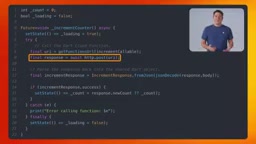
Deployment requires just one command: firebase deploy.
Core Value and Current Status
Key Advantages of Full-Stack Dart
- True symmetry: One set of tools, one set of packages, one set of AI agent skills — shared code and business logic
- Better security: Keep the client lean while secrets and sensitive logic stay in the cloud
- Instant updates: Update server-side logic without waiting for app store review
- Local-first development: The Firebase Emulator Suite supports fully offline testing of the entire architecture. The suite is a collection of locally running service emulators covering core services like Firestore, Authentication, Cloud Functions, and Storage, allowing developers to test the entire application architecture in a completely offline environment without connecting to real cloud services. This local-first development model eliminates network latency, prevents test data from polluting production environments, supports integration testing in CI/CD pipelines, and reduces cloud service costs during development. For full-stack Dart applications, the emulator means the frontend Flutter app and backend Dart functions can run and be debugged on the same machine. Developers can set breakpoints to simultaneously trace client requests and server-side processing logic — something nearly impossible to achieve in cross-language architectures.
- Zero-friction deployment: No custom Dockerfiles or IAM configuration needed
Current Progress
Firebase Dart Functions is currently in the experiment stage, with support for:
- HTTPS on-request and on-call function triggers
- Emulator support
- Firebase deploy
Google has published a Codelab called "Deploy Dart on Firebase Functions" for developers to try out. The team has explicitly stated that community feedback is needed to move this experiment toward general availability.
Conclusion
The vision of full-stack Dart is "one language, one layer of logic, one unified tech stack." For the Flutter community, which already has millions of active developers, this eliminates the biggest friction point between frontend and backend. While still in the experimental stage, its technical foundations — Dart's AOT compilation performance, Cloud Run's OS-only runtime support, and Firebase CLI's seamless integration — already demonstrate strong engineering viability.
For Flutter teams currently maintaining duplicated logic across languages, this may be one of the most noteworthy infrastructure evolutions to watch.
Related articles
 Tutorials
Cursor + Codex Dual-IDE Collaboration: A Practical Methodology for Open-Source Project Customization
A complete methodology for open-source project customization based on real-world experience, detailing the Cursor+Codex dual-IDE workflow, seven-stage process, MVP validation, and AI source code reading techniques.
 Tutorials
Cursor Multi-Agent in Practice: Building a Full-Stack Next.js Blog in 50 Minutes
Build a full-stack blog in 50 minutes using Cursor IDE's multi-Agent mode with Next.js, Clerk auth, and Supabase. Learn the 4-phase AI Agent workflow and key integration pitfalls.
 Tutorials
Building an AI Software Factory from Scratch: A Cursor Engineer's Hands-On Experience with Multi-Agent Collaboration
Cursor engineer Eric shares practical insights on building an AI software factory: automation levels, guardrail design, parallel Agent management, and scaling to 1000+ Agents for 24/7 development.