Five Core Capabilities of GitHub Copilot's MCP Integration in JetBrains
Five Core Capabilities of GitHub Copil…
GitHub Copilot fully supports MCP protocol, delivering groundbreaking AI programming collaboration capabilities
GitHub Copilot now fully supports the MCP protocol in JetBrains IDEs, introducing five core capabilities: Agent Mode for autonomous task planning and execution with auto-error fixing; Sampling for fine-grained multi-model scheduling balancing efficiency and quality; MCP Prompts for reusable preset workflow templates; MCP Resources for flexible project context injection; and Elicitation for structured dialogue guiding developers through configuration and requirements gathering. These capabilities mark a new era in AI-assisted programming, shifting from passive completion to proactive collaboration.
GitHub Copilot's deep integration with JetBrains IDEs has received a major upgrade—full support for the Model Context Protocol (MCP), bringing a series of groundbreaking new features. From the autonomous task execution of Agent Mode to the structured dialogue guidance of the Elicitation mechanism, these capabilities are redefining how developers collaborate with AI in programming.
What is Model Context Protocol (MCP)? MCP is a standardized protocol proposed and open-sourced by Anthropic in late 2024, designed to solve interoperability issues between AI models and external tools and data sources. Before MCP, every AI tool needed to develop separate integration solutions for different data sources, resulting in massive amounts of redundant and fragmented "point-to-point" connections. MCP defines a unified client-server communication specification, allowing any MCP-compatible AI application to seamlessly invoke tools, resources, and prompt templates provided by any MCP Server—similar to how the USB standard unified hardware connections. Developers only need to build an MCP Server once, and it can be reused by all compatible AI tools, dramatically reducing the cost of ecosystem development.
Agent Mode: Making Copilot Truly Autonomous
Agent Mode is one of the most critical capabilities in this update. It transforms GitHub Copilot from a passive code completion tool into an intelligent agent capable of autonomously planning and executing tasks.
Understanding the Technical Essence of AI Agents: AI Agents represent one of the most important paradigm shifts in large language model applications in recent years. Traditional LLM applications use a single "input-output" mode, while Agent mode introduces a "plan-execute-observe-reflect" loop mechanism (the ReAct framework widely adopted in academia). Agents can decompose complex goals into multiple subtasks, invoke external tools to gather information, and dynamically adjust subsequent steps based on execution results. Copilot's Agent Mode is the engineering implementation of this architecture: it acts as an Orchestrator within the IDE environment, calling GitHub APIs, file systems, terminals, and other tools through the MCP protocol to form a complete task execution loop.
In practical demonstrations, a developer only needs to ask a question—"What are the unresolved Issues in this repository?"—and Copilot automatically identifies and calls the GitHub MCP Server to retrieve the information. After obtaining the Issue list, the developer can directly ask Copilot to implement a specific Issue, and it will automatically begin working.
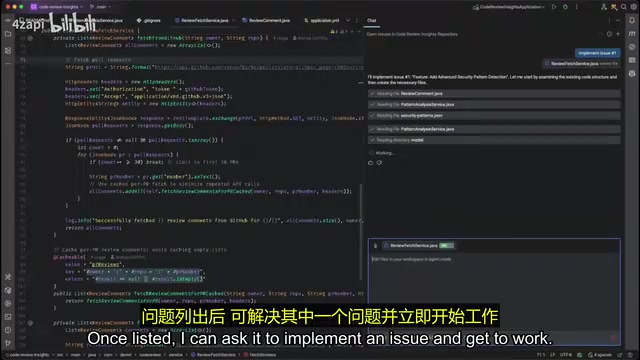
Copilot clearly displays each step: reading relevant files, formulating a work plan, and generating output code. When terminal commands need to be executed (such as building and validating), it requests user confirmation. More critically, if errors occur, Copilot automatically continues fixing them until the problem is resolved—this self-correction capability relies on the model's deep understanding of compiler output and test results, and is the core characteristic that distinguishes Agent architecture from traditional code completion. Developers can review all changes, iterate through additional prompts, and accept modifications only when satisfied.
This workflow dramatically reduces the time developers spend on context switching and manual operations, truly delivering a "state your requirements, await delivery" development experience.
Sampling: Fine-Grained Model Scheduling
The Sampling mechanism in MCP's enhanced features provides developers with unprecedented model control granularity.
Technical Principles of Sampling: In the MCP specification, Sampling is a capability that allows Servers to request model inference from the client. Its essence is a "reverse invocation" mechanism—normally the client calls the Server, but Sampling allows the Server to call back to the client's model capabilities during execution. Copilot extends this with the concept of Model Routing, which aligns closely with the "mixed model deployment" strategy in the LLMOps domain: lightweight models (such as GPT-4o mini) handle high-frequency, low-complexity tool calls, while flagship models (such as Claude 3.5 Sonnet) focus on tasks requiring deep reasoning. This layered scheduling not only optimizes response speed but also effectively controls API call costs—an important engineering practice for AI system design in production environments.
Through Settings → Model Context Protocol, developers can configure which models Copilot is allowed to use at both the global level and the individual MCP Server level. This means you can assign the most appropriate model for different task scenarios—for example, using a faster model for simple queries and a more powerful model for complex reasoning tasks.
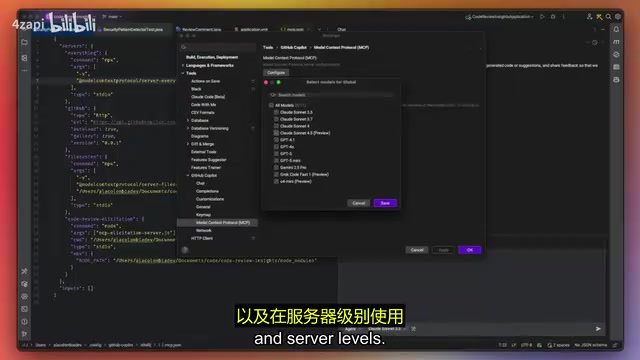
Once configured, developers can invoke tools using their preferred model, with results displayed directly in the chat window. This flexible model scheduling capability allows developers to find the optimal balance between efficiency and quality.
MCP Prompts: One-Click Access to Preset Workflows
MCP Prompts is another extremely practical new feature. By typing a slash (/) in the chat window, you can browse all preset prompt templates provided by installed MCP Servers.
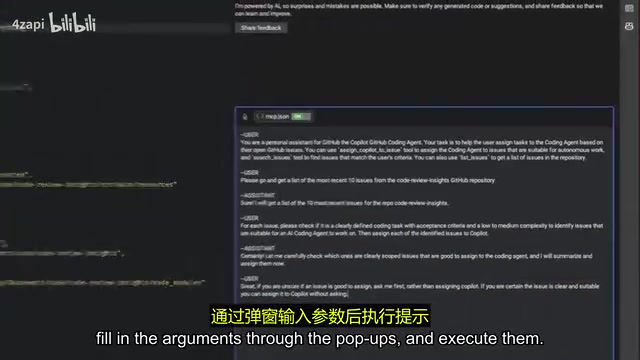
After selecting a Prompt, the system guides the developer through a popup to fill in required parameters, then executes directly. If the Prompt requires resources such as files or images, the system automatically adds them as referenced context without manual intervention.
The core value of this feature lies in encapsulating common complex operations into reusable workflows. Teams can share standardized Prompt templates through MCP Servers, ensuring best practices are consistently propagated across the team. From an engineering management perspective, this effectively institutionalizes the results of "Prompt Engineering"—crystallizing individual experience into team assets and preventing each developer from repeatedly searching for optimal AI interaction patterns.
MCP Resources: Flexible Context Injection
Beyond Prompts, MCP Servers can also serve as additional context sources. After clicking "Add Context" and selecting "MCP Resources," you can choose resources from available MCP Servers.
For MCP Servers that provide resource access (such as File System Server), developers can use the "Add Mention" feature to directly select specific configuration files or file patterns. This allows Copilot to reason based on more precise project context when answering questions or generating code, significantly improving output quality.
The underlying logic of this mechanism is consistent with RAG (Retrieval-Augmented Generation) technology—by injecting precise external knowledge into the model, it compensates for the limitations of its training data, making generated results more aligned with the actual circumstances of specific projects rather than relying on generalized common knowledge.
Elicitation: Structured Dialogue Guidance
Among all the new features, Elicitation (guided dialogue) is perhaps the most innovative.
The Design Philosophy of Elicitation: This concept originates from the field of Requirements Engineering, referring to the process of obtaining tacit knowledge and requirements from stakeholders through systematic questioning techniques. In traditional software development, requirements analysts use interviews, questionnaires, prototype demonstrations, and other methods to "elicit" clients' true needs. MCP's Elicitation mechanism transplants this human professional skill to the AI interaction layer: AI proactively assumes the "questioner" role, reducing users' cognitive burden through structured dialogue flows. The design philosophy behind this is highly consistent with "User-Centered Design" (UCD)—acknowledging that users often cannot fully express their own needs, and the system should proactively bridge this information gap.
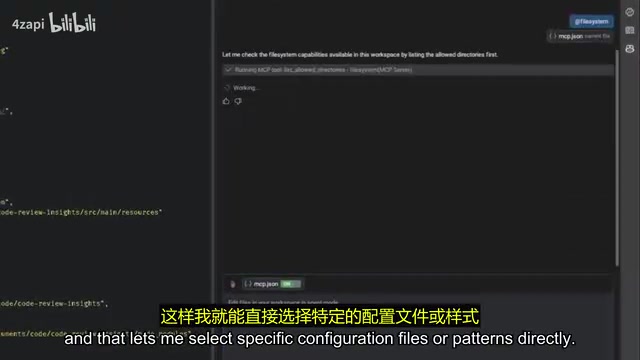
When invoking the repository's configured Elicitation feature, Copilot guides the developer into a structured dialogue flow. Developers can answer questions step by step, and the dialogue history is persistently saved, even surviving IDE restarts. This cross-session persistence capability solves the context fragmentation problem in long-cycle tasks and is particularly critical in complex project configuration scenarios.
This capability is extremely valuable in the following real-world scenarios:
- Configuration Wizards: Guiding developers through complex project configurations, ensuring no critical steps are missed
- Requirements Gathering: Helping developers organize and clarify requirements through structured questioning
- Troubleshooting: Copilot proactively asks the right questions rather than leaving developers to figure out what to do on their own
This "AI asks, humans answer" interaction pattern overturns the traditional human-machine dialogue paradigm. It acknowledges a reality: developers often don't know what information they need to provide, and AI can bridge this cognitive gap through structured guidance.
Summary and Outlook
GitHub Copilot's comprehensive MCP support in JetBrains IDEs marks a new phase in AI-assisted programming. From passive code completion to proactive task execution, from simple Q&A to structured dialogue guidance, the combination of these capabilities brings Copilot increasingly closer to being a true "AI development partner."
For developers, now is the time to reassess your workflows. The openness of the MCP ecosystem means that as more MCP Servers emerge, Copilot's capability boundaries will continue to expand. Developers who master these new features will gain a significant competitive advantage in productivity.
Key Takeaways
- Agent Mode enables Copilot to autonomously read files, plan tasks, execute code, and auto-fix errors, achieving end-to-end autonomous development
- The Sampling mechanism supports fine-grained model configuration at both global and individual MCP Server levels, enabling flexible model scheduling
- MCP Prompts allow developers to invoke preset workflow templates with one click, automatically injecting required file and resource context
- The Elicitation feature guides developers through configuration, requirements gathering, and troubleshooting via structured dialogue, with conversation history persisting across sessions
- The openness of the MCP protocol enables Copilot's capabilities to continuously expand through third-party Servers, building a richer developer tool ecosystem
Related articles
 Tutorials
Cursor + Codex Dual-IDE Collaboration: A Practical Methodology for Open-Source Project Customization
A complete methodology for open-source project customization based on real-world experience, detailing the Cursor+Codex dual-IDE workflow, seven-stage process, MVP validation, and AI source code reading techniques.
 Tutorials
Cursor Multi-Agent in Practice: Building a Full-Stack Next.js Blog in 50 Minutes
Build a full-stack blog in 50 minutes using Cursor IDE's multi-Agent mode with Next.js, Clerk auth, and Supabase. Learn the 4-phase AI Agent workflow and key integration pitfalls.
 Tutorials
Building an AI Software Factory from Scratch: A Cursor Engineer's Hands-On Experience with Multi-Agent Collaboration
Cursor engineer Eric shares practical insights on building an AI software factory: automation levels, guardrail design, parallel Agent management, and scaling to 1000+ Agents for 24/7 development.