Five Essential Cursor Skills Every QA Engineer Needs: A Complete Breakdown
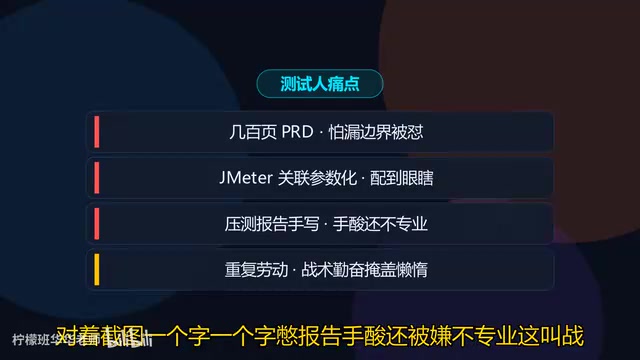
Five Cursor AI Skills that transform QA engineers from manual executors into quality architects.
This guide breaks down five custom Cursor Skills that help QA engineers automate their entire workflow — from PRD requirements analysis and structured test case generation to JMeter script creation, one-click load test reports, and end-to-end web automation. By leveraging AI-powered skill packs, testers can compress days of manual work into hours and shift their focus from repetitive execution to high-value quality strategy.
The QA Efficiency Trap: Are You Still Doing Manual Labor the Old-Fashioned Way?
Let's be honest — many QA engineers burn the midnight oil not because the work is inherently difficult, but because they're still using decade-old methods to do grunt work that AI can handle in seconds. Staring at hundreds of pages of PRDs all day, terrified of missing a single boundary condition. Configuring correlation and parameterization in JMeter scripts until your eyes blur. Painstakingly writing up a load test report word by word from screenshots after a stress test — that's not diligence, that's "tactical hustle masking strategic laziness."
Now, with Cursor's custom Skills capability, QA engineers can compress the entire workflow — from requirements analysis, test case writing, and script generation to load test reports and web automation — from two days down to four hours.
Cursor is an AI-native code editor deeply rebuilt on top of VS Code, developed by Anysphere. It features deep integration with large language models like GPT-4 and Claude. Its "custom Skills" feature allows users to codify domain-specific expertise into reusable AI skill packs through preset prompt templates and workflow rules. In essence, each Skill is a carefully designed set of system prompts combined with input/output specifications, enabling AI to perform like a domain expert in specific task scenarios. This capability allows non-AI specialists to build highly customized AI workflows through "configuration" rather than "programming."
Let's break down each of the five Skills — their core logic and real-world applications.
Skill 1: PRD Requirements Analysis & Test Checklist Generation
The core capability of the first Skill: feed a PRD document or product screenshot directly into Cursor, and instantly get a requirements analysis plus a complete test checklist.
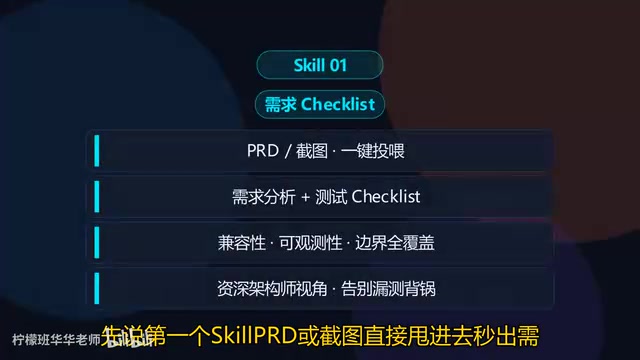
A PRD (Product Requirements Document) is the core deliverable from product managers, typically containing feature descriptions, business flows, interaction prototypes, and non-functional requirements. In traditional testing workflows, QA engineers read through PRDs page by page, extracting test points based on personal experience — a process that's highly dependent on individual skill and prone to omissions. Industry data shows that defects caused by requirements misunderstanding account for 40%-60% of total defects, and the cost of fixing these defects is 5-10x higher than catching them during development.
Coverage Dimensions
This Skill doesn't simply translate a PRD into test points — it performs comprehensive analysis across multiple dimensions:
- Functional boundary scenarios: Automatically identifies implicit boundary conditions in the PRD. "Implicit boundary conditions" refer to extreme scenarios not explicitly described in the PRD but inevitably present in real-world usage — such as empty inputs, excessively long strings, concurrent operations, and special character injection. These scenarios are often the most common sources of production incidents.
- Compatibility test points: Generates browser/device compatibility checklists based on project characteristics, covering combination matrices of mainstream browsers like Chrome, Firefox, and Safari across different resolutions and operating systems.
- Observability checks: Test coverage for logging, monitoring, and alerting. Observability is one of the core capabilities of modern distributed systems, encompassing three pillars — Logging, Metrics, and Tracing — ensuring that issues can be quickly identified and diagnosed when they arise.
Say goodbye to being the "scapegoat for missed tests." Instead of relying on experience and memory to cover test points, you now have AI systematically organizing them, dramatically reducing the omission rate.
Skill 2: From PRD to Structured Test Case Documents
The second Skill solves the "last mile" problem of going from a checklist to executable test cases. It generates structured test cases based on the PRD plus checklist, following your company's standard templates, covering both API testing and functional testing.
Core Advantages
- Automatic format alignment: Output directly conforms to your company's test case template standards. In enterprise-level test management, unified case formatting is critical — it directly impacts case review efficiency, defect traceability, and data import compatibility with test management platforms (such as TestRail, Zentao, TAPD, etc.).
- Ready to execute with minor tweaks: Generated cases can be run directly after slight adjustments. AI-generated cases cover standard fields including preconditions, operation steps, expected results, and test data — QA engineers only need to verify the accuracy of business logic.
- Xmind export support: Convenient for team reviews and visual presentations. Xmind is a mind-mapping tool widely used in testing for case review scenarios, where its tree structure clearly displays the hierarchical relationships between functional modules and test points.
This means QA engineers no longer need to spend significant time on low-value work like "format alignment" and can instead focus their energy on reviewing and supplementing test case logic.
Skill 3: Automated JMeter Script Generation
The most painful part of performance testing is writing scripts. Parameterization, correlation extraction, assertion configuration — every step is error-prone, and debugging is even more time-consuming.
Apache JMeter is the industry's most popular open-source performance testing tool. Originally designed for web application load testing, it has since expanded to support databases, FTP, message queues, and many other protocols. JMeter's core concepts include: Thread Groups (simulating concurrent user counts and execution strategies), Samplers (defining specific request types), Assertions (validating whether responses meet expectations), Parameterization (using data sources like CSV files to drive different request parameters), and Correlation (extracting dynamic values like Tokens and Session IDs from previous responses for use in subsequent requests). JMX files are JMeter's test plan file format — essentially XML structures. Writing them manually requires understanding the XML Schema and the nesting relationships of various components, resulting in a steep learning curve.
How to Use It
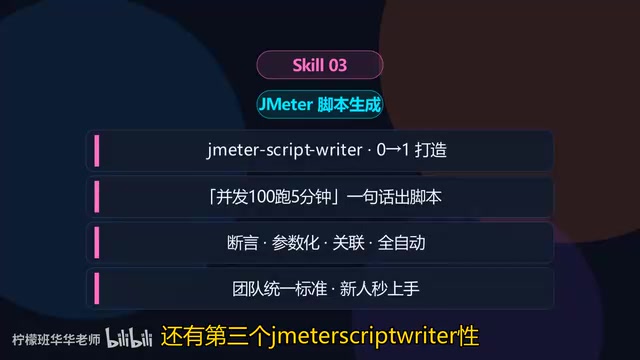
You simply describe your testing requirements in natural language — for example, "100 concurrent users, run for 5 minutes, test the login API" — and the Skill automatically generates:
- Standardized JMeter JMX script files
- Complete assertion configurations (including response code assertions, response content assertions, etc.)
- Parameterization and correlation extraction logic (automatically identifying variables like Tokens and Sessions that need dynamic passing)
- Thread group and timer settings (including ramp-up time, loop count, constant/random timers, etc.)
Team Value
The greatest value of this Skill isn't just efficiency — it's unifying team script standards. New hires don't need to spend two weeks learning JMeter's various configuration details; they can use the Skill to generate standard scripts and get started immediately. Script style, naming conventions, and assertion strategies are all unified across the team, significantly reducing maintenance costs. This is especially important in large teams — when the number of performance test scripts reaches hundreds, unified coding standards directly determine script maintainability and team collaboration efficiency.
Skill 4: One-Click Load Test Report Generation
After a load test is complete, manually writing a report from a pile of screenshots and data is the most painful part. This Skill lets you toss in screenshots with brief descriptions and automatically generates a professional HTML-format load test report.
Report Contents
- Metric interpretation: TPS (Transactions Per Second) measures system throughput capacity and is a key indicator for evaluating system capacity. Response time focuses on percentile values like P90 and P99, which reflect real user experience far better than averages. Error Rate is the percentage of failed requests out of total requests, typically required to stay below 0.1% in load test scenarios. The Skill provides professional interpretation and grading of these core metrics.
- Bottleneck analysis: Automatically identifies performance bottlenecks based on data. AI can quickly identify common bottleneck patterns through pattern recognition — such as database connection pool exhaustion, frequent JVM GC triggers, slow SQL blocking, and thread deadlocks — cross-referencing multi-dimensional data including CPU usage, memory consumption, and network IO.
- Optimization recommendations: Provides specific tuning directions for identified issues, such as index optimization, caching strategy adjustments, connection pool parameter tuning, and JVM memory configuration suggestions.
- Visual presentation: HTML format with clean layout, ready to send directly to your boss. Compared to traditional Word or PPT reports, HTML format supports interactive charts and responsive layouts, displaying well across different devices.
Writing a load test report used to take at least half a day. Now it takes ten minutes — and the result is more professional and standardized than anything written by hand.
Skill 5: End-to-End Web Automation Testing
The fifth Skill is the most "heavyweight" in the entire skill pack, covering the full lifecycle of web automation testing from planning to implementation.
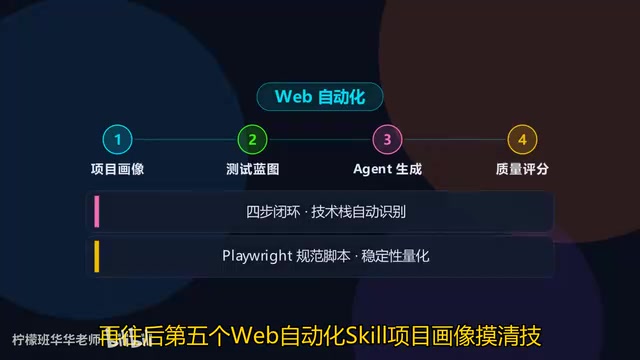
Three-Step Strategy
- Project profiling: Automatically maps out the project's tech stack (frontend frameworks like React/Vue/Angular, API protocols like REST/GraphQL, deployment methods like Docker/K8s, etc.). Tech stack identification directly impacts automation tool selection — for example, components based on Shadow DOM require special element location strategies, and SPAs (Single Page Applications) need handling for async loading and route changes.
- Test blueprint planning: Plans the automation path based on project characteristics and determines priorities. Following the test pyramid model: a large base of unit tests (fast, low cost), a middle layer of API/interface tests (covering business logic), and a small top layer of UI end-to-end tests (simulating real user operations). High-frequency regression scenarios and core business flows are prioritized for automation to maximize ROI.
- Agent-driven code generation: Automatically generates layered, stability-first automation test code. Mainstream tech stacks include Selenium, Playwright, and Cypress. Playwright, developed by Microsoft, supports multi-browser testing, auto-waiting, network interception, and other modern features, rapidly becoming the new generation's top choice. Generated code adopts design patterns like Page Object Model (POM), separating page element locators from test logic to significantly improve maintainability. "Stability first" is the core principle — unstable automation cases (known as "Flaky Tests") severely erode team trust in automation and cause test results to be ignored.
The essence of this Skill is codifying a test architect's thinking patterns into a reusable AI workflow. Those exhausting regression testing projects can finally achieve full automation coverage.
The Real Shift: From Executor to Quality Architect
The core value of these five Skills isn't about "being lazy" — it's about gaining an unfair advantage. The work model shifts from "manually do A then do B" to "I want to do A, AI generates the checklist; I want to do B, AI generates the test cases."
This transformation reflects a deeper shift in the software testing industry. According to Gartner's predictions, by 2025, over 70% of enterprises will incorporate AI-assisted tools into their testing workflows. The traditional "labor-intensive" testing model is being replaced by an "AI-augmented" model, where QA engineers' core competitiveness shifts from "execution speed" to "quality judgment" and "strategy formulation."
The role of QA engineers is changing accordingly:
- Before: A relentless typing machine — translating requirements into test cases, translating operations into reports
- Now: A quality architect — responsible for reviewing AI output, steering quality direction, and making high-value decisions
When AI handles 80% of repetitive work, QA professionals can finally focus their energy where human judgment truly matters: risk assessment, architecture design, team collaboration, and quality strategy formulation. These higher-order capabilities are precisely what AI currently cannot replace — they require deep understanding of business context, soft skills for cross-team communication, and experience-based intuitive judgment.
Conclusion
The practical value of this Cursor Skills suite lies in the fact that it's not a point solution — it's a systematic approach covering the entire testing lifecycle. From PRD requirements analysis to web automation implementation, every stage has a corresponding AI acceleration solution. For QA engineers looking to break through efficiency bottlenecks, mastering this skill pack is the most worthwhile learning investment right now.
It's worth noting that introducing AI tools doesn't mean QA engineers can completely "hand things off." AI-generated output still requires professional review and calibration — it may produce cases that seem reasonable but don't actually fit the business scenario, or miss industry-specific compliance testing requirements. The best practice is to position AI as an "efficient first-draft generator" while QA engineers play the role of "quality gatekeeper," forming an optimal human-AI collaborative workflow.
Related articles
Databricks Open-Sources Omni: A Meta-Framework for Unified Management of All AI Agents
Databricks open-sources Omni under Apache 2.0 — a meta-framework unifying Claude Code, Codex & more AI Agents with shared sessions, cross-vendor review & enforced security policies.
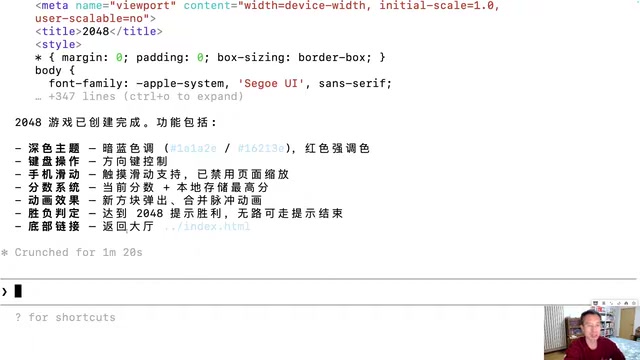
Generating 10 Web Games with One-Line Prompts: A Hands-On Claude Code Experience
A senior developer uses Claude Code to generate 10 playable web games including 2048, Gomoku, and Tetris with one-line prompts in under an hour. A deep dive into AI programming's real capabilities.

DiffusionGemma: Google's Open-Source Diffusion Language Model with 4x Faster Inference
Google releases DiffusionGemma, an open-source diffusion language model achieving up to 4x faster inference and real-time self-correction by generating text in parallel rather than token by token.