Four Core Advantages Frontend Developers Have When Transitioning to AI Agent Development
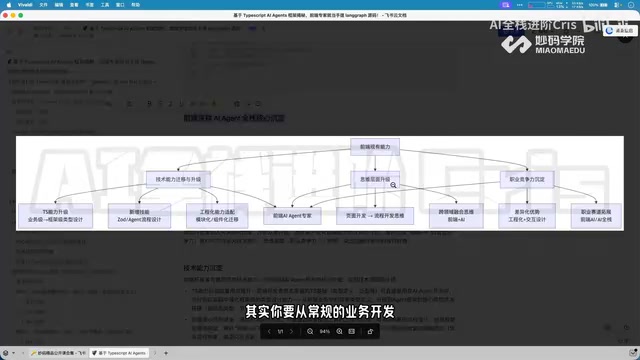
Frontend developers have underestimated advantages when transitioning to AI Agent development via TypeScript.
Frontend developers possess four core advantages for transitioning to AI Agent development: TypeScript's first-class support in major AI frameworks, natural bridging from AI SDKs to service layers via Node.js, isomorphism between frontend state management and Agent process orchestration, and transferable process design thinking. This article details the feasible path and recommended learning roadmap.
Frontend to AI Agent: An Underestimated Career Path
In the wave of AI Agent development, frontend developers are often seen as being at a disadvantage — after all, Python is the "official language" of AI. But is that really the case?
An AI Agent refers to an AI system capable of perceiving its environment, making autonomous decisions, and executing actions to achieve goals. Unlike traditional single-turn Q&A AI, Agents possess capabilities such as tool invocation, memory management, multi-step reasoning, and autonomous planning. For example, an AI Agent can receive a high-level instruction like "analyze competitors and generate a report," autonomously break it down into sub-tasks such as searching for information, calling APIs, organizing data, and generating documents, then execute them sequentially. Since 2023, with the leap in large language model capabilities, AI Agents have rapidly moved from academic concepts to engineering implementation, becoming the core paradigm of AI application development.
In reality, frontend developers possess several severely underestimated core advantages. From the natural fit of the TypeScript ecosystem to the seamless connection of full-stack thinking, transitioning from frontend to AI Agent development is not only feasible but in some aspects even more competitive than pure backend developers.
Mindset Upgrade: From Button Clicks to Process Design
The first step in transitioning from frontend to AI Agent isn't learning a new framework — it's a fundamental shift in mindset.
In traditional frontend development, our focus is often limited to individual interactions. For example, with a "Share" button, many frontend developers' understanding stops at "click → send request → done." But if you want to move toward AI Agent development, you must think deeply about the complete business chain behind that button:
- What's the version control logic after sharing?
- How should the permission system be designed?
- What's the backend API implementation approach?
- How should the database storage structure be organized?
- How does the shared content appear when other users access it?

This upgrade from "point-based thinking" to "process thinking" is precisely the core capability of AI Agent development. Because an Agent is essentially a complex process orchestration system — you need to design tool invocation chains, handle exception branches, and manage state transitions. A tool invocation chain refers to the complete path an Agent follows when calling external tools (such as search engines, database queries, code executors, etc.) in a certain order during task execution. Each step's output may become the next step's input, with timeout handling, failure retries, and result validation needed along the way. If frontend developers can break through the limitations of the interaction layer, this process design capability transfers directly to Agent development.
Advantage 1: TypeScript's First-Class Status in AI Frameworks
A fact many people overlook: TypeScript enjoys nearly equal status with Python in AI development frameworks.
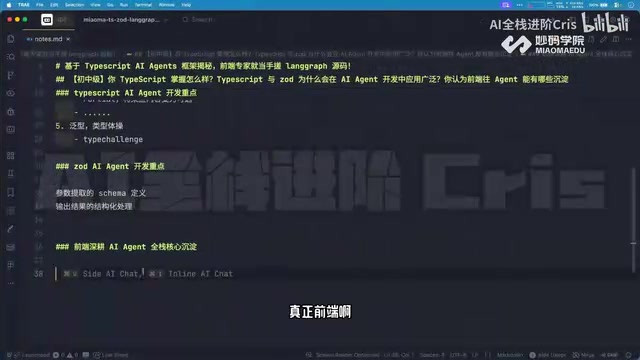
Mainstream AI development frameworks have very mature TypeScript support:
| Framework | Python Support | TypeScript Support |
|---|---|---|
| LangChain.js | ✅ | ✅ First-class support |
| LangGraph | ✅ | ✅ First-class support |
| Deep Agent | ✅ | ✅ First-class support |
| Mistral | ✅ | ✅ First-class support |
| LlamaIndex | ✅ | ✅ First-class support |
There are deep reasons why these frameworks prioritize TypeScript support. LangChain.js is the JavaScript/TypeScript version of LangChain, offering nearly equivalent functionality to the Python version, including chain calls, tool integration, vector storage, and other core capabilities. LangGraph focuses on stateful multi-step Agent workflow orchestration, supporting complex patterns like loops, conditional branches, and human-in-the-loop collaboration — which is critical for building production-grade Agents. LlamaIndex's TypeScript version focuses on RAG (Retrieval-Augmented Generation, where an LLM retrieves relevant documents before answering questions, then generates answers based on the retrieved results) scenarios, helping developers combine private data with large language models. A large number of AI applications ultimately need to be delivered to users through the web, and TypeScript's type system provides stronger compile-time safety guarantees in complex Agent workflows, which has led to its continuously rising status in AI engineering.
This means frontend developers can enter AI Agent development directly with familiar TypeScript without learning Python from scratch. The code reliability brought by the type system is actually a significant advantage in complex Agent workflows — when an Agent needs to orchestrate dozens of tools and manage multi-turn conversation state, TypeScript's type inference and compile-time checks help you catch numerous potential errors before runtime.
Advantage 2: Natural Bridge from AI SDK to Service Layer
Once frontend developers master TypeScript, the path to extending upward to the server side is extremely smooth.
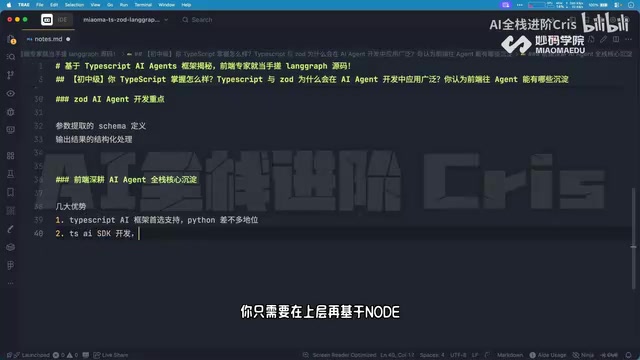
The specific technology stack bridging path is as follows:
- AI SDK Layer: Develop and encapsulate AI capabilities based on TypeScript. This layer primarily uses tools like LangChain.js and Vercel AI SDK to encapsulate LLM calls, Prompt engineering, tool definitions, and more into reusable modules.
- Service Layer: Use mature frameworks from the Node.js ecosystem (Nest.js, Nuxt.js, Next.js) to turn AI capabilities into services. Nest.js provides enterprise-grade modular architecture and dependency injection mechanisms, suitable for building complex AI microservices; Next.js's API Routes and Server Actions allow AI capabilities to be deployed directly as Serverless functions, greatly simplifying operational complexity.
- Data Persistence Layer: Complete data storage through Prisma + PostgreSQL. Prisma is the most popular ORM tool in the Node.js and TypeScript ecosystem. It defines data models through declarative schemas and automatically generates type-safe database clients. Compared to traditional hand-written SQL, Prisma allows frontend developers to perform database operations in a way that's close to manipulating JavaScript objects, greatly reducing the learning curve for the data layer. PostgreSQL has become a popular choice for AI application data storage in recent years due to its native support for JSON data types and vector extensions (pgvector) — it can store both structured business data and vector embeddings needed by AI, covering multiple storage needs of AI applications with a single database.
The elegance of this path lies in the fact that every layer is within the capability range of frontend developers. You don't need to cross a language gap — the entire technology stack from frontend to AI server-side can be unified with a single language.
Advantage 3: Isomorphism Between Agent Process Design and Frontend State Management
Frontend developers have long dealt with state management — Redux, Vuex, Zustand — and this experience has direct transfer value in Agent development.
The core of AI Agents is state management and process orchestration:
- Tool invocation chains are similar to frontend middleware pipelines. Just as middleware in Express/Koa processes requests sequentially, an Agent's tool invocation chain also breaks tasks into multiple processing stages, where each stage completes a specific function and passes the result to the next.
- Agent state machines are similar to frontend routing state management. At each execution step, an Agent needs to maintain a global state (containing conversation history, tool call results, intermediate reasoning artifacts, etc.), and each tool call or LLM inference is a state transition. LangGraph explicitly adopts a graph state machine design where nodes represent processing steps and edges represent state transition conditions — this is highly consistent with the design philosophy of frontend route guards and state machine libraries (like XState).
- Multi-Agent collaboration is similar to the micro-frontend architecture philosophy. In complex scenarios, multiple specialized Agents each handle different domains (e.g., one for searching, one for analysis, one for generation), collaborating through message passing to complete tasks — this mirrors the micro-frontend pattern where sub-applications are developed independently and coordinate through communication mechanisms.
In frontend development, the core philosophy of state management libraries like Redux is: managing complex UI state changes through a single source of truth, immutable state, and pure function reducers. AI Agent state management follows an extremely similar pattern — the Agent's global state is the "single source of truth," each tool call result updating the state is a "dispatch action," and the logic deciding which tool to call next is the "reducer." If you can skillfully design Redux state trees and action flows, then designing Agent state graphs and tool invocation flows will feel very natural to you.
This structured thinking is a hidden advantage of frontend developers, often underestimated by themselves.
Recommended Learning Path for Frontend-to-AI-Agent Transition
Based on the above analysis, here's the recommended learning path for frontend developers transitioning to AI Agent development:
- Strengthen Advanced TypeScript Skills: Expand from UI development to server-side and AI SDK development. Focus on mastering advanced features like generic programming, type gymnastics, and decorators — these are frequently used when encapsulating AI tools and defining Agent interfaces.
- Learn Agent Process Design: Master frameworks like LangChain.js and LangGraph. Start with a simple single-tool Agent and gradually progress to complex scenarios like multi-tool orchestration and multi-Agent collaboration. Also understand the basic principles of Prompt Engineering, as Agent behavior is largely determined by Prompt design.
- Supplement Server-Side Knowledge: Nest.js/Next.js service development + Prisma database operations. Focus on understanding server-side concepts like API design, authentication/authorization, and streaming responses (SSE/WebSocket — the core technology behind token-by-token output in AI applications).
- Develop Business Architecture Thinking: Upgrade from focusing on individual interactions to focusing on complete business chains. Try designing an AI Agent solution for your current project — for example, an intelligent customer service Agent that can automatically process user feedback, classify issues, and assign tickets — and walk through the entire process from requirements analysis to technology selection.
Conclusion
Transitioning from frontend to AI Agent development isn't wishful thinking — it's an advancement path with clear technical support. The ecosystem advantages of TypeScript, the low barrier to full-stack bridging, and the inherent process design thinking of frontend developers are all tangible competitive strengths.
The key is: Don't just be an executor of buttons — become a designer of processes. This applies not only to AI Agent development but to every frontend engineer looking to break through their career ceiling. As AI Agents become the new paradigm for software delivery, developers who understand user interaction, master process orchestration, and can use TypeScript to span the entire stack will become the scarcest compound talent in the market.
Related articles
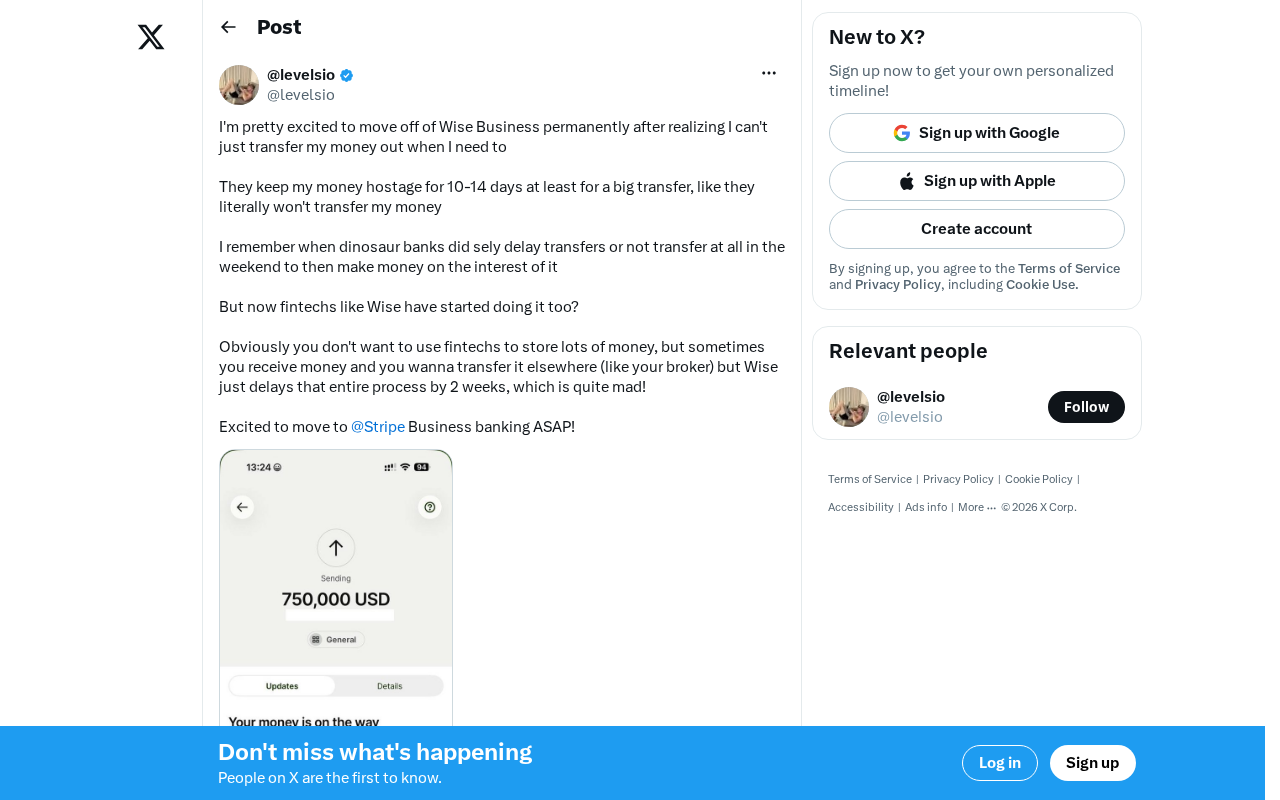
Wise Large Transfer Delayed Two Weeks: How Should Cross-Border Entrepreneurs Respond?
Wise Business users face 10-14 day delays on large transfers, sparking debate on whether fintech is repeating traditional banking mistakes. Analysis and practical tips for cross-border entrepreneurs.

Perplexity Partners with Intel: Local AI Models and Hybrid Inference Come to Laptops
Perplexity partners with Intel to bring local AI models and hybrid inference to Core Ultra Series 3 laptops. We break down the architecture, NPU capabilities, and the cloud-to-edge AI trend.

AI Large Model Learning Roadmap Breakdown: Three Stages from Application Development to Model Fine-Tuning
Deep breakdown of a popular AI large model learning roadmap covering LangChain, RAG, Agent, and LoRA fine-tuning across three stages, with analysis of its strengths and limitations for career changers.