Four Prompts to Remove the AI Smell from Your Articles, Plus Detection Tools and a Complete Workflow
Four prompts plus a detection workflow to make AI-written articles sound naturally human.
This article shares four battle-tested prompts that tackle the most common giveaways of AI-generated content: formulaic expressions, bloated structure, stiff language, and mismatched tone. Combined with AI detection tools, they form a complete workflow — from first draft to final polish — that helps creators produce natural-sounding content while reducing platform throttling risks.
Why Your AI Articles Get Spotted Instantly
Using AI to write articles has become a daily routine for content creators, but here's the awkward reality: readers can spot most AI-generated content at a glance. Those overly polished parallel sentences, the cookie-cutter "first, second, finally" structure, and the complete absence of personal warmth all silently scream — "this was written by AI."
This "AI smell" isn't accidental — it's baked into how large language models generate text. Autoregressive models like the GPT series essentially predict the "next most likely token" word by word. This probability-based generation method naturally gravitates toward high-frequency, safe expression patterns, resulting in output that's conservative and homogeneous in both vocabulary and sentence structure. While sampling strategies like Temperature and Top-p (nucleus sampling) can introduce some randomness, under default settings, models still produce text that's "statistically most correct" — which is precisely the root cause of the lack of personality. In other words, AI isn't bad at writing; its "writing instinct" is simply to pick the safest expression every time, which stands in stark contrast to the personalized choices humans make when writing.
What makes things worse is that many platforms have started detecting and throttling AI-generated content. Since 2024, platforms like Douyin, Xiaohongshu, and Zhihu have been adding clauses about AI-generated content to their community guidelines, with some requiring creators to proactively label AI-assisted content. At the algorithmic distribution level, platforms typically limit the exposure of low-quality AI content through mechanisms like content homogeneity detection and originality scoring. Baidu Search has also emphasized the E-E-A-T principle (Experience, Expertise, Authoritativeness, Trustworthiness) in its search quality evaluation guidelines, where the "Experience" dimension directly addresses whether content contains genuine personal experience — precisely the weakest link in purely AI-generated content. If your articles carry heavy AI fingerprints, it doesn't just hurt the reading experience — it can directly impact your traffic distribution.
Today I'm sharing a battle-tested method: four core prompts + a detection workflow to systematically eliminate the AI smell from your articles.
Four AI-Removal Prompts Explained in Detail
Before diving into the specific prompts, it's worth understanding the technical principles behind them. These four prompts essentially fall under the domain of Prompt Engineering — the practice of carefully designing input instructions to guide large language models toward desired outputs, which has evolved into an independent technical discipline. Effective prompts typically contain four elements: role definition, task description, constraints, and output format. In the context of removing AI smell, the key lies in imposing "anti-pattern" constraints on the model — explicitly telling it which typical AI expression habits to avoid while providing positive examples of human writing style, leveraging the model's In-Context Learning capability to adjust output style. Understanding this underlying logic will make you much more confident when using and tweaking these prompts.
Prompt 1: Strip AI Traces, Cut the Fluff
The core function of the first prompt is to eliminate the telltale signs of AI writing. AI-generated articles tend to have signature characteristics: they love opening with hollow lead-ins like "nowadays" or "with the development of technology," they stuff transitional filler between paragraphs, and they inevitably end with an "at the end of the day" summary.
This prompt is specifically designed to identify and remove these formulaic expressions, letting the article get straight to the point. To use it, simply feed the AI-generated first draft into it for the first round of "de-flavoring."
Prompt 2: Simplify Structure — One Paragraph, One Idea
AI has a chronic problem when writing articles — the structure is too "textbook-like." Every paragraph tries to cover everything, information density is too high, and readers end up unable to grasp the key points.
The design philosophy of the second prompt is one topic per paragraph, so each paragraph carries only one core information point. After optimization, readers can tell at a glance what each paragraph is about, dramatically improving the reading experience. This structure is actually closer to how humans naturally write — when we write by hand, we instinctively develop one point at a time rather than piling all related information together like AI does.
Prompt 3: Conversational Polish — Make Sentences Sound Human
This is the prompt the creator says they use the most. Its core task is to convert AI's overly formal, formulaic language into more natural, conversational expression.
Human writing has an obvious characteristic: sentences vary in length, people occasionally use informal but vivid phrasing, and they even throw in filler words and personalized word choices. AI-generated text, on the other hand, tends to have uniform sentence patterns and precise but cold vocabulary. This prompt specifically solves the "doesn't sound like a real person wrote it" problem.
From a linguistic perspective, this "doesn't sound human" feeling has theoretical roots. Linguists divide language use into two dimensions — "written register" and "spoken register" — which differ systematically in lexical density, syntactic complexity, information density, and interactivity. In informal writing (like social media posts), humans naturally blend both registers, creating a distinctive "written-spoken hybrid" style — using short sentences, dropping subjects, inserting filler words, and employing rhetorical devices like metaphor and hyperbole. Because formal text makes up a larger proportion of AI training data, models default to a high-information-density written register, and this register mismatch is the core reason content "doesn't sound human." So this prompt is essentially guiding the model to switch from a written register to a spoken register, simulating how humans actually express themselves in informal contexts.
Prompt 4: Adjust Tone — Match the Platform and Audience
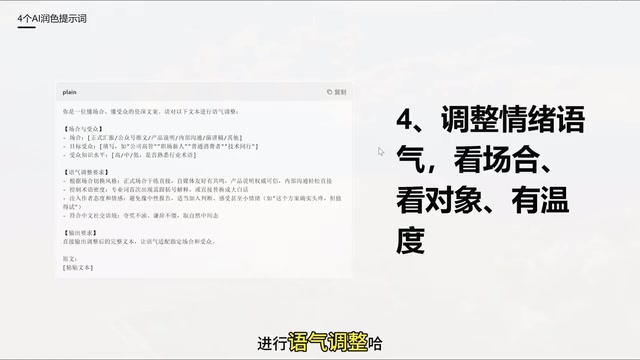
The fourth prompt handles fine-tuning tone and warmth. The same piece of content should sound completely different when posted on Zhihu versus Xiaohongshu; the wording also needs adjustment depending on whether you're addressing professional readers or general users.
AI's default output tone tends to be "neutral-to-formal," which feels out of place in many contexts. With this prompt, you can make targeted tone adjustments based on your target platform and audience characteristics, making the content fit the publishing context.
Don't Hit Publish Yet: Quality-Check with Detection Tools
After optimizing with all four prompts, the creator strongly recommends running one more round of scientific detection to make sure AI traces have actually been effectively eliminated.
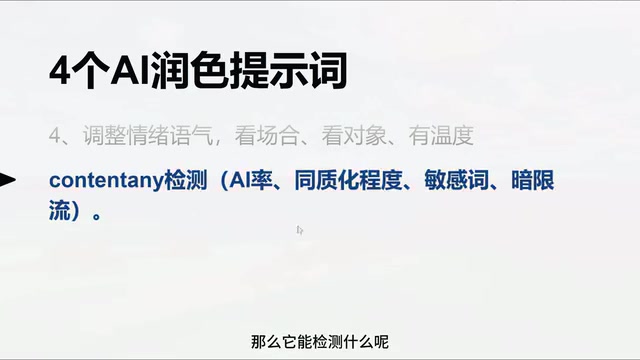
It's worth understanding how AI content detection technology works. Current mainstream detection methods are based on two main technical approaches: first, statistical feature analysis, which judges text by detecting Perplexity and Burstiness — AI-generated text typically has low perplexity and uniform burstiness because language models tend to choose high-probability word combinations, making the output statistically too "smooth"; second, deep learning classifier-based methods that train binary classification models on large samples of human and AI writing. OpenAI once launched an AI text classifier but took it offline due to insufficient accuracy. Tools like GPTZero and Originality.ai are still iterating on the market. It's worth noting that these detection tools aren't infallible — detection accuracy drops significantly for deeply rewritten AI text — which actually validates the value of the four prompts above.
The detection tool shown in the video performs multi-dimensional analysis with quite comprehensive coverage:
- AI-assisted writing ratio: Directly quantifies the proportion of AI-generated content in the article
- Title violation detection: Checks whether the title contains sensitive words or compliance risks, with modification suggestions
- Title effectiveness evaluation: Predicts the title's appeal and click-through potential
- Content sensitivity detection: Identifies potentially sensitive topics in the article
- Homogeneity score: Detects content overlap with existing articles online
- Traffic potential assessment: Estimates the article's traffic performance
- Over-marketing detection: Flags excessive marketing tendencies
- Data accuracy: Verifies the reliability of cited data
- Logic check: Detects logical flaws in the argumentation
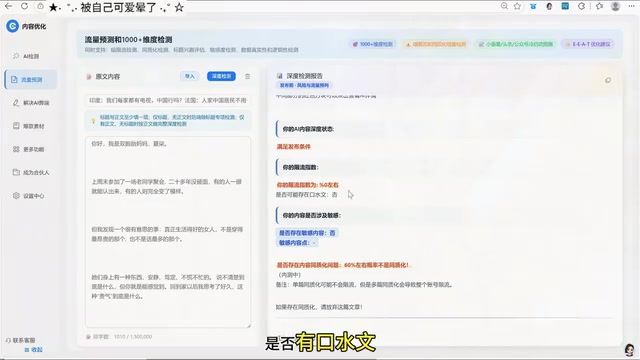
If the detection results show a high AI-assisted writing ratio, the tool also offers a one-click optimization feature with different style options (deep optimization, moderate optimization, quick optimization) to further reduce the AI score.
Practical Tips: Build Your AI-Removal Workflow
Combining all the methods above, here's a standardized workflow you should establish:
Step 1: AI generates the first draft → Use your preferred AI tool to complete the content framework and initial draft.
Step 2: Four rounds of prompt optimization → Apply the four prompts in sequence to address AI traces, structure, conversational tone, and voice. You don't need to use all four every time — just pick the 2-3 that are most needed based on the situation.
Step 3: Detection and verification → Run the article through a detection tool to check the AI score and other risk items.
Step 4: Manual fine-tuning → Based on detection results and your own judgment, do a final round of manual polishing. Add personal experiences, unique perspectives, or emotional expression — these are the parts AI struggles most to imitate.
It's important to note that removing AI smell isn't about "deception" — it's about improving content quality. An article that reads naturally, flows smoothly, and has personal style is inherently more valuable than templated AI output. These prompts and tools are essentially helping you use AI as a better writing assistant, not letting AI replace your thinking.
What ultimately determines an article's quality is always your eye for topics, unique insights, and real experience — these are the core competitive advantages that AI simply cannot replace.
Related articles
Claude AI Builds a FiveM Server from Scratch: Full RP Server Setup Test
Real test of Claude AI building a complete FiveM RP server from an empty folder, covering Qbox framework, economy, police jobs, housing, and phone systems.

Full Walkthrough: Recreating Apple's AI Photo Reconstruction Feature with TRAE Work
A Bilibili creator uses TRAE Work AI Agent to recreate Apple's photo spatial reconstruction feature, covering research, cloud development, and multi-device collaboration.

TraeHarness Open-Sourced: 18 AI Agents Form a Virtual Development Team
TraeHarness is an open-source multi-agent framework with 18 specialized AI Agents simulating a real software team, covering requirements, architecture, development, testing, and deployment.