From Copilot to Agentic AI: Understanding AI's Evolution Through Four Stages
Agent is the core AI capability direction that won't become obsolete.
This article traces AI's four-stage evolution from Chat Mode, Copilot Mode, Agent Mode to Agentic AI Mode, showing how AI's role shifts from information provider to autonomous decision-maker, with Agent as the core vehicle. The two key capabilities of Agentic AI are multi-agent collaborative architecture and autonomous decision-making based on the ReAct framework, supported by MCP protocol for standardized tool invocation. Learners should focus on foundational architectural thinking and frameworks rather than chasing easily replaceable surface-level technologies.
AI Technology Iterates Rapidly — What Core Skills Won't Become Obsolete?
Over the past two years, prompt engineering, RAG, local LLM deployment, fine-tuning... these once red-hot concepts are gradually fading from the mainstream spotlight. The breakneck pace of technological iteration leaves many learners anxious: Will what I learn today be replaced tomorrow?
To answer this question, we need to identify the unchanging thread within AI's overall development trajectory. By systematically examining the evolution of AI technology from 2023 to 2026, a clear conclusion emerges: The Agentic AI paradigm, with Agent at its core, is the technological direction that won't become obsolete.
Four Stages of AI Development: From Chat Mode to Autonomous Agents
2023: Chat Mode — AI as a Glorified Search Engine
After OpenAI launched ChatGPT, AI entered the "chat mode" era. Users ask questions in a dialog box, and the large model understands intent and returns information. But fundamentally, AI is merely an information organizer — you still need to open Excel or PowerPoint yourself and manually complete the actual work. AI occupies a tiny fraction of the entire production workflow; the real productivity still comes from humans.
2024: Copilot Mode — AI Becomes the Co-Pilot
AI began to initially intervene in human production processes, with AI-assisted programming being the most typical use case. GitHub Copilot was released in 2021 and officially commercialized in 2022, marking the first milestone product for AI entering the software development workflow. Its foundation is built on OpenAI's Codex model (a code-specialized fine-tuned version of GPT-3), which analyzes the current file context and cursor position to generate real-time code completion suggestions. Copilot's commercial success (reportedly over 1.3 million paid users) validated the market viability of "AI-assisted professional work" and spawned more aggressive AI coding tools like Cursor and Windsurf.
However, at this stage AI could only control local code snippets — overall project architecture, file creation, and debugging still required human leadership. From a technical evolution perspective, the fundamental limitation of Copilot mode lies in its "context window" being restricted to the current file, unable to understand the cross-file project structure. This is precisely the bottleneck that the subsequent Agent mode aims to break through.
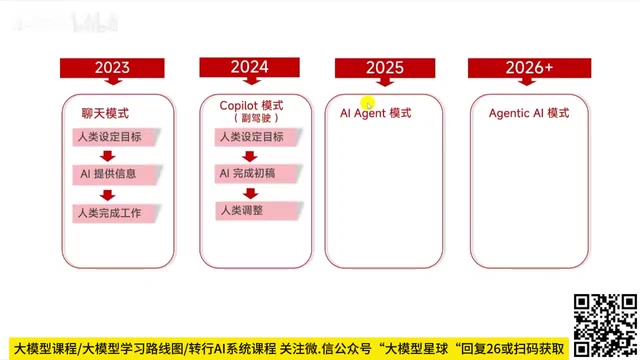
At this stage, AI handles roughly one-third of the workload, with humans remaining the primary operators. The "co-pilot" metaphor is remarkably precise — AI assists, but the steering wheel is still in human hands.
2025: Agent Mode — AI Becomes the Primary Operator
Two landmark events in 2025 completely disrupted the previous two modes:
The first was the emergence of Manus. Users only need to issue a complex task (such as "present Company X's Q3 business data"), and Manus automatically completes the entire pipeline — web data scraping, filtering, writing to Excel, data analysis, and chart generation — with zero human intervention required.
The second was the explosive popularity of Claude Code. Unlike traditional AI editors, Claude Code has only a single dialog box. Users describe their requirements, and code writing, file generation, and project architecture are all completed by AI.
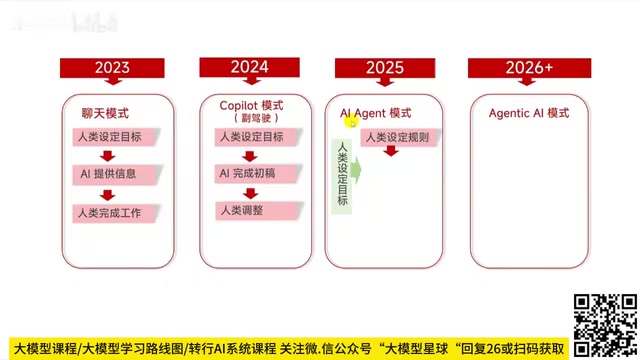
This is the core characteristic of AI Agent mode. Understanding the technical essence of Agents helps grasp the deeper reasons behind this leap: An AI Agent is a system capable of perceiving its environment, autonomously planning, and executing actions to achieve goals. Unlike traditional LLMs' single-turn Q&A, Agents possess three key capabilities — Memory, Tool Use, and Planning. Memory enables Agents to maintain context across steps; Tool Use allows Agents to operate external systems (such as browsers, code interpreters, databases); Planning capability enables Agents to decompose complex goals into executable sub-step sequences. The combination of these three elevates Agents from "answering questions" to "completing tasks."
In this mode, AI occupies two-thirds of the production process, and the human role transforms to: setting goals, providing resources, and defining rules. Agents can invoke tools and perform logical reasoning, becoming the primary operator of the entire production process. This is why 2025 is called the "Year One of Agents."
2026: Agentic AI Mode — Multi-Agent Collaboration and Autonomous Decision-Making
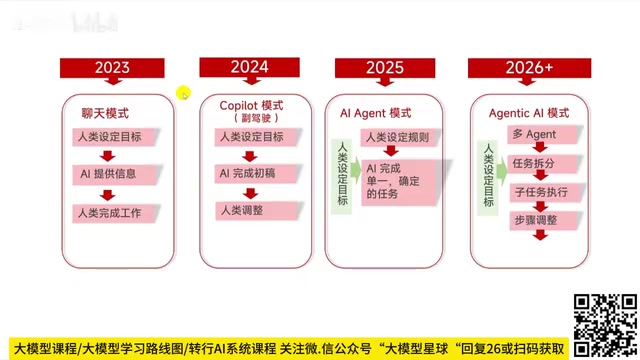
In the current stage, Agent mode further evolves into Agentic AI mode, with core upgrades in two areas:
- Multi-Agent division of labor and collaboration: For complex tasks, the system can decompose them into multiple sub-tasks and assign them to Agents with different specialized skills for parallel completion.
- Reflection and adjustment capabilities: Agents possess a "reflect-adjust" thinking loop during execution — execute a step, check whether the result meets expectations, automatically adjust if not, and repeat until the goal is achieved.
Multi-Agent Systems (MAS) draw design inspiration from the wisdom of human organizational division of labor: complex tasks completed through specialization and collaboration are far more efficient than a single omnipotent individual. In technical implementation, multi-agent systems typically include an "Orchestrator" responsible for task decomposition and scheduling, along with multiple "Worker Agents" each focused on specific domains. Microsoft's AutoGen, Stanford's CAMEL project, and CrewAI are all representative implementations of multi-agent collaborative architectures, each making different trade-offs in task allocation strategies and communication mechanisms.
Why Agent Is the Core Technology That Won't Become Obsolete
From this development trajectory, a clear trend emerges: AI's role progressively evolves from information provider → assistant → primary operator → autonomous decision-maker. And the core vehicle of this evolution is the Agent.
According to market estimates, the AI Agent market will grow incrementally from 2026 to 2029, with 75% of enterprises already piloting or implementing AI Agents in their production processes. "One person with an entire company's digital workforce" is no longer a fantasy.
The key insight is: while specific tools and frameworks will continuously update, the architectural philosophy of multi-agent collaborative cooperation and the thinking frameworks for autonomous agent decision-making are foundational logic that won't disappear with technological iteration. This is like learning programming requires understanding algorithms and data structures, rather than just learning a specific framework's API.
Deconstructing the Two Core Capabilities of Agentic AI
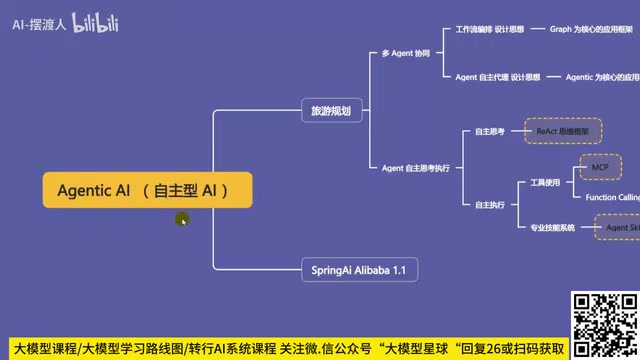
Core Capability One: Multi-Agent Collaborative Architecture
Multi-Agent collaboration has two mainstream design philosophies:
- Graph engine-driven workflow orchestration: Defines calling relationships and data flow between Agents through Directed Acyclic Graphs (DAGs), suitable for scenarios with high process determinism where execution paths are predictable and auditable.
- Agent autonomous proxy mode: Agents autonomously decide which sub-Agents to invoke and which tools to use based on task requirements, with LLM-based dynamic routing offering greater flexibility. Suitable for open-ended tasks, but with relatively lower behavioral controllability.
Currently, mainstream application frameworks include JManners (which can be understood as a Java version of Manus) and AgentScope (a framework promoted by Alibaba/Ant AI). Both frameworks are part of the Ant AI ecosystem and represent important technical directions for domestic Agentic AI.
Core Capability Two: Agent Autonomous Thinking and Execution
This can be understood from two dimensions:
The logic of autonomous thinking — the ReAct framework. ReAct (Reasoning + Acting) was jointly proposed by Princeton University and Google in 2022 and published at ICLR 2023. Its core idea is to interleave the language model's reasoning traces (Thought) with external actions (Action), observing environmental feedback (Observation) after each action before entering the next round of reasoning. This "Think-Act-Observe" loop breaks the limitation of traditional Chain-of-Thought reasoning that occurs only within the model, allowing Agents to dynamically correct strategies based on real-world feedback, significantly reducing error accumulation caused by hallucinations. Currently, mainstream Agent frameworks (LangChain, AutoGen, CrewAI) all use ReAct or its variants as their core execution paradigm. Agents don't mechanically execute instructions but dynamically adjust strategies based on intermediate results — this is the key mechanism that endows Agents with "intelligence."
The capability for autonomous execution — MCP Protocol + Agent Skills. MCP (Model Context Protocol) was officially open-sourced by Anthropic in November 2024, aiming to solve the "fragmentation" problem of AI model integration with external tools. Before MCP, every AI application needed to develop a separate adaptation layer for each tool, resulting in extremely high development costs and poor reusability. MCP defines a standardized client-server communication protocol that allows any tool following the protocol (MCP Server) to be directly invoked by any AI model supporting MCP (MCP Client) — similar to how the USB interface unified peripheral connection standards. Currently, thousands of MCP Servers cover scenarios including file systems, databases, GitHub, Slack, browser control, and more. Major vendors including OpenAI and Google have successively announced support for the protocol, and MCP is becoming the de facto standard for Agent tool invocation.
Agent Skills take this even further: not just using individual tools, but completing work according to an entire professional workflow. For example, a "Data Analysis Agent" doesn't just know how to invoke Python — it masters the complete skill chain from data cleaning, statistical analysis, to visualization.
Learning Recommendations: Grasp the Underlying Logic, Don't Chase Surface-Level Technology
Returning to the opening question: What kind of AI technology won't become obsolete?
The answer is already clear: Don't learn superficial new technologies — learn the foundational capabilities at the core of AI's development trajectory. Specifically:
- Understand the design philosophy of multi-agent collaborative architectures, not just how to use a particular framework
- Master autonomous decision-making thinking frameworks like ReAct, understanding how Agents "think"
- Learn the engineering encapsulation of MCP protocol and Skills, giving Agents genuine professional capabilities
- Develop the ability to decompose and coordinate complex business processes — this is humanity's most core competitive advantage in the Agentic AI era
Technological tools will continuously evolve, but architectural philosophies and thinking frameworks have lasting vitality. Rather than anxiously chasing every new tool, it's better to take the time to understand the design philosophy behind Agents — this is the truly future-oriented learning strategy.
Key Takeaways
- AI development has gone through four stages: Chat Mode → Copilot Mode → Agent Mode → Agentic AI Mode, with the trend of Agent as the core operator being irreversible
- The technical essence of Agents is the combination of Memory, Tool Use, and Planning capabilities, upgrading AI from "answering questions" to "completing tasks"
- The two cores of Agentic AI: Multi-Agent division of labor architecture + Agent autonomous decision-making (ReAct thinking framework)
- MCP Protocol (open-sourced by Anthropic in 2024) solves standardized tool invocation, while Agent Skills enable engineering encapsulation of professional workflows — together they empower Agent execution capabilities
- 75% of enterprises are already piloting AI Agents, with market size continuing to grow from 2026-2029
- Learning should focus on underlying architectural philosophies and thinking frameworks, not on chasing easily replaceable surface-level technologies
Related articles
 Deep Dives
Deep Dive into How OpenClaw (Open-Source Crayfish) AI Agent Works
Deep analysis of OpenClaw AI Agent internals: System Prompt, tool calling, SubAgents, Skill system, memory, and Context Engineering explained.
 Deep Dives
Demystifying Transformer: A Word-Continuation Function, Deconstructed
Understand Transformer through the lens of word continuation. Breaking down language generation into Embedding, Transformer Block, and Probability output modules for intuitive understanding.
 Deep Dives
Five Core Differences Between Claude Code and Regular AI Chat
A detailed comparison of Claude Code vs regular AI chat across five dimensions: interaction, context understanding, execution, memory, and tool integration.