From Programmer to Agent Developer: A Detailed Four-Stage Learning Roadmap

A systematic four-stage roadmap for programmers transitioning to AI Agent development.
This article provides programmers with a four-stage learning roadmap for transitioning to AI Agent development: first, master the core Agent architecture (LLM, planning, memory, and tool set); then deep dive into classic paradigms like ReAct and CoT along with key technologies like RAG; next, master Prompt engineering and optimization techniques; and finally, drive skill development through hands-on projects such as intelligent customer service, data analysis, and multi-Agent collaboration systems. Programmers can leverage their coding and engineering strengths to quickly get started after filling in AI theory gaps.
With the explosive growth of large model technology, AI Agent development has become one of the hottest directions in the tech industry. For traditional programmers, how to efficiently transition into Agent development is a topic worth exploring in depth. This article presents a systematic learning roadmap, combined with practical experience, to guide you through the journey from zero to one in Agent development.

Why Should Programmers Pay Attention to Agent Development?
Before diving into the specific learning roadmap, we need to understand a key trend: AI Agents are moving from concept to real-world deployment. Unlike traditional API calls, Agents possess the ability to autonomously plan, manage memory, and invoke tools, enabling them to complete more complex task chains. This means that enterprise demand for Agent development talent is growing rapidly, and programmers with coding experience have a natural advantage in this space.
The core advantage for programmers transitioning to Agent development is this: you already have programming thinking and engineering capabilities. You just need to fill in the knowledge gaps around AI theory and Agent architecture to get up to speed quickly.
Stage 1: Building a Solid Foundation in Agent Core Theory
The first step in the transition is to systematically understand the core architecture of Agents. A complete AI Agent typically consists of the following key components:
- Large Language Model (LLM): The Agent's "brain," responsible for understanding instructions, reasoning, and generating responses
- Planning Module: Breaks down complex tasks into executable sub-steps
- Memory Module: Includes short-term memory (conversation context) and long-term memory (knowledge base retrieval)
- Tool Set: External capabilities the Agent can invoke, such as search engines, code executors, database queries, etc.

The architectural design of these four major components didn't emerge from thin air — they have deep academic and engineering roots. The large language model, as the core reasoning engine, directly determines the Agent's upper bound of capability. The planning module draws from the STRIPS planning system in classical AI, combining symbolic planning with the semantic understanding capabilities of neural networks. The memory module's design is inspired by Working Memory and Long-term Memory theories from cognitive science — short-term memory corresponds to the context within a conversation window, while long-term memory achieves cross-session knowledge persistence through vector databases. Tool-calling capability is the key breakthrough that allows LLMs to transcend pure text generation and truly interact with the external world, and it's what fundamentally distinguishes Agents from ordinary chatbots.
The focus of this stage is not writing code, but building the right cognitive framework. It's recommended to read Lilian Weng's classic blog post LLM Powered Autonomous Agents, as well as Agent-related technical documentation published by OpenAI, Anthropic, and other companies. Only after understanding these foundational concepts can you make sound architectural decisions in subsequent development.
Stage 2: Deep Dive into Agent Working Principles and Classic Paradigms
After mastering the basics, you need to further understand how Agents work, particularly several classic Agent paradigms.
The ReAct Paradigm: Alternating Cycles of Reasoning and Action
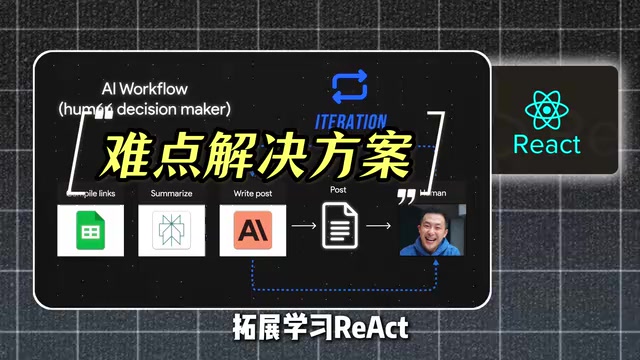
ReAct (Reasoning + Acting) is one of the most mainstream Agent architectures today. It was formally proposed by Google Research in 2022 in the paper ReAct: Synergizing Reasoning and Acting in Language Models. The core innovation lies in interleaving reasoning traces and action steps within the same generation sequence, overcoming the dual limitations of pure reasoning models lacking external information retrieval and pure action models lacking planning capability.
The core idea is to have the LLM alternate between "thinking" and "acting" — first reasoning about the current situation, then deciding which tool to call, and then continuing to reason based on the tool's returned results until the task is complete. Experiments show that ReAct significantly outperforms methods using CoT or actions alone on complex reasoning benchmarks like HotpotQA and FEVER. This pattern also closely mirrors how humans solve problems.
Chain of Thought (CoT): A Key Technique for Improving Reasoning Quality
Chain of Thought (CoT) is a key technique for enhancing LLM reasoning capabilities, systematically proposed by Google Brain in 2022 in the paper Chain-of-Thought Prompting Elicits Reasoning in Large Language Models. The theoretical basis is that forcing the model to explicitly output intermediate reasoning steps before giving a final answer activates the logical reasoning abilities acquired during pre-training, significantly improving performance on complex math, logic, and commonsense reasoning tasks. In Agent development, CoT is often combined with ReAct, making every decision the Agent takes well-grounded while also providing an interpretable reasoning chain for debugging and auditing.
Common Challenges in Agent Development and Solutions
This stage also requires attention to common challenges in Agent development:
- Hallucination: LLMs may generate inaccurate information, which can be mitigated through techniques like RAG (Retrieval-Augmented Generation). RAG was proposed by Meta AI in 2020, and its core idea is to retrieve relevant document fragments from an external knowledge base and inject them into the Prompt before the LLM generates an answer, allowing the model to respond based on real, up-to-date information. In engineering practice, this typically relies on vector databases like Pinecone, Weaviate, and Chroma to store text embeddings and achieve precise recall through semantic similarity search.
- Tool Call Failures: Robust error handling and retry mechanisms need to be designed
- Context Window Limitations: Memory management strategies for long conversation scenarios
- Cost Control: Design call chains wisely to avoid unnecessary token consumption
It's recommended to practice with mainstream frameworks like LangChain and LlamaIndex, which already encapsulate standard implementations of the above paradigms and can significantly lower the learning curve.
Stage 3: Prompt Engineering and Optimization Techniques
Prompt Engineering is a seriously underestimated aspect of Agent development. The difference between an excellent Agent and a mediocre one often comes down to the quality of Prompt design.
Understanding the essence of Prompt Engineering helps master its optimization logic: LLMs are fundamentally conditional probability models, and the input context (i.e., the Prompt) directly determines the output probability distribution. Few-shot Prompting was formally introduced by Brown et al. in the GPT-3 paper, demonstrating that a small number of examples can activate the model's In-Context Learning capability without any gradient updates. Structured output constraints leverage mechanisms like OpenAI's Function Calling and JSON Mode to seamlessly bridge natural language generation with programmatic data processing, serving as critical infrastructure for Agent engineering in production.
Key optimization techniques include:
- System Prompt Design: Clearly define the Agent's role, capability boundaries, and behavioral guidelines
- Few-shot Examples: Provide a small number of high-quality input-output examples to guide the model to respond in the expected format
- Structured Output: Use JSON Schema and similar approaches to constrain model output format, improving downstream parsing reliability
- Temperature Parameter Tuning: Adjust randomness based on task type (creative generation vs. precise execution)
The core goal of this stage is: making your Agent produce expected results more accurately and consistently. It's recommended to build your own Prompt template library and iteratively test across different scenarios.
Stage 4: Hands-On Projects to Drive Skill Development
No matter how thorough your theoretical learning is, it all comes back to practice. The following types of projects are excellent for hands-on experience:
- Intelligent Customer Service Agent: Combine RAG technology to build a customer service system that answers questions based on an enterprise knowledge base
- Data Analysis Agent: Have the Agent autonomously write SQL queries and generate visualization charts
- Code Assistant Agent: Integrate a code execution environment to enable automated code generation, testing, and debugging
- Multi-Agent Collaboration System: Use frameworks like CrewAI and AutoGen to build systems where multiple Agents collaborate to complete complex tasks
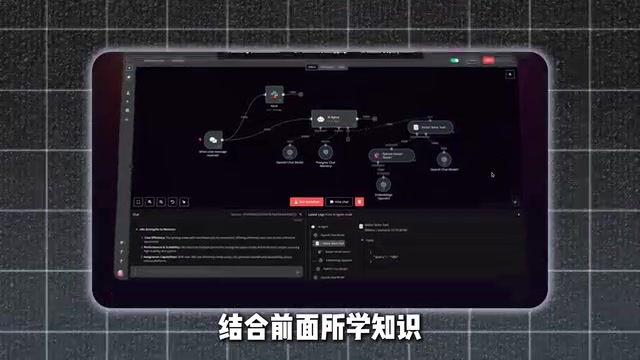
The concept of Multi-Agent Systems originates from the field of distributed artificial intelligence. The core idea is to accomplish complex tasks that a single Agent cannot handle through the collaborative division of labor among multiple specialized Agents. CrewAI uses a role-playing mechanism, assigning each Agent a clearly defined responsibility. AutoGen (developed by Microsoft Research) enables flexible inter-Agent collaboration through programmable conversation patterns. LangGraph provides more granular process control based on a directed graph state machine model. The emergence of these frameworks marks the evolution of Agent development from monolithic architecture to distributed collaborative architecture, placing higher demands on developers' system design skills — you need to think about responsibility boundaries, communication protocols, and state synchronization mechanisms between Agents, much like designing a microservices architecture.
Each project should go through the complete development lifecycle: requirements analysis → architecture design → development → testing and optimization → deployment. The engineering experience accumulated through this process is what truly sets you apart in the job market.
Key Mindset for Transitioning to Agent Development
For programmers transitioning to Agent development, three months of intensive study can indeed get you to a beginner level, but becoming a true expert requires continuously keeping up with this rapidly evolving field. A few suggestions:
- Maintain a Consistent Learning Pace: Invest at least 1-2 hours daily; avoid sporadic effort
- Stay on Top of Cutting-Edge Developments: Subscribe to technical blogs and papers from leading AI labs
- Participate in Open Source Communities: Contributing code and joining discussions on GitHub is the most efficient way to learn
- Stay Business-Oriented: Don't pursue technology for technology's sake; always think about how Agents can solve real business problems
The wave of Agent development is just beginning. For developers with programming experience, this is a rare opportunity to leapfrog ahead. The key question is: are you willing to start taking action now?
Key Takeaways
- AI Agents consist of four core components — LLM, planning module, memory module, and tool set — an architecture that integrates classical AI planning theory with cognitive science memory models. Understanding this foundation is the first step in the transition
- ReAct and CoT are the most mainstream Agent paradigms, both backed by papers from top research labs; mastering these classic architectures helps solve planning and reasoning challenges in real-world development
- Prompt engineering is an underestimated yet critical aspect of Agent development; its essence is the precise control of LLM conditional probability distributions, directly determining the accuracy and stability of Agent output
- Drive learning through hands-on projects like intelligent customer service, data analysis, and code assistants, accumulating complete engineering experience from architecture design to deployment; building multi-Agent collaboration systems further develops distributed system design thinking
- Programmers have the natural advantage of programming thinking and engineering capabilities; after filling in AI theory gaps, they can quickly enter the Agent development track
Related articles
 Tutorials
Cursor + Codex Dual-IDE Collaboration: A Practical Methodology for Open-Source Project Customization
A complete methodology for open-source project customization based on real-world experience, detailing the Cursor+Codex dual-IDE workflow, seven-stage process, MVP validation, and AI source code reading techniques.
 Tutorials
Cursor Multi-Agent in Practice: Building a Full-Stack Next.js Blog in 50 Minutes
Build a full-stack blog in 50 minutes using Cursor IDE's multi-Agent mode with Next.js, Clerk auth, and Supabase. Learn the 4-phase AI Agent workflow and key integration pitfalls.
 Tutorials
Building an AI Software Factory from Scratch: A Cursor Engineer's Hands-On Experience with Multi-Agent Collaboration
Cursor engineer Eric shares practical insights on building an AI software factory: automation levels, guardrail design, parallel Agent management, and scaling to 1000+ Agents for 24/7 development.