Frontend Engineers Leveling Up to AI Agents: LangGraph.js Architecture Design & Practical Guide

Frontend engineers should master LangGraph.js to advance into AI Agent development.
This article explains how AI Agent development has become an essential skill for frontend engineers, focusing on LangGraph.js's core architecture (state, nodes, edges) and its graph-structure orchestration advantages. Using AI automatic video editing as a case study, it demonstrates that the AI era demands comprehensive abilities spanning coding, business understanding, and architecture design. The article recommends a three-layer architecture (engine, capability, business) and provides a learning path from content-layer products to workflow agents to general-purpose agents.
Why Frontend Engineers Must Pay Attention to AI Agent Development
If you still think AI has nothing to do with frontend development, just go to one interview and you'll find out — nine out of ten companies now ask AI-related questions. An interviewer might directly ask you: "Are you familiar with AI application development frameworks? Have you tried building an Agent yourself?"
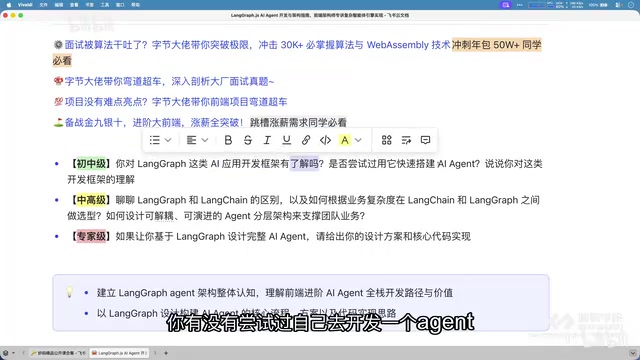
LangChain, LangGraph, and Dify Agent — these three frameworks are like the React and Vue ecosystems in the frontend world. They form the core technology stack for current AI Agent development. Whether in terms of conceptual design or underlying implementation, they effectively guide developers through learning and practicing AI Agent development.
It's worth noting that LangChain was born in late 2022, created by Harrison Chase, initially to solve the "glue code" problem in LLM application development — developers had to manually stitch together prompts, model calls, output parsing, and other steps. LangGraph was then released by the LangChain team in 2024 as an advanced framework specifically addressing LangChain's limitations in complex Agent scenarios: chain-based calls couldn't handle loops, fallbacks, and conditional branching. LangGraph draws on directed graph (DAG) and state machine design principles, modeling an Agent's execution process as a traversable graph where each execution is a graph traversal.
This article will cover LangGraph.js core knowledge across three progressive dimensions: beginner-to-intermediate framework understanding, intermediate-to-advanced architecture selection, and expert-level complete implementation solutions.
Three High-Frequency Interview Questions: From Understanding to Practice
Question 1: How much do you know about AI application development frameworks?
This is the most basic cognitive-level question. You need to clearly understand the positioning and applicable scenarios of frameworks like LangChain, LangGraph, and Dify. LangGraph focuses on building stateful, multi-step Agent workflows. It uses the concept of a Graph to organize Agent execution logic, where each node represents a processing step and edges represent transition conditions.
Question 2: How do you choose between LangGraph and LangChain?
An interviewer might ask: "Based on business complexity, how would you choose between LangGraph and LangChain? How would you design a decoupled, evolvable layered Agent architecture?"
LangChain is better suited for linear, chain-based call scenarios, such as simple Q&A or document retrieval. LangGraph is suited for complex Agent scenarios requiring conditional branching, loops, and state management. When your business needs an Agent to make decisions, fall back, or process in parallel across multiple steps, LangGraph's graph structure advantage becomes apparent.
Question 3: How do you design a complete AI Agent based on LangGraph?
This is an expert-level question that requires you to provide a complete solution design and code implementation. This is also what the second half of this article will focus on.
Core Competitiveness in the AI Era: Comprehensive Ability, Not a Single Skill
The people who truly benefit from the AI dividend are those with solid coding skills, business understanding, and product architecture design capabilities. Let's illustrate with a concrete example.
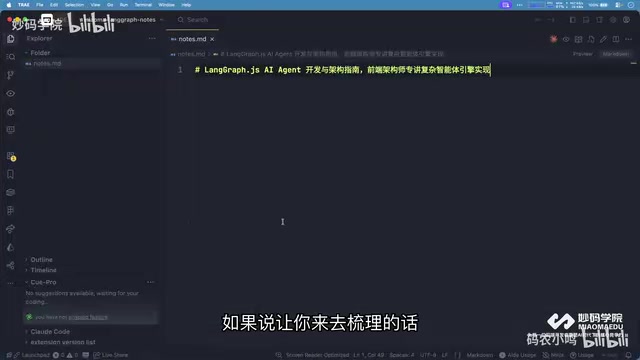
Using "AI Automatic Video Editing" as an Example
Your boss says: "Can you use AI to build an automatic video editing tool for me?" What seems like a simple request involves numerous technical points behind the scenes:
1. Audio/Video Processing Layer
First, you need audio/video processing, and FFmpeg is the most essential tool in this domain. FFmpeg is an open-source, cross-platform audio/video processing framework born in 2000 that remains the industry's most authoritative multimedia processing tool to this day. In AI video editing scenarios, FFmpeg serves as the underlying "workhorse": extracting keyframes for visual model analysis, cutting segments by timestamp, merging audio tracks with video streams, transcoding to target formats, and more. The Node.js ecosystem has wrapper libraries like fluent-ffmpeg, allowing frontend engineers to call FFmpeg capabilities through JavaScript APIs without diving into the C language level. Understanding basic operations like video encoding, decoding, and frame extraction, as well as FFmpeg's basic commands and parameter system, is a prerequisite skill for building AI video processing Agents.
2. Visual Recognition and Analysis
Automatic editing requires frame recognition technology — identifying scene content, detecting shot transitions, analyzing image quality, and more.
3. TTS Voice Synthesis
If automatic voiceover is needed, Text-to-Speech (TTS) technology comes into play. Modern TTS technology has evolved through three stages: concatenative synthesis, parametric synthesis, and today's end-to-end neural network synthesis based on deep learning. Modern TTS systems (such as Volcano Engine, CosyVoice, F5-TTS) generally adopt Transformer or Diffusion architectures, capable of generating natural speech close to human quality. Here's a key cost consideration:
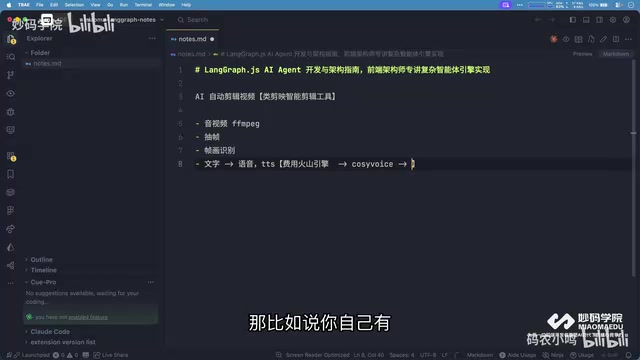
- Volcano Engine (ByteDance): Great quality but generally the most expensive
- CosyVoice (Alibaba): A viable option, but rates are still relatively high
- F5-TTS: Local deployment solution, suitable for teams with computing resources
In terms of cost structure, cloud APIs charge by character count or duration, with costs becoming significant at scale; local deployment solutions (like F5-TTS) require a one-time computing investment with marginal costs approaching zero, but need GPU resources to support real-time inference. You can't just consider feature implementation — you must also consider cost. For Agent architecture designers, TTS solution selection is essentially a business decision between "elastic cost vs. fixed cost," not a purely technical one. Even though producing a video for 100 yuan is cheaper than hiring someone, it's still a considerable expense at scale.
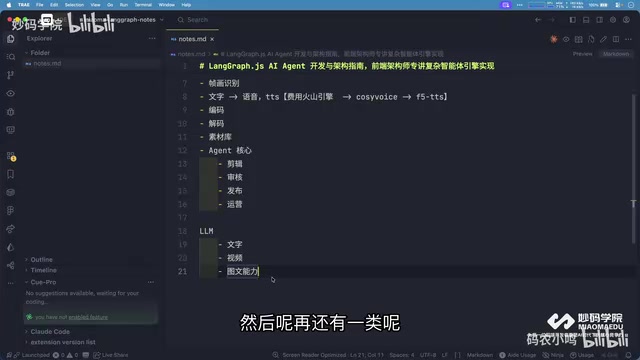
4. Agent Core Orchestration
From editing → review → publishing → automatic comment collection → automatic operations, this entire pipeline can be handled by an Agent. This is where the core value of Agent architecture design lies.
Workflow Agents vs. General-Purpose Agents
Intelligent agents can be broadly divided into two categories:
Workflow Agents
These orchestrate Agent execution logic through predefined nodes and processes. There are two implementation approaches:
- Visual orchestration: Platforms like Coze, Dify, N8N, and ComfyUI where you build workflows by dragging and dropping nodes through a UI
- Code orchestration: Using frameworks like LangGraph.js to define nodes, states, and transition logic at the code level
Both approaches have their advantages, but in engineering practice, visual orchestration platforms have several systemic limitations: version control difficulties (workflow configurations are hard to manage in Git), weak debugging capabilities (lacking breakpoint debugging and variable tracing), limited extensibility (custom node capabilities are bounded by the platform), and vendor lock-in risk (extremely high migration costs when platforms adjust pricing or discontinue services). Code orchestration solutions (like LangGraph.js) have a steeper learning curve but offer significant advantages in maintainability, testability, and long-term evolution capability — which is why enterprise-level Agent projects tend to favor code-based solutions.
General-Purpose Agents
Examples include OpenAI's Codex, Tencent's CodeBuddy, and Alibaba's Wukong. These possess stronger autonomous decision-making capabilities and can independently plan execution steps based on objectives. Most are still in closed beta.
LangGraph.js Core Architecture: State, Nodes, and Edges
Designing AI Agents with LangGraph.js requires understanding three core concepts. The theoretical foundation of this design comes from two classic computer science concepts: Directed Graphs, composed of nodes and directed edges, are naturally suited for describing execution logic like "after step A completes, enter step B or step C based on conditions"; Finite State Machines define transition rules between different states, ensuring the Agent is always in a clearly defined state at any given moment. LangGraph combines both, giving Agent execution observability (state is trackable at every step) and recoverability (resume from any node as a checkpoint).
State
State is the data container that persists throughout the entire Agent execution process. Every node can read and modify state, enabling information sharing and context passing between nodes.
Node
Each node represents a specific processing step — it could be an LLM call, tool execution, data processing, etc. Node definitions should follow the single responsibility principle and maintain reusability.
Edge
Edges define the transition relationships between nodes, including:
- Normal edges: Unconditional transition to the next node
- Conditional edges: Determine transition direction based on state
- Loop edges: Support iterative reasoning by the Agent
Layered Architecture Design Recommendations
A decoupled, evolvable Agent architecture should be divided into three layers:
- Engine Layer: Responsible for graph definition, state management, and node scheduling — this is LangGraph's core capability
- Capability Layer: Encapsulates atomic capabilities such as tool calls, model calls, and data processing
- Business Layer: Combines the engine and capabilities for specific business scenarios to implement particular Agent workflows
Learning Path for Frontend Engineers Advancing to AI Agents
For frontend engineers, the path to advancing into AI Agent development can be planned as follows:
- Content-layer products: Text-to-text, text-to-video, and image/text processing products — these directly correspond to LLM core capabilities and are the easiest entry point
- Workflow Agents: Learn frameworks like LangGraph.js and master the core concepts and implementation methods of Agent orchestration
- General-purpose Agents: Understand advanced Agent capabilities like autonomous decision-making and planning/reasoning
The key is: don't just learn framework APIs — understand Agent design thinking in the context of specific business scenarios. Every technical point should be actionable — know how to do it and be able to implement it in code.
Summary
AI Agent development is becoming an essential skill for frontend engineers. LangGraph.js provides an excellent graph-structure orchestration solution that lets us build complex intelligent agent workflows using familiar JavaScript/TypeScript. But the technical framework is just a tool — the real value lies in your depth of business understanding, architecture design capability, and comprehensive consideration of cost and efficiency. Stop just building pages — it's time to level up to Agent engine development.
Related articles
 Tutorials
Cursor + Codex Dual-IDE Collaboration: A Practical Methodology for Open-Source Project Customization
A complete methodology for open-source project customization based on real-world experience, detailing the Cursor+Codex dual-IDE workflow, seven-stage process, MVP validation, and AI source code reading techniques.
 Tutorials
Cursor Multi-Agent in Practice: Building a Full-Stack Next.js Blog in 50 Minutes
Build a full-stack blog in 50 minutes using Cursor IDE's multi-Agent mode with Next.js, Clerk auth, and Supabase. Learn the 4-phase AI Agent workflow and key integration pitfalls.
 Tutorials
Building an AI Software Factory from Scratch: A Cursor Engineer's Hands-On Experience with Multi-Agent Collaboration
Cursor engineer Eric shares practical insights on building an AI software factory: automation levels, guardrail design, parallel Agent management, and scaling to 1000+ Agents for 24/7 development.