Frontend to AI Full-Stack: Complete Skill Tree & Learning Roadmap
Frontend to AI Full-Stack: Complete Sk…
A complete skill roadmap for frontend developers transitioning to AI full-stack engineers
This article systematically outlines the complete skill tree for frontend developers transitioning to AI full-stack engineers, covering five major areas: core fundamentals (TypeScript, PostgreSQL), frontend tech stack (React/Vue + ShadCN UI + Tauri 2), backend framework (NestJS as the top choice), AI application development (LangChain JS + LangGraph JS + RAG + Vector Databases), and engineering & DevOps (Docker + CI/CD). The core principle is to unify on TypeScript and achieve the transition at minimal cost.
The Rise of AI Full-Stack Frontend Roles: Why Frontend Developers Should Pay Attention
Whether it's ByteDance, Alibaba, or other top-tier tech companies, "AI Full-Stack Frontend Engineer" is becoming a hot position in the job market. However, many frontend developers feel lost when facing this new direction: What exactly do I need to learn? To what depth? And how can I make this transition at the lowest cost?
Based on insights shared by a senior AI full-stack developer, this article systematically outlines the complete skill tree needed for frontend developers transitioning to AI full-stack roles. It covers five major areas: core fundamentals, frontend tech stack, backend frameworks, AI application development, and engineering & DevOps — helping frontend developers build a clear path for advancement.
Core Fundamentals: Programming Literacy & Deep Skills
The foundation of any technical role depends on solid computer science fundamentals. For the AI full-stack direction, the following are essential:
- Data Structures & Algorithms: The core competency that demonstrates programming literacy
- Computer Networks & Operating Systems: Understanding the underlying logic of how systems run
- Programming Languages: TypeScript is the top choice; Python is also necessary as the primary language in the AI ecosystem; Java is a bonus if you already know it
- Database Principles: PostgreSQL is highly recommended — it can replace both MySQL and MongoDB, making it the most worthwhile database to learn today
It's worth emphasizing that TypeScript should become the unified language for full-stack development. Abandon JavaScript, embrace TypeScript — it not only ensures type safety but also delivers an excellent development experience in isomorphic frontend-backend scenarios.
Frontend Tech Stack: From Frameworks to Multi-Platform Development
Framework & UI Component Library Selection
For frontend frameworks, React (at least up to React 18) and Vue 3 are both viable options. However, for UI component libraries, ShadCN UI paired with Tailwind CSS is currently the optimal solution.
Why not Ant Design or Element UI? ShadCN UI's design philosophy is more modern, offers stronger component customizability, and integrates seamlessly with Tailwind CSS — making it ideal for rapid AI application development.
Multi-Platform Development: Tauri 2 vs Electron
In the desktop application development space, Tauri 2 is replacing Electron as the superior choice.
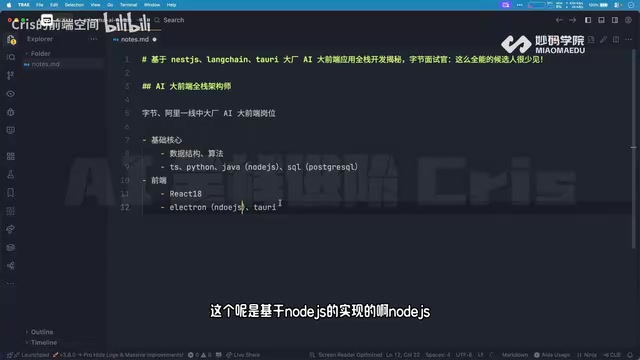
Tauri is built on Rust, while Electron is built on Node.js — they're not even on the same level fundamentally. Tauri's advantages include:
- Smaller build size: Packaged applications are significantly smaller than Electron apps
- Better performance: Rust's underlying performance brings notable improvements
- Cross-platform capability: Tauri 2 supports write-once, build-everywhere — covering Windows, macOS, Linux, and even iOS and Android
In real-world business scenarios, there are numerous desktop application use cases such as AI video editing, AI operations tools, AI customer service systems, and knowledge base construction. Mastering Tauri enables rapid delivery of enterprise-grade products.
Engineering Tools & State Management
- Package Management & Monorepo: PNPM + Monorepo architecture
- Build Tools: Vite or ByteDance's RSPack
- State Management: Zustand or Jotai for React; Pinia for Vue
Backend Tech Stack: A Full-Stack Solution Centered on NestJS
Why NestJS Is the Top Choice for Frontend-to-Full-Stack Transition
For frontend developers advancing to full-stack, NestJS is a 100% recommended framework. Its systematic design is brilliantly crafted, perfectly integrating object-oriented programming, functional programming, reactive programming, dependency injection, inversion of control, aspect-oriented programming, and other paradigms.
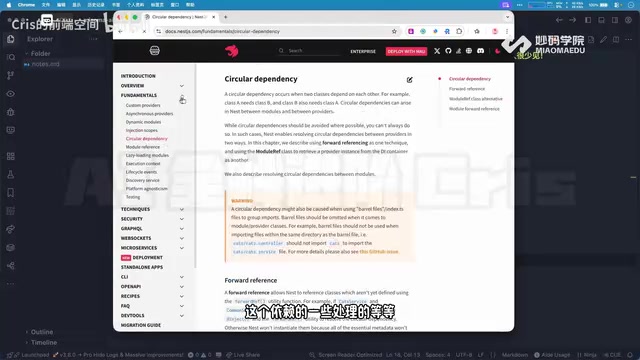
NestJS has a very comprehensive knowledge system:
- Basic Concepts: Controller, Providers, Modules, Middleware, Exception Filters, Pipes, Guards, Interceptors, Custom Decorators
- Fundamentals: IoC Container, Circular Dependency handling, etc.
- Techniques: Database, Authentication, Caching, Serialization, Task Queues, Logging, Cookies, Events, File Upload, Session Control, Performance Optimization
- Security: JWT authentication, OAuth2, Auth0, and various other authentication schemes
- Microservices: Redis, RabbitMQ, Kafka, gRPC, etc.
The framework itself already solves 60%-70% of infrastructure concerns — the rest only requires upper-layer encapsulation based on team needs. If you've previously worked with Spring Boot, picking up NestJS will be very straightforward.
Alternative Options
React developers can choose Next.js, and Vue developers can choose Nuxt.js. They're not just SSR solutions — they're complete frontend-backend isomorphic solutions.
Database & API Design
- Database: PostgreSQL, paired with PG Vector for vector storage
- ORM Framework: Prisma or TypeORM
- API Design: RESTful API or GraphQL, with JWT authentication
AI Application Development: From LangChain to RAG in Practice
LangChain JS & LangGraph JS
There are two core frameworks for AI application development: LangChain JS and LangGraph JS.
LangChain (Chain-based invocation): Suitable for linear AI processing workflows. Input → LLM call → Prompt optimization → RAG query processing → Output — the entire process executes sequentially like a chain.
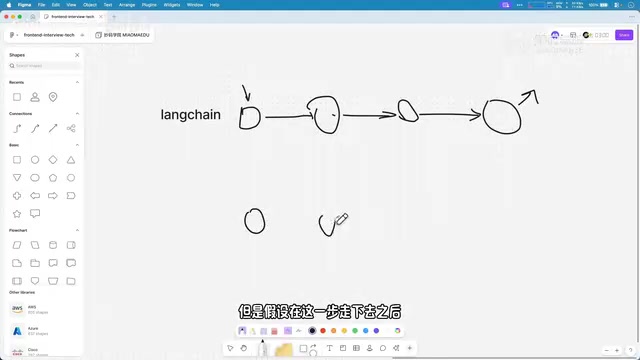
LangGraph (Graph-based invocation): When processing flows become complex and require conditional branching, loops, backtracking, and other operations, simple chain structures are no longer sufficient. LangGraph abstracts workflows into graph structures, supporting complex jumps and loops between nodes — ideal for building more intelligent AI Agents.
Although LangChain and LangGraph were originally Python frameworks, they both have corresponding JavaScript versions. As the classic saying goes: "Anything that can be developed in JavaScript will eventually be developed in JavaScript." Frontend developers can enter the AI application development space at minimal cost using the JS versions.
Additionally, frameworks like Mastra and RAGFlow are worth watching, but LangChain and LangGraph remain the most widely used.
RAG & Vector Databases
RAG (Retrieval-Augmented Generation) development requires knowledge chunking and vectorization. Core components include:
- Embedding Models: Such as
mxbai-embed-large, which can be conveniently deployed and used via Ollama - Vector Database: PostgreSQL + PG Vector is the recommended solution
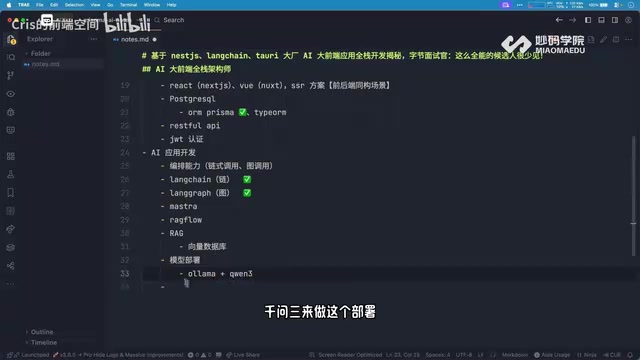
Model Deployment & Fine-Tuning
- Local Deployment: Ollama + Qwen3 is a lightweight local deployment solution
- Model Fine-Tuning: Master basic fine-tuning concepts and workflows to customize models based on business needs
Engineering & DevOps: Infrastructure for Full-Stack Development
Full-stack development requires engineering and operations capabilities:
- Version Control: Git (essential)
- Monorepo Solution: PNPM + Monorepo
- CI/CD: Continuous Integration & Continuous Deployment
- Containerization: Docker → Docker Compose → K8s/K3s/MiniKube
Special emphasis: Docker is a prerequisite for learning CI/CD. Without Docker knowledge, you essentially can't claim CI/CD competency. After mastering Docker, progressively learn Docker Compose for multi-container orchestration, and eventually advance to Kubernetes.
Core Principles for Tech Selection & Action Items
The entire AI full-stack frontend technology selection follows several core principles:
- Unified Language: Use TypeScript across the full stack to ensure type safety and development efficiency
- Productivity First: Tauri 2 + ShadCN UI + Vite, pursuing the ultimate development experience
- AI Capability Integration: LangChain JS + Vector Database + Embedding Models, building complete AI application capabilities
- Scalability: NestJS + PostgreSQL + Docker, ensuring system maintainability and extensibility
Currently, most enterprises are still confused about how to implement AI applications — and this is precisely the opportunity for frontend developers. If you can connect the complete pipeline of AI + Frontend + Backend within the next few months, combined with product thinking, you'll not only qualify for AI full-stack positions at major tech companies but also independently deliver enterprise-grade AI application projects.
Related articles
 Tutorials
Cursor + Codex Dual-IDE Collaboration: A Practical Methodology for Open-Source Project Customization
A complete methodology for open-source project customization based on real-world experience, detailing the Cursor+Codex dual-IDE workflow, seven-stage process, MVP validation, and AI source code reading techniques.
 Tutorials
Cursor Multi-Agent in Practice: Building a Full-Stack Next.js Blog in 50 Minutes
Build a full-stack blog in 50 minutes using Cursor IDE's multi-Agent mode with Next.js, Clerk auth, and Supabase. Learn the 4-phase AI Agent workflow and key integration pitfalls.
 Tutorials
Building an AI Software Factory from Scratch: A Cursor Engineer's Hands-On Experience with Multi-Agent Collaboration
Cursor engineer Eric shares practical insights on building an AI software factory: automation levels, guardrail design, parallel Agent management, and scaling to 1000+ Agents for 24/7 development.