Gemini 3.5 Flash Generates a Classic Paint App in One Shot — Canvas Capabilities Impress
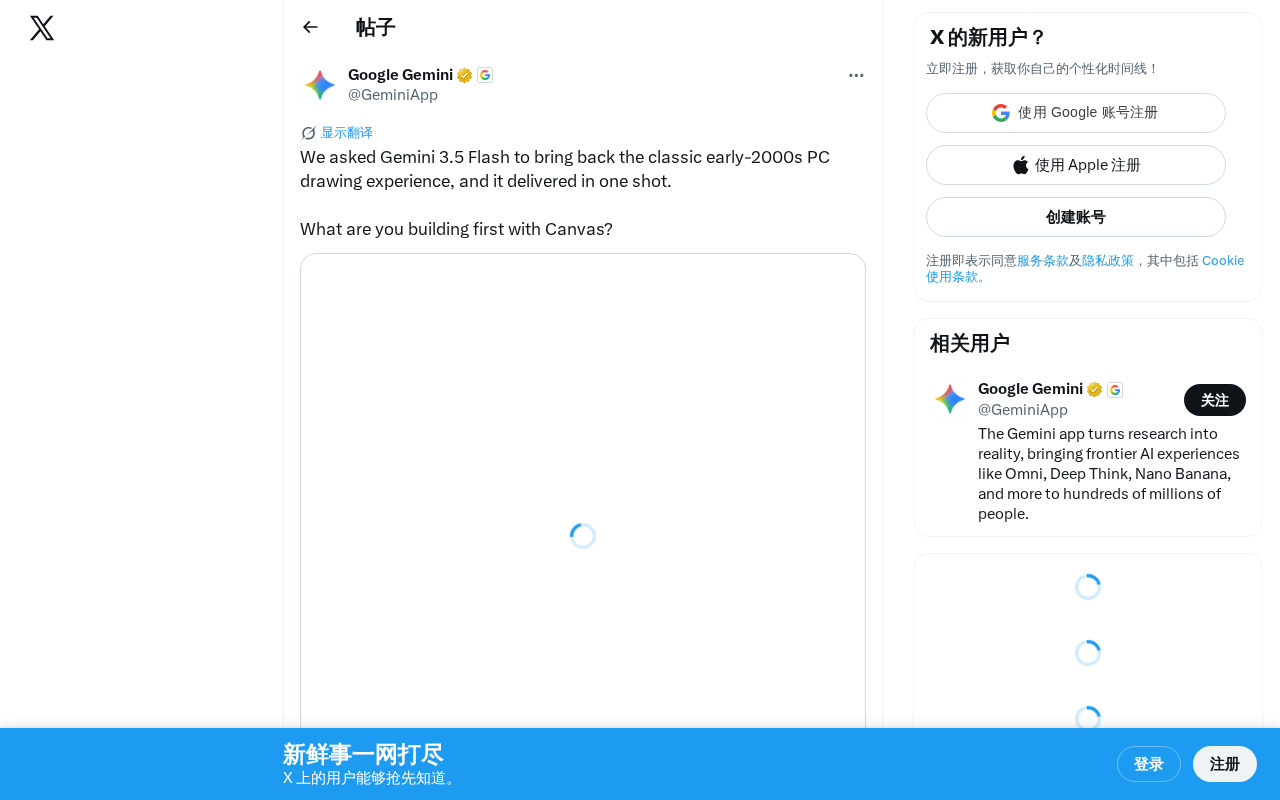
Gemini 3.5 Flash recreates a classic MS Paint-style app in one shot using Google's Canvas platform.
Google demonstrated Gemini 3.5 Flash's impressive one-shot code generation by recreating a classic early 2000s PC paint application from a single prompt on its Canvas platform. The demo showcases Flash's strong frontend development understanding, precise context interpretation, and UI fidelity, while highlighting the growing competition in AI-powered application development.
One Prompt to Recreate a Classic: Gemini 3.5 Flash's Canvas Power
Google recently showcased an impressive capability of the Gemini 3.5 Flash model — recreating the complete experience of an early 2000s classic PC drawing application with just a single simple prompt. This demonstration not only highlights the model's powerful code generation abilities but also invites a fresh look at AI's enormous potential in application development.
One Shot, Zero Revisions: What One-Shot Capability Means
The term "one shot" refers to an AI model delivering a complete, usable result on the first attempt after receiving a user instruction — no multi-round iterations or modifications needed. In this case, the Google team gave Gemini 3.5 Flash a seemingly simple request: "Bring back the classic early 2000s PC drawing experience."
The model immediately generated a fully functional drawing application that faithfully recreated the iconic paint software style of that era — inevitably evoking memories of Windows' classic MS Paint. From interface layout to interaction logic, Gemini 3.5 Flash demonstrated precise understanding of user intent and powerful code generation capabilities.
Canvas: Google's Interactive Code Generation Platform
The core vehicle for this demonstration is Google's Canvas feature. Canvas is an interactive development environment within the Gemini ecosystem that allows users to generate, preview, and edit complete applications through natural language descriptions.
Core Advantages of Canvas
- Instant Visualization: Generated code can be run and previewed directly within Canvas — users don't need to set up any development environment
- Natural Language Driven: Users simply describe the desired application in everyday language, and the model handles converting requirements into runnable code
- Iterative Refinement: If the initial output isn't quite right, users can continuously adjust and refine through conversation
This "what you say is what you get" development paradigm is dramatically lowering the barrier to software development. Even ordinary users with no programming experience can quickly build functional applications through Canvas.
Gemini 3.5 Flash's Technical Positioning
Gemini 3.5 Flash is the speed-and-efficiency-focused variant in Google's Gemini model family. The "Flash" name itself hints at its core characteristic — rapid response. Compared to the larger-parameter Pro version, Flash significantly improves inference speed and reduces usage costs while maintaining high-quality output.
Based on this drawing application demonstration, the Flash version excels in the following areas:
- High Code Generation Quality: Generating a complete runnable application in one shot indicates the model has deep understanding of frontend development (HTML/CSS/JavaScript)
- Precise Context Understanding: The description "classic early 2000s PC drawing experience" contains multiple layers of information — era feel, platform characteristics, application type — and the model accurately captured all elements
- Strong UI/UX Fidelity: Beyond implementing core functionality, the model also faithfully reproduced the visual design language of that era
The Competitive Landscape of AI Programming
This demonstration also reflects the intense competition in the current AI programming space. Anthropic's Claude Artifacts, OpenAI's Canvas (same name, different product), and various AI coding assistants are all competing for the "natural language to runnable application" track.
With this nostalgic and intuitive example, Google cleverly demonstrated its product's competitiveness. While a classic paint application isn't particularly complex in terms of features, it involves multiple frontend technical elements — canvas rendering, mouse event handling, tool switching, color selection — and generating all of these correctly in one shot genuinely demonstrates the model's comprehensive capabilities.
Looking Ahead: The Future of AI Development Tools
"What will you build first with Canvas?" — The question Google posed at the end of the demonstration actually points to a larger proposition: When AI can generate complete applications in one shot, how will the paradigm of software development change?
It's foreseeable that more and more "disposable apps" will emerge in the future — users quickly generating a purpose-built tool through AI to solve a specific problem, then discarding it after use. This pattern will fundamentally change our understanding of software development costs and timelines.
For developers, AI tools are not a replacement but an amplifier. They free developers from repetitive coding work, allowing them to focus on higher-level architectural design and innovative thinking. For non-technical users, tools like Canvas open an entirely new door — the era where everyone can become a "developer" may truly not be far away.
Related articles
OpenCode In-Depth Review: Hands-On with a Free Open-Source AI Coding Assistant
In-depth review of OpenCode, an open-source AI coding assistant. Covers its three-layer architecture, setup, building a to-do app, and model comparisons with DeepSeek Flash and more.
How Wayfair Uses GPT Models to Process a Catalog of 40 Million Products
Deep dive into how Wayfair uses OpenAI GPT models for catalog enrichment across 40M SKUs, covering technical implementation, AI solutions for non-standardized product classification, and implications for e-commerce.
Codex AI Coding Agent Explained: What's the Real Difference from ChatGPT?
Deep dive into OpenAI's Codex coding agent, comparing Codex vs ChatGPT in programming scenarios and how AI agents are reshaping software development.