Gemini Omni: How Powerful Is AI Video Generation That Understands Physics?
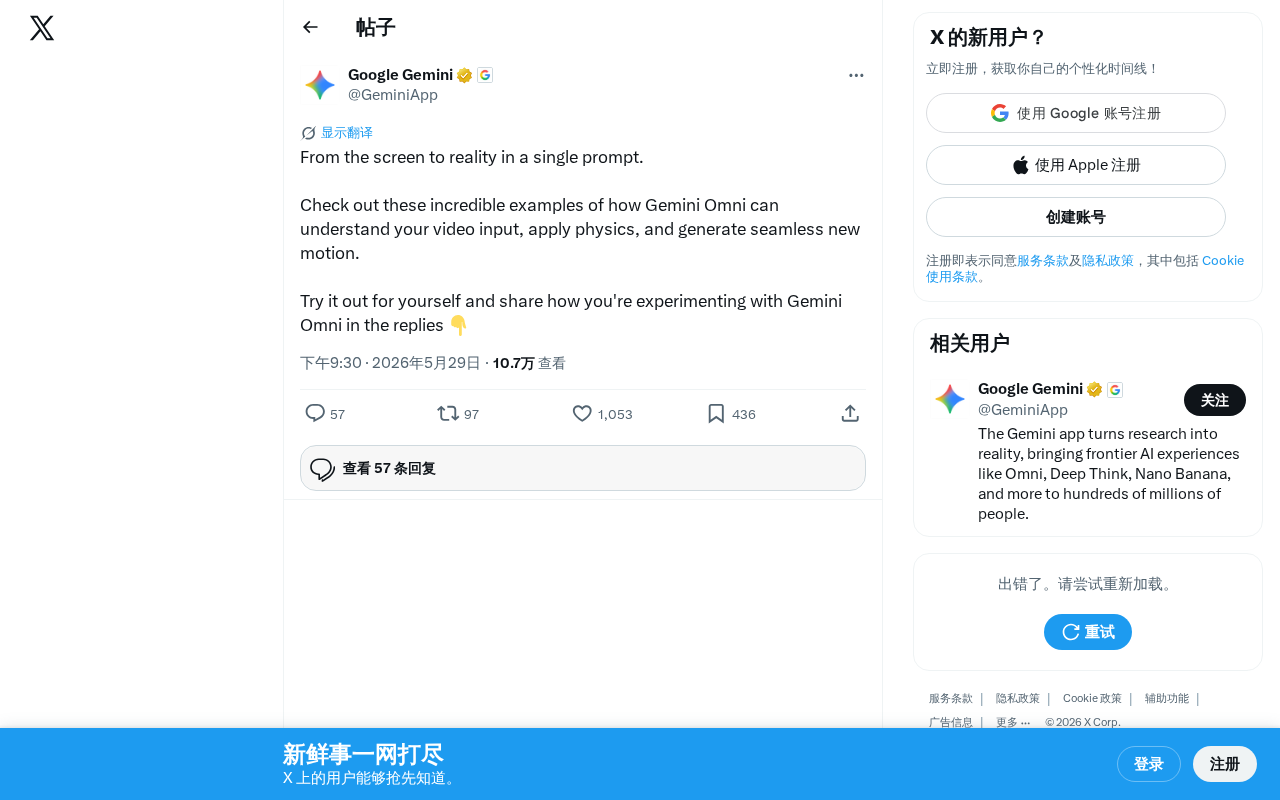
Gemini Omni achieves a breakthrough in video generation through physics-aware understanding
Google's latest multimodal model Gemini Omni takes video as input, understands the underlying physical laws including gravity, collisions, and fluid motion, and generates new motion sequences that are physically seamless with the original video. This marks an important evolution in AI video generation from "visual similarity" toward "physical correctness," with broad application potential in film VFX, game development, and educational demonstrations.
What Is Gemini Omni's Physics-Aware Video Generation
Gemini Omni is the latest multimodal model in Google's Gemini series, with its core breakthrough lying in deep understanding of video content. A Multimodal Large Language Model (Multimodal LLM) refers to an AI system capable of simultaneously processing multiple data modalities including text, images, audio, and video. Unlike approaches such as GPT-4V that "attach a vision encoder after the fact," the Gemini series jointly models multiple modalities from the training stage, giving it a deeper understanding of temporal relationships between video frames — the architectural foundation that enables Gemini Omni to handle complex motion information.
Unlike traditional image generation, Gemini Omni doesn't just "understand" what's happening in a video — it comprehends the underlying physical laws: how objects move, how forces are transmitted, and how actions continue.
Based on this understanding, the model can generate new motion sequences that are fully consistent with the original video in terms of physical logic. Google officially describes this process as "From the screen to reality," emphasizing the leap in physical realism of the generated content.
Core Technical Highlights
Video Input Understanding: Moving Beyond Pure Text-Driven Generation
Traditional AI video generation typically relies on text descriptions to create content, while Gemini Omni directly uses video as its input source. The model needs to extract complex information from continuous frame sequences — motion trajectories, velocity changes, object interactions — placing extremely high demands on the model's temporal understanding capabilities. This "understanding video through video" approach makes generated results more aligned with real-world scenarios.
Internalized Physics: More Than Pixel Extrapolation
Gemini Omni's most striking feature is its internalized understanding of physical laws. There are generally two paths for AI models to "internalize physics": one is to incorporate large amounts of synthetic video generated by physics simulation engines (such as MuJoCo, PhysX) into training data, allowing the model to implicitly master Newtonian mechanics through statistical learning; the other is to introduce explicit physics constraint modules into the model architecture. Gemini Omni currently leans toward the former approach — through mixed training on massive real-world physics videos and simulation data, the model forms implicit representations of concepts like gravity, friction, and elasticity in its latent space.
As a result, the model can identify physical phenomena in videos such as gravitational effects, collision rebounds, and fluid motion, maintaining consistency of these laws when generating new content. This isn't simple pixel-level extrapolation, but rather deep modeling based on understanding how the physical world operates.
Seamless Motion Continuity: Eliminating Discontinuities
Google emphasizes that the generated motion is "seamless" — there are no noticeable discontinuities between newly generated frames and the original video. Whether it's motion continuity, lighting consistency, or the naturalness of object deformation, everything achieves a high degree of unity.
Application Scenarios and Possibilities
The potential applications of this technology are extensive:
- Film VFX Previsualization: Directors can shoot a simple live-action video and let AI automatically extend it into physics-compliant VFX scenes
- Game Development: Rapidly generate in-game physics animations based on real motion capture video
- Educational Demonstrations: Extend classroom physics experiment videos to show motion changes under different conditions
- Product Design: Input motion videos of product prototypes to simulate performance under different materials and environments
Industry Significance and Competitive Landscape
Gemini Omni's capability marks AI video generation's evolution from "looking realistic" toward "being physically correct." Physical consistency has long been an unsolved core challenge in video generation. Take OpenAI's Sora as an example — while its Diffusion Transformer architecture achieved breakthroughs in visual quality, it still frequently exhibits "physics hallucinations" such as liquids disappearing without reason or rigid bodies passing through each other. The fundamental cause is that diffusion models essentially learn pixel distributions without modeling causal physical processes. By using video as conditional input rather than relying solely on text, Gemini Omni can theoretically use the motion dynamics from the original video as strong constraints, systematically reducing physical drift during generation.
Google's choice to focus on physics understanding demonstrates its differentiation strategy in the multimodal AI competition. By positioning physics understanding as a core selling point, Gemini Omni is poised to establish a unique advantage in professional creative fields.
How to Experience Gemini Omni
Google has already opened trial access to Gemini Omni, allowing users to directly upload videos and control generation results through prompts. Based on community feedback, this feature has a very low barrier to entry — one video plus one prompt can yield impressive results.
For creators and developers, now is an excellent time to explore the boundaries of this technology. As more users experiment and provide feedback, Gemini Omni's performance in physics-aware video generation deserves continued attention.
Key Takeaways
- Gemini Omni can understand physical motion laws from video input and generate seamlessly connected new dynamic sequences
- The core breakthrough lies in internalized understanding of physics, including consistent modeling of gravity, collisions, fluid motion, and other phenomena
- Generation requires only a single prompt plus video input, dramatically lowering the barrier to use
- Marks an important evolution in AI video generation from "visual similarity" toward "physical correctness"
- Has broad application potential in film VFX, game development, educational demonstrations, and other fields
Related articles
 Tech Frontiers
GitHub Agent HQ Launch: AI Coding Tools Enter the Era of Platform Competition
GitHub Universe unveils Agent HQ platform for unified coding agent management, Copilot upgrades with multi-model support. OpenAI completes restructuring, Anthropic tests new model, NVIDIA open-sources AI models.
 Tech Frontiers
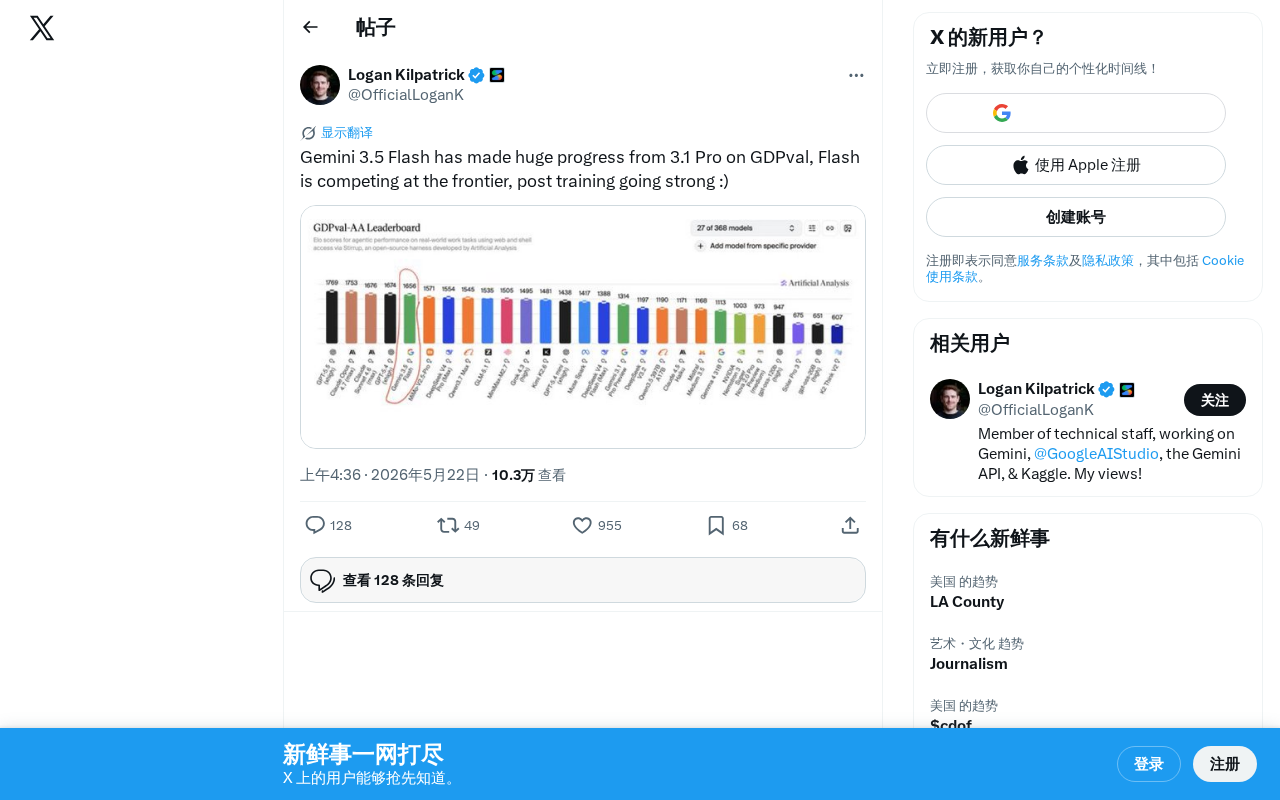
Gemini 3.5 Flash Achieves a Massive Leap on the GDPval Benchmark
Google Gemini 3.5 Flash surpasses Gemini 3.1 Pro on the GDPval benchmark. The lightweight Flash model leverages post-training techniques to approach frontier-level performance, redefining the balance between quality and cost.
 Tech Frontiers
Google Gemini Antigravity Weekly Quota Tripled — AI Coding Without Limits
Google Gemini triples Antigravity weekly quotas following a prior daily quota boost. Analyzing the impact on developers and its strategic significance in AI coding.