Gemma 4 12B: Google's Open-Weight Model Runs Locally on Your Laptop
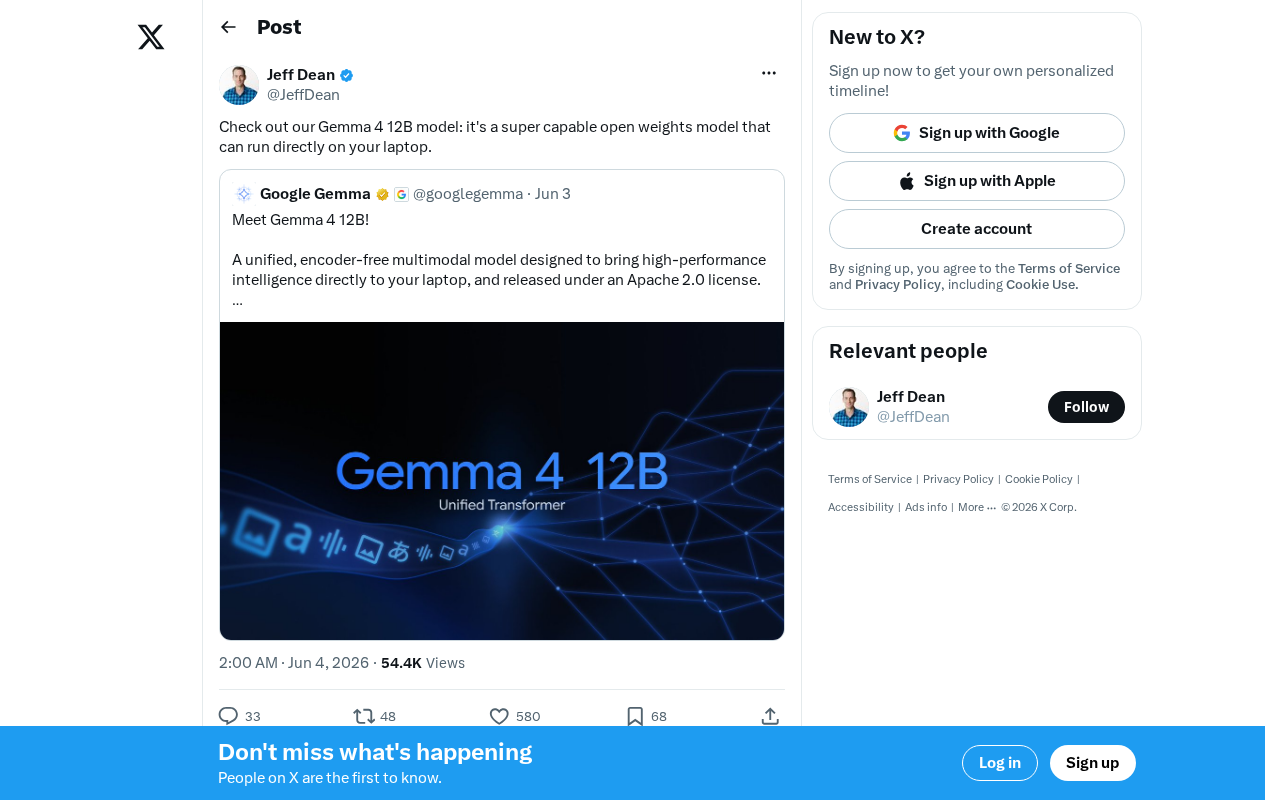
Google's Gemma 4 12B brings powerful open-weight AI to your laptop with just 12B parameters.
Google released Gemma 4 12B, an open-weight model that runs on consumer laptops thanks to its 12B parameter sweet spot. With 4-bit quantization reducing VRAM needs to 6-8GB, it enables private, zero-cost, offline AI inference. The release reflects Google's strategy to compete with Meta's Llama, Mistral, and Qwen in the open-source LLM race.
Gemma 4 12B: A New Benchmark for Open-Weight Models
Google has officially released the Gemma 4 12B model — an open-weight AI model with one standout feature: it can run directly on your laptop.
In an era where large models typically demand tens of gigabytes of VRAM and cloud infrastructure, a 12B-parameter model that runs on consumer hardware is a significant milestone for developers and researchers alike.
Why 12B Parameters Is the Sweet Spot for Local Deployment
The Optimal Balance Between Performance and Efficiency
The 12B parameter range is emerging as the "golden size" in the open-source community. Compared to 7B models, 12B delivers meaningful improvements in reasoning ability, knowledge breadth, and instruction following. Yet compared to 70B+ models, the hardware requirements drop dramatically — making local deployment a realistic option.
To understand why, consider the relationship between parameter count and hardware demands: in large language models, each parameter is essentially a learnable weight in the neural network. Stored in FP16 (half-precision floating point), 1B parameters require approximately 2GB of VRAM, putting a 12B model at roughly 24GB in FP16. However, with 4-bit quantization, memory requirements compress to around 6–8GB — well within the range of many consumer laptop GPUs (like the NVIDIA RTX 4060 with 8GB) or Apple Silicon's unified memory. This is precisely why 12B has become the sweet spot for local deployment.
According to Google's official positioning, Gemma 4 12B is described as "super capable," indicating leading performance within its parameter class. Given Google's sustained investment in training data quality and architectural optimization across the Gemma series, this claim has solid technical backing.
The Practical Value of Running on a Laptop
Running large models locally delivers multiple benefits for developers and everyday users:
- Privacy protection: Sensitive data never leaves your machine — all inference happens locally
- Zero latency: No network connection required for inference, resulting in faster response times
- Zero cost: No API call fees, making long-term usage more economical
- Customizability: Developers can freely fine-tune and adapt the model to build tailored solutions
These advantages are especially compelling in edge computing scenarios. Edge computing refers to processing data at or near the source — typical applications include offline voice assistants for smart homes, local preliminary screening of medical imaging (keeping patient data on-premises), real-time industrial quality inspection, and developer code assistants (where enterprise code never leaves the internal network). Models like Gemma 4 12B that run locally are bridging the critical gap from "cloud-based AI services" to "on-device AI capabilities."
The Strategic Thinking Behind Open Weights
The Competitive Landscape of Open-Source LLMs
Google's decision to release Gemma 4 12B with open weights continues the Gemma series' open strategy. With Meta's Llama series, Mistral, Qwen, and other open-source models competing fiercely, Google needs to consistently deliver high-quality open models to maintain its influence in the developer community.
It's worth noting that "open weights" is fundamentally different from fully open source. According to the OSI (Open Source Initiative) definition, true open source requires full reproducibility — including public training data, training code, and model weights. Open weights means only the final model parameter files are available for download and use; the training dataset composition, data cleaning pipelines, and specific training hyperparameters may not be fully disclosed. Google's Gemma series uses a custom Gemma license that permits commercial use and redistribution but includes certain usage restrictions. That said, for most developers, open weights are more than sufficient for deployment and fine-tuning needs.
The Technical Evolution of the Gemma Series
Gemma is Google DeepMind's open model family, built on Gemini's model architecture and training methodology. From early 2024's Gemma 1 (2B/7B) to Gemma 2 (2B/9B/27B), and now Gemma 4 12B, the series has undergone continuous architectural iteration. Gemma 2 introduced a hybrid mechanism alternating between local attention and global attention, along with efficiency optimizations like Group-Query Attention (GQA). Gemma 4 12B very likely inherits these architectural innovations while further scaling up training data volume and quality — Google's web index, academic papers, and code repositories represent a core competitive advantage in training high-quality models.
What Can Developers Do with Gemma 4 12B?
The release of Gemma 4 12B further lowers the barrier to AI application development. Developers can:
- Rapidly prototype and validate locally without configuring cloud environments
- Build offline AI applications suited for edge computing scenarios
- Perform domain-specific fine-tuning based on the open weights
- Integrate it into existing local development workflows
The Future of Local AI Deployment
As model compression techniques continue to advance and hardware capabilities keep improving, running high-quality AI models on consumer devices is transitioning from "barely usable" to "smooth experience."
Two key model compression techniques deserve deeper explanation here: Quantization is the process of reducing model weights from high precision (such as 32-bit FP32 or 16-bit FP16) to lower precision (such as INT8 or INT4), trading minimal accuracy loss for significant memory and computational efficiency gains. Currently, the GGUF format combined with inference frameworks like llama.cpp supports various quantization schemes from 2-bit to 8-bit. Knowledge Distillation uses a large model's (teacher model) outputs to train a smaller model (student model), enabling the smaller model to approximate the larger model's performance with fewer parameters. Gemma 4 12B itself likely incorporates knowledge distilled from larger-scale Gemini models — one of the technical foundations enabling its "super capable" performance at just 12B parameters.
The release of Gemma 4 12B is yet another strong validation of the local AI deployment trend. For developers interested in on-device AI, this model is worth evaluating immediately. We recommend following Google's official model card and benchmark results for a comprehensive understanding of Gemma 4 12B's specific performance across various tasks.
Key Takeaways
Related articles

Vibe Coding Beginner's Guide: A Complete Roadmap to Building Software with AI — No Coding Experience Required
Vibe Coding lets anyone build software using plain language instructions with AI. Learn what it is, when to use it, which tools to pick, and how to get started.

Beginner's Guide to Vibe Coding: Turn Ideas into Products with AI — No Coding Experience Required
Vibe Coding lets anyone build software products through natural language conversations with AI — no programming skills required. Learn the concept, top tools (Cursor, Claude Code, Codex), and how to get started.
Codex in Action: One Prompt, 47 Minutes, a Complete Algorithm Research Paper
Testing OpenAI Codex: one detailed prompt generates a complete algorithm paper in 47 minutes, including working code, figures, and LaTeX manuscript. Covers prompt design, quality assessment, and real submission experience.