Getting Started with AI Agent Development: A Complete Learning Path from Concepts to Practice
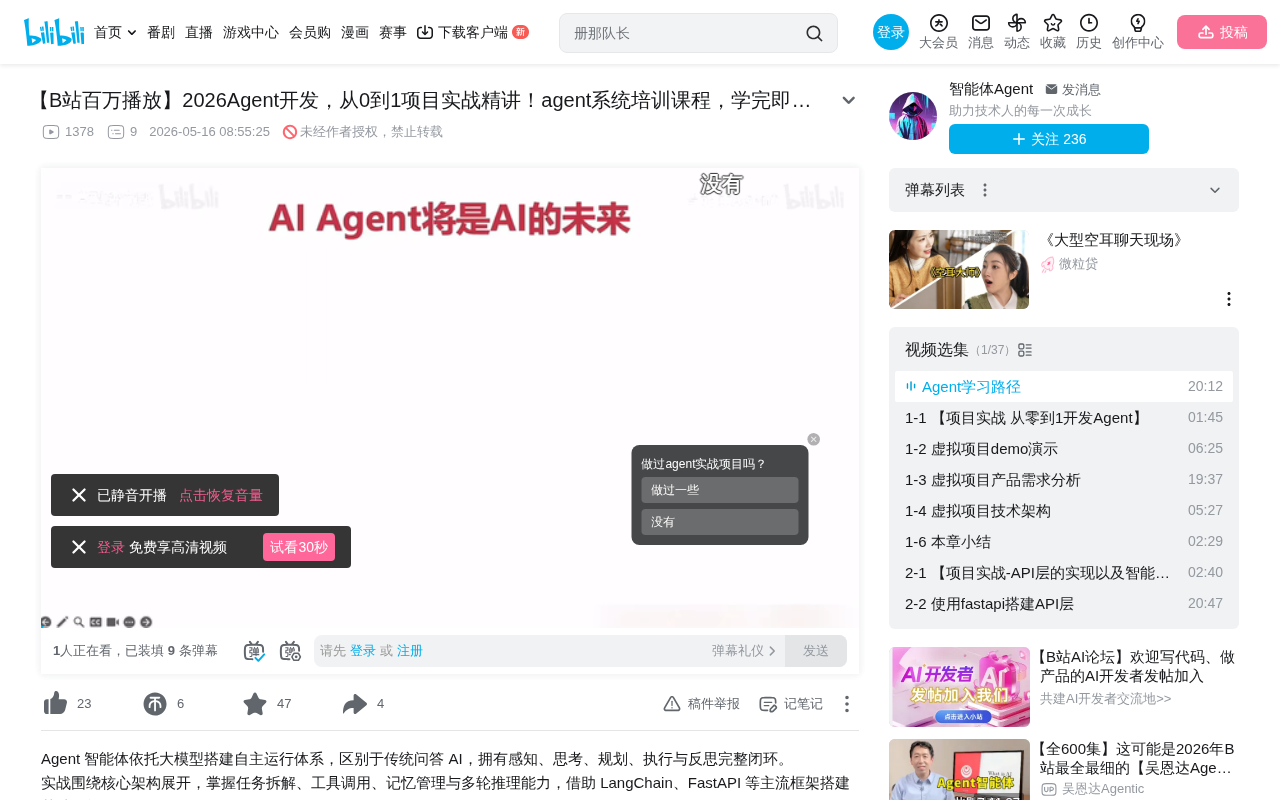
AI Agent is the next-gen AI form evolving from chat to action, with the market poised to explode.
This article explains how AI is evolving from chatbots to autonomous intelligent agents (AI Agents) capable of executing tasks independently. Bill Gates predicts all software will be rebuilt using the Agent paradigm within five years. The market is expected to grow at a 42.8% CAGR to $29 billion by 2028. The article outlines three challenges in learning Agent development and recommends a three-stage systematic approach: industry awareness, LangChain framework mastery, and hands-on project development.
AI's Next Form: From Chat to Action
When we talk about artificial intelligence, most people immediately think of chatbots like ChatGPT. But is chat really the ultimate form of AI?
Bill Gates stated clearly on his personal blog: Existing software forms are quite clumsy, and the future of software is intelligent agents (AI Agents). He believes that within five years, everyone will have their own intelligent assistant, and all software will be worth rebuilding using the Agent paradigm. This isn't a simple technological iteration—it's "the biggest revolution in computing since we went from typing commands to tapping on icons."
An AI Agent is an artificial intelligence system capable of autonomously perceiving its environment, making decisions, and executing actions. Unlike traditional chatbots that can only passively respond to user input, Agents possess goal-orientation, autonomous planning capabilities, and tool-use abilities. Their core architecture typically includes a perception module (receiving user instructions and environmental information), a reasoning module (thinking and planning based on large language models), a memory module (storing historical interactions and knowledge), and an action module (calling external tools to complete tasks). This architecture enables Agents to decompose complex tasks into multiple sub-steps, execute them sequentially, and adjust strategies based on feedback, achieving end-to-end task automation.
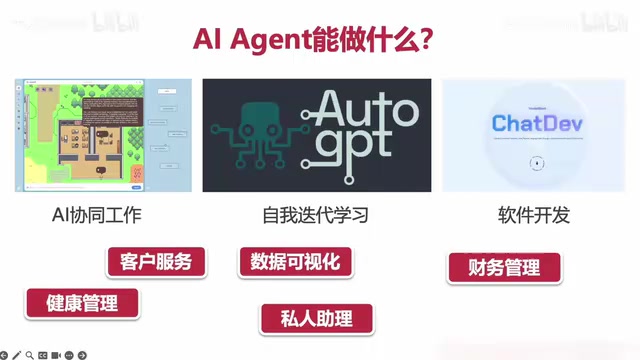
The core value of Agents lies in this: they evolve AI from "what it can tell you" to "what it can do for you." Imagine not needing to open different applications separately to draft documents, create spreadsheets, or send emails—you simply tell your device what you need in everyday language.
AI Agent Market Outlook and Typical Application Scenarios
Explosive Market Growth
According to Grand View Research, the autonomous AI Agent market was already valued at $3.9 billion in 2022 and is expected to expand at a compound annual growth rate (CAGR) of 42.8% from 2023 to 2030. Another report shows the market growing from $5 billion in 2023 to $29 billion by 2028.
Behind these numbers is strong demand for Agent technology across industries. From the surge in GitHub stars for open-source projects like AutoGPT to the rapid deployment of enterprise applications, Agents are experiencing an explosion similar to the early days of mobile internet.
AutoGPT is an open-source project released on GitHub in March 2023 that first demonstrated the possibilities of autonomous AI Agents to the public. Within just weeks of its release, the project garnered over 100,000 stars, becoming one of the fastest-growing projects in GitHub history. AutoGPT's core concept is letting GPT-4 autonomously set sub-goals, execute tasks, evaluate results, and iteratively improve without continuous human intervention. Subsequently, similar projects like BabyAGI, AgentGPT, and MetaGPT emerged, forming a thriving open-source Agent ecosystem. While these projects still have shortcomings in stability and practicality, they validated the feasibility of the Agent paradigm and laid the technical foundation for subsequent commercialization.
Typical Application Scenarios for AI Agents
Agent applications go far beyond chat. Here are several directions that have already been implemented:
- Software Development: The Stanford Smallville project and ChatDev demonstrated the possibilities of multi-Agent collaboration, writing code through verbal instructions
- Customer Service: LLM-based Agents can handle customer inquiries and provide personalized support, applicable to banking, e-commerce, and other industries
- Data Analysis: Transforming raw data into interactive charts, providing insights for market analysis, health data tracking, and other scenarios
- Business Consulting: Connecting to databases, automatically completing data cleaning and statistical analysis, directly outputting business reports
Generative Agents (Stanford Smallville) is a research project jointly published by Stanford University and Google Research in 2023. Researchers placed 25 AI Agents in a virtual sandbox environment, each with an independent identity background, memory system, and behavioral patterns. These Agents could autonomously carry out daily activities—waking up, making breakfast, going to work, socializing, and even spontaneously organizing parties. The project's breakthrough was proving that large language models combined with memory retrieval mechanisms can produce believable, human-like social behaviors. ChatDev further applied multi-Agent collaboration to software development scenarios, simulating the collaborative workflow of roles like CEO, CTO, programmers, and testers, completing the entire process from requirements analysis to code writing through natural language dialogue.
Unlike traditional AI tools, Agents are proactive—they can offer suggestions before users make requests, execute tasks across applications, and continuously improve their performance over time through interactions.
Three Major Challenges in Learning AI Agent Development
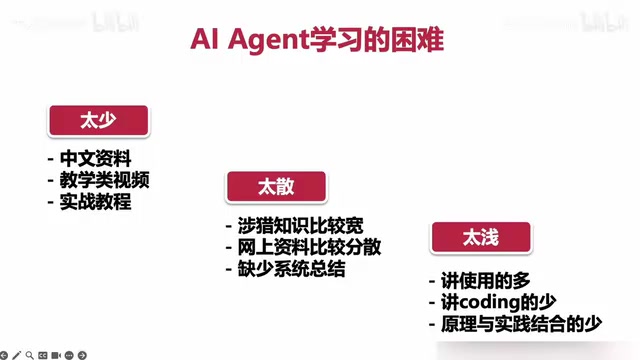
Scarcity of Chinese Learning Resources
Chinese learning materials are extremely scarce, while English resources update and evolve rapidly. According to surveys, over 60% of beginners consider finding high-quality, up-to-date learning materials their number one challenge.
Fragmented Knowledge Systems
Agent development involves multiple domains including large models, tool calling, vector databases, and AI engineering. Since the industry is still in its early stages, there's a lack of systematic knowledge consolidation, making it particularly difficult to build a complete knowledge framework.
Vector databases are database systems specifically designed for storing and retrieving high-dimensional vector data. In AI applications, unstructured data such as text, images, and audio are converted into numerical vectors of hundreds to thousands of dimensions through embedding models (such as OpenAI's text-embedding-ada-002). The distance between these vectors in mathematical space reflects the semantic similarity of the original data. Traditional databases excel at exact match queries, while vector databases excel at "semantic similarity search"—finding results closest in meaning to the query content, even if they are completely different in literal terms. Major vector databases include Pinecone (cloud-native), Milvus (open-source distributed), Weaviate, and Chroma (lightweight), which use approximate nearest neighbor algorithms like HNSW and IVF to achieve millisecond-level large-scale vector retrieval.
Limited Practical Opportunities
Most courses on the market remain at the level of "how to use tools" or "how to build business models," lacking content that combines theory with actual coding. Resources that truly provide hands-on projects are rare, making it extremely difficult to validate theoretical knowledge through application.
A Three-Stage Path for Systematically Learning AI Agent Development
A complete Agent development learning path typically consists of three major parts:
Stage One: Industry Awareness and Technology Selection
Start with the development history of large models, explore mainstream models on platforms like Hugging Face, understand the limitations of current models, and then introduce solutions like fine-tuning and LangChain. You also need to master the complete pipeline from papers and algorithms to applications in the AIGC industry.
Stage Two: Deep Dive into the LangChain Framework
LangChain is an open-source framework created by Harrison Chase in October 2022, designed to simplify application development based on large language models. Its core design philosophy is "chain composition"—modularizing capabilities like model calls, prompt engineering, external tools, and data retrieval so developers can combine these modules like building blocks to construct complex applications. LangChain quickly became the de facto standard for LLM application development, and its parent company LangChain Inc. raised over $25 million in funding in 2023. The framework supports both Python and JavaScript, and its ecosystem includes supporting tools like LangSmith (debugging and monitoring) and LangServe (deployment). For Agent development, LangChain provides a complete Agent execution framework, including the ReAct reasoning pattern, tool registration mechanisms, and various memory management solutions.
Using LangChain as an example, you need to systematically master its seven core modules:
- Model I/O concepts and local environment setup
- Prompt Template applications
- Knowledge base construction and Retrieval-Augmented Generation (RAG)
- Text splitting and vector databases
- Agent tool calling and chain-of-thought reasoning
RAG (Retrieval-Augmented Generation) is a key technology for addressing the knowledge limitations of large language models. LLM training data has a cutoff date and cannot cover all domain-specific knowledge, so direct answers may produce "hallucinations" (fabricating non-existent information). RAG works as follows: enterprise documents and knowledge bases are first split into text chunks, converted into vectors through an Embedding Model, and stored in a vector database. When a user asks a question, the system first retrieves the most relevant text fragments from the vector database, then feeds these fragments as context along with the user's question into the large model, generating accurate answers based on real data. This approach preserves the language generation capabilities of large models while ensuring factual accuracy and timeliness of responses.
Stage Three: Agent Hands-on Project Development

Put theory into practice through complete virtual projects. A typical AI Agent project should possess the following capabilities:
- Independent personality and memory system
- Tool-calling abilities such as real-time search
- Integration with external systems like email and SMS
- RAG capabilities for continuous domain knowledge learning
- Voice synthesis and emotion detection
- Multi-platform deployment and engineering practices
Why Now Is the Best Time to Learn AI Agent Development
The importance of mastering Agent technology today is comparable to learning web development in the PC era or mastering app development in the mobile era. Several key signals:
- Significant salary premium: According to Indeed reports, AI-related positions average 20%-30% higher annual salaries than traditional tech roles, with Agent development positions being particularly prominent
- Strong cross-industry demand: Applications extend from internet companies to manufacturing, healthcare, financial services, and other sectors
- Maturing infrastructure: The foundational work of large models and computing power is gradually being completed, and the application layer is about to explode
- The global AI market continues to expand, with Agents set to occupy a significant share
For practitioners with industry experience and data assets, learning Agent development allows them to combine their business advantages to develop intelligent applications in vertical domains, achieving business multiplication. Whether you're an application developer, product manager, entrepreneur, or a traditional developer looking to transition, Agent development offers a clear path for technical advancement.
AI won't replace people—it will replace people who don't know how to use AI. During this window of technological transformation, building your Agent development knowledge system and practical capabilities as early as possible will lay a solid foundation for long-term career growth.
Key Takeaways
- AI Agent is the next form of artificial intelligence; Bill Gates predicts all software will be rebuilt using the Agent paradigm within five years
- The Agent market is expected to expand at a 42.8% CAGR, growing from $5 billion in 2023 to $29 billion by 2028
- Learning Agent development faces three major challenges: scarce Chinese-language resources, fragmented knowledge systems, and limited practical opportunities
- A systematic learning path includes three parts: industry awareness, framework deep-dive (e.g., LangChain), and hands-on project development
- The importance of mastering Agent technology today is comparable to learning web development in the PC era or app development in the mobile era
Related articles
 Tutorials
Cursor + Codex Dual-IDE Collaboration: A Practical Methodology for Open-Source Project Customization
A complete methodology for open-source project customization based on real-world experience, detailing the Cursor+Codex dual-IDE workflow, seven-stage process, MVP validation, and AI source code reading techniques.
 Tutorials
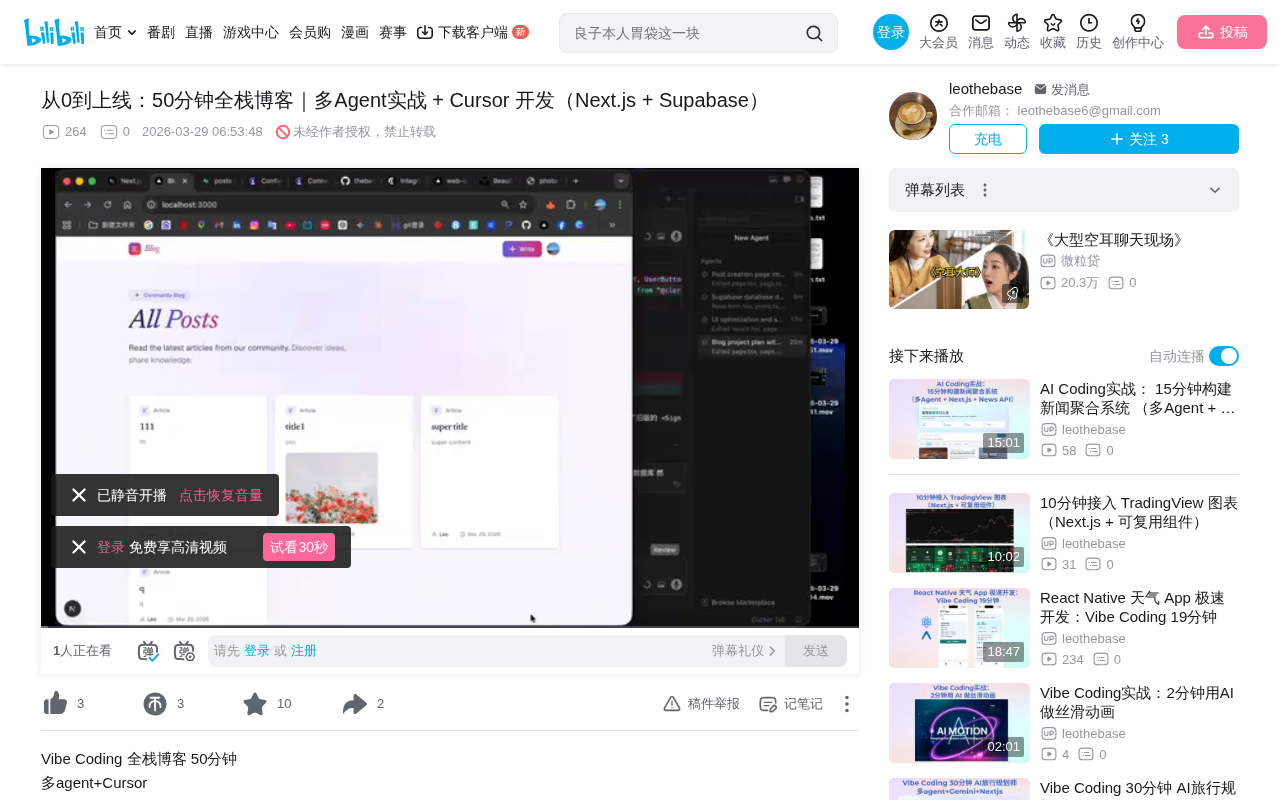
Cursor Multi-Agent in Practice: Building a Full-Stack Next.js Blog in 50 Minutes
Build a full-stack blog in 50 minutes using Cursor IDE's multi-Agent mode with Next.js, Clerk auth, and Supabase. Learn the 4-phase AI Agent workflow and key integration pitfalls.
 Tutorials
Building an AI Software Factory from Scratch: A Cursor Engineer's Hands-On Experience with Multi-Agent Collaboration
Cursor engineer Eric shares practical insights on building an AI software factory: automation levels, guardrail design, parallel Agent management, and scaling to 1000+ Agents for 24/7 development.