Getting Started with Coze: A Complete Guide to Building AI Agents from Scratch

A beginner's guide to Coze platform's AI agents and AI applications with key concepts explained
Coze is a no-code/low-code AI application development platform by ByteDance, offering two core products: AI Agents and AI Applications. AI Agents use conversation-based interaction with the ReAct framework to enable perception-reasoning-action loops, while AI Applications overlay an LLM understanding layer onto traditional software architecture with complete graphical interfaces. Both rely on large model technology, with the key difference being their interaction methods—and they can be combined in practice.
What is the Coze Platform
Coze is a next-generation AI application development platform launched by ByteDance. Its core mission is to lower the barrier to AI application development. Whether or not you have a programming background, you can build various AI applications powered by large language models on Coze.
The platform provides visual orchestration tools that support no-code or low-code application building. Once built, you can publish your applications to social platforms and messaging apps like WeChat and Doubao, or integrate them into your own business systems via API or SDK.
Industry Background on Low-Code/No-Code Platforms
Low-Code and No-Code platforms represent a major trend in software development in recent years. Traditional application development requires developers to master programming languages, databases, server architecture, and other specialized skills—an extremely high barrier to entry. Low-code platforms compress development cycles from months to days or even hours through visual drag-and-drop interfaces, pre-built components, and templates. Gartner predicts that by 2025, 70% of new applications will be built using low-code or no-code technologies. Coze extends this philosophy into the AI domain, enabling ordinary users to "assemble" applications with intelligent capabilities—representing an important direction in the democratization of AI tools.
For students preparing for the Teacher Qualification Exam, Coze has become an important knowledge point in AI-related exam content. Understanding the concepts of AI agents and AI applications, along with their differences, forms the foundation for mastering this field.
Two Core Products on Coze: AI Agents and AI Applications
The Coze platform primarily offers two types of products: AI Agents and AI Applications. While both rely on large language model technology at their core, they differ fundamentally in interaction methods and use cases.
AI Agents: Conversation-Based AI Projects
An AI agent is a conversation-based AI project. Its workflow can be summarized in three steps:
- Receive Input: The user enters a question or request in the chat box
- Process and Analyze: The large model invokes plugins, workflows, and other tools to analyze user needs and execute business processes
- Generate Response: Returns the processed results to the user in conversational form
You can think of an AI agent as a "virtual person"—you ask it questions, it thinks, and then gives you answers. Typical use cases include intelligent customer service and personal assistants. For example, a "synthesize new elements" agent only requires users to describe their needs in the chat box, and the agent will automatically invoke relevant tools to complete the task and return results.
The Technical Relationship Between Large Models and AI Agents
A Large Language Model (LLM) serves as the "brain" of an AI agent, but a standalone LLM can only generate text—it cannot proactively execute tasks. The core value of an Agent lies in equipping the LLM with "hands and feet"—calling external APIs through Plugins to obtain real-time data, orchestrating multi-step task execution logic through Workflows, and saving contextual information through Memory Modules. This architecture is known as the "ReAct" framework (Reasoning + Acting), which enables the model to take action while reasoning. This is the mainstream technical paradigm in the current AI Agent field. It is precisely this closed loop of "perception—reasoning—action" that makes AI agents far more powerful than ordinary chatbots.
AI Applications: Intelligent Programs with Complete Interfaces
AI applications are closer to the software systems we use daily. They have comprehensive business logic and visual user interfaces, complete with various menus, buttons, and functional modules. What distinguishes them from traditional applications is that AI applications integrate large model technology at their core, giving them intelligent capabilities.
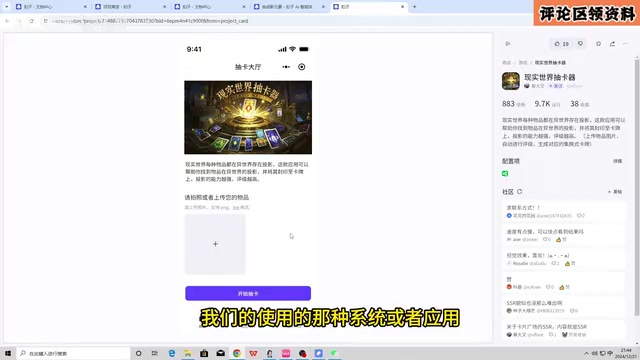
Common AI applications include AI translation tools, intelligent note-taking apps, and more. Users interact through graphical interfaces rather than pure Q&A conversations.
The Fundamental Difference Between AI Applications and Traditional Software
Traditional software relies on hard-coded rules and fixed business logic, often struggling with ambiguous inputs or edge cases. The revolutionary aspect of AI applications is the introduction of large models as an "understanding layer," enabling software to process natural language input, understand user intent, and make reasonable judgments beyond predefined rules. For example, traditional translation software relies on dictionaries and grammar rules, while AI translation tools can understand context, grasp tone, and even perform cultural adaptation. This "software + intelligence" fusion model is redefining application forms across industries—AI applications don't replace traditional software but rather overlay cognitive and reasoning capabilities onto existing interaction frameworks.
Key Differences Between AI Agents and AI Applications
Understanding the differences between these two is a critical knowledge point for both exam preparation and practical application:
| Dimension | AI Agent | AI Application |
|---|---|---|
| Interaction Method | Q&A conversation format | Graphical interface operation |
| User Interface | Primarily chat box | Complete UI with menus, buttons, etc. |
| Typical Scenarios | Intelligent customer service, personal assistants | AI translation, intelligent note-taking |
| Underlying Technology | LLM + Plugins + Workflows | LLM + Complete business logic |
| Technical Paradigm | ReAct framework: perception-reasoning-action | Traditional software architecture + LLM understanding layer |
In simple terms, an AI agent is like having a conversation with an expert, while an AI application is like using intelligent software. The two are not opposing concepts but rather solutions for different scenarios. In actual products, they can also be combined—a functional module within an AI application can perfectly embed an AI agent to handle complex natural language interaction needs.
How to Get Started with Coze as a Complete Beginner
For users with absolutely no programming background, the following progressive learning path is recommended:
- Understand Basic Concepts: First, clarify the meanings and relationships of core concepts like large models, AI agents, plugins, and workflows
- Experience Existing Agents: Try out agents built by others on the Coze platform to intuitively feel the interaction patterns
- Build Simple Projects Hands-On: Use the platform's visual tools to start practicing with the simplest Q&A agents
Coze's design philosophy is to enable non-technical users to build AI applications, so the learning curve for its visual orchestration tools is relatively gentle. The key is to practice frequently and deepen your understanding of concepts through hands-on experience. It's worth noting that even on a no-code platform, understanding the underlying "plugin—workflow—model" collaboration logic will help you design more reasonable and stable AI application architectures.
Final Thoughts
As AI technology penetrates deeper into the education sector, low-code AI platforms like Coze have evolved from an "optional skill" to "essential knowledge." For Teacher Qualification Exam candidates, understanding the concepts and differences between AI agents and AI applications is not only an exam requirement but also a practical skill that may prove useful in future teaching work. I recommend supplementing theoretical study with hands-on experience on the Coze platform to transform abstract concepts into concrete understanding.
Key Takeaways
- Coze is a no-code/low-code AI application development platform launched by ByteDance that requires no programming background, aligning with the global low-code development trend
- The platform offers two core products: AI Agents (conversation-based interaction) and AI Applications (graphical interface interaction)
- AI agents work through Q&A format, employing the ReAct framework at their core to give LLMs "perception—reasoning—action" capabilities, with typical scenarios including intelligent customer service and personal assistants
- AI applications overlay an LLM "understanding layer" onto traditional software architecture, enabling software to handle ambiguous inputs and natural language, with complete visual interfaces and business logic
- Both rely on large model technology at their core; the key difference lies in interaction methods, and they can be combined in actual products
- Complete beginners can get started quickly through a three-step path: understanding concepts, experiencing existing projects, and building hands-on
Related articles
 Tutorials
Cursor + Codex Dual-IDE Collaboration: A Practical Methodology for Open-Source Project Customization
A complete methodology for open-source project customization based on real-world experience, detailing the Cursor+Codex dual-IDE workflow, seven-stage process, MVP validation, and AI source code reading techniques.
 Tutorials
Cursor Multi-Agent in Practice: Building a Full-Stack Next.js Blog in 50 Minutes
Build a full-stack blog in 50 minutes using Cursor IDE's multi-Agent mode with Next.js, Clerk auth, and Supabase. Learn the 4-phase AI Agent workflow and key integration pitfalls.
 Tutorials
Building an AI Software Factory from Scratch: A Cursor Engineer's Hands-On Experience with Multi-Agent Collaboration
Cursor engineer Eric shares practical insights on building an AI software factory: automation levels, guardrail design, parallel Agent management, and scaling to 1000+ Agents for 24/7 development.