Getting Started with LangChain for Enterprise Development: Core Modules and Debugging Tools Explained
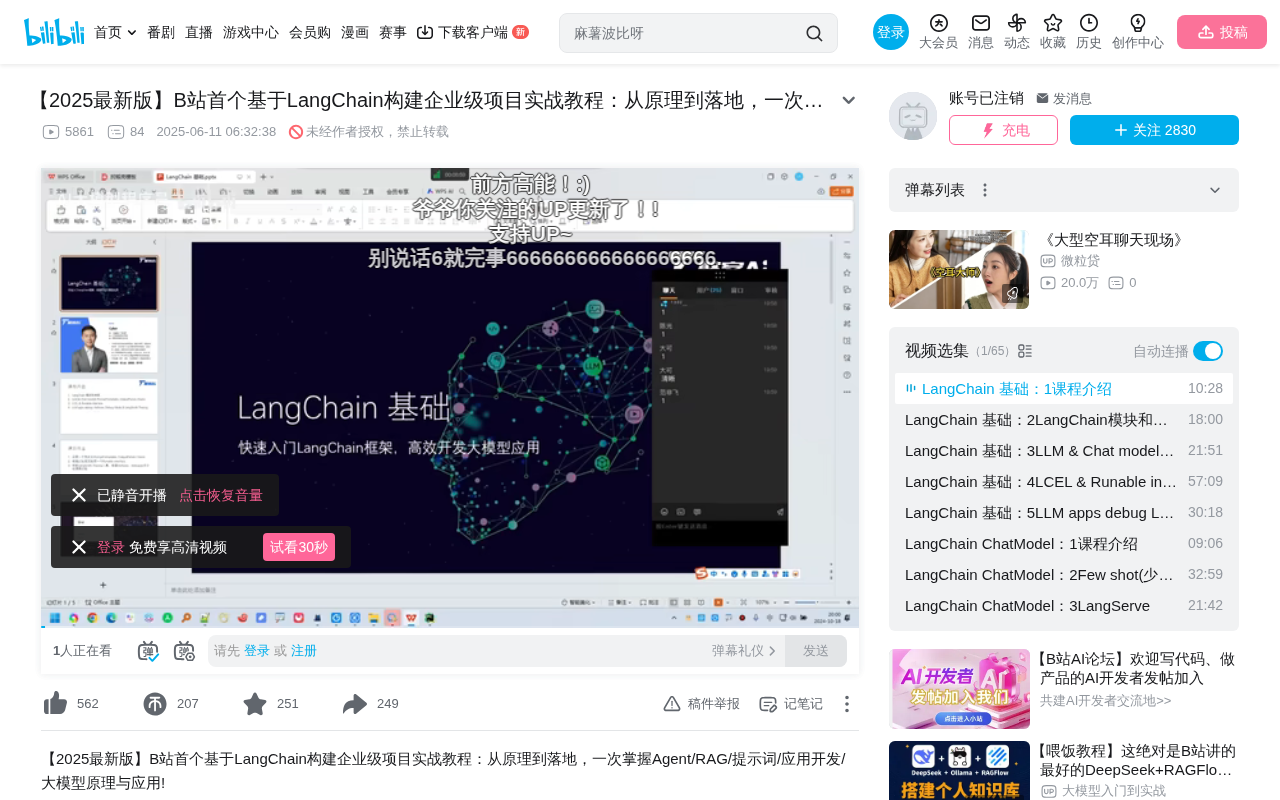
A systematic overview of LangChain's core modules and development debugging methods.
LangChain is the mainstream framework for LLM application development, reducing complexity through modular design with prompt templates, output parsers, and Chain invocations. LCEL expression language unifies component orchestration via the Runnable protocol, while LangSmith provides distributed tracing for debugging and performance monitoring, forming a complete toolchain from development to operations.
Overview
As the mainstream framework for LLM application development, LangChain serves a role similar to the Spring framework in the Java ecosystem — by encapsulating LLM interfaces, Agents, prompt templates, and other components, it significantly reduces development complexity. Open-sourced by Harrison Chase in October 2022, LangChain quickly became one of the most popular frameworks in the field, with over 90k GitHub stars. Its creation was motivated by the fact that while providers like OpenAI offer powerful APIs, building complex applications by calling these APIs directly requires developers to handle prompt management, context maintenance, multi-model orchestration, tool invocation, and other repetitive tasks on their own. LangChain abstracts these common capabilities into standardized components, forming a complete ecosystem that includes LangChain Core, LangChain Community, LangGraph, and LangSmith, covering the full lifecycle from prototype validation to production deployment.
This article, based on a practical video tutorial series on Bilibili, systematically covers LangChain's core module system and development debugging methods to help developers quickly build a comprehensive understanding.
Core Module Analysis
Prompt Templates
LangChain componentizes prompt engineering, allowing developers to manage and reuse prompts through templates rather than manually concatenating strings each time. Compared to hand-writing prompts with raw API calls, code maintainability improves dramatically.
Prompt Engineering is one of the most critical aspects of LLM application development — prompt quality directly determines the accuracy and usability of model output. In real projects, a prompt often includes system role definitions, contextual information, Few-shot Examples, output format constraints, and more. Manually concatenating strings is error-prone and difficult to reuse or test. LangChain's prompt templates decouple these parts into independent, composable units, supporting various template types like ChatPromptTemplate and FewShotPromptTemplate, allowing developers to assemble complex prompt structures like building blocks.
Key advantages of prompt templates:
- Support variable interpolation for dynamically generating prompts for different scenarios
- Facilitate team collaboration and version management
- Seamlessly integrate with other modules to form complete processing pipelines
Output Parsers
Output Parsers are responsible for formatting the text returned by LLMs into structured data (JSON, XML, Markdown, etc.). Similar to a JSON Parser in Java, LangChain's Output Parser automatically handles response parsing and type conversion, eliminating the tedious work of manually processing unstructured text.
LLM raw output is natural language text, but downstream business systems typically require structured data. LangChain provides multiple built-in parsers, including PydanticOutputParser (based on Python's Pydantic data validation library, mapping output directly to strongly-typed objects), JsonOutputParser, CommaSeparatedListOutputParser, and more. Crucially, Output Parsers not only handle parsing but also automatically generate Format Instructions that are injected into prompts, guiding the LLM to output in the expected format — forming a closed-loop mechanism of "constraint → generation → parsing." When parsing fails, OutputFixingParser can be used for automatic repair and retry, greatly improving system robustness.
Chain (Chained Invocation)
LangChain supports a chaining style similar to Java's Stream API, linking multiple processing steps through method chains for cleaner, more intuitive code. Chain is the core design philosophy of LangChain and the origin of the framework's name.
The Chain design draws from the Pipeline pattern in functional programming. Earlier versions of LangChain used explicit Chain classes like LLMChain and SequentialChain to orchestrate call flows. As the framework evolved, these traditional Chain classes have been gradually replaced by LCEL syntax, but the core idea of "chained composition" remains central to the framework's design. In practice, a typical Chain might include: document retrieval → context injection → model inference → result formatting in a RAG (Retrieval-Augmented Generation) scenario, where each step is an independent, testable unit connected through Chains to form an end-to-end processing pipeline.
LCEL: LangChain Expression Language
LCEL (LangChain Expression Language) is an expression language specification provided by LangChain, with the Runnable Interface at its core. It defines the interface specification for chained invocations, and developers write streaming calls and component orchestration code following this syntax.
The Runnable protocol defines unified interfaces including invoke (synchronous), ainvoke (asynchronous), stream (streaming output), astream (async streaming), and batch (batch processing). Any component implementing the Runnable protocol can be composed using the pipe operator |, for example: chain = prompt | llm | output_parser. This design borrows from Unix pipe philosophy, making data flow between components extremely intuitive. LCEL also supports advanced orchestration primitives like RunnablePassthrough (data pass-through), RunnableParallel (parallel execution), and RunnableLambda (custom function wrapping), capable of expressing complex topologies including branching, parallelism, and conditional routing.
LCEL's design goals include:
- Unifying the invocation protocol between components
- Supporting streaming output and async execution
- Simplifying orchestration logic for complex chains
Think of LCEL as similar to template expression syntax in frontend frameworks — mastering it is key to using LangChain effectively.
LangSmith: Tracing and Debugging
Why Tracing Is Needed
In complex LangChain applications, a single request may involve:
- Multiple LLM calls
- Tools execution
- Agent decision chains
- Function Calling
These components are deeply nested, with chains potentially spanning dozens of steps, making troubleshooting extremely difficult. Without observability tools, debugging LLM applications is like groping in a black box.
Debugging LLM applications is far more challenging than traditional software systems due to their non-deterministic nature: the same input may produce different outputs, intermediate steps involve natural language processing, and errors are often semantic deviations rather than program exceptions. In Agent scenarios, models autonomously decide which tools to call and in what order, forming dynamic execution paths that render traditional breakpoint debugging nearly useless. Function Calling is a mechanism provided by OpenAI and other providers that allows models to declare the need to call external functions during inference, with the framework handling actual execution and returning results to the model for continued reasoning — this multi-turn interaction further increases chain complexity.
LangSmith Core Features
LangSmith is LangChain's official distributed tracing system, functionally similar to SkyWalking or Zipkin in the Java microservices ecosystem. In Java microservices, SkyWalking and Zipkin achieve distributed tracing by passing TraceIDs between services, allowing developers to view which services a request passed through, along with each service's latency and status in a visual interface. LangSmith applies the same concept to LLM call chains.
After registering at smith.langchain.com (supports Google accounts, approximately 1000 free calls per month), you can:
- View complete call chains: Each call generates a Trace containing multiple Spans (such as Prompt rendering, LLM calls, Tool execution), with each Span recording complete input/output, token consumption, latency, and cost estimates
- Identify performance bottlenecks: For example, discovering that a search took 3.81 seconds and quickly identifying slow nodes
- Troubleshoot errors: Precisely locate which step has problematic payloads, avoiding blind investigation
- Dataset management and automated evaluation: Developers can build test case sets for regression testing of model outputs, which is particularly important during prompt iteration and optimization
Debug Configuration
LangChain's Debug mechanism is similar to log level configuration in Java (like Log4j's DEBUG/INFO/WARN), outputting debug information at corresponding detail levels. During local development, properly configuring Debug levels significantly improves problem diagnosis efficiency. LangChain provides two configuration methods: set_debug(True) as a global switch and set_verbose(True) for verbose mode — the former outputs complete input/output logs for all components, while the latter focuses on summary information at key nodes. In production environments, it's recommended to disable Debug mode and rely on LangSmith for remote tracing to avoid performance impacts from excessive logging.
Summary
LangChain lowers the barrier to LLM application development through modular design. Combined with LCEL expression language and LangSmith tracing tools, it forms a complete toolchain from development to operations. For developers with Java/Spring backgrounds, prompt templates correspond to configuration management, Chains correspond to the pipeline pattern, and LangSmith corresponds to distributed tracing — these concepts all have familiar counterparts, making the learning curve relatively gentle.
It's worth noting that the LangChain ecosystem is still evolving rapidly. LangGraph, as the next-generation Agent orchestration framework, has gradually become the recommended solution for building complex Agent applications. Based on a directed graph state machine model, it offers more flexible control flow management compared to traditional Chains. Developers are advised to stay current with LangGraph and LangSmith developments after mastering LangChain's core concepts, to address increasingly complex LLM application scenarios.
Key Takeaways
- LangChain simplifies application development by encapsulating LLM interfaces and components, similar to Spring for Java
- LCEL (LangChain Expression Language) provides the Runnable Interface to standardize chained invocations, supporting pipe operator composition
- LangSmith is the official tracing tool for identifying performance bottlenecks and troubleshooting complex call chains
- Output Parsers enable structured format conversion of LLM output, supporting automatic format instruction injection and parse failure recovery
- LangGraph, as the next-generation Agent orchestration framework, is becoming the recommended solution for complex Agent applications
Related articles
 Tutorials
Cursor + Codex Dual-IDE Collaboration: A Practical Methodology for Open-Source Project Customization
A complete methodology for open-source project customization based on real-world experience, detailing the Cursor+Codex dual-IDE workflow, seven-stage process, MVP validation, and AI source code reading techniques.
 Tutorials
Cursor Multi-Agent in Practice: Building a Full-Stack Next.js Blog in 50 Minutes
Build a full-stack blog in 50 minutes using Cursor IDE's multi-Agent mode with Next.js, Clerk auth, and Supabase. Learn the 4-phase AI Agent workflow and key integration pitfalls.
 Tutorials
Building an AI Software Factory from Scratch: A Cursor Engineer's Hands-On Experience with Multi-Agent Collaboration
Cursor engineer Eric shares practical insights on building an AI software factory: automation levels, guardrail design, parallel Agent management, and scaling to 1000+ Agents for 24/7 development.