Getting Started with Spring AI: How Java Developers Can Integrate Large Language Models

Spring AI is Java's LangChain, enabling developers to build LLM apps with Spring Boot conventions.
Spring AI is a large model interaction framework for Java developers, similar to Python's LangChain, deeply integrated with Spring Boot's design philosophy. It offers six core features: multi-model and multimodal support, unified abstract API with structured output, Chat Memory, vector storage and RAG, Tool Calling with MCP protocol compatibility, and observability. It requires JDK 17+ and Spring Boot 3.x+. While Python remains the mainstream for AI development, Spring AI provides unique seamless integration advantages for enterprises with Java technology stacks.
Introduction: Why Should Java Developers Pay Attention to Spring AI?
In the world of AI large model application development, Python's LangChain is practically the de facto standard. But for the massive Java developer community, is there an equally elegant framework for integrating with large language models? The answer is Spring AI.
Spring AI can be understood as the LangChain of the Java world — it enables Java developers to rapidly build applications that interact with large models using the familiar Spring Boot style. This article systematically covers Spring AI's core features, environment setup essentials, and its positioning in enterprise applications.
What Is Spring AI?
Positioning: A Large Model Interaction Framework for the Java Ecosystem
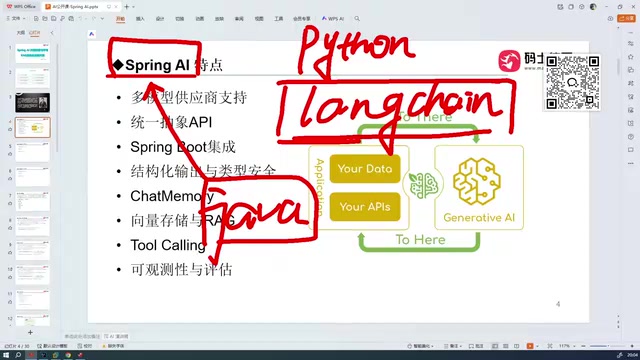
If you're familiar with the Python ecosystem, LangChain needs no introduction. LangChain was born in October 2022, created by Harrison Chase, and quickly became one of the most popular frameworks in AI application development. Its core philosophy is to modularize LLM invocation, prompt management, memory, tool calling, and other capabilities, combining them into complex AI workflows through "chain" composition. Spring AI was initiated in 2023 by the Spring team under VMware (now Broadcom), with its design philosophy directly inspired by LangChain's modular approach, but switching the implementation language from Python to Java while deeply adhering to Spring's "convention over configuration" principle.
What Spring AI does is essentially the same as LangChain, except it's designed for Java developers. Specifically, Spring AI enables you to interact with large models using Java code, covering capabilities that go beyond text conversations to include multimodal operations.
Multimodal refers to AI models' ability to simultaneously process and understand multiple types of data input, including text, images, audio, video, and more. New-generation large models like GPT-4V and Claude 3 natively support multimodal capabilities — from a technical standpoint, multimodal models encode different modalities of data into the same vector space, enabling the model to understand semantic correlations across modalities. Spring AI's multimodal support means developers can use a unified API interface to send mixed image+text inputs to models without worrying about the underlying multimodal implementation differences between different models, covering capabilities like image recognition, speech processing, and text-to-speech.
Deep Integration with the Spring Ecosystem
Spring AI's greatest advantage is that it's not a standalone framework but is deeply integrated into the Spring family's design philosophy:
- Auto Configuration: Just like Spring Boot, you can connect to large models through annotations and configuration files
- Unified Abstract API: Differences between various LLM providers are encapsulated at the lower level, keeping upper-layer code consistent
- Externalized Configuration: Model parameters, API Keys, and other configuration items can be managed uniformly through
application.yml
If you're very familiar with Spring Boot, the learning curve for Spring AI is extremely low. This seamless integration with existing technology stacks is Spring AI's core competitive advantage.
Six Core Features of Spring AI
1. Multi-Model and Multimodal Support
Spring AI supports mainstream LLM providers, including OpenAI, Anthropic Claude, and China's DeepSeek, among others. While the number of supported models still lags behind LangChain, mainstream models are basically all covered, with simultaneous multimodal capability support.
2. Unified Abstract API and Structured Output
This is an extremely practical feature of Spring AI. When conversing with large models, the returned content can be automatically encapsulated into Java objects — the framework natively supports JSON-formatted return data and can directly map it to POJOs, achieving type-safe structured output.
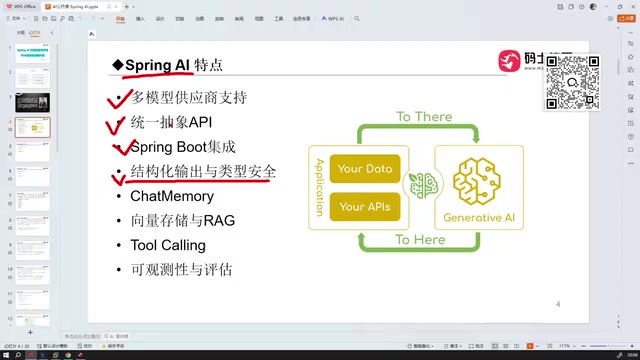
This means you don't need to manually parse the text returned by large models — the framework handles the conversion from unstructured text to structured data for you. It's worth noting that modern language features introduced in JDK 17, such as Records (immutable data classes) and Pattern Matching, are extensively used by Spring AI to implement this type-safe structured output, which is one of the key reasons the framework requires JDK 17+.
3. Chat Memory
When conducting multi-turn conversations with large models, how to make the model "remember" chat history is a critical issue. Spring AI provides a Chat Memory mechanism:
- In-memory storage: The default approach, suitable for development and debugging
- Database persistence: Stores conversation history in a database, suitable for production environments
It's important to note that Chat Memory is not enabled by default and requires manual configuration by the developer.
4. Vector Storage and RAG
RAG (Retrieval-Augmented Generation) is the core technical solution for addressing large model "hallucination" issues and knowledge timeliness problems, and is one of the most critical technical approaches in enterprise AI applications today. Its workflow is divided into three phases: First is the indexing phase, where enterprise private documents are chunked, converted into high-dimensional vectors through an Embedding model, and stored in a vector database; next is the retrieval phase, where the user's question is similarly vectorized and a similarity search is performed in the vector database to find the most relevant document fragments; finally is the generation phase, where the retrieved context and the user's question are injected together into a prompt, and the large model generates the final answer.
Vector databases are the core infrastructure of RAG architecture, specifically designed for storing and retrieving high-dimensional vector data. Unlike the exact matching of traditional relational databases, vector databases perform Approximate Nearest Neighbor (ANN) searches, finding semantically similar content by calculating cosine similarity or Euclidean distance between vectors. Mainstream vector databases include dedicated solutions like Pinecone, Weaviate, and Qdrant, as well as traditional databases with vector extensions like pgvector (a PostgreSQL plugin) and Redis Vector. Spring AI provides a unified VectorStore interface abstraction for these vector databases, allowing developers to switch between different vector databases without modifying business logic code — only configuration changes are needed — providing a complete technology stack for building enterprise knowledge base Q&A systems.
5. Tool Calling and MCP Protocol
Tool Calling allows large models to invoke external tools (such as search engines, database queries, API calls, etc.) during conversations, and is a key capability for building AI Agents.
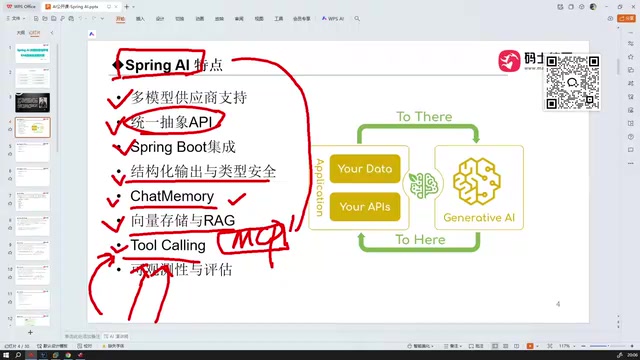
The traditional problem is that each large model (DeepSeek, Claude, ChatGPT, etc.) has its own independent set of APIs for tool invocation, forcing developers to write different adapter code for different models. The MCP (Model Context Protocol) was created to solve this problem. MCP is an open standard protocol released by Anthropic in November 2024, inspired by the design approach of LSP (Language Server Protocol), defining a standardized client-server communication protocol that enables any tool conforming to the MCP specification to be called by any model supporting MCP, thereby providing a unified tool calling standard.
Spring AI handles this cleverly: since the framework itself adopts a unified abstract API design, its underlying encapsulation is already implemented in the MCP style. Therefore, implementing Tool Calling in Spring AI is virtually equivalent to implementing MCP. When switching underlying models, you only need to replace the model configuration — business code requires almost no changes.
6. Observability and Evaluation
Spring AI also supports monitoring and tracing of model invocations, including call count statistics, logging, and more — all operations are traceable. This is crucial for operations and cost control in production environments.
Environment Setup Essentials
Before starting with Spring AI, make sure your development environment meets the following minimum requirements:
| Component | Minimum Version | Notes |
|---|---|---|
| Spring Boot | 3.x | Versions below this will throw errors |
| JDK | 17+ | No longer supports the commonly used JDK 8 in enterprises |
| Maven | 3.9+ | Older versions may cause dependency resolution issues |
A special reminder here: many Java developers in enterprises still use JDK 8, but Spring AI requires JDK 17 or above. JDK 17 is the third LTS (Long-Term Support) version after JDK 8 and JDK 11, released in September 2021. It not only introduces modern language features like Records, Sealed Classes, and Pattern Matching that are extensively used by Spring AI, but also shows significant improvements in GC algorithm maturity (ZGC, Shenandoah), making it better suited for handling high-concurrency requests in AI inference scenarios. For enterprises still using JDK 8, upgrading to JDK 17 is a necessary step toward embracing the modern Java ecosystem — Spring AI is simply accelerating this process. Older Maven versions may also cause various dependency resolution errors, so upgrading directly to 3.9+ is recommended.
Spring AI's Real Positioning in Enterprises
Python Remains Mainstream, But Java Has Its Market
To be objective, in the AI application development space, Python remains the absolute mainstream. The proportion of enterprises using Java (Spring AI) to develop large model applications is still relatively small.
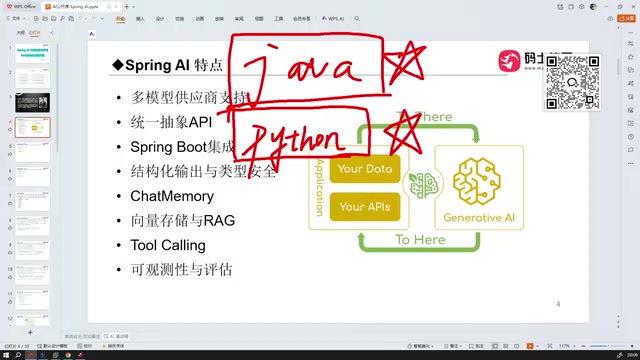
But this doesn't mean Spring AI lacks value. In the following scenarios, Spring AI has irreplaceable advantages:
- Enterprises with existing Java technology stacks: If a company's backend services are entirely built on Spring Boot, introducing Spring AI enables seamless integration, avoiding the technology stack fragmentation that comes with introducing Python
- AI empowerment for Java teams: Enables Java developers to quickly integrate AI capabilities without needing to learn Python
- Enterprise RAG applications: Spring AI's support for RAG scenarios is already quite mature, and this is also the most common AI application scenario in enterprises
Language Should Not Be a Barrier
For developers with some work experience, programming languages themselves should not be a barrier to learning. Java and Python share many syntactic similarities, with core differences more reflected in ecosystems and toolchains. If you're a Python developer, understanding Spring AI's design philosophy can also deepen your understanding of frameworks like LangChain.
Conclusion
Spring AI opens a door for Java developers into the world of large model application development. Its core value lies in: enabling integration and interaction with various large models in the way Spring Boot developers are most familiar with. While it doesn't yet match the breadth of model support in Python's LangChain ecosystem, its unified abstract API, structured output, Chat Memory, RAG support, and natural compatibility with the MCP protocol make it the framework of choice for enterprises with Java technology stacks building AI applications.
For Java developers, now is the perfect time to learn Spring AI — the framework is maturing, enterprise demand is growing steadily, and getting ahead gives you a competitive edge.
Key Takeaways
- Spring AI is a large model interaction framework in the Java ecosystem similar to Python's LangChain, deeply integrated with Spring Boot's design style, with an extremely low learning curve
- Six core features cover multi-model support, unified abstract API, Chat Memory, vector storage and RAG, Tool Calling/MCP protocol compatibility, and observability
- High environment requirements: Spring Boot 3.x+, JDK 17+, Maven 3.9+, no longer supporting the enterprise-common JDK 8; modern language features like JDK 17's Records are deeply used by Spring AI
- Spring AI's Tool Calling implementation is naturally compatible with the MCP protocol released by Anthropic in 2024, requiring almost no business code changes when switching between different large models
- RAG architecture implements semantic retrieval through vector databases; Spring AI provides a unified VectorStore abstraction supporting mainstream vector databases like Pinecone, Weaviate, and pgvector
- Python remains the mainstream for AI development, but Spring AI has irreplaceable integration advantages in enterprises with existing Java technology stacks
Related articles
 Tutorials
Cursor + Codex Dual-IDE Collaboration: A Practical Methodology for Open-Source Project Customization
A complete methodology for open-source project customization based on real-world experience, detailing the Cursor+Codex dual-IDE workflow, seven-stage process, MVP validation, and AI source code reading techniques.
 Tutorials
Cursor Multi-Agent in Practice: Building a Full-Stack Next.js Blog in 50 Minutes
Build a full-stack blog in 50 minutes using Cursor IDE's multi-Agent mode with Next.js, Clerk auth, and Supabase. Learn the 4-phase AI Agent workflow and key integration pitfalls.
 Tutorials
Building an AI Software Factory from Scratch: A Cursor Engineer's Hands-On Experience with Multi-Agent Collaboration
Cursor engineer Eric shares practical insights on building an AI software factory: automation levels, guardrail design, parallel Agent management, and scaling to 1000+ Agents for 24/7 development.