GitHub AI Weekly: Agent Ecosystem Support Tools Explode onto the Scene
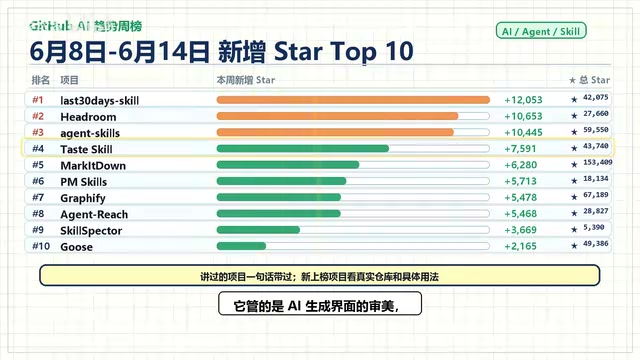
GitHub AI trending shows Agent ecosystem middleware tools exploding across the board in June 2026.
The second week of June 2026 on GitHub AI trending reveals a clear shift: the Agent ecosystem is moving from filling individual capability gaps to building comprehensive supporting infrastructure. New projects like PM Skills (product workflow), Agent Reach (external data retrieval), Graphify (code knowledge graphs), and NVIDIA's Skill Spectre (security scanning) represent the arrival of the Agent "middleware era," signaling that large-scale Agent deployment is imminent.
Overview: From Point Solutions to Ecosystem Infrastructure
The GitHub AI trending chart for the second week of June 2026 sends a very clear signal — the Agent ecosystem is shifting from "filling individual capability gaps" to "building supporting infrastructure." Last week's chart was dominated by foundational capability projects like context compression, document conversion, and design enhancement. This week, however, support tools for product workflow management, external information retrieval, code knowledge graphs, and Skill security scanning have surged onto the leaderboard en masse.
For Agents to truly get work done, being good at chatting is far from enough. They need to find information, understand project structures, invoke skills, and know which skills shouldn't be installed carelessly. This week's chart happens to fill in exactly that chain.
This evolutionary pattern has a classic parallel in software engineering — Middleware. Middleware is the software layer between the operating system and applications, responsible for communication, data management, and service coordination. In web development, middleware handles cross-cutting concerns like authentication, logging, and routing. "Middleware" in the Agent ecosystem works the same way — these tools aren't the Agent itself, nor are they end-user features. They're the connectivity layer, governance layer, and enhancement layer needed to make Agent capabilities actually work in practice. Nearly every new project on this week's chart belongs to this layer.
Perennial Chart-Toppers: Foundational Capability Projects
Let's quickly run through the projects that continue to hold their positions:
- Last 30 Day Skill: ~12,000 new stars this week, holding steady at #1. This is an intelligence search tool for Agents that scrapes information from the past 30 days across platforms like Reddit, X, YouTube, and Hacker News.
- Headroom: ~10,600 new stars this week. It compresses logs, files, and Registry content from tool outputs before feeding them into models. The core value proposition is saving Tokens. Current mainstream LLMs charge by token (GPT-4o costs roughly $2.50 per million input tokens, Claude Sonnet around $3). A mid-sized project's codebase might contain hundreds of thousands of lines of code — feeding it all in directly would generate enormous costs and exceed context window limits. Common token compression strategies include summary extraction (using a smaller model to compress before sending to the larger model), semantic deduplication (removing duplicate or low-information-density content), and structural compression (preserving key structures while discarding redundant formatting). The ROI of these tools is very straightforward — every 10% improvement in compression ratio directly saves 10% on API call costs.
- Agent Skills: ~10,400 new stars this week. An engineering skill library for AI coding Agents that packages workflows like writing code, reviewing code, and maintaining projects into Skills.
- Test Skill: ~7,600 new stars this week. Specifically manages the aesthetic quality of AI-generated interfaces, reducing that "obviously AI-made" look.
- Markdown: ~6,300 new stars this week. Converts PDFs and Office documents to Markdown for easy integration with knowledge bases and Agent workflows.
The sustained popularity of these projects shows that demand for the Agent foundational capability layer remains strong. But what's more worth watching are the four new projects that debuted on this week's chart.
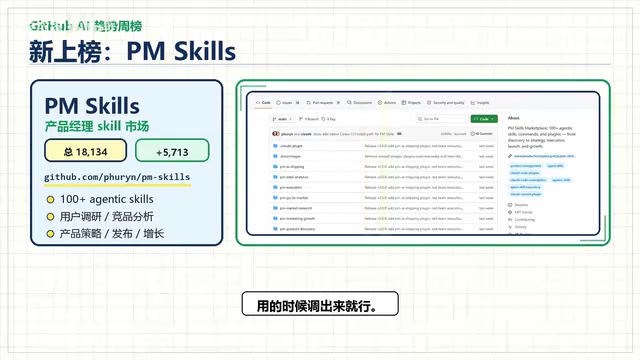
PM Skills: A Skill Marketplace for Product Managers
~5,700 new stars this week
PM Skills is a Skill marketplace designed for product managers, featuring over 100 built-in Agent Skills covering the complete product workflow — user research, competitive analysis, product strategy, launch planning, and growth initiatives.
Here's a typical scenario: you're building a new product. You can have an Agent first organize user pain points, then pull competitive comparisons, and finally break it down into a launch plan. These steps used to require you to repeatedly write prompts to guide the process. PM Skills packages these workflows directly into Skills that you can simply invoke when needed.
The significance of this project is that the concept of Skills is expanding from developer tools to business roles. When product managers have their own Skill library, it means Agents are no longer serving programmers exclusively. This actually echoes the logic of the low-code/no-code movement — democratizing technical capabilities isn't about making everyone learn to code, but about packaging complex operations into modules that business users can use directly. PM Skills essentially reduces the "prompt engineering" barrier for Agents to near zero.
Agent Reach: The Agent's Eyes on the External Internet
~5,500 new stars this week
Agent Reach solves a very practical problem: How does an Agent access external internet information?
It can read and search Twitter, Reddit, YouTube, GitHub, as well as Bilibili and Xiaohongshu. The project is designed for CLI-based invocation, eliminating the need to wrangle each platform's API separately.
This tool is especially useful for research. For example, if you want to check the recent reputation of an AI tool, you can have the Agent browse complaints on Reddit, watch review videos on YouTube, check issues on GitHub, and look for real user feedback on Chinese-language communities. You typically can't find this kind of honest information just by looking at official websites.
Agent Reach's value lies in breaking down the Agent's information walls. Most Agents currently can only process content you feed them, while Agent Reach gives them the ability to proactively retrieve information from multiple external platforms. This is a critical step in the Agent's evolution from "passive execution" to "active research."
This shift corresponds to an important paradigm evolution in AI Agent research. Early LLM applications were purely "stimulus-response" — they processed whatever the user input. Later, RAG (Retrieval-Augmented Generation) enabled models to retrieve information from pre-built knowledge bases, but the data sources were still passive and pre-prepared. True Agents need "Tool Use" capabilities — the ability to autonomously decide which external tools to call based on task requirements. This capability is known in academia as Agentic RAG or Active Retrieval, and it represents the critical watershed between chatbots and autonomous workers. Agent Reach is the concrete engineering implementation of this paradigm.
Graphify: Understanding Code Relationships Through Knowledge Graphs
~5,500 new stars this week
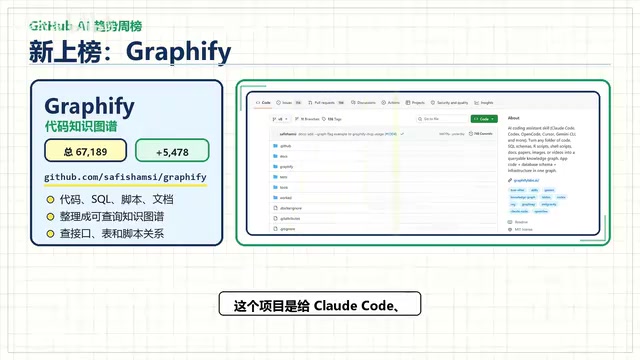
Graphify is a companion project for AI coding tools like Cloud Code, Codex, Cursor, and Gemini CLI. It can organize a code directory, SQL Schema, or script documentation into a queryable knowledge graph.
Knowledge Graph technology was first applied at scale by Google in 2012 for its search engine. Its core approach uses "entity-relationship-entity" triple structures to represent knowledge, distinguishing it from traditional relational databases or full-text indexes. In a code context, entities can be functions, classes, data tables, or API endpoints, while relationships include calls, inheritance, dependencies, reads/writes, and more. Graph databases (like Neo4j) or graph query languages (like Cypher, SPARQL) are common underlying implementations. Compared to vector embedding-based semantic search, graphs have a natural advantage in multi-hop reasoning — for example, answering chain questions like "A calls B, B depends on C, C reads table D."
Why is this needed? Because as projects grow larger, Agents easily end up searching only local files and lacking understanding of global relationships. What Graphify does is lay out the relationships first, so you can then ask:
- Where does this API endpoint originate from?
- Which modules use this table?
- What's the relationship between this script and the database?
These kinds of questions are easily missed by full-text search. With a graph in place, Agents can trace paths much more reliably.
Graphify represents an important trend: AI coding tools are upgrading from "file-level understanding" to "relationship-level understanding." This is especially critical for code maintenance and refactoring in large projects. When a project has hundreds of files and dozens of data tables, any single-point modification can trigger chain reactions. The traditional approach relies on senior engineers' experience and memory to maintain the big picture. Knowledge graphs give Agents this same "global vision," which is hugely significant for lowering the maintenance barrier of large projects.
NVIDIA Skill Spectre: A Skill Security Scanner
~3,700 new stars this week
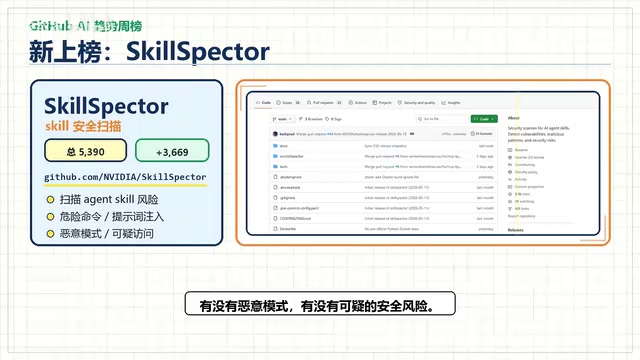
NVIDIA's Skill Spectre performs security scanning for AI Agent Skills.
Skills are increasingly resembling a plugin ecosystem — when you install a Skill, it might read files, run commands, access web pages, or invoke tools. So you can't just evaluate how feature-rich it is; you also need to check whether it has vulnerabilities, malicious patterns, or suspicious security risks.
That's exactly what Skill Spectre does. As the Skill ecosystem expands, scanning tools like this will become increasingly common — just like how security audit tools emerged after the npm ecosystem exploded.
This analogy isn't arbitrary. Software supply chain security has left the industry with deep lessons in recent years: in 2018, the npm ecosystem suffered the event-stream incident, where a widely-depended-upon open-source package was injected with cryptocurrency wallet-stealing code by a malicious maintainer, affecting millions of downloads. The 2021 Log4Shell vulnerability sent enterprises worldwide into emergency patching mode. The Chrome extension store has also repeatedly seen malicious plugins disguised as legitimate tools. The risks with Agent Skills may be even greater — because Skills can not only read and write files but also execute system commands and access network resources under the Agent's identity, giving them a larger attack surface than traditional plugins. A malicious Skill could theoretically cause an Agent to leak sensitive data or perform destructive operations without the user's knowledge.
NVIDIA entering the security tools space is itself a signal: major companies are already building security infrastructure for the scaling of the Agent Skill ecosystem. This also means the industry's positioning of Agent Skills has shifted from "experimental toys" to "production-grade components" — you only take something's security seriously when you take the thing itself seriously.
Also Worth Watching: Goose Open-Source Agent
Another project worth noting this week is Goose, with ~2,200 new stars. It's an open-source AI Agent that can install, execute, edit, and test code — not just offering code suggestions, but actually doing the work. While its star count isn't the highest, its "full-lifecycle execution" positioning gives it unique value in the open-source Agent space.
Goose represents another evolutionary direction for AI coding tools: from "Copilot" to "Autopilot." The model pioneered by GitHub Copilot offers completion suggestions while you write code, with decision-making authority always remaining with the human. Full-lifecycle Agents like Goose, however, attempt to take over a more complete development cycle — understanding requirements, writing code, running tests, fixing issues — with humans playing more of a reviewer role than an executor role. This model places higher demands on Agent reliability and controllability, which is precisely why the supporting tools mentioned earlier — security scanning, knowledge graphs, and others — exist.
Trend Analysis: The "Middleware Era" of the Agent Ecosystem Has Arrived
Looking at this week's chart as a whole, a clear chain emerges:
| Layer | Project | Function |
|---|---|---|
| Product Workflow | PM Skills | Business Skill marketplace |
| External Information | Agent Reach | Multi-platform information retrieval |
| Code Understanding | Graphify | Knowledge graph construction |
| Security Assurance | Skill Spectre | Skill security scanning |
The Agent ecosystem is undergoing an evolutionary path similar to the early internet: first came core applications (the Agent itself), then foundational capabilities (compression, conversion, search), followed by middleware and supporting tools (workflow management, security auditing, relationship graphs).
Looking back at internet history, this path was almost inevitable. In the mid-1990s, the Web's core was browsers and servers; then came web server middleware like Apache and Nginx; after that came database connection pools, message queues, load balancers, CDNs, and other infrastructure layers. The maturation of each layer created the conditions for the explosion of the layer above it. The mobile internet era followed the same pattern — after the App Store launched, it was the maturation of middleware like push notification services, crash monitoring, A/B testing platforms, and payment SDKs that truly catalyzed the mobile app boom.
We are now in the "Middleware Era" of the Agent ecosystem. Going forward, we can expect a continuous stream of supporting projects around Agent monitoring, debugging, permission management, Skill marketplace operations, and more. For developers and product managers, paying attention to these supporting tools now is preparation for the imminent scaling of Agent applications.
It's particularly worth noting that the concentrated emergence of these middleware projects often signals that an ecosystem is about to enter a rapid growth phase. When the "utilities and infrastructure" are in place, the application layer explosion usually isn't far behind.
Key Takeaways
Related articles

Vibe Coding in Practice: How a Product Manager Built a Study App from Pain Point to Launch Using AI Tools
A product manager used AI tools like Claude Code to independently build a quiz app from exam prep pain points to launch. A full walkthrough of Vibe Coding methodology, MVP definition, and testing.
PilotDeck: A Local Console That Tames Multi-Task Agent Chaos
PilotDeck is an open-source local Agent console from a Tsinghua-affiliated team that solves multi-task chaos with workspace isolation, white-box memory management, and smart model routing.
Fusion Startup Funding Landscape: A Deep Dive into the $7.1 Billion Flow and Industry Dynamics
Global fusion startups have raised $7.1B, heavily concentrated in top players. A deep analysis of funding patterns, tech pathways, commercialization challenges, and the investment logic behind this ultimate energy bet.