GitHub May 2026 Availability Report: A Comprehensive Analysis of Nine Service Degradation Incidents
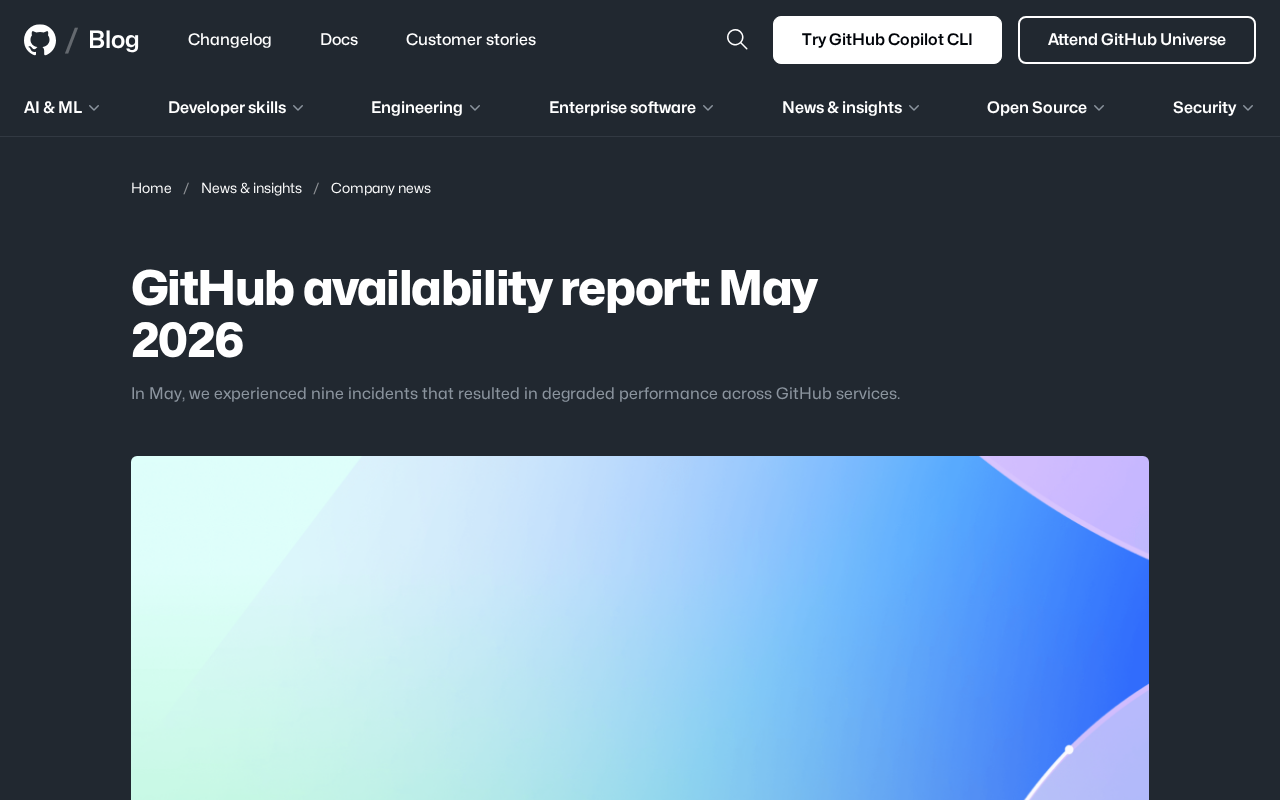
GitHub's May 2026 report reveals nine service degradation incidents, highlighting hyperscale reliability challenges.
GitHub's May 2026 Availability Report disclosed nine service degradation incidents, averaging one every 3.4 days. The article analyzes the impact on CI/CD pipelines, enterprise workflows, and open source projects, discusses single-platform dependency risks and multi-platform mirroring strategies, and examines the engineering challenges of maintaining reliability across GitHub's expanding hyperscale service ecosystem.
Overview
The official GitHub blog has published its May 2026 Availability Report, disclosing nine incidents that caused degraded service performance during the month. As the world's largest code hosting platform, GitHub's stability directly impacts the daily workflows of tens of millions of developers and enterprises. This monthly report provides an important window into the reliability of its infrastructure.
What Nine Incidents Really Mean
Incident Frequency Analysis
Nine service degradation incidents in a single month means an issue affecting user experience occurred roughly every 3.4 days on average. For a critical piece of infrastructure that supports global software development collaboration, this frequency deserves attention. While GitHub officially categorizes these events as "degraded performance" rather than full outages, even brief performance dips can trigger cascading effects on CI/CD pipelines, code reviews, automated deployments, and other critical workflows.
It's worth explaining that CI/CD (Continuous Integration/Continuous Deployment) is a core practice in modern software engineering, referring to the complete pipeline that automatically triggers builds, tests, and deployments after code is committed. GitHub Actions is GitHub's built-in automation platform, officially launched in 2019, which allows developers to define workflows through YAML configuration files and handle everything from code checks to production deployments directly within GitHub repositories. As of 2026, GitHub Actions has become one of the most widely used CI/CD platforms globally, executing millions of workflows daily. When GitHub experiences performance degradation, the Actions execution queue can become backlogged, causing build tasks to wait in queue for tens of minutes or even hours — a particularly severe impact for teams that rely on rapid iterative release strategies.
Historical Trend Comparison
Since its acquisition by Microsoft, GitHub has consistently published monthly availability reports — a level of transparency that deserves recognition. Microsoft acquired GitHub in 2018 for $7.5 billion, making it one of the most closely watched acquisitions in the tech industry at the time. After the acquisition, GitHub maintained relatively independent operations within the Microsoft ecosystem while gaining strong support from Microsoft's Azure cloud infrastructure. Microsoft's investment enabled GitHub to significantly expand its service capabilities, launching heavyweight products such as GitHub Copilot (an AI programming assistant) and GitHub Codespaces (a cloud-based development environment). However, the rapid expansion of services also means a dramatic increase in system complexity, requiring the infrastructure team to continuously balance innovation speed with system stability.
Looking at historical trends, the number of monthly incidents typically fluctuates in the single digits, and nine is on the relatively high end. This may be related to the platform's continuously expanding service scale, rapid iteration of new features (such as deep integration of Copilot-related services), and sustained user growth.
Real-World Impact on Developers
Disruption to Daily Development Workflows
GitHub's service degradation affects different types of users to varying degrees:
- Individual developers: May experience slower git push/pull operations and page loading delays — generally limited impact
- Enterprise teams: CI/CD pipelines relying on GitHub Actions may experience queuing delays or execution failures, directly affecting release cadence
- Open source projects: PR reviews and issue management for large open source projects may be disrupted
The Risk of Single-Platform Dependency
This report also serves as another reminder for developers and enterprises to seriously consider the risks of single-platform dependency. When core development infrastructure encounters problems, is there a viable backup plan?
A multi-platform mirroring strategy is one of the primary approaches to mitigating this risk — hosting code repositories simultaneously on multiple platforms (such as GitHub, GitLab, Bitbucket, or self-hosted Gitea instances) to achieve redundant backup and failover. Since Git itself is a distributed version control system and every cloned repository contains the complete commit history, multi-platform mirroring is relatively straightforward to implement technically. Developers can configure multiple remote addresses or use automated scripts to periodically sync repositories. More mature enterprise-grade solutions also include: deploying GitHub Enterprise Server on-premises as a backup, using artifact caching to reduce dependency on remote CI/CD, and designing manual rollback mechanisms for critical deployment processes.
Some teams have already begun adopting these multi-platform mirroring strategies or incorporating fault-tolerance mechanisms into critical processes to reduce dependency on a single service provider.
Platform Reliability and Transparency
The Industry Benchmark of Monthly Reports
GitHub's commitment to publishing monthly availability reports sets an excellent benchmark in the industry. This transparency not only helps users understand the platform's actual operational status but also drives internal teams to continuously improve infrastructure stability. Each incident report typically includes root cause analysis and remediation measures, providing valuable reference for SRE (Site Reliability Engineering) practices across the entire industry.
SRE (Site Reliability Engineering) is an engineering methodology pioneered by Google around 2003, with the core philosophy of applying software engineering approaches to solve operations problems. SRE teams typically set SLOs (Service Level Objectives) and SLIs (Service Level Indicators), using an Error Budget mechanism to balance system reliability with feature iteration speed. When the error budget is exhausted, teams pause new feature development and prioritize fixing stability issues. GitHub's monthly availability report is a manifestation of the "Postmortem" practice in SRE culture — identifying systemic issues and driving fundamental improvements through open, blameless incident analysis. This practice has been widely adopted by major cloud providers including AWS, Google Cloud, and Cloudflare.
The Engineering Challenges of Hyperscale Systems
As GitHub's platform capabilities continue to expand — from code hosting to Actions, Packages, Copilot, Codespaces, and other comprehensive developer services — the difficulty of maintaining high availability grows exponentially.
Modern GitHub is far more than a simple code hosting platform. Its service matrix includes: GitHub Actions (CI/CD automation), GitHub Packages (package management and container registry), GitHub Copilot (an AI programming assistant powered by large language models), GitHub Codespaces (fully-featured cloud-based development environments), GitHub Advanced Security (code security scanning and vulnerability detection), and GitHub Projects (project management tools), among others. Complex dependencies exist between these services — for example, Copilot needs to call AI inference services, Codespaces needs to dynamically allocate cloud computing resources, and Actions needs to coordinate thousands of runners. Performance fluctuations in any single subsystem can affect other services through cascading effects — a classic challenge faced by hyperscale distributed systems.
Behind the nine incidents lies precisely this kind of deep engineering challenge that a hyperscale distributed system faces during continuous evolution.
Conclusion
The nine service degradation incidents in May 2026 remind us that even the world's top technology platforms cannot achieve perfection. For developers, continuously monitoring GitHub's availability reports, establishing appropriate fault-tolerance strategies, and avoiding over-reliance on a single platform are pragmatic steps to safeguard development efficiency. At the same time, we look forward to GitHub demonstrating concrete improvements addressing these issues in future reports.
Key Takeaways
Related articles
What Is Google WebMCP? A Deep Dive into the New Standard for AI Agents to Directly Invoke Web Functionality
A deep dive into Google WebMCP (Web Model Context Protocol): how it works, its technical implementation, and use cases. Learn how WebMCP lets AI Agents directly invoke web tools.

AI Can't Kill Old-School Programming: Why Fundamentals Are Still a Developer's Moat
Vibe Coding is trending, but can it replace solid fundamentals? A deep analysis of why core principles, systems thinking, and knowledge frameworks remain a developer's moat in the AI era.

ZeroStack: An In-Depth Look at the Rust-Based Minimalist Coding Agent That Uses Only 16MB of RAM
In-depth review of ZeroStack, a Rust-based coding agent using only 16MB RAM. Analyzing its file I/O, multi-model support, permission controls, and ideal use cases.