AI Can't Kill Old-School Programming: Why Fundamentals Are Still a Developer's Moat

AI changes how we code, but engineering fundamentals remain a developer's irreplaceable moat.
As AI coding tools like Cursor and Copilot make Vibe Coding mainstream, many developers are abandoning fundamentals. This article argues that underlying principles, systematic knowledge frameworks, and engineering thinking remain irreplaceable. Without them, developers fall into a vicious cycle of AI-generated bugs, becoming tool operators rather than technical leaders. The key is human-AI collaboration where you stay in control.
When "Old-School Programming" Became a Meme
A senior developer with over a decade of experience was sitting at his computer writing code by hand one day, only to be called a "traditional craftsman" by a junior colleague who'd just entered the industry. What he was doing got jokingly labeled "old-school programming."
The most painful truth might not be layoffs — it's that the fundamentals you've honed for over a decade became "cultural heritage" overnight. AI coding tools have evolved incredibly fast — tools like Cursor and Copilot can generate code far faster than any human can type. Cursor is an AI-native code editor deeply rebuilt on top of VS Code, integrating large language models like GPT-4 to understand an entire project's code context and perform multi-file coordinated editing. GitHub Copilot, co-developed by GitHub and OpenAI and trained on the Codex model, provides real-time line-level and function-level code completions as you write. With emerging tools like Windsurf and Devin constantly appearing, AI coding tools have formed a complete ecosystem. Interview criteria are shifting too: from "deep expertise in a specific technology" to "proficiency in AI prompting."
But here's the question: if you rely on Vibe Coding every day, can you really go far?
Vibe Coding is a concept coined by OpenAI co-founder Andrej Karpathy in early 2025. It refers to a development approach that relies entirely on AI code generation tools — developers simply describe requirements in natural language, AI generates all the code, and the developer doesn't even need to read or understand the generated code. The concept sparked fierce debate in the developer community the moment it was introduced: is it the future of programming, or a path toward technical regression?
AI Is the Ultimate Sidekick, But It's Not Your Brain
As a heavy AI user, one senior developer admits: over 90% of the code in current projects is generated with AI assistance. AI is indeed the ultimate sidekick.
However, many developers report that Vibe Coding is nowhere near as simple as it sounds — things fall apart as soon as you tackle a large project. The reasons are straightforward:
- For building a frontend UI or writing simple CRUD operations, AI is genuinely impressive
- Once a project grows larger and logic gets more complex, people with zero understanding of underlying principles only get more frustrated
- Without understanding the fundamentals, you can't provide AI with precise context
"Context" is critical here. The quality of code generated by large language models is highly dependent on the input context — the deeper your understanding of the tech stack, the more precise your prompts, and the higher the quality of AI-generated code. Conversely, if you can't even articulate what you want, AI will only give you an answer that "looks like it runs" but doesn't hold up under scrutiny.
The Vicious Cycle of Vibe Coding
AI gives you buggy code → you blindly copy it → error → you feed the error message back to AI → AI patches it → new bugs appear… Eventually it becomes: you're spending every day using AI-written code to fix bugs that AI itself wrote.
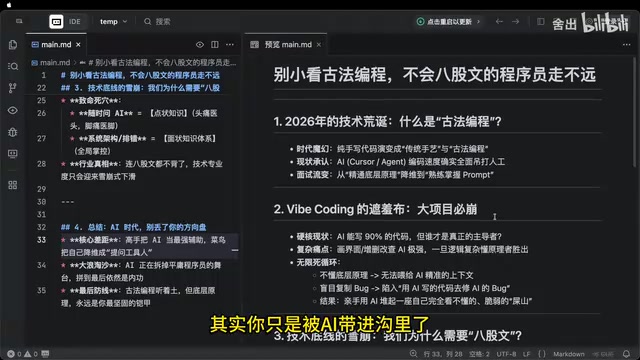
You've personally used AI to pile up a fragile mountain of spaghetti code that even you can't understand. You thought you had a cheat code, but AI actually led you into a ditch. This phenomenon is known in the industry as "AI debt" — similar to technical debt, but more insidious and dangerous, because the code's author (AI) can't be held accountable for its decisions, and the nominal developer doesn't understand the code's internal logic at all. When deep systemic issues arise, no one can truly fix them.
The Truth Behind the Death of Rote Interview Questions: It's Not Progress — It's a Collapse of Technical Standards
Many interviews no longer require memorizing standard technical questions, which seems like a good thing. People used to complain that these rote questions were all about memorization and disconnected from real work. But consider another perspective:
When an industry stops testing and studying even its standard technical questions, that's absolutely not progress — it's the beginning of a total collapse in technical professionalism.
The term "八股文" (bāgǔwén, literally "eight-legged essay") borrows from China's imperial examination system. In the context of developer interviews, it refers to those standardized technical knowledge points that get tested repeatedly — things like Java's JVM memory model, HashMap's underlying implementation, TCP's three-way handshake and four-way teardown, Redis cache penetration and avalanche, and Spring's IOC and AOP principles. While this interview system has been widely criticized for being overly standardized and disconnected from real business scenarios, it objectively established a universal baseline for evaluating technical competence across the industry.
No matter how much these rote questions are criticized, they at least represent a minimum threshold of technical professionalism. They forced you to understand:
- What high concurrency is
- What memory models are
- What network protocols are
These three form the "iron triangle" of foundational knowledge for backend developers. High concurrency involves a series of low-level technologies including thread pool management, locking mechanisms, asynchronous programming, and load balancing — it's the core challenge of internet system design. Memory models (like the Java Memory Model) define the rules for variable visibility, ordering, and atomicity in multithreaded environments — without understanding them, you can't explain why seemingly correct code produces bizarre results under multithreading. Network protocols (TCP/IP, HTTP, WebSocket, etc.) are the foundation of all distributed system communication — understanding how protocols work is essential for effectively troubleshooting network timeouts, packet loss, connection leaks, and other common production issues.
These are a programmer's technical baseline. After AI came along, many people can't even be bothered to grind through these basics anymore. They ask AI whenever a problem comes up, getting only "point-form" knowledge — treating the headache when the head hurts, treating the foot when the foot hurts.
Point-Form Knowledge vs. Systematic Knowledge
Real system architecture design and production issue troubleshooting require a systematic knowledge framework.
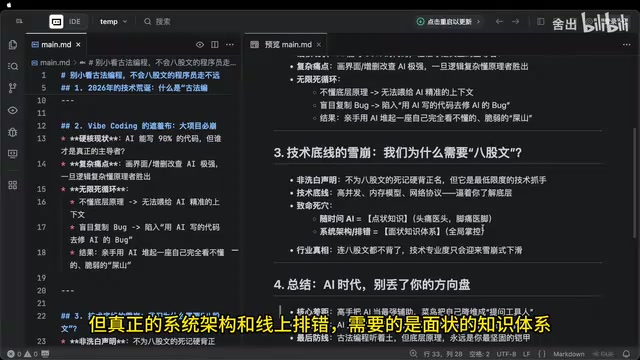
A systematic knowledge framework stands in contrast to "point-form knowledge." Point-form knowledge is isolated and fragmented — like knowing how to call a specific API or how to fix a specific error. Systematic knowledge weaves together multiple dimensions — operating systems, networking, databases, middleware, design patterns — into an interconnected web, forming a holistic technical understanding. In real-world engineering, a production incident might simultaneously involve slow database queries, JVM garbage collection pauses, network jitter, and business logic flaws. Only engineers with systematic knowledge can quickly identify the root cause.
Why can experienced developers spot problems at a glance? Because they have a systematic knowledge map. Relying on AI to feed you scattered fast-food knowledge every day might fill your stomach, but it definitely won't build muscle — your technical skills have no depth, no systematic support, and will only become increasingly superficial. This is also why the value of senior architects is hard to replace with AI — their decisions depend on a holistic understanding of the entire tech stack and years of accumulated engineering intuition, and that intuition simply cannot be obtained by asking AI questions.
Leader vs. Tool Operator: Your Fundamentals Determine Your Role
The ability to have AI successfully write 90% of the desired code ultimately comes down to the human being the one in charge:
- Having a knowledge map in your head
- Knowing where the destination is
- Knowing how to navigate each path
- Knowing how to handle errors when they occur
AI just helps you execute. It's like an experienced architect using CAD software — the software helps you draft quickly, but core decisions about structural safety, spatial layout, and material selection must be made by someone who knows the domain. If someone with zero knowledge of architecture operates CAD, the drawings might look beautiful, but the building they produce might collapse.
But if the new generation of programmers doesn't even want to dig into the fundamentals, handing over control to machines and reducing themselves to a "prompting tool" that just copies and pastes — it's not that it can't work, but it's not professional. In this mode, your value is entirely bounded by AI's capabilities: what AI can do, you can do; what AI can't do, you can't do either. You have no independent value beyond the tool itself.
Beware the "Zero Barrier" Anxiety Harvesting
AI is eliminating mediocre white-collar workers and junior programmers. According to public statements from multiple tech companies and industry surveys, AI's impact on programming roles shows a clear stratification effect. Between 2024 and 2025, many companies have already reduced hiring for junior development positions because AI tools can handle most basic coding work. However, demand for senior developers who handle complex system design, cross-team technical decisions, and legacy system modernization has actually grown. This "polarization" means the entry path into programming is being reshaped.
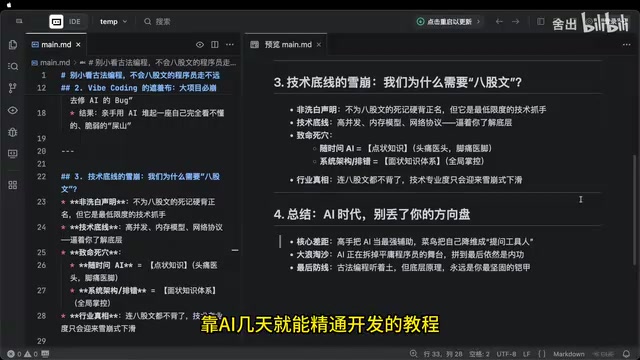
Those tutorials claiming "zero barrier to entry, master development with AI in just a few days" are essentially harvesting anxiety. They exploit people's uncertainty about the AI era and their fear of being replaced, selling a "shortcut illusion."
The reality is: zero barrier, a few days — it's absolutely impossible to build beautiful, complete, complex software. After the AI Great Leap Forward enthusiasm cools down, what matters is still fundamentals — your inner strength. Future developers may need to build systematic thinking faster rather than staying at the level of simple CRUD operations. AI has lowered the barrier to coding, but it has never lowered the barrier to engineering.
Embrace AI Coding, But Don't Lose Your Moat
We can embrace AI and use the most cutting-edge tools, but we must never forget what our core competitiveness is:
- Don't be too anxious — first examine your own technical foundation. Technology waves come every few years — from cloud computing to big data to blockchain to AI. Every time, someone shouts "XX is dead," but the people who actually get eliminated are never practitioners of a specific technology — they're the ones who stopped learning and thinking.
- Old-school programming may sound outdated, but underlying principles are always the most solid moat against AI and the tides of change. Operating system principles, computer networking, data structures and algorithms, system design — the half-life of this "old-school" knowledge is far longer than that of any framework or tool.
- AI is a tool, not a replacement — you must keep control in your own hands. The ideal state is "human-AI collaboration": you handle thinking, decision-making, and architecture; AI handles execution, acceleration, and filling in the gaps.
AI changes the way we code, but engineering thinking remains constant. Instead of worrying about whether AI will replace you, ask yourself: without AI's code completion, can you still independently think through how a system should be designed? If the answer is yes, then AI gives you wings. If the answer is no, then what you need to worry about isn't AI — it's your own technical foundation.
Related articles

Five Common Claude Code Mistakes — How Many Are You Making?
Five common Claude Code mistakes developers make: copy-pasting code, skipping CLAUDE.md, inefficient prompting, ignoring docs, and poor context management — with fixes.
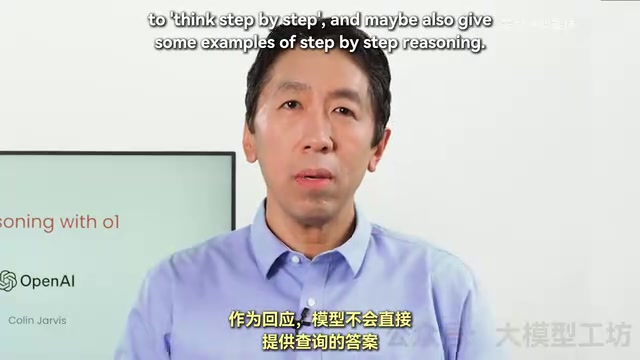
Andrew Ng's New Course Explained: A Practical Guide to Using OpenAI's O1 Reasoning Model
Deep dive into Andrew Ng and OpenAI's Reasoning with O1 course covering test-time scaling, new prompting paradigms, multi-model orchestration, and practical applications for developers.

Learning AI After College Entrance Exams: A Complete Path from Zero to Freelancing
How to efficiently learn AI skills during summer break after exams? A complete path from mastering prompts and hands-on projects to freelancing on platforms.