GitHub Universe 2026 Returns: Officially Entering the AI Agent Era
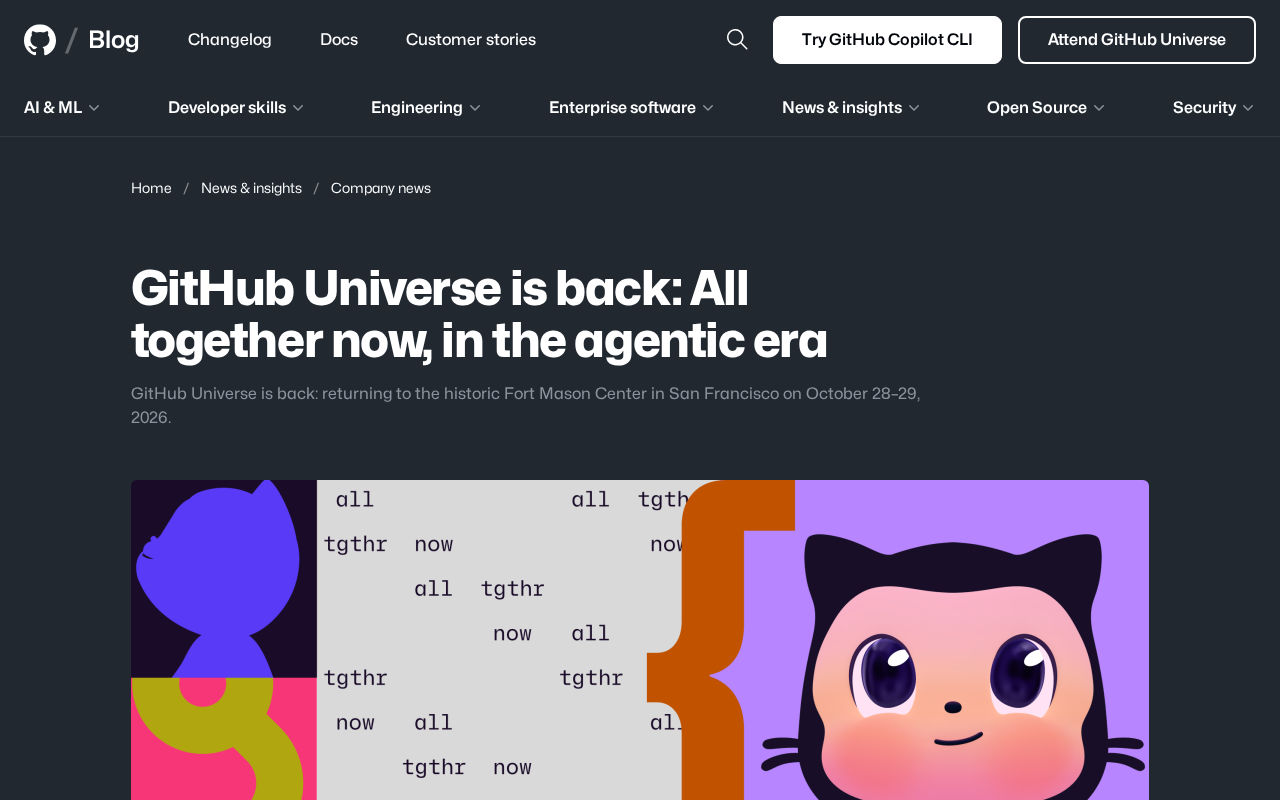
GitHub Universe 2026 returns in San Francisco, officially declaring the dawn of the AI Agent era.
GitHub Universe 2026 will take place October 28-29 at San Francisco's Fort Mason Center, themed around the "Agentic Era." The conference marks GitHub's evolution from AI-assisted coding with Copilot to autonomous AI Agents that can independently plan, code, test, and debug. This shift reflects an industry-wide trend toward Agentic AI, with multi-Agent collaboration and end-to-end automation poised to transform how software is built and who builds it.
GitHub Universe Conference Makes a Major Comeback
GitHub has officially announced that its flagship annual developer conference, GitHub Universe, will return on October 28-29, 2026, at the historic Fort Mason Center in San Francisco. This announcement signals GitHub's renewed emphasis on in-person developer community connections while heralding a brand-new technical theme — the Agentic Era.
From Copilot to Agentic: GitHub's AI Evolution Path
The Next Phase of AI-Assisted Programming
GitHub has defined this conference under the banner of the "Agentic Era," and the naming itself sends a powerful signal. Looking back at GitHub's AI trajectory in recent years:
- 2021: Launched GitHub Copilot, pioneering AI-assisted programming
- 2023-2024: Copilot continued to evolve, expanding from code completion to Copilot Chat and Copilot Workspace
- 2025: Introduced Copilot Coding Agent, with AI beginning to autonomously complete development tasks
- 2026: Officially declared the dawn of the Agentic Era
GitHub Copilot was originally built on OpenAI's Codex model (a code-specialized fine-tuned version of GPT-3), trained on massive volumes of open-source code to achieve context-aware code completion. Copilot Chat introduced a conversational interaction paradigm, allowing developers to describe requirements in natural language and receive code suggestions. Copilot Workspace, launched in 2024, went even further — it could understand requirements described in GitHub Issues, automatically generate implementation plans, write code, and create Pull Requests. This was essentially a leap from "code snippet-level assistance" to "task-level automation." The 2025 release of Copilot Coding Agent marked a critical turning point — it could be assigned a GitHub Issue and then autonomously complete coding, run tests, and commit code in an independent cloud development environment, all without requiring real-time developer involvement. Developers only needed to participate during the final Pull Request review.
From "assistance" to "autonomy," GitHub's AI strategy is undergoing a qualitative leap. The term "Agentic" means AI is no longer merely responding passively to developer commands — it can proactively plan, execute, and iterate on complex software engineering tasks. Agentic AI is fundamentally different from traditional generative AI. Traditional large language models operate in a "prompt-response" single-turn or multi-turn conversation mode, while Agentic AI possesses four core capabilities: goal decomposition (breaking complex tasks into executable sub-steps), tool invocation (using external tools like APIs, databases, and file systems), environment awareness (observing execution results and adjusting strategies accordingly), and autonomous iteration (self-debugging and correcting when encountering errors). In software development scenarios, this means an AI Agent can function like a junior engineer — receiving a task description and then autonomously reading the codebase, understanding the architecture, writing the implementation, running tests, and fixing failing test cases until the task is complete. The core breakthrough of this paradigm is "closed-loop execution" — AI no longer just offers suggestions but actually completes the work.
What the Agentic Era Means for Developers
For developers, the Agentic Era could bring the following transformations:
- Autonomous code review and fixes: AI Agents can independently identify code issues and submit fix proposals
- End-to-end feature development: Full-process automation from requirement understanding to code implementation, testing, and deployment
- Multi-Agent collaboration: Multiple specialized AI Agents working together to complete complex projects
- Evolving developer roles: Shifting from "the person who writes code" to "the architect who guides and reviews AI's work"
Among these, Multi-Agent Collaboration represents an advanced form of Agentic AI, inspired by the division-of-labor model in human teams. In a typical multi-Agent system, different Agents are assigned specialized roles — for example, one Agent handles frontend development, another focuses on backend logic, and there are dedicated testing Agents and code review Agents. These Agents communicate and coordinate through a shared message bus or orchestration layer (Orchestrator). Microsoft Research's AutoGen framework and open-source community projects like CrewAI and LangGraph are all exploring this direction. In GitHub's context, multi-Agent collaboration could mean that future CI/CD pipelines will have different AI Agents responsible for code quality checks, security vulnerability scanning, performance optimization suggestions, and documentation generation, forming an automated "AI development team."
Fort Mason Center: An In-Person Gathering Place for the Developer Community
The choice of Fort Mason Center as the venue carries significant meaning. This historic complex on San Francisco's waterfront combines cultural heritage with the capacity to host large-scale tech events. Fort Mason Center originally served as the U.S. Army's primary military port facility in the Pacific Theater, dating back to the Civil War era. During World War II, it was the departure point for 1.6 million soldiers heading to the Pacific front. After being incorporated into the Golden Gate National Recreation Area in 1972, it was transformed into a cultural arts center. Its distinctive warehouse-style buildings provide expansive exhibition and event spaces, while offering stunning views of the Golden Gate Bridge and San Francisco Bay. GitHub Universe has been successfully held here multiple times in the past, and this return also signifies a renewed embrace of in-person community interaction.
After the shift to online formats during the pandemic, GitHub's decision to bring developers "All together now" reflects an industry consensus: in an era of rapid AI transformation, face-to-face exchanges, live technical demonstrations, and community connections are more important than ever. The tech industry's tradition of choosing historic venues for conferences is well-established — Apple's WWDC was long held at San Francisco's Moscone Center, and Salesforce's Dreamforce is similarly rooted in San Francisco. These in-person conferences are not just stages for product launches but critical touchpoints for developer ecosystem building. In-person hackathons, workshops, and informal conversations often spark community cohesion and innovation that simply cannot be replicated online.
Industry Context and Outlook
AI Agents Become the Main Thread of Technological Development
GitHub's "Agentic Era" positioning is far from an isolated case. The entire tech industry is accelerating toward the Agent direction:
- Major model providers like OpenAI, Anthropic, and Google have all released Agent frameworks
- Microsoft (GitHub's parent company) is deeply integrating Agent capabilities into the development toolchain
- The open-source community has seen a surge of Agent development frameworks and tools
As of 2025-2026, competition among AI Agent frameworks has reached a fever pitch. OpenAI has launched the Assistants API with built-in tool-calling capabilities, and its Swarm framework explores multi-Agent orchestration. Anthropic's Claude is known for its "Computer Use" capability, which can directly operate desktop applications and browsers. Google's Gemini is building out its Agent ecosystem through projects like Project Mariner and Jules. In the open-source space, LangChain/LangGraph provides flexible Agent-building frameworks, while AutoGPT and BabyAGI were pioneering experiments in early autonomous Agents. Microsoft, as GitHub's parent company, has deeply embedded Agent capabilities into enterprise development toolchains through the Semantic Kernel framework and Azure AI Agent Service, creating a complete Agent development loop from VS Code to GitHub to Azure. GitHub's unique advantage in this ecosystem lies in its control of the world's largest code knowledge base and developer workflow entry point, which gives GitHub's Agents a natural ability to understand code context and integrate into development processes.
As the world's largest code hosting platform and developer community, GitHub's official framing of the "Agentic Era" represents, to a certain extent, the entire software development industry's endorsement of this trend.
Directions Worth Watching
For developers planning to follow GitHub Universe 2026, the following areas are particularly worth anticipating:
- New Copilot Agent capabilities: Expected to showcase more powerful autonomous coding, debugging, and project management abilities
- Deep integration of GitHub Actions with AI Agents: GitHub Actions is GitHub's CI/CD automation platform launched in 2019, allowing developers to define automated workflows through YAML configuration files. Deep integration of AI Agents with GitHub Actions means every node in a workflow could be driven by intelligent Agents — for example, when a Pull Request is submitted, an AI Agent would not only run the preset test suite but also intelligently analyze the impact scope of code changes, automatically generate missing test cases, assess performance impact, and provide optimization suggestions. Going further, Agents could automatically trigger remediation workflows based on production environment monitoring data, achieving a fully automated closed loop from "problem discovery" to "problem resolution," pushing DevOps toward truly "self-healing" infrastructure
- New platform tools for Agent development: Potentially including Agent debuggers, Agent behavior observability dashboards, and Agent permission management frameworks
- Latest developments in the open-source Agent ecosystem: Tracking growth trends in Agent-related open-source projects on GitHub and the formation of community standards
Conclusion
The return of GitHub Universe 2026 is not just the restart of a developer conference — it's a clear declaration from GitHub about the future direction of software development. From the theme "All together now, in the agentic era," it's evident that GitHub views AI Agents as the core of the next-generation development paradigm, and this conference will serve as the ideal stage to showcase that vision.
From a broader perspective, software development is undergoing the most profound paradigm shift since the open-source movement. If GitHub redefined developer collaboration in 2008 through social code hosting, then in 2026, GitHub is attempting to redefine the fundamental question of "who writes the code" through the Agentic Era. Developers' core competitive advantage will gradually shift from "the ability to write code" to higher-order capabilities like "defining problems, designing architecture, and reviewing AI output" — and GitHub Universe 2026 is likely to become a landmark moment in this transformation.
Related articles
Five Common Claude Code Mistakes — How Many Are You Making?
Five common Claude Code mistakes developers make: copy-pasting code, skipping CLAUDE.md, inefficient prompting, ignoring docs, and poor context management — with fixes.
Andrew Ng's New Course Explained: A Practical Guide to Using OpenAI's O1 Reasoning Model
Deep dive into Andrew Ng and OpenAI's Reasoning with O1 course covering test-time scaling, new prompting paradigms, multi-model orchestration, and practical applications for developers.

Learning AI After College Entrance Exams: A Complete Path from Zero to Freelancing
How to efficiently learn AI skills during summer break after exams? A complete path from mastering prompts and hands-on projects to freelancing on platforms.