GitHub Uses LLM Reasoning to Reduce Secret Scanning False Positives: AI-Driven DevSecOps in Practice
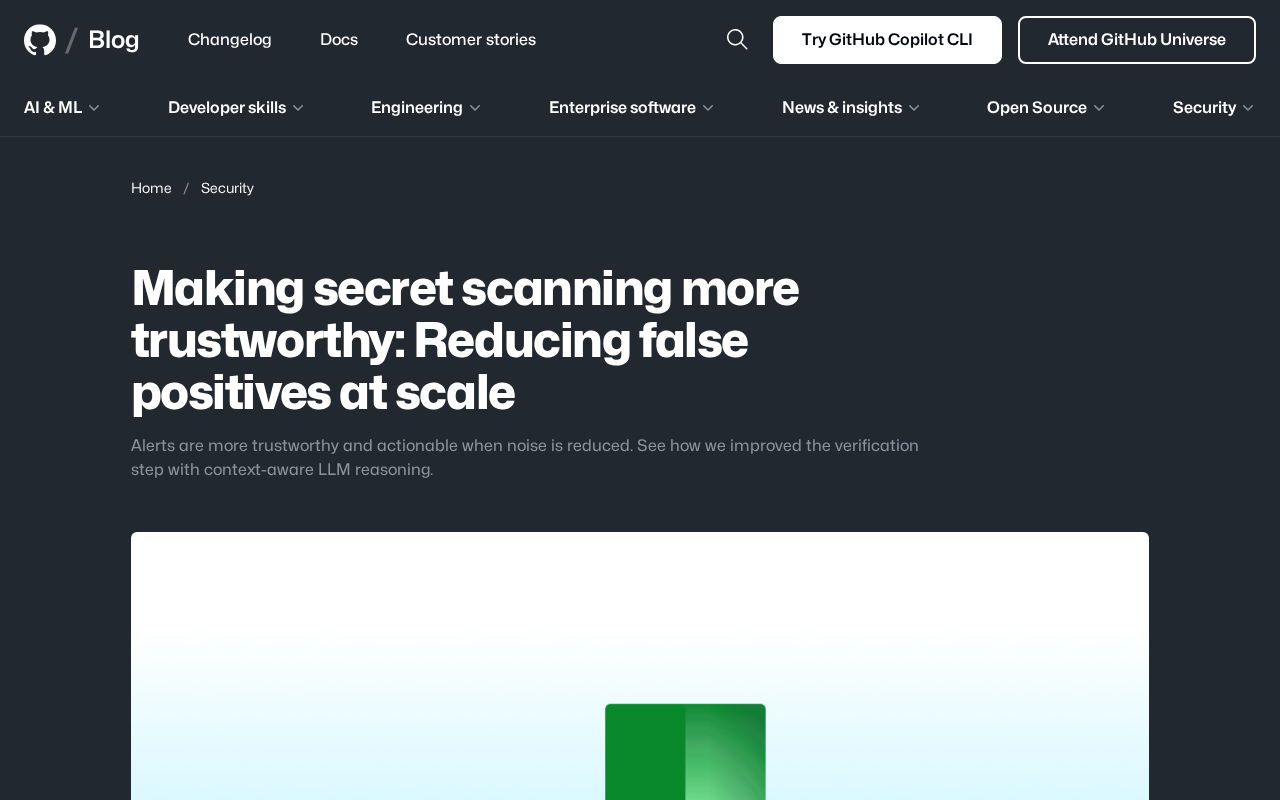
GitHub uses LLM reasoning in Secret Scanning to cut false positives and combat developer alert fatigue.
GitHub has introduced context-aware LLM reasoning into its Secret Scanning feature to significantly reduce false positives at scale. By combining traditional regex-based detection with LLM-powered semantic analysis of code context, file paths, variable names, and comments, the system filters out placeholders and test data while surfacing genuine credential leaks. This hybrid architecture addresses alert fatigue and marks a key milestone in AI-driven DevSecOps practices.
Overview
GitHub recently published a blog post introducing context-aware LLM reasoning into its Secret Scanning feature to dramatically reduce false positives at scale, making security alerts more trustworthy and actionable. This improvement marks another significant real-world application of AI in the DevSecOps space.
False Positives: The Persistent Pain Point of Security Scanning Tools
Why Secret Scanning Is Essential
In modern software development, secret leaks—such as API keys, database credentials, and access tokens—are among the most common security risks. According to GitGuardian's annual report, over 12.8 million new hardcoded secrets were detected in public GitHub repositories in 2023 alone, a significant year-over-year increase. Once exploited by malicious actors, leaked credentials can lead to data breaches, service hijacking, and even supply chain attacks. Historically, high-profile companies like Uber and Samsung have suffered major security incidents due to secrets exposed in code repositories.
GitHub's Secret Scanning feature automatically detects sensitive credentials accidentally committed to repositories, helping developers identify and remediate issues before leaks cause real damage. The feature operates on two levels: first, through a partner program with over 200 service providers (such as AWS, Azure, and Stripe), where detected strings matching their credential formats trigger automatic notifications for revocation; second, for repositories with Push Protection enabled, it blocks commits containing suspected secrets at push time, shifting the security boundary to the earliest stage of the development workflow.
Alert Fatigue and the Trust Crisis Caused by False Positives
However, a core challenge facing security scanning tools is false positives—instances where the tool incorrectly flags benign content as a security threat. In the context of secret scanning, this means a large volume of strings that aren't real credentials get pushed to developers as leak alerts. Industry research shows that traditional static analysis security tools can have false positive rates as high as 40%-60%, and even higher in some scenarios.
When alerts are flooded with invalid information, developers gradually develop "alert fatigue"—a concept originally from the medical field, where clinicians exposed to excessive monitor alarms unconsciously become less responsive. In software security, alert fatigue manifests as developers no longer taking each alert seriously, or even ignoring or bulk-dismissing them. Research from the Ponemon Institute shows that security teams face an average of over 10,000 security alerts per day, with nearly half never investigated. This erosion of trust is more dangerous than having no scanning tool at all, because genuine security threats can be buried in the noise—a classic "boy who cried wolf" effect.
GitHub's Solution: Context-Aware LLM Validation
The Limitations of Traditional Regex Matching
Traditional secret scanning relies primarily on regular expression (regex) matching and simple format validation. Regular expressions are a formal language for describing string patterns. In secret detection, they define specific character combination rules to match potential credential formats—for example, AWS access keys always start with AKIA, followed by 16 uppercase letters and digits. Beyond regex matching, some tools also use Shannon Entropy analysis to assess string randomness, since real secrets typically have high information entropy, while ordinary English words or variable names have lower entropy values.
While these methods can identify strings that "look like secrets," they are fundamentally syntax-level pattern matching and lack the ability to understand code semantics. For example, placeholder values in sample code (like sk_test_xxxxxxxxxxxx), fake keys used for testing, expired or revoked credentials, and even Base64-encoded plain text can all trigger false positives because they match regex patterns or exhibit high entropy. Regular expressions cannot understand semantic information like "this code is a tutorial example" or "this variable name suggests it's a placeholder"—and that is their fundamental limitation.
How LLM Reasoning Improves Detection Accuracy
GitHub's improvement introduces context-aware LLM reasoning into the validation step. Large Language Models (LLMs), built on the Transformer architecture, derive their core advantage from the self-attention mechanism, which captures dependencies between any positions in an input sequence. This means that when an LLM analyzes code containing a suspected secret, it doesn't just "see" the secret string itself—it simultaneously "understands" hundreds or even thousands of tokens of surrounding context, including function definitions, comments, file structure, and more. This capability far exceeds traditional NLP methods (such as TF-IDF-based text classification or simple keyword matching), which struggle with the highly structured and semantically rich nature of code.
Specifically, the system no longer just checks the format of the string itself, but makes comprehensive judgments based on code context:
- Code context analysis: The LLM can understand code semantics and determine whether a string appears in a real configuration file or is merely a documentation example or test code. For instance, it can recognize that a code snippet in a
README.mdis for educational purposes, or that credentials in a file prefixed withtest_are test data - Pattern recognition: By learning from large volumes of real leak and false positive cases, the LLM can identify common non-sensitive patterns (such as
EXAMPLE_KEY,your-api-key-here,TODO: replace with real key, and other placeholders), as well as conventionally used example credential formats in the developer community - Multi-signal fusion: It combines file paths, variable naming, comment content, code structure (e.g., whether it's in a
.env.examplefile), git commit messages, and other multi-dimensional information for comprehensive assessment, producing more reliable confidence scores than any single signal alone
Performance Challenges of Deployment at Scale
Deploying LLM validation on a platform like GitHub presents enormous scalability challenges. GitHub hosts over 400 million repositories, serves more than 100 million developers, and processes millions of code pushes daily that need scanning. The computational cost of LLM inference is far higher than regex matching—a typical LLM inference call may require hundreds of milliseconds to several seconds of GPU compute time, while regex matching typically completes in microseconds. If LLM inference were applied to every line of every push, GPU costs would be prohibitively high, and inference latency would severely impact the developer push experience.
GitHub needs to find a balance between accuracy and performance, ensuring that security scanning doesn't become a bottleneck in the development workflow. Common industry optimization strategies include: tiered inference architectures (using lightweight rules to quickly filter out obvious non-secrets, invoking the LLM only for suspected secrets requiring fine-grained validation), model distillation (transferring a large model's judgment capabilities to smaller, faster specialized models), batch inference and asynchronous processing, and task-specific model quantization (such as INT8/INT4 quantization to reduce memory footprint and improve throughput). GitHub's blog post also hints at a similar layered strategy, where the LLM only handles "gray area" cases that traditional methods cannot resolve.
Industry Significance and Impact on Developers
The Hybrid Architecture of AI-Powered Security Tools
This case demonstrates an important application direction for LLMs in security: not replacing traditional detection rules, but serving as an "intelligent filtering layer" to improve the accuracy of existing tools. This design philosophy has deep theoretical roots in security engineering—in information retrieval and security detection, recall (not missing real threats) and precision (not generating false positives) often have an inverse relationship. Traditional regex rules ensure high recall through permissive matching strategies, while the LLM validation layer dramatically improves precision through semantic understanding. Together, they achieve a Pareto improvement in overall performance.
This "traditional rules + AI validation" hybrid architecture has precedents in the security industry. For example, spam filtering systems have long employed a dual-layer architecture of "rule engines + machine learning classifiers," and intrusion detection systems (IDS) commonly combine signature detection with anomaly detection. GitHub's innovation lies in upgrading this classic architectural paradigm to the LLM era, leveraging the deep semantic understanding of large models to handle complex contextual judgments that traditional machine learning methods struggle with.
Tangible Benefits of Fewer False Positives
For development teams using GitHub, fewer false positives mean:
- Higher credibility of security alerts, making teams more willing to respond promptly
- Reduced time costs for manual review
- Less friction between security processes and development workflows
- Faster remediation of genuine security threats
The Broader Trend of LLMs in the Development Toolchain
GitHub's approach reflects an industry-wide trend: embedding LLM capabilities into every stage of the development toolchain—from code generation (Copilot) to code review to security scanning. AI is comprehensively improving the efficiency and quality of software development. This trend aligns closely with the core philosophy of the DevSecOps movement, which advocates "shifting left"—integrating security checks as early as possible in the software development lifecycle, rather than conducting security audits only after deployment. The introduction of LLMs enables these early-stage security checks to maintain high sensitivity without slowing development with excessive false positives.
In the broader industry landscape, GitHub is not alone in pursuing this direction. Snyk has integrated AI capabilities into its Software Composition Analysis (SCA) and Static Application Security Testing (SAST) products; Semgrep is exploring LLM-enhanced authoring and optimization of its code analysis rules; and Google's OSS-Fuzz project is leveraging LLMs to automatically generate fuzz test cases for discovering vulnerabilities in open-source software. It's foreseeable that AI-enhanced security tools will become a standard capability of future development platforms, and GitHub, with its massive code data assets and first-mover advantage, holds a favorable position in this space.
Conclusion
GitHub's introduction of context-aware LLM reasoning to improve the validation step of secret scanning is an excellent example of AI technology landing in real-world security scenarios. It demonstrates that LLMs can not only generate code but also understand the security semantics of code, providing developers with more accurate and trustworthy security protection. As these technologies mature, the longstanding industry affliction of "alert fatigue" may finally see fundamental relief.
Key Takeaways
Related articles

A Gen-Z Woman Making $1.5M/Month: Deconstructing the Growth Methodology Behind AI Apps
Gen-Z indie dev Nicole built 4 hit AI apps earning $1.5M/mo. Deep dive into her industrialized UGC engine, traffic testing system, and minimalist tech stack.
Replit's AI Loops Workflow Explained: Multi-Agent Collaboration Replaces Prompt Engineering
Deep dive into Replit's AI Loops workflow: how orchestrators, parallel agents, and Computer Use Verifiers build automated closed-loop systems through multi-agent collaboration.
Claude Code + Skills: A Practical Guide to AI-Powered Test Case Generation
Learn how to use Claude Code + Skills to auto-generate enterprise-grade test cases. Covers AI Agent vs LLM differences, the four core capabilities, and the complete workflow from requirements to test cases.